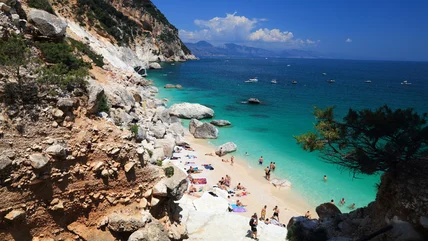
Italy has been called the "paradise of travelers", and its endless charms continue to draw tourists from far and wide, as they have down the centuries. Few countries offer such a diversity of scenery, from the Alpine peaks with their perpetual covering of snow to the sun-kissed coasts of Sicily; few others possess such a wealth of historical remains, left by a world empire which extended from Britain to Africa and, in later centuries, by the powerful city states of the Middle Ages; and few have such a range of magnificent museums and galleries displaying archaeological remains, art treasures from all the great periods of history, and painting and sculpture which are of central importance in the history of European art.
And in addition to all this there are the many beautiful resorts which, year after year, attract countless thousands of tourists to Italy's coasts and lakes.
Italy lies in southern Europe - a long peninsula in the shape of a high-heeled boot extending south-eastwards into the Mediterranean. In addition to its mainland territory it includes a number of islands and archipelagoes. The two largest islands, Sardinia and Sicily, lie on the south-west side of the Tyrrhenian Sea, the section of the Mediterranean which separates them from the mainland. Among the smaller islands and island groups are the Tuscan islands (Elba), the Pontine Islands, Ischia, Capri and the Lipari Islands in the Tyrrhenian, the Tremiti Islands in the Adriatic, and the Isole Egadi, Pantelleria and the Isole Pelagie in the Sicilian Channel.
The Republic of Italy is divided into 20 regions and 95 provinces
The capital of Italy is Rome, situated in Central Italy some 20km/ 12 miles inland from the coast of the Tyrrhenian Sea.
In northern Central Italy is the tiny independent republic of San Marino, an enclave within Italian territory, which has a treaty of friendship with Italy.
Within the territory of Rome is the tiny state of Vatican City, of which the Pope is sovereign.