15 Top-Rated Attractions & Things to Do in Perugia
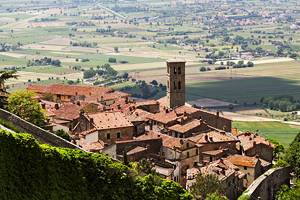
Perugia, capital of the region of Umbria, is worth visiting not only for the beauty of its hilltop setting, but also for its fine old buildings. Before it came under Roman rule, ancient Perusia was one of the twelve cities of the Etruscan federation, and considerable sections of the Etruscan walls, which extended for 2,800 meters around the town, have been preserved.
Perugia is known to the art world as the center of the Umbrian school of painting in the 15th and 16th centuries; its leading members, Pietro Vannucci (called Perugino) and Bernardino Betti (called Pinturicchio) both worked here. The young Raphael worked in Perugino's studio until 1504. You'll find works by all three in churches and public buildings, which, because of the art, are the top things to see in Perugia.
Plan your visit with our list of the top attractions and things to do in Perugia.
See also: Where to Stay in Perugia
- 1. Rocca Paolina
- 2. Galleria Nazionale dell'Umbria
- 3. San Lorenzo
- 4. Fontana Maggiore and Piazza IV Novembre
- 5. San Pietro
- 6. Palazzo dei Priori and Collegio del Cambio
- 7. Sant'Arcangelo
- 8. Arco d'Augusto
- 9. San Domenico
- 10. Day Trip to Lago Trasimeno
- 11. Ipogeo dei Volumni (Etruscan Tomb)
- 12. Studio Moretti Caselli
- 13. Museo Archeologico
- 14. Oratorio di San Bernardino
- 15. Day Trip to Deruta
- Where to Stay in Perugia for Sightseeing
- Map of Attractions & Things to Do in Perugia
- Perugia, Italy - Climate Chart
1. Rocca Paolina
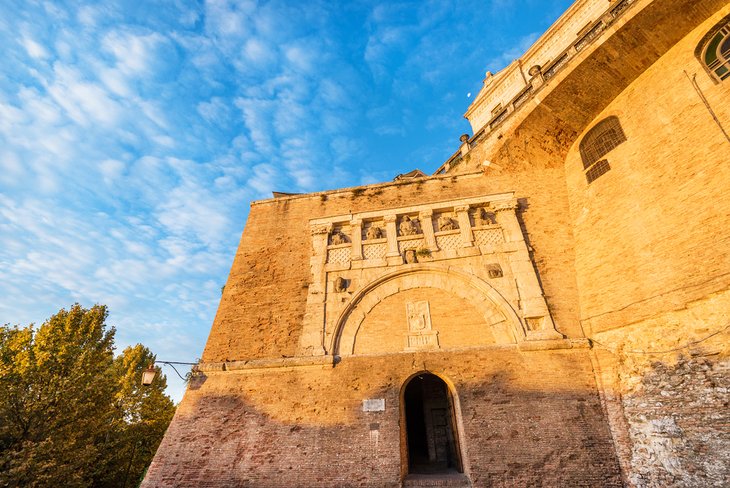
One of the most unusual places to see in Perugia is buried deep beneath its charming old streets and piazzas. Its story goes back to 1540, when Pope Paul III, a member of the Farnese family, ruled the Italian states.
Perugia, which was ruled by the rival Baglioni family, was the last to fall to papal forces, and Pope Paul took his revenge by ordering a massive fortress built on the Colle Landone, the neighborhood where all the Baglioni palaces and properties lay. More than 100 homes, tower houses, churches, and monasteries, some dating to Etruscan and Roman times, were destroyed and their stones used to build the fortress.
It wasn't until the middle of the 19th century that Perugia was free of papal rule, at which time they destroyed the hated symbol of their subjection. What tourists can see today are the vaulted foundations and passages that were once streets, now deep underground.
This free attraction is easy to reach from the escalators that take you from the Piazzale Partigiani car park or station to Via Baglioni Baglioni (there is no Via Farnese, so the Baglionis got the last laugh). Inside, an excellent art film relating the history of the Rocca and Perugia is well worth seeing.
2. Galleria Nazionale dell'Umbria
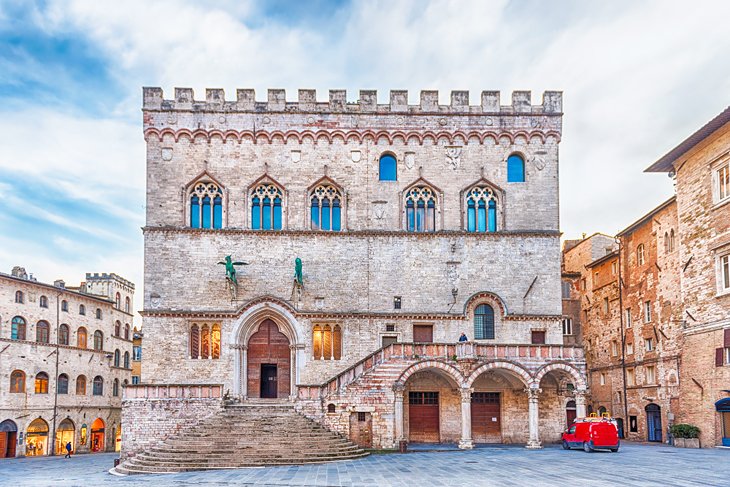
The National Gallery of Umbria, on the third floor of Palazzo dei Priori, contains paintings by Perugino; Pinturicchio; and other artists of the Umbrian school, including Benedetto Bonfigli and Bartolomeo Caporali; as well as sculptures by di Cambio and di Duccio. It demonstrates the development of painting in Umbria from the Middle Ages to the 20th century, with its greatest strengths lying between the 13th and 18th centuries.
Highlights of the collections are a 1272 crucifix by an unknown Perugian artist; five statues from 1281 by Arnolfo di Cambio; Madonna and Child by Duccio di Boninsegna, painted in 1305; a 1456 Madonna with Saints by Benozzo Gozzoli (1456); a polyptych of Sant'Antonius by Piero della Francesca; and another by Fra Angelico dating from 1437.
In the Cappella dei Priori is a fresco cycle by Benedetto Bonfigli, completed between 1454 and 1480 and picturing Perugia at that time. In the chapel are several works by Perugino, a polyptych of St. Augustine by Pinturicchio, and sculptures by Agostino di Duccio.
Address: Palazzo dei Priori, Corso Vannucci 19, Perugia
3. San Lorenzo
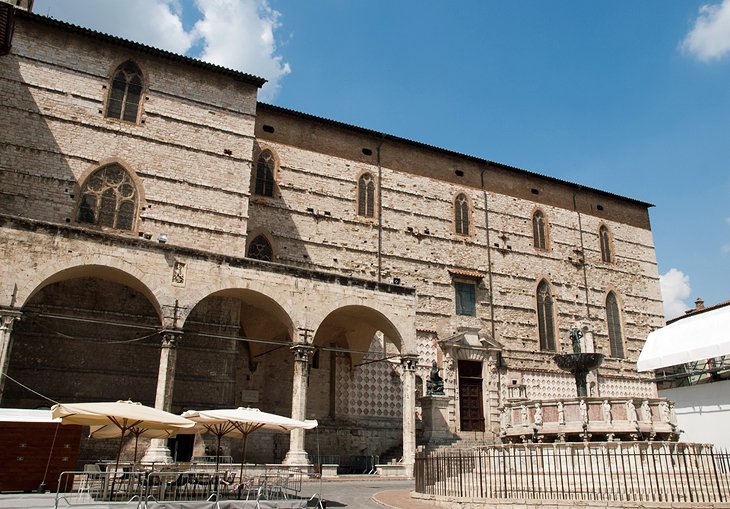
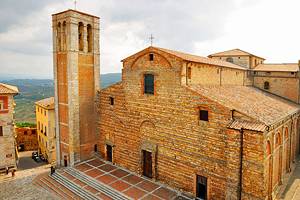
The 15th-century Gothic hall-church of San Lorenzo, Perugia's cathedral, has an unfinished façade, despite the fact that its building continued from the laying of its foundation stone in 1345 until 1587. The pink and white exterior stone decoration was only completed on the side wall facing the Fontana Maggiore.
Inside are beautiful 15th-century choir-stalls and a pulpit that was built in the 14th century of older stone fragments. The stucco decorations and false marble painting is an 18th-century addition, and the 16th-century Mannerist doorway was moved here from the nearby Collegio del Seminario.
Look in the Chapel of San Bernardino for Federico Barocci's Deposition, from 1567-69. In the sacristy, which you can reach from the chapel to the right of the high altar, are 16th-century frescoes by Giovanni Antonio Pandolfi di Pesaro. East of the cathedral, the church of San Severo contains a 1505 fresco by Raphael, The Trinity.
Address: Piazza IV Novembre, Perugia
4. Fontana Maggiore and Piazza IV Novembre
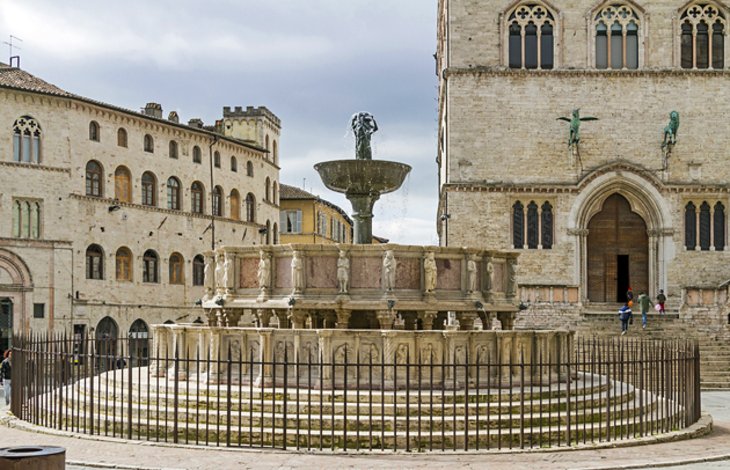
In the center of Perugia's attractive main square, Piazza IV Novembre, the 13th-century Fontana Maggiore is one of the most beautiful fountains of that period, with reliefs by the master Tuscan stone-carvers Nicola and Giovanni Pisano. Its two multi-sided basins are of white and pink stone, and above them, a trio of bronze nymphs support an urn from which water flows.
This piazza has always been the political and social center of the community: it was the forum during Roman times, and the medieval town spread along the five streets that join here. On the west side of the square is the Archbishop's Palace with the Museum of Natural History, and beyond it is the arched vaulting of the Palazzo del Podesta, which burned down in 1534. From the Piazza IV Novembre, the medieval Via delle Volte runs to the Piazza Fortebraccio.
5. San Pietro
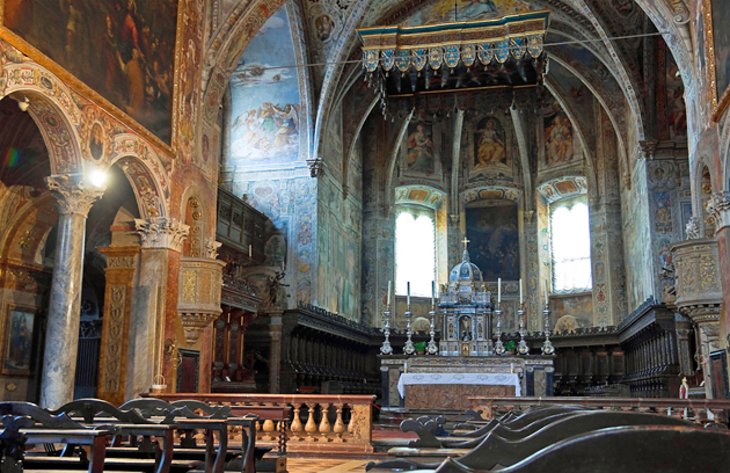
Outside the Porta San Pietro is the church of San Pietro, an early Christian structure rebuilt in the 12th century incorporating 18 of the ancient columns. The beautiful Gothic wooden choir-stalls, completed between 1535 and 1591, are considered among Italy's finest.
The painted and gilded wooden ceiling is from 1556, and the church is further decorated by frescos and paintings by a number of artists, Antonio Vassilacchi, Sassoferrato, Guido Reni, Vasari, Guerricino, and Perugino among them. In the sacristy are inlaid furniture and paintings by Perugino, Parmigianino, and Raphael.
The richly decorated Porta San Pietro dates from the 14th century, and its outer gate from the 15th century. Southwest of the church, the Giardini del Frontone extends all the way to the Porta San Costanzo, with beautiful views.
Address: Via Borgo XX Giugno, Perugia
6. Palazzo dei Priori and Collegio del Cambio
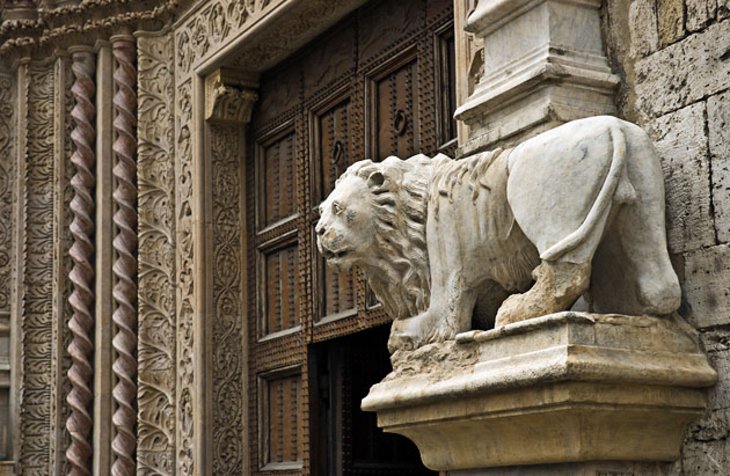
On the south side of the cathedral is the Palazzo dei Priori, also known as the Palazzo Comunale, a massive building in Italian Gothic style from the late 13th and early 14th centuries. On the side facing the Piazza IV Novembre are a griffin (the emblem of Perugia), a 14th-century bronze lion, and chains, all commemorating Perugia's victory over Siena in 1358.
On the first floor of the palace, which is entered through the beautifully carved main doorway facing Corso Vannucci, is the splendid Sala dei Notari. The hall is covered in late 13th-century frescoes of biblical and allegorical scenes.
An extension was added to the Palazzo dei Priori in the mid-15th century to house the Collegio del Cambio, now a tourist attraction itself. The Bankers Guild was one of the most powerful in the city, and their headquarters and exchange is lavishly decorated. The entrance of carved wood is only the beginning of things to see here.
The walls of the Sala dei Legisti (lawyers room) are by Giampietro Zuccari, and the furniture is of inlaid woods. But it is the Sala dell'Udienza (audience room), which is considered Italy's finest and best preserved 15th-century secular room. The walls and vaulting are decorated with frescoes by Perugino.
Address: Corso Vannucci, Perugia
7. Sant'Arcangelo
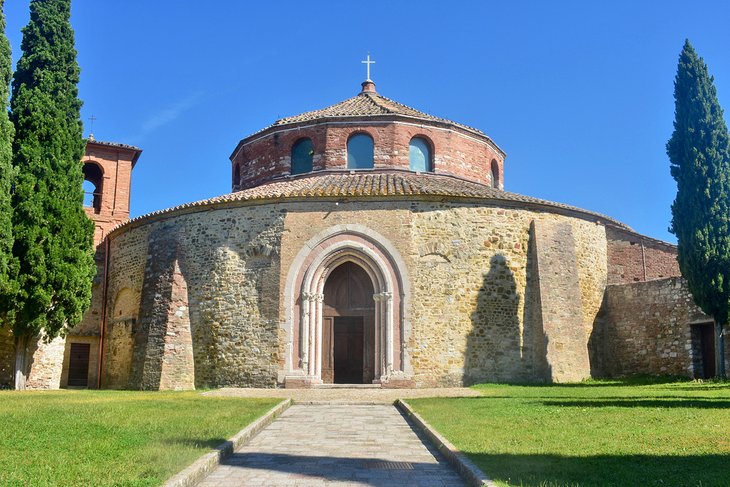
In the Borgo Sant'Angelo neighborhood, near the ancient northern gate of Porta Sant'Angelo, is the round church of Sant'Arcangelo, built between the fifth to sixth centuries. This paleo-Christian temple incorporates 16 columns with Corinthian capitals, reused from an older pagan temple. The architecture is early Romanesque with some Byzantine influences; the columns separate the central nave from the ambulatory around it.
The church has interesting early Christian symbols, including a pentagram at the entrance; there are also crosses of the style used by the Knights Templar. Twentieth-century restorations revealed windows that had been filled in, as well as the remains of some early frescoes.
Address: Via del Tempio, Perugia
8. Arco d'Augusto
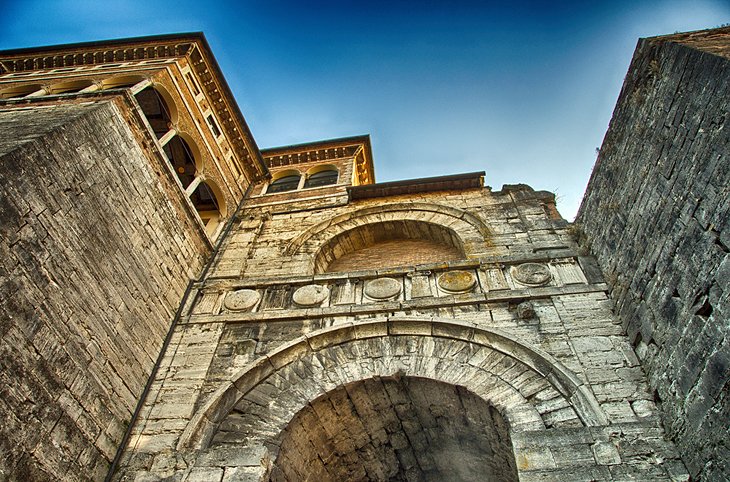
Once one of seven gates that allowed access through the Etruscan walls that encircled Perugia, Arco d'Augusto was built in the second half of the third century BC but takes its name from the Roman emperor who restored it in 40 BC after conquering the city. Because of the walls and Perugia's elevated position, Augustus was successful in taking Perugia only after a seven-month siege.
The inscription "Augusta Perusia" on the gate dates from this period. The two arches of the gate connect two trapezoidal towers. The loggia at the top of one of these was added in the Renaissance, and the fountain below that tower was completed in 1621.
9. San Domenico
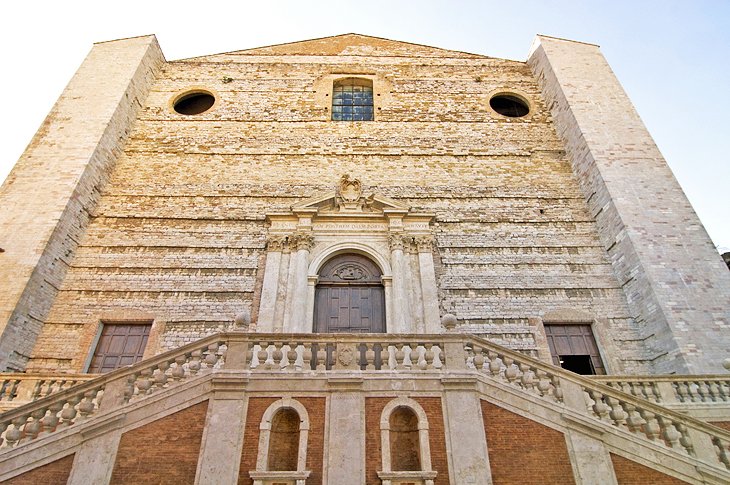
The brick church of San Domenico was begun in 1305, but not long after it was finished, the topmost section was found to be unstable and demolished. In 1614, the pillars in the nave collapsed, and with them the vaulting they supported, so the church was altered during its reconstruction from 1621 to 1634.
Baroque decorative additions that were made at that time have since been removed, and the church retains most of its Gothic appearance, which you can see in the exterior, the choir chapels, and the unusually large window in the apse. If you notice a similarity between the design of this church and the cathedral, it's because this Gothic hall style was the inspiration for the later San Lorenzo.
Important artworks to look for are the Renaissance inlaid wood in the choir; remains of 15th-century frescoes attributed to Benedetto di Bindo; the 15th-century altarpiece by Agostino di Duccio in the Madonna del Voto chapel; and the tomb of Pope Benedict XI, one of the best examples of 14th-century Gothic wall tombs.
Address: Piazza Giordano Bruno, Perugia
10. Day Trip to Lago Trasimeno
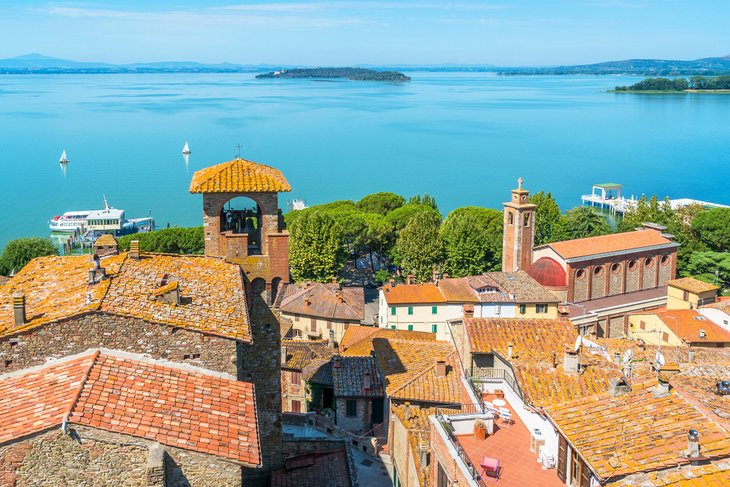
West of Perugia, Lake Trasimeno is the largest Italian lake south of the Po valley, with a surface of 128 square kilometers. Fed almost solely by rain-water, its volume varies greatly according to season. Historically, Lake Trasimene is famous as the scene of the second Punic War, when the Carthaginians under Hannibal defeated the Romans in 217 BC.
Above the north side of the lake is the ancient little town of Passignano sul Trasimeno with an old castle; on another promontory above the west side of the lake is Castiglione del Lago, also with a castle.
11. Ipogeo dei Volumni (Etruscan Tomb)
About four kilometers east of Perugia, near Ponte San Giovanni, the underground Tomb of the Volumni, thought to date from the third century BC, is one of the finest tombs in Etruria. Entered by a staircase leading underground, the large, well-preserved tomb imitates the plan of houses of that period, with nine chambers grouped round a central atrium.
Here, you will find finely carved burial urns and other artifacts, including the travertine urn of Arnth Veltimna Aules. The tomb is part of a larger necropolis used as far back the 5th or 6th century BC. It was discovered when a new road was being built between Perugia and Rome.
12. Studio Moretti Caselli
After admiring the intricate stained-glass in Italian churches, you may be interested to know how it is made. You can delve into this fine art on a tour of the studio and workshop of a fifth-generation of family glass artists.
The Moretti Caselli studio has been creating and restoring stained-glass windows and other glass art since 1860, and you can learn about the entire process on a guided visit with one of the artists. As you learn about the process and science of stained glass, you'll see the kilns, and shelves of pigments, that have been used for centuries to create some of Italy's most beautiful church windows.
This is one of the most engaging and informative tours in Tuscany. You will need a reservation, but the tour is free; you are expected to leave a modest donation.
Address: Via Fatebenefratelli 2, Perugia
Official site: http://www.studiomoretticaselli.it/?lang=en
13. Museo Archeologico
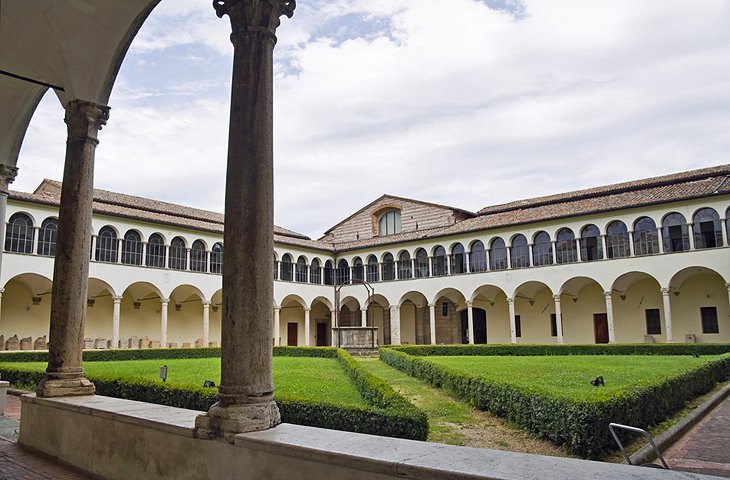
In the former Dominican monastery that adjoins San Domenico is the Museo Archeologico Nazionale dell'Umbria, with Roman and Etruscan antiquities from the Bronze and Iron Ages, some dating back as far as the 16th century BC.
The rarest piece in the museum is the third- or second-century BC Cippus Peruvianus, the longest known Etruscan inscription. The collection includes funerary urns, Etruscan and Roman bronzes, jewelry, gold work, and works recovered from tombs of the Hellenistic period.
Address: San Domenico, Piazza Giordano Bruno, I-06100 Perugia
14. Oratorio di San Bernardino
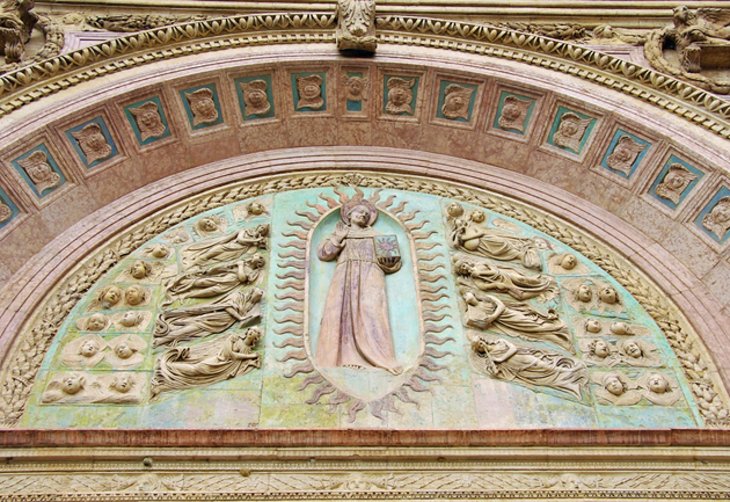
The magnificent facade of the Oratorio di San Bernardino, made of colored marble, limestone, and glazed terra-cotta, was created between 1457 and 1461 by Agostino di Duccio, best known as the artist responsible for the Tempio Malatesta in Rimini. His half-round bas relief in the central arch is Perugia's most important Renaissance work.
San Bernardino of Siena, who had preached in Perugia, was canonized in 1450, and the local Franciscan friars built this oratory to honor him. A fourth-century paleo-Christian sarcophagus serves as the base of the high altar, behind which is a door leading to the Oratory of St. Andrew, with a wooden ceiling from 1558 and painted decoration and stucco work from the 18th and 19th centuries.
Address: Piazza San Francesco al Prato, Perugia
15. Day Trip to Deruta
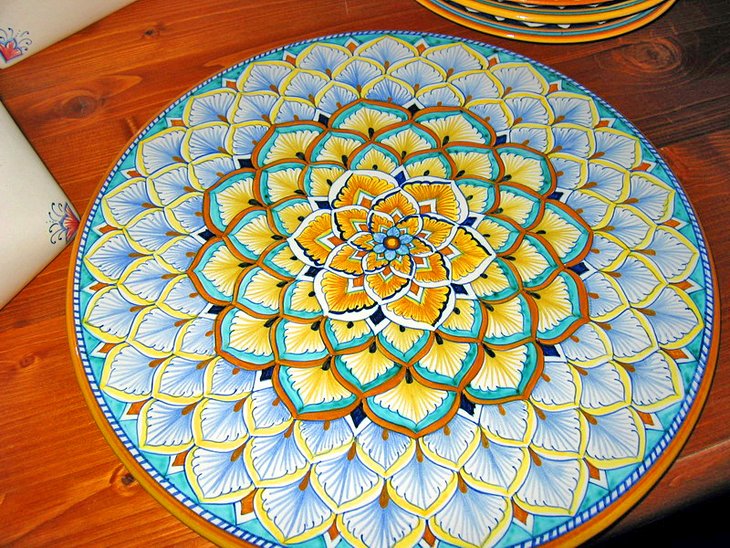
About 20 kilometers south of Perugia, Deruta is a center for Umbrian ceramics, and shops selling this brightly painted majolica ware fill the little town center. To see some beautiful old pieces, visit the Museo delle Maioliche on the first floor of the Palazzo Communale.
The little church of the Madonna del Bagno, on the E45, two kilometers south of Deruta, has more than 600 majolica votive plaques. The town itself is attractive and it's worth strolling through its atmospheric stone streets.
Where to Stay in Perugia for Sightseeing
We recommend these charming hotels and guesthouses in Perugia, close to the evocative old town:
- The 5-star luxury hotel Sina Brufani radiates old-world charm, and offers guests extras that include a pool and nightly turndown service.
- The mid-range Sangallo Palace Hotel is in a convenient location for sightseeing, with an indoor pool and complimentary breakfast.
- The affordable Hotel Rosalba is only a few steps from the old town, and offers beautiful views.
- Guest rooms at the budget Hotel Sant' Ercolano have small balconies; the location is fantastic.
Map of Attractions & Things to Do in Perugia
Perugia, Italy - Climate Chart
| Average minimum and maximum temperatures for Perugia, Italy in °C | |||||||||||
| J | F | M | A | M | J | J | A | S | O | N | D |
| 9 0 | 11 2 | 14 3 | 17 5 | 22 9 | 26 12 | 30 15 | 29 15 | 26 13 | 20 9 | 13 4 | 9 2 |
| PlanetWare.com | |||||||||||
| Average monthly precipitation totals for Perugia, Italy in mm. | |||||||||||
| 58 | 69 | 61 | 71 | 74 | 71 | 46 | 61 | 69 | 76 | 94 | 71 |
| Average minimum and maximum temperatures for Perugia, Italy in °F | |||||||||||
| J | F | M | A | M | J | J | A | S | O | N | D |
| 47 32 | 51 34 | 56 37 | 62 41 | 71 48 | 78 54 | 85 58 | 84 59 | 78 55 | 67 47 | 56 39 | 48 34 |
| PlanetWare.com | |||||||||||
| Average monthly precipitation totals for Perugia, Italy in inches. | |||||||||||
| 2.3 | 2.7 | 2.4 | 2.8 | 2.9 | 2.8 | 1.8 | 2.4 | 2.7 | 3.0 | 3.7 | 2.8 |
More Related Articles on PlanetWare.com
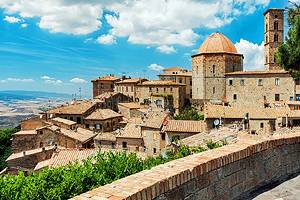
Exploring More Tuscan Hill Towns: Some of the top-rated tourist attractions in Tuscany are the medieval and Renaissance towns that crown its hilltops. Visit San Gimignano to see its famed medieval towers or explore the ancient sights in the former Etruscan town of Volterra. In Assisi, you can tour the shrine of St. Francis, who was born here.
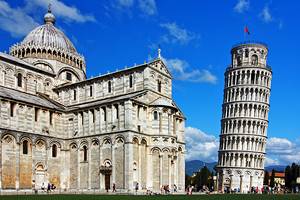
Discovering Tuscan Cities: Along with the hill towns, Tuscany is known for three cities whose landmarks are among the top places to visit in Italy. The top-rated tourist attractions in Florence include the magnificent Cathedral of Santa Maria del Fiori and the treasures of Renaissance art in the Uffizi Gallery. The highlight of nearby Siena is the Cathedral of Santa Maria Assunta, and everyone knows Pisa and the Leaning Tower.