12 Top-Rated Attractions & Things to Do in San Gimignano
San Gimignano, about 50 kilometers southwest of Florence, owes its almost pristine medieval appearance to a combination of location and neglect. At the height of the Middle Ages, the Via Francigena, which passes through San Gimignano, was the main route of pilgrims traveling to Rome.
It was also the main trade route, useful for transporting the local saffron to profitable markets. When faster routes developed, San Gimignano declined, new building ceased, and it was all the inhabitants could do to prevent the collapse of old ones. So structures remained almost unaltered until recent restorations promoted by UNESCO set about preserving them.
Despite its declining fortunes, San Gimignano still attracted important later Renaissance artists such as Domenico Ghirlandaio, Benozzo Gozzoli, and Benedetto da Maiano, whose works you'll see in its churches. The town's major attractions for tourists are the 13 towers that remain from the original 70 and give San Gimignano its distinctive skyline.
Find the best places to visit in this charming town with our list of the top attractions and things to do in San Gimignano.
- 1. Centro Storico: Piazza della Cisterna and Towers
- 2. Santa Maria Assunta and Piazza del Duomo
- 3. Palazzo del Pópolo and Torre Grosso
- 4. Sant'Agostino
- 5. San Gimignano 1300
- 6. Casa Campatelli and Tower
- 7. Rocca Montestaffoli
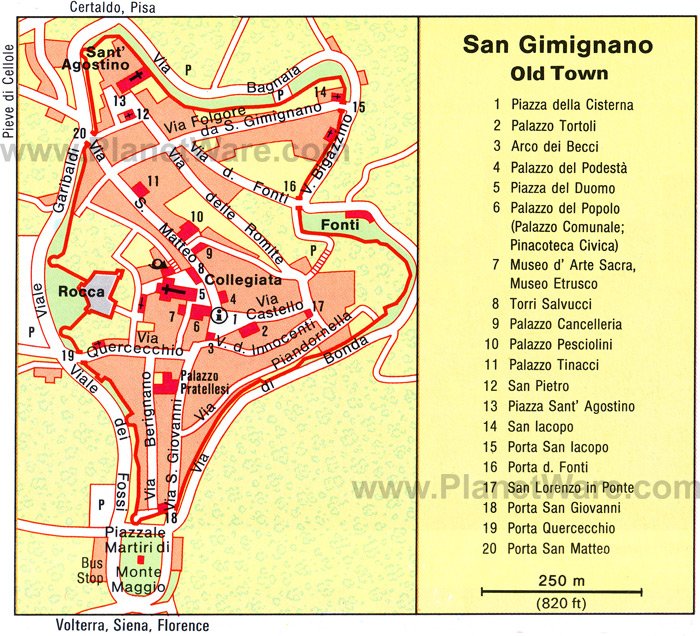
- 8. City Walls and Gates
- 9. Museums of Torture and the Death Penalty
- 10. Santa Chiara Museum (Archeological Museum and Herbarium)
- 11. San Iácopo
- 12. Pieve di Cèllole
- Where to Stay in San Gimignano for Sightseeing
- Map of Attractions & Things to Do in San Gimignano
1. Centro Storico: Piazza della Cisterna and Towers
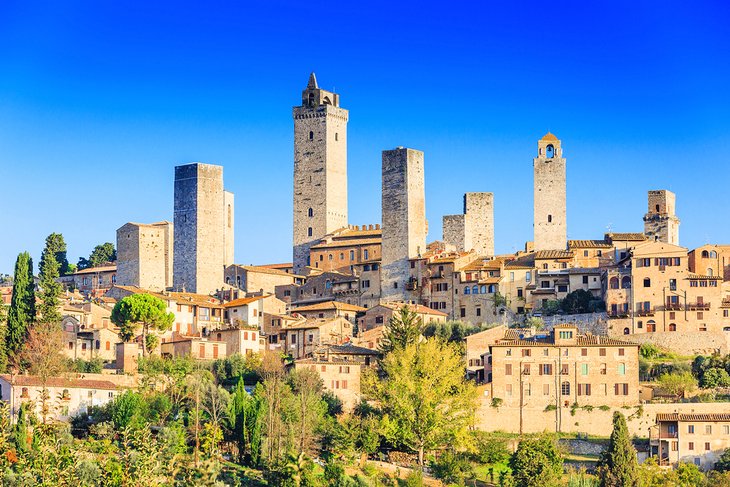
There is no doubt that the main appeal of San Gimignano is its medieval center, the Centro Storico, bristling with square towers that were both fortified homes and status symbols for the rival families that built them.
At the heart of this old center is little Piazza della Cisterna, the town's triangular main square, where you'll find a cluster of these: the stump of a tower on Casa Razzi, the remains of another on Palazzo Tortoli, the tall Torre del Diávolo (Devil's tower) on the Palazzo dei Cortesi, and the two Torri Ardinghelli on the west side.
The piazza's patterned brick pavement leads to Via del Castello, where you'll find more noble homes and towers. Overlooking Piazza del Duomo are the two Torri Salvucci, said to have been built for the purpose of bypassing the Communal Statutes of 1255 that limited towers to the height of the Podestà Tower. To show their superiority (and to annoy their rivals, the equally powerful Ardinghelli family) the Salvuccis supposedly built two whose combined height was taller than the Podestà.
2. Santa Maria Assunta and Piazza del Duomo
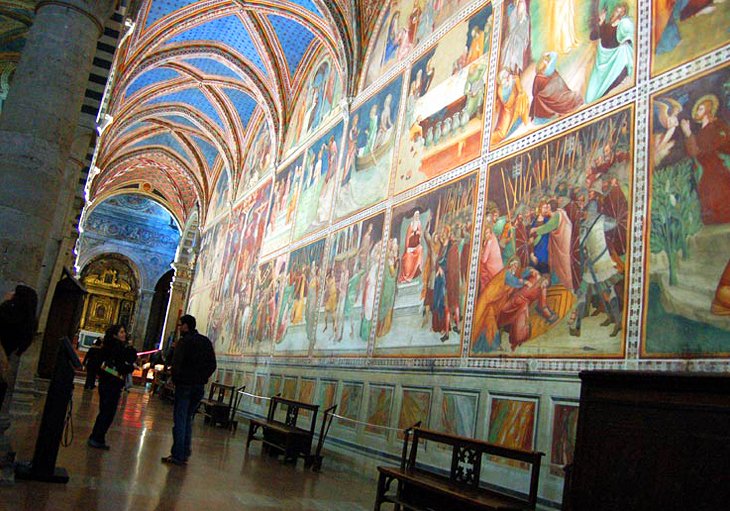
The Romanesque church of Santa Maria Assunta was built originally in the 12th century, but in 1457, it was enlarged by Giuliano da Maiano, who added a transept and side chapels. The starkly plain facade faces the misleadingly named Piazza del Duomo; this is not a cathedral and there has never been one in San Gimignano.
Inside the church are several outstanding fresco cycles. On the entrance wall is a 15th-century fresco by Benozzo Gozzoli and two wooden statues of the Annunciation from the same period, by Iácopo della Quercia. In the right-hand aisle is a monumental 14th-century cycle by Barna da Siena, with three bands of New Testament scenes. Its counterpart in the left-hand aisle is a series of highly restored Old Testament scenes by Bártolo di Fredi.
The Renaissance Cappella di Santa Fina, by Giuliano and Benedetto da Maiano (1468) honors San Gimignano's patron saint, much revered for miracles. The altar, also by Benedetto da Maiano, holds a tabernacle with relief decoration and the remains of St. Fina. In the arcades on either side of the altar are frescoes by Doménico Ghirlandaio (1475) depicting the life and death of St. Fina.
Address: Piazza del Duomo, San Gimignano
3. Palazzo del Pópolo and Torre Grosso
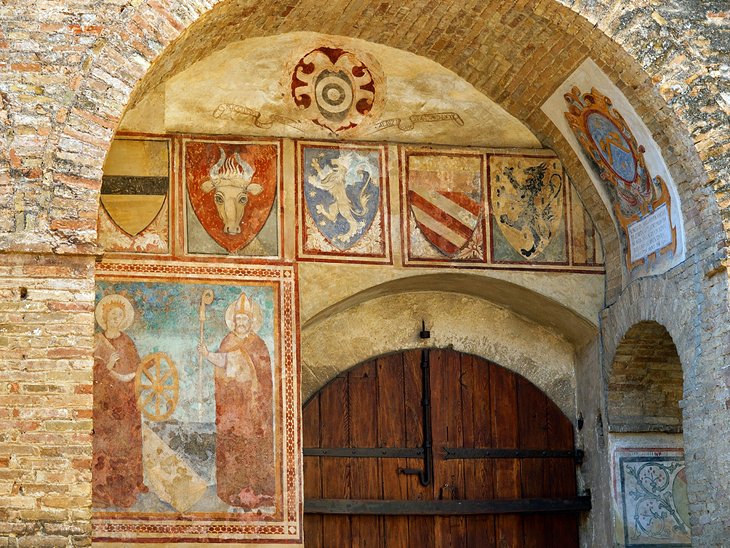
To the left of Santa Maria Assunta is the Palazzo del Pópolo, begun in 1288 and enlarged in 1323. It has been the seat of municipal government since its construction. Its tower, known as the Torre Grossa (Fat Tower), is the tallest in town at 54 meters; an early ordinance ruled that no other tower could be higher. From the top are views of the town and surrounding countryside as far as the Apuan mountains.
Inside is the Museo Civico (Municipal Art Gallery), reached through a picturesque courtyard with a well dating to 1361. The most famous room is the Sala di Dante, named for a visit to the town by the poet in 1300 and decorated by a collection of medieval court frescos.
Highlights of the collection of artworks from the 13th to 17th centuries are a 13th-century painted crucifix by Coppo di Marcovaldo, Lippo Memmi's Madonna Enthroned, two round paintings of the Annunciation by Filippino Lippi, and an altar-piece painted by Pinturicchio in 1511. These three were among the artists who contributed to the renewal of San Gimignano during the Renaissance.
Address: Piazza del Duomo, San Gimignano
Official site: www.sangimignanomusei.it
4. Sant'Agostino
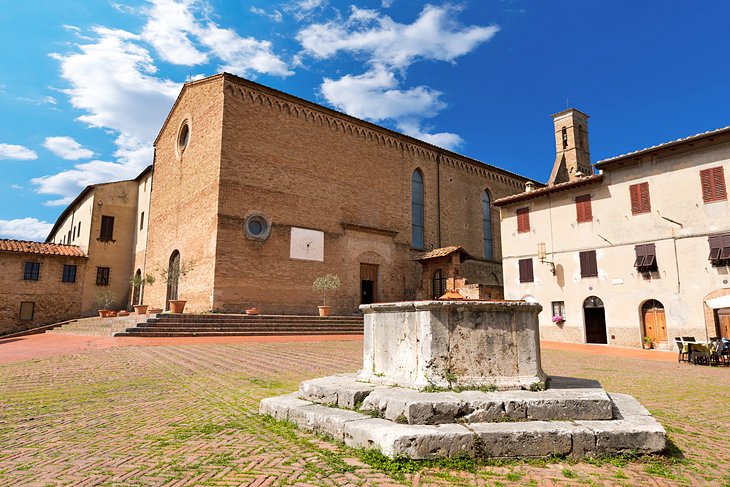
At the northern tip of the old town near Porta San Matteo stands the church of Sant'Agostino, an aisleless brick church built between 1280 and 1298 in plain Gothic style. The interior, however, is far from plain. Immediately on the right of the entrance is the Cappella di San Bártolo, with an elaborate marble altar made by Benedetto da Maiano in 1494 and containing the remains of San Bártolo.
The main reason to go to this church, however, is the splendid cycle of 15th-century frescoes by Benozzo Gozzoli in the choir. Beautifully painted in a lively narrative style, they depict in 19 scenes the life of St. Augustine, from his boyhood in North Africa to his vision of St. Jerome and his death. For art lovers, this church is one of the most important things to see in San Gimignano. More frescoes are in the nave by Benozzo Gozzoli, Lippo Memmi, and others.
Through the sacristy are the 15th-century cloister and the chapter-house. Piazza Sant'Agostino is one of San Gimignano's most interesting squares, with a hexagonal stone well and the little Church of San Pietro, one of the city's oldest.
Address: Piazza Sant'Agostino, San Gimignano
5. San Gimignano 1300
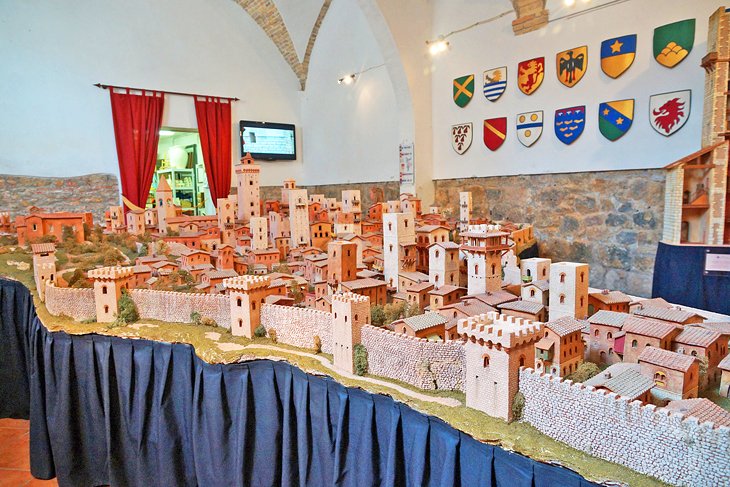
Although it is a history museum/exhibition, San Gimignano 1300 is a work of art as well. Its central feature is a large (27 square meters) scale model of the city as it appeared in 1300. The meticulously researched model is made of fired clay, which was sourced from nearby caves, and painted with natural pigments to assure historically accurate colors.
Other miniature scenes recreate scenes of medieval street life and show details of the city's architecture. The buildings and authentically dressed figures are all created by hand from clay, marble, and marble dust.
Storyboards, multi-media, and other exhibits reveal the history of San Gimignano, its towers and the importance of the Via Francigena. Everything in the museum was made by hand, a project that took two years to complete.
Address: Via Berignano 23, San Gimignano
Official site: www.sangimignano1300.com/eng/index_eng.html
6. Casa Campatelli and Tower
In a city so wrapped up in its medieval history, it is interesting to see what life was like in the 1700s, long after the town's decline in importance but still centuries before its regeneration and UNESCO acclaim.
The 18th-century palazzo, rebuilt from a much earlier tower house complex by a prosperous Florentine family, was an upper-middle-class home. It retains both that appearance but the atmosphere as well, with original furnishings and family collections. Life in the palazzo is illustrated through a video projection, which also provides a history of the town and its legends and traditions.
The palazzo incorporates one of the town's famous medieval towers, in fact the only one retaining its original interior form. It is completely hollow inside except for the balconies at each landing of the stairs leading to its top.
Address: Via S. Giovanni 15, San Gimignano
Official site: www.fondoambiente.it/torre-e-casa-campatelli-eng
7. Rocca Montestaffoli
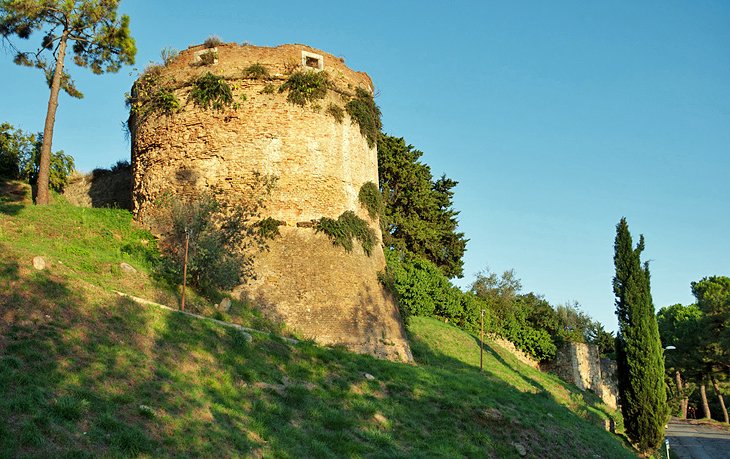
Built against the town walls on the highest point of the hill is the rocca (castle), erected by the Florentines in 1353 but demolished in 1555 on the orders of Cosimo I. Only a tower and fragments of the walls survive, and from the top are magnificent views of the town and surrounding countryside.
Each year on the third weekend in June, a tournament, La Giostra dei Bastoni, is held here as part of the Ferie delle Messi, a medieval festival.
8. City Walls and Gates
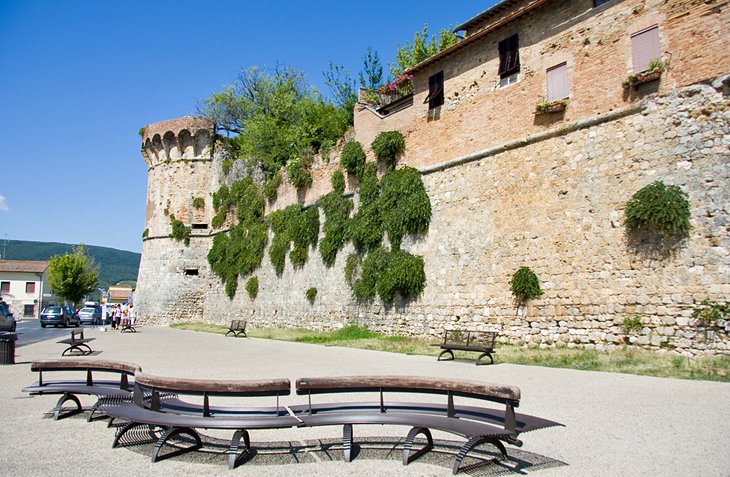
You can walk along the 13th-century walls surrounding San Gimignano's centro storico - historic center. The views are splendid and there are interesting gates, some original and others built by the Medici, who controlled the town in the 15th and 16th centuries.
The earlier Porta San Giovanni, built in the 13th century, has an unusual segmented arch supporting a guardroom; Porta San Matteo dates from the 12th century; and Porta delle Fonti at the east end leads to an atmospheric public fountain dating to the Middle Ages, whose arches hide an earlier Lombard stone fountain from the ninth century.
9. Museums of Torture and the Death Penalty
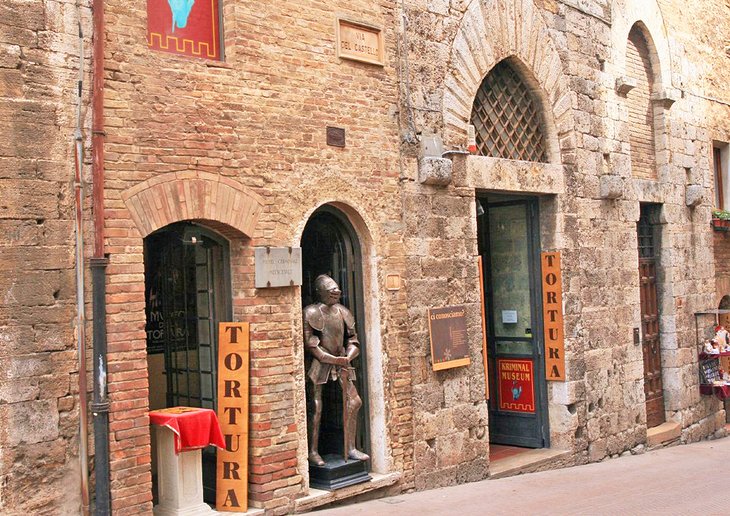
If iron maidens, racks, inquisition chairs, and guillotines sound like pleasant company for an hour or so, this pair of San Gimignano museums is for you. The collection of actual historic artifacts in the Museo Storico della Tortura is impressive, and wax figures demonstrate the effectiveness of the torture devices in graphic detail.
One section deals with methods used to drive the devil out of those accused of heresy or witchcraft that were commonly used by the Inquisition Tribunal and in witch hunts of the Middle Ages, when such practices approached a fine art.
The affiliated Museo della Pena di Morte deals with the death penalty and various means of execution. Here, the emphasis is a bit more on the history of the death penalty, but it has its share of gruesome lethal equipment. The settings of both museums are appropriately dark and grim.
Museo della Tortura
- Address: Via San Giovanni 125, San Gimignano
Museo della Pena di Morte
- Address: Via San Giovanni 82, San Gimignano
10. Santa Chiara Museum (Archeological Museum and Herbarium)
The former Conservatorio di Santa Chiara is home to the Archeological Museum and the Herbarium of Santa Fina. The latter is one of the most unusual museums you'll find in Tuscany, displaying more than 100 ceramic and glass pieces from the 14th-century Herb Pharmacy and Herbarium of the Spedale di Santa Fina.
These are shown in the setting of a reproduced pharmacy, where herbal remedies were prepared, and the shop where they were sold. Along with the containers are examples of the herbs used.
The adjoining Archaeological Museum shows Etruscan, Roman, and medieval finds from the area, with descriptions of the techniques used in making glass and pottery over different periods. The Etruscan collection comes from local necropolises and settlements dating from the seventh to first centuries BC. Upstairs is the Modern and Contemporary Art Gallery, which hosts temporary art exhibitions.
Address: Via Folgore, San Gimignano
11. San Iácopo
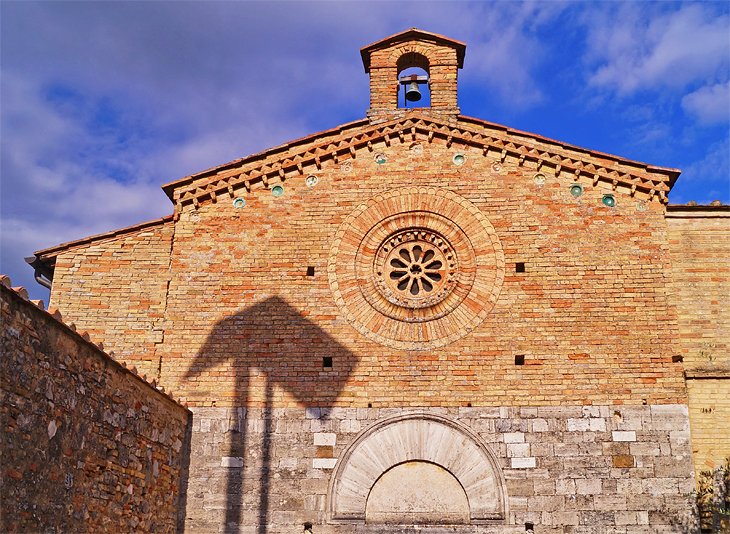
Near the northern town gate of Porta San Iácopo and surrounded by olive trees, the little Romanesque Church of San Iácopo is believed to have been built by the Knights Templar in the 13th century on their return from the First Crusade. The façade, part brick and part travertine marble, has a beautiful rose-window and a Pisan-style doorway on whose arched lintel is a coat of arms of the Templars.
The interior is aisleless, with groined vaulting, and contains a fine fresco of the Crucifixion by Memmo di Filippuccio, from the early 14th century. Like several other San Gimignano churches, San Iácopo had a hospice for the poor and for pilgrims traveling to and from Rome on the Via Francigena. The unusual enclosed space above the town gate was a passageway for nuns to reach the church in private.
Address: Via Folgore, San Gimignano
12. Pieve di Cèllole
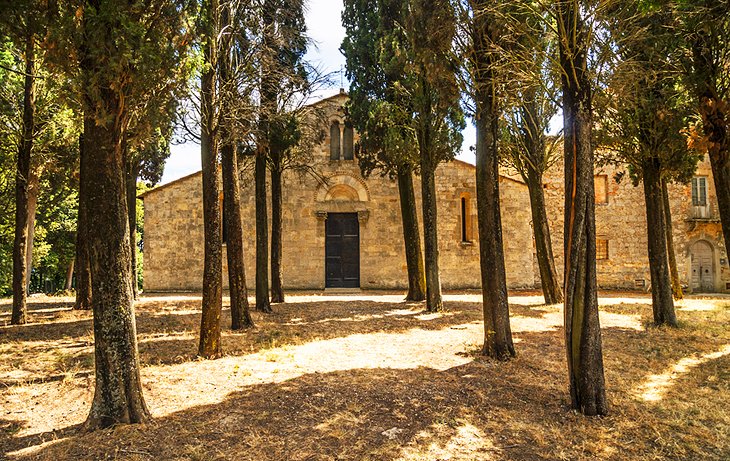
Standing among the cypress trees on a hill about four kilometers northwest of San Gimignano, the Pieve - Parish Church - of the village of Cèllole was probably built at the end of the 12th and beginning of the 13th centuries, although a church there is mentioned from the beginning of the 12th century.
The facade is plain, but the outside of the apse has rich figural carving. Inside is a beautiful baptismal font in travertine, and 14th-century frescoes.
Pieve di Cèllole lies along the Via Francegina, with panoramic views of San Gimignano and the countryside. This is a good point from which to walk a few kilometers along this historic pilgrimage route.
Where to Stay in San Gimignano for Sightseeing
Below are some moderately priced lodgings in good locations, close to tourist attractions, restaurants, and shopping in San Gimignano.
- Hotel Leon Bianco: Locations don't get any more central than this family-run hotel housed in an historic palazzo on Piazza della Cisterna. Rooms are air-conditioned, and breakfast is included.
- Hotel L'Antico Pozzo: The beautifully renovated historic building is inside the city walls, with spacious and stylishly furnished rooms, air-conditioning and free high-speed Internet; breakfast is included.
- La Cisterna: Some of the comfortable, simply decorated rooms have balconies with views over the city, and all have small refrigerators and air-conditioning. The hotel is close to shopping and places to see, and offers a breakfast buffet with gluten-free options.
- Hotel Bel Soggiorno: Modest but comfortable rooms, some with balconies overlooking the Tuscan hills, are air-conditioned, and the small hotel has its own restaurant.
Map of Attractions & Things to Do in San Gimignano
More Related Articles on PlanetWare.com
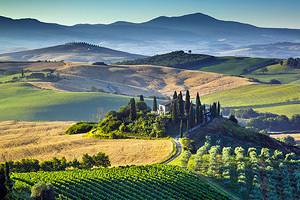
More Tuscan Hill Towns: Medieval hilltop towns are among the top-rated tourist attractions in Tuscany and are in fact among the best places to visit in Italy. All within an easy distance of each other are Arezzo, the former Etruscan town of Volterra, and Montepulciano, with its blend of medieval and Renaissance architecture.
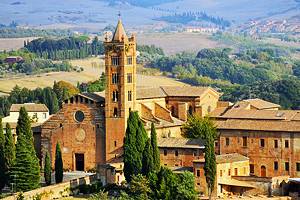
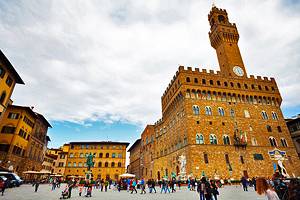
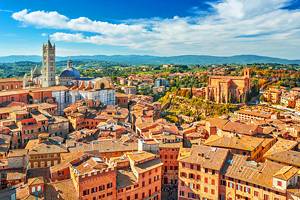
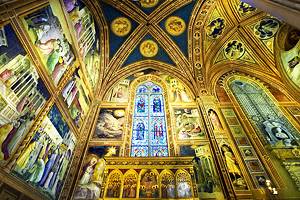
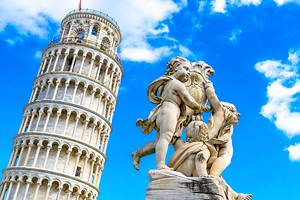
Exploring Tuscan Cities: San Gimignano is in the province of Siena, which you can visit with the help of our handy articles, Top-Rated Tourist Attractions in Siena and Exploring Siena's Cathedral of Santa Maria Assunta: A Visitor's Guide. Not far north of Siena is Florence, with its magnificent cathedral and palaces, and to the west of San Gimignano is Pisa, home of the famous Leaning Tower.