Exploring Siena's Cathedral of Santa Maria Assunta: A Visitor's Guide
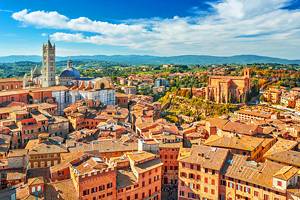
Unquestionably one of Italy's finest Gothic churches, and the most important sight in Siena, Siena's cathedral (Duomo di Siena) is equally stunning inside and out, featuring the work of Italy's finest artists of the day: Nicola and Giovanni Pisano, Donatello, Pinturicchio, Lorenzo Ghiberti, and Bernini.
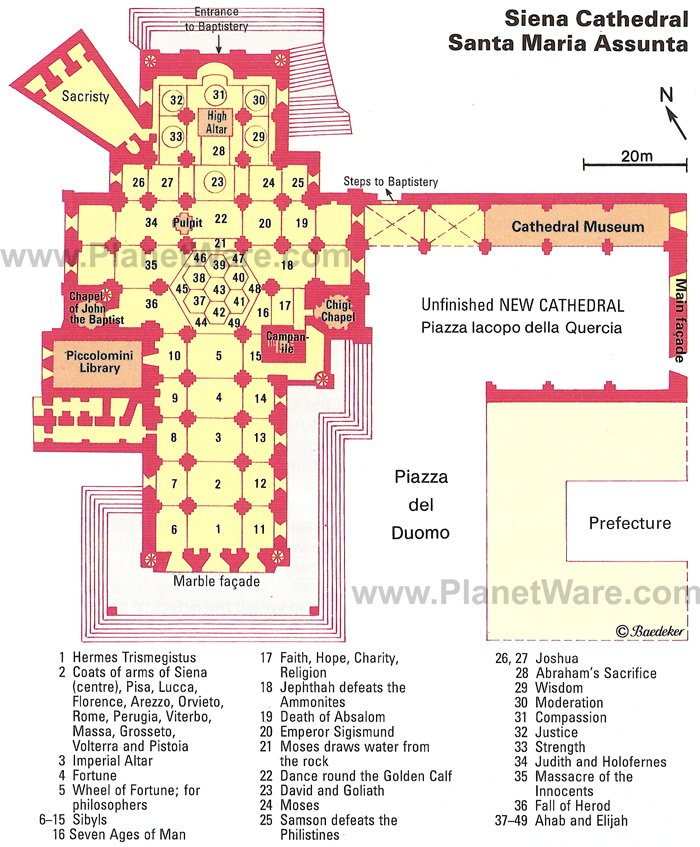
The cathedral in its present form was begun in 1229, and the dome was completed in 1264. Around 1317, the choir was extended over the baptistery, and only about 20 years later, the people of Siena planned a gigantic expansion, which would have made it the largest Gothic building in Italy.
The existing church was to become the transept of a new church more than 100 meters long, with its new nave turned by 90 degrees. These grandiose plans came to nothing when it was discovered that the foundations couldn't handle the added weight, and because the plague struck down so much of Siena's population in 1348.
One of the most popular attractions in Tuscany, Siena Cathedral often has very long lines to buy tickets. You can avoid these with a Skip-the-Line Siena Cathedral Duomo Complex Entrance Ticket purchased in advance. See below for more information on the features of the cathedral, how to get to it, and where to stay nearby.
See also: Where to Stay near the Cathedral of Santa Maria Assunta
- Façade and Campanile
- Interior
- Marble Floor
- Pisano Pulpit
- Piccolómini Library Frescoes
- Baptistery
- Cappella di San Giovanni Battista
- Presbytery
- Cappella Chigi
- Crypt Frescoes
- Museo del Duomo (Cathedral Museum)
- Facciatone
- Tips and Tactics: How to Make the Most of Your Visit to Siena Cathedral
- Where to Stay near the Cathedral of Santa Maria Assunta
- Getting to Siena Cathedral
- Address
Façade and Campanile
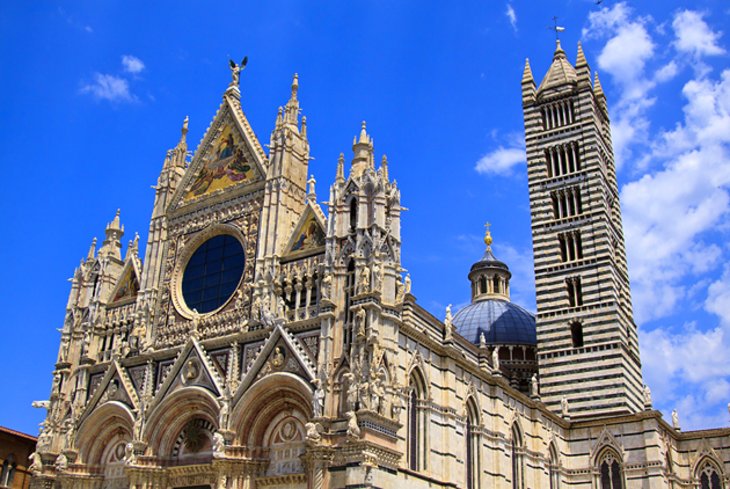
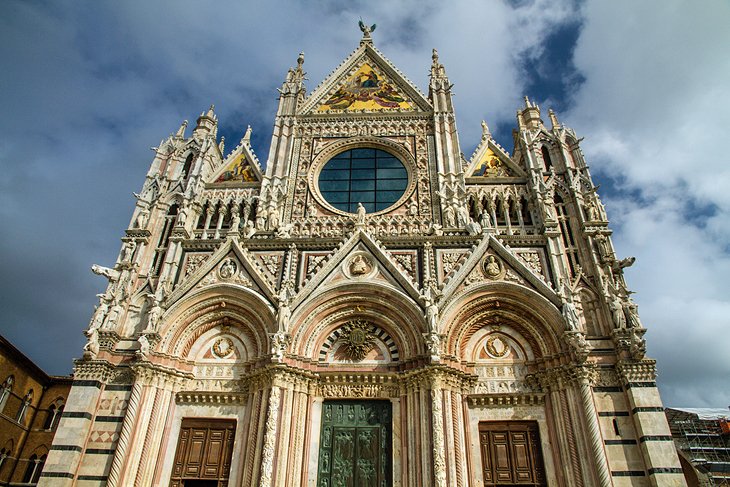
The cathedral's façade will take your breath away, a masterpiece of design and sculpture by Giovanni Pisano, with a beautiful rose window and Venetian mosaics adding to the already colorful effect of green, red, and white marble inlay. It is one of the finest achievements of Italian Gothic.
Referring to Pisano's sculptures on the façade, the contemporary sculptor Henry Moore called him "the first modern sculptor."
Almost the entire width of the façade is filled by three doorways of equal height, surmounted by pediments, with a slender tower at each end. Above the central doorway is a rose-window. Beautifully detailed sculptures decorate the remaining areas so harmoniously that it never seems overdone.
To protect the original Pisano works from weathering, most were replaced by skillful copies in 1869, and the mosaics were added over the doors in 1877. In the corner formed by the nave and the right transept is the Romanesque campanile, completed in the late 14th century. On the doorway of the tower is a 15th-century bas-relief of the Virgin and Child attributed to Donatello.
Interior
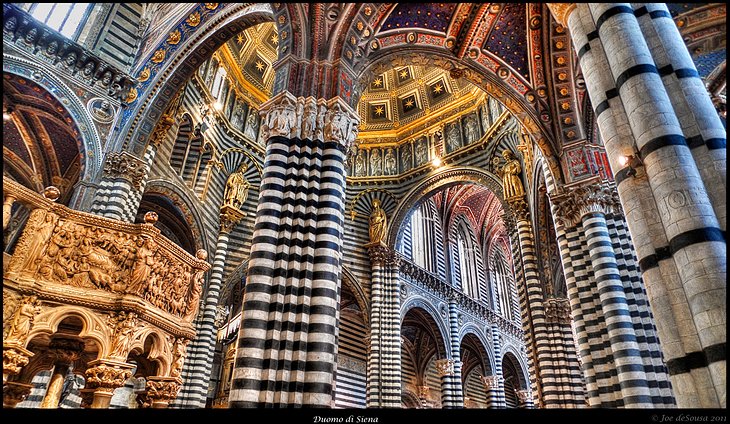
The Siena Cathedral interior is just as awe-inspiring as its exterior. The alternating bands of dark and light marble that make the cathedral's façade and campanile so striking continue inside, creating quite an impact as you enter the soaring nave.
These dramatic stripes break the vertical severity of its columns and extend onto the walls above. The geometry of the black-and-white stripes contrasts with the ceiling, which is a surprising rich blue spangled with gold stars, a theme that continues into the dome.
Above the rounded arches of the nave are busts of Christ and 171 popes as far as Lucius III, and in the spandrels of the arches are terracotta busts of 36 Roman emperors.
The inner wall of the façade has 15th-century reliefs picturing the life of the Virgin and the story of Sant'Ansano; the 16th-century, stained-glass rose window is of the Last Supper. Another stained-glass window is in the choir.
Marble Floor
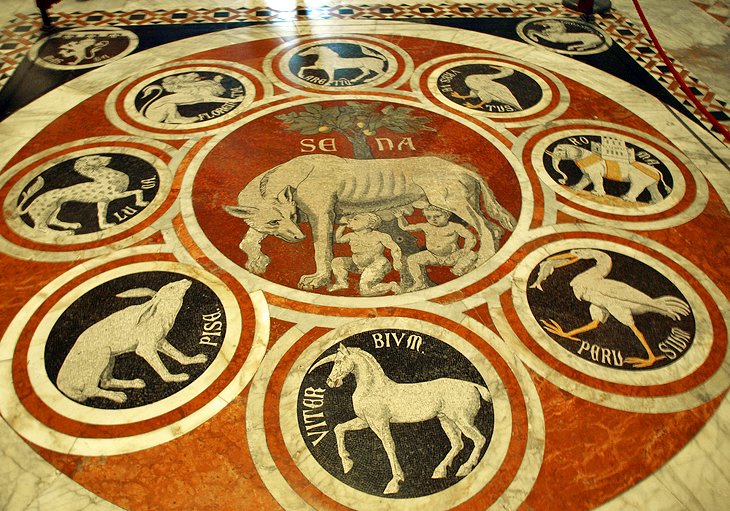
For all the dramatic effect of the striped marble interior, it is the floor that will draw your attention. The Florentine master Giorgio Vasari, who was responsible for some of Tuscany's greatest architectural works, described Siena's cathedral floor as "the most beautiful ... largest, and most magnificent ... that ever was made."
Its 56 panels took from the 14th through the 18th centuries to complete, beginning with the cartoons, or drawn designs, all but one created by Siena's leading artists. The exception is the Hill of Wisdom panel designed by Pinturicchio from Perugia, in 1505. Over the course of their completion, the marble artists refined their techniques, at first scratching the designs into the marble and filling in the lines with asphalt but later inlaying different colors of marble in intarsia or mosaics.
Not all the mosaic floors are normally visible, but those in the nave and side aisles are usually uncovered and protected by barriers. The floors of the apse and transepts have special coverings to protect them from wear during mass and are usually uncovered only during the month of July and from late August through late October.
Pisano Pulpit
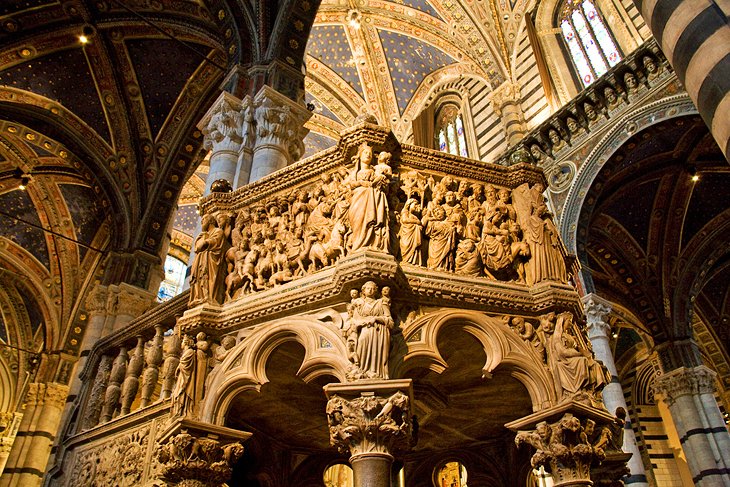
It is almost impossible to name one single work in the cathedral as its highlight, but to many, it would have to be the incomparable carved marble pulpit by Nicola Pisano and his students. Done from 1256 to 1268, it is one of the finest works of art in Tuscany.
Octagonal in shape, it is held aloft on nine columns of granite, porphyry, and green marble. The outer columns stand alternately on the base and on stone lions; the inner ones on allegories of the Seven Liberal Arts and Philosophy.
Above the capitals are personifications of the Virtues. Around the outside of the pulpit itself are seven magnificently carved reliefs in Carrera marble: the Nativity, the Adoration of the Kings, the Flight into Egypt, the Slaughter of the Innocents, the Crucifixion, and the Last Judgment.
Piccolómini Library Frescoes
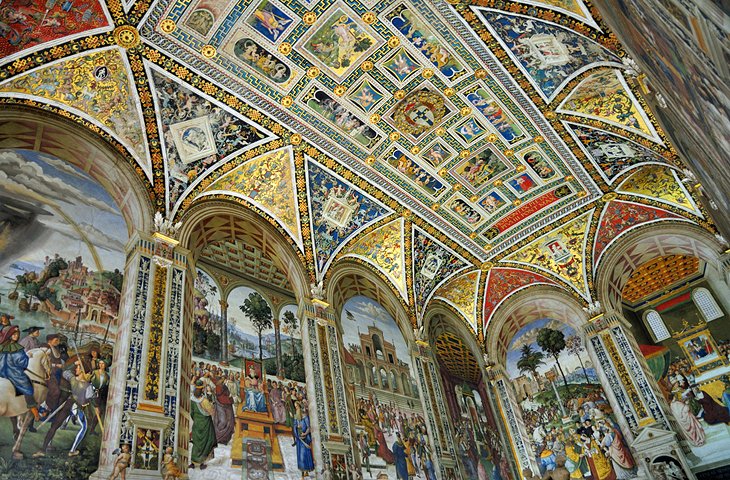
The Piccolómini Library is off the left aisle. It lies beyond a finely carved marble entrance wall by Lorenzo di Mariano, from 1497, an excellent example of High Renaissance decorative sculpture. Begun in 1495, the library was built for Cardinal Francesco Piccolómini (later Pope Pius III) to house a priceless collection of illuminated 15th-century musical manuscripts, which are displayed here.
The brightly colored frescoes that cover the walls and ceiling were painted in 1502-08 by Pinturicchio and his pupils. They depict 10 scenes in the life of the cardinal's uncle, Enea Silvio Piccolómini, who became Pope Pius II. The ceiling of the library is also covered with frescoes by Pinturicchio — the Piccolómini coat of arms surrounded by mythological figures, separated by bands of ornamental designs.
Baptistery
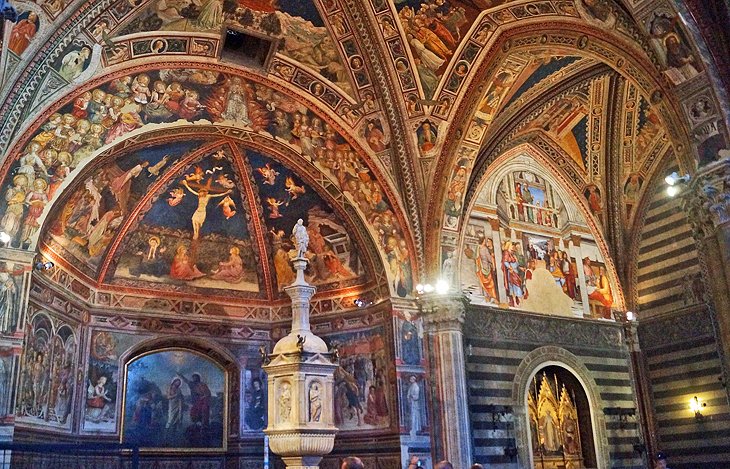
The baptistery, which is a few steps lower than the crypt, was built when the choir was extended, its groined vaulting held on heavy pillars. It is completely covered with frescoes, originally painted about 1450 by Lorenzo di Pietro, known as Vecchietta, and other artists. Unfortunately, these frescoes were clumsily "restored" in the late 19th century, destroying their artistic quality almost entirely.
In front of the apse, on a stepped hexagonal base, is a marble font created in the early 14th century, probably by Iácopo della Quercia. The six sides of the font have bronze reliefs of scenes from the life of John the Baptist by Iácopo della Quercia, Giovanni di Turino, Lorenzo Ghiberti, and Donatello.
Cappella di San Giovanni Battista
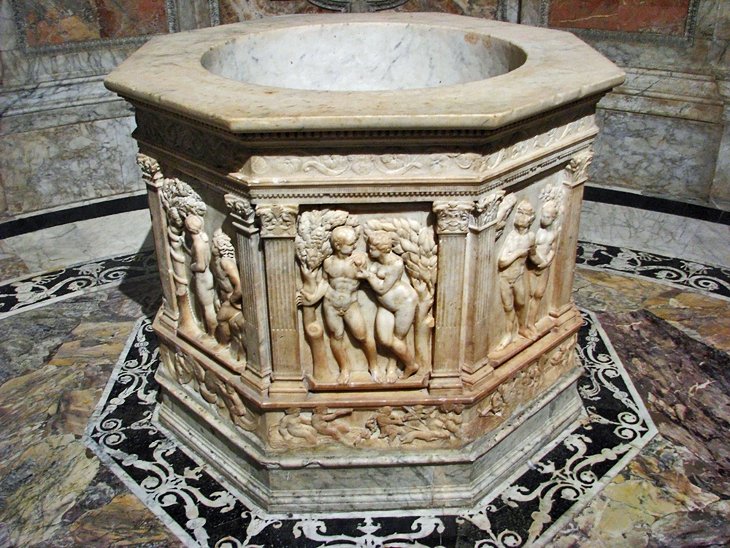
In the left arm of the transept is the Cappella San Giovanni, with a beautiful early 16th-century doorway by Lorenzo di Mariano. The chapel houses one of the cathedral's treasures, a bronze statue of John the Baptist by Donatello, done in 1457. There is also a statue of St. Catherine of Alexandria by Neroccio from 1487.
The frescoes showing scenes from the life of St. John the Baptist and two portraits are by Pinturicchio. In the center of the chapel, set in a marble inlaid floor, is a small carved baptismal font from about 1460.
Presbytery
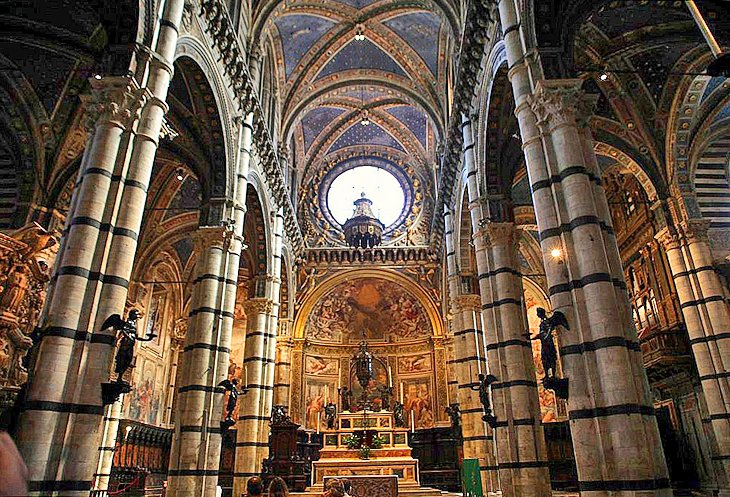
The presbytery is dominated by the large marble altar done by Baldassare Peruzzi in 1532, under an earlier bronze ciborium by Vecchietta and flanked by angels carrying candles.
The apse has frescoes by various 16th- and 17th-century artists, some of which were poorly repaired in the 19th century.
The 36 carved choir-stalls that remain from the original 90 are in Late Gothic style, dating from 1363 to 1397. Behind the stalls are highly decorative inlaid panels by Fra Giovanni da Verona, from 1503.
Cappella Chigi
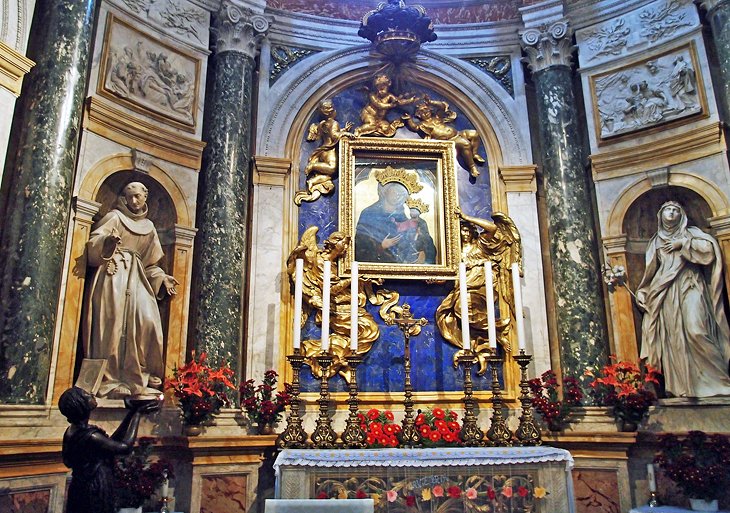
Look for the entrance to the Chigi Chapel in the right transept; it was built in 1659-62 to the design of the great Baroque architect Giovanni Lorenzo Bernini. Of the four statues in the chapel, two — St. Jerome and The Magdalene — are by Bernini; the other two, of San Bernardino and St. Catherine of Siena, are by his students.
Crypt Frescoes
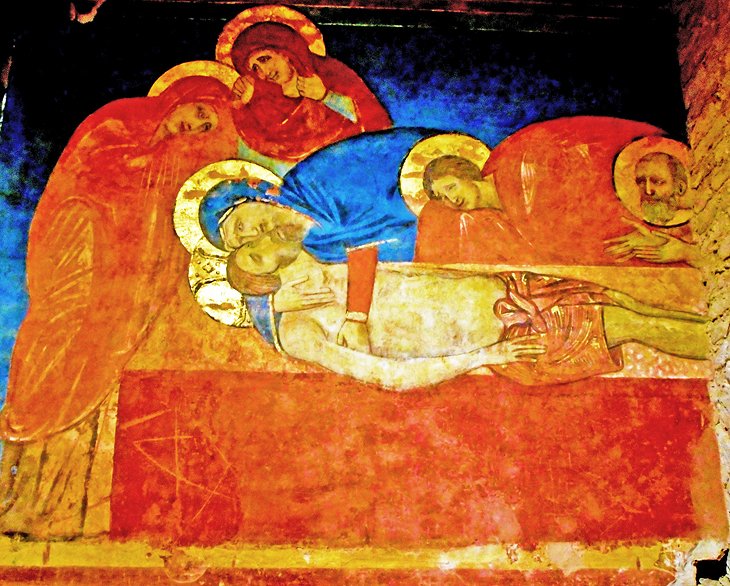
It is well worth seeking out the somewhat circuitous route to the crypt. Go around the outside of the right transept and through the doorway in the first bay of the unfinished new cathedral. The entrance to the crypt is on the first landing of the staircase. You'll be surprised by what you see. Unlike most dim and somber church crypts, this one seems alive with color, and is considered one of the most important recent archaeological discoveries.
In 1999, when the cathedral commissioned excavations to recover rooms connected to two adjacent oratories, they led underneath the cathedral choir and unexpectedly to a cycle of frescoes of New Testament scenes by several prominent Siena artists from the late 13th century. In another room are the originals of statues from the cathedral facade, now replaced by copies.
Museo del Duomo (Cathedral Museum)
If you still have time and energy left after seeing all the cathedral's treasures, take a few minutes to see the collections housed in three bays of the nave of what was intended to be the new cathedral.
Highlights to look for are reliefs by Nicola Pisano, works by Giovanni Pisano and his workshop, a magnificent relief of the Virgin and Child with St. Antony and Cardinal Casini by Iácopo della Quercia, more sculpture by Giovanni Pisano from the facade of the cathedral, and a number of panel-paintings.
The most significant of these are Duccio di Buoninsegna's famous Maestà — the largest altarpiece ever painted, Pietro Lorenzetti's Birth of the Virgin, Bernini's delicate gold sculpture Golden Rose, Donatello's Madonna and Child, a Pisano crucifix, and the reliquaries in the Treasury, especially those for San Galgano and San Clemente.
Facciatone
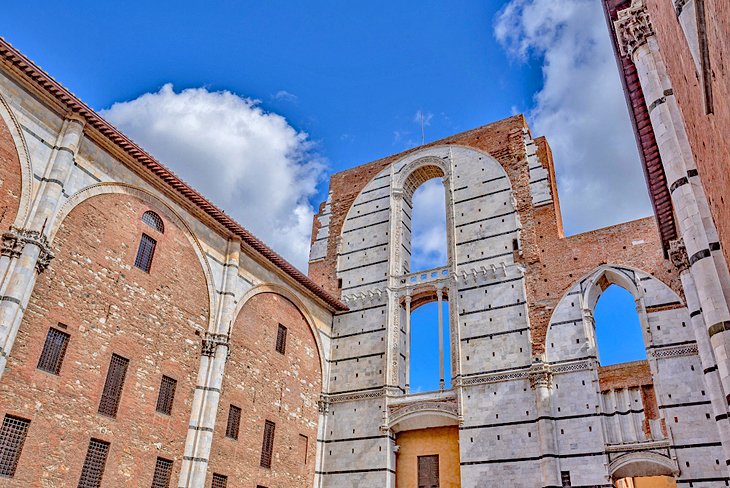
At the height of Siena's fortunes, in the 14th century, the city planned and began work on an expansion to create a new nave, which would be 100 meters long, with the original nave creating a transept. But the Black Plague swept through the city in 1348, leaving two thirds of the population dead. With them died the plans for the grandiose new cathedral.
The incomplete façade forms a somewhat incongruous wall beside the old cathedral. Called the Facciatone, it is all that remains of the ill-fated project. One of the least-known things to do in Siena is to climb to the top of the Facciatone, accessible through the museum, for splendid aerial views of the city.
Tips and Tactics: How to Make the Most of Your Visit to Siena Cathedral
- Skipping the Lines: Especially during the busiest tourist seasons, lines waiting to enter the cathedral can be daunting. You can avoid them by securing an advance Skip-the-Line Siena Cathedral Duomo Complex Entrance Ticket.
- Dress Code: This is a place of worship, so dress accordingly (women's shoulders should be covered, shorts are not appropriate, and men must wear shirts).
- Services: The public is welcome to attend weekday and Sunday masses, but no sightseeing is permitted during these. You can get the Siena Cathedral mass times from their website.
- Food and Drink: Cafés and restaurants are throughout Siena, only a few steps from the cathedral.
Where to Stay near the Cathedral of Santa Maria Assunta
You can't go wrong basing yourself in the heart of the city near the major attractions. We recommend these delightful hotels an easy stroll from Siena's famous cathedral:
- Relais degli Angeli: boutique luxury, hand-painted ceilings, valet service, comfortable beds, delicious free breakfast.
- Palazzo Ravizza: 3-star hotel, countryside views, old-world charm, antique furnishings, grand piano.
- Hotel Athena: mid-range pricing, bucolic views, friendly front desk staff, lovely terrace.
- Hotel Tre Donzelle: budget hotel, convenient location, hospitable owners, quaint decor.
Getting to Siena Cathedral
- By Train: Siena is about 90 minutes from Florence by train, and they leave frequently throughout the day. The train station is about one-and-a-half kilometers from the cathedral and other tourist attractions in the town center.
- By Bus: SITA buses take only about an hour from Florence and have the added advantage of taking you to the historic center, close to the cathedral. Be sure to take the rapide (express) bus.
- By Road: The autostrada from Florence to Siena takes only 45 minutes, but unless you are staying at a hotel with parking, you cannot enter the old town, and you'll have trouble finding a parking place within any reasonable walking distance.
Address
More Related Articles on PlanetWare.com
Exploring Siena and its Surroundings: The magnificent cathedral is only one of the attractions to visit in Siena; you'll find more stunning churches and exciting places to visit in our list of day trips from Siena.
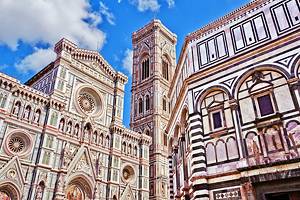
Discovering Tuscany's Great Churches: Having seen Siena's Cathedral, you'll want to tour the other great Tuscan cathedral in nearby Florence. You can do this with the help of our handy Exploring Santa Maria del Fiore Cathedral Visitor's Guide and discover the surrounding attractions in the Piazza del Duomo. Ready for more great Renaissance art? You'll find ideas in our article on the Top-Rated Churches in Florence.