Exploring Santa Maria del Fiore Cathedral: A Visitor's Guide
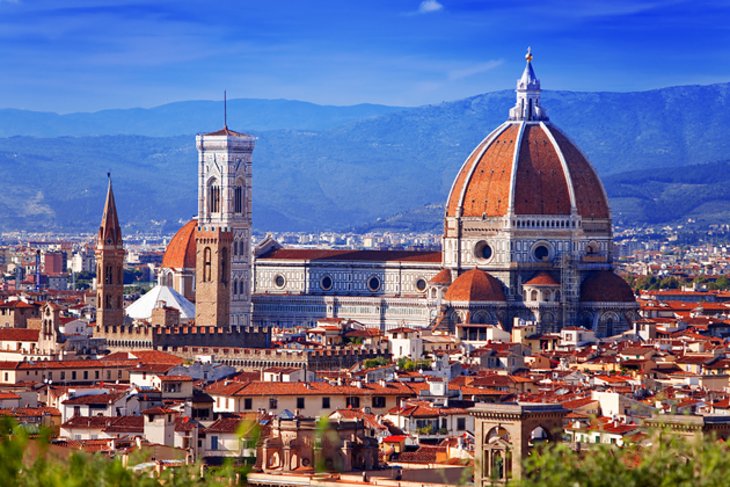
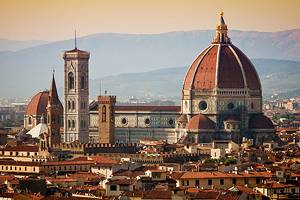
The symbol of Florence and by far its most visited tourist attraction, the duomo (cathedral) complex forms one of the world's most magnificent works of art. Visiting the Cathedral of Santa Maria del Fiore is an experience you won't want to miss.
At the end of the 13th century, the citizens of Florence wanted to build a cathedral that reflected the growing importance of their city. Work progressed for more than a century under several great architects, including Giotto and Pisano, so that by 1420, Filippo Brunelleschi was able to crown it with the dome–a sensational architectural feat for its day and one that still astonishes architects for its daring.
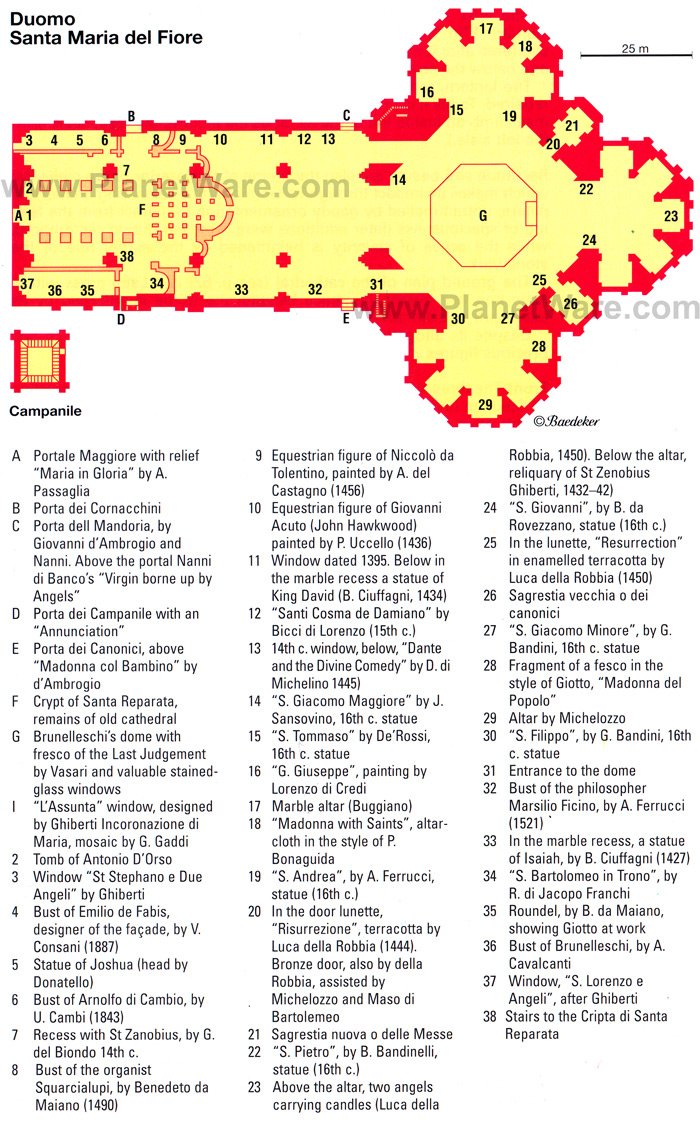
Italy's third-largest church, the Duomo, is more than 152 meters long and 90 meters wide at the transept (where the two main aisles cross) and towers above the historic center. But it's the artistry more than the size that makes this one of Europe's major must-sees.
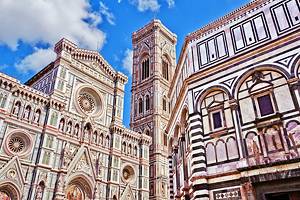
The magnificent façade, added in the 1800s to replace an unfinished one demolished three centuries earlier, dominates Piazza del Duomo with a dazzling display of inlaid marble in red, white, and green.
On This Page:
Cathedral Exterior
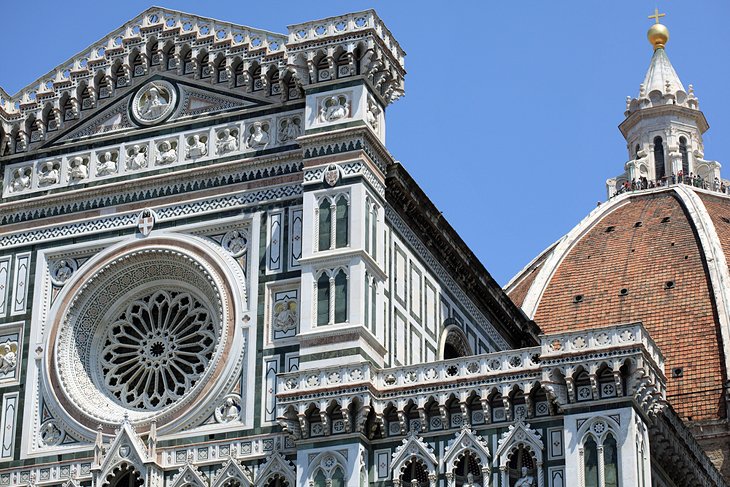
Although the façade was built in the 1800s, its design is true to the church's medieval Gothic style that harmonizes with Giotto's tower, using Tuscan marble inlaid with intricate designs and niches for statues. The alternating colors were chosen to exemplify the two basic principles of Florentine art: "rectitude and beauty."
Above the central doorway is a large rose window, with smaller ones at either side. The bronze doors have reliefs of Mary, to whom the cathedral is dedicated. Before going inside, walk around the building to see its four portals, especially the Porta della Mandorla on the left, the finest of them with work by Donatello, Ghirlandaio, and other Renaissance artists.
Cathedral Interior
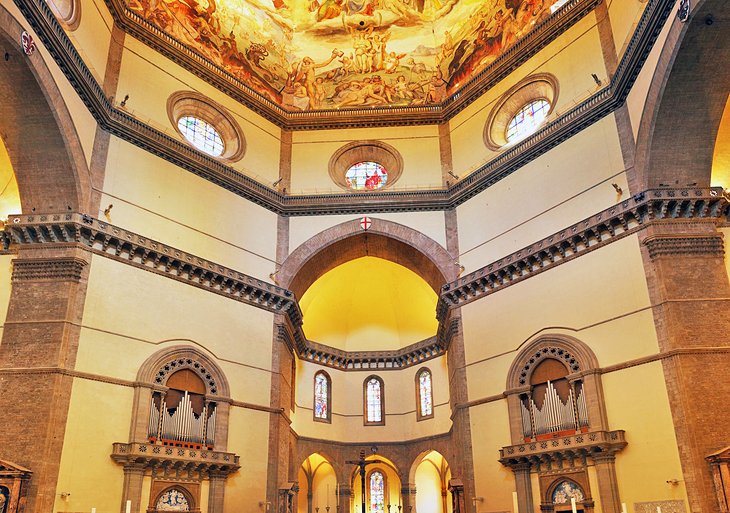
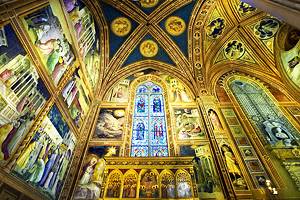
After the exuberance of the façade, you may be surprised by the sobriety inside. As in most Italian churches, the tastes of later generations altered the interior, but here these decorations were removed in still later work, restoring the almost unornamented grandeur of its soaring Gothic arches and stone pillars.
No matter where you stand, your eyes will be drawn toward the transept, and then upward to the astonishing dome overhead. But you should have a look around to discover some fine works of art, especially the 44 windows, which formed 14th- and 15th-century Italy's largest work of stained glass.
From inside, you'll get a better look at the three rose windows, whose stained-glass pictures were designed by Lorenzo Ghiberti, most famous for his bronze panels on the baptistery doors. While you're looking up, notice the clock–its hands move counter-clockwise.
Aisles and Apses
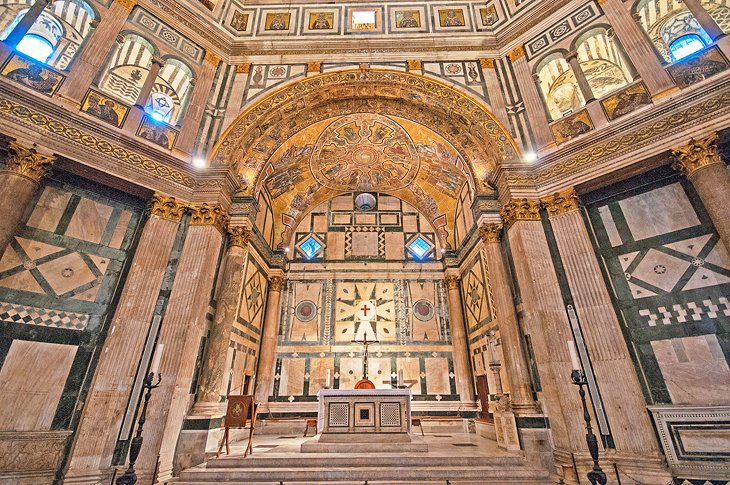
The two aisles on either side have various sculptures, paintings, and frescoes. Notice in the north aisle (left as you face the main altar) that the equestrian figure of John Hawkwood, who commanded Florence's mercenary army, is painted (by Paolo Uccello in 1436) to imitate sculpture. And although Florence sent Italy's great poet Dante into exile, where he died, they have glorified him posthumously with a portrait in the north aisle.
Each of the three apses–the rounded areas that form the short arms of the cathedral's Roman cross floor plan–is divided into several chapels. Those in the north apse have stained-glass windows by Ghiberti, and a double-sided retablo (altarpiece).
Be sure to look at the floor to find Toscanelli's 1468 gnomon, used for astronomical calculations. At the summer solstice, on June 21st, the sun's rays shine down through a cone-shaped hole in the lantern of the dome onto this metal plate. In the south apse, the first chapel (next to the Old Sacristy) contains an interesting fresco, Madonna del Popolo by Giotto.
The Sacristies
Separating the three apses are two sacristies, where priests prepare for the mass, each with works by Florence's master of glazed terra-cotta, Luca della Robbia. In the New Sacristy, on the north side, look for the lunette above the door, Resurrection of Christ (1444).
The beautiful bronze door is also by della Robbia (many of these artists, like Ghiberti, Giotto, and Brunelleschi were equally talented in several fields). Its 10 panels depict Mary with the infant Jesus, John the Baptist, Evangelists, and other biblical figures.
This sacristy is where Lorenzo the Magnificent and his brother Giuliano took refuge in 1478 when attacked during a service in the cathedral. Only Lorenzo managed to escape. In the Old Sacristy are a terra-cotta relief and two terra-cotta candlesticks in the form of angels, both by Luca della Robbia.
Choir and Dome
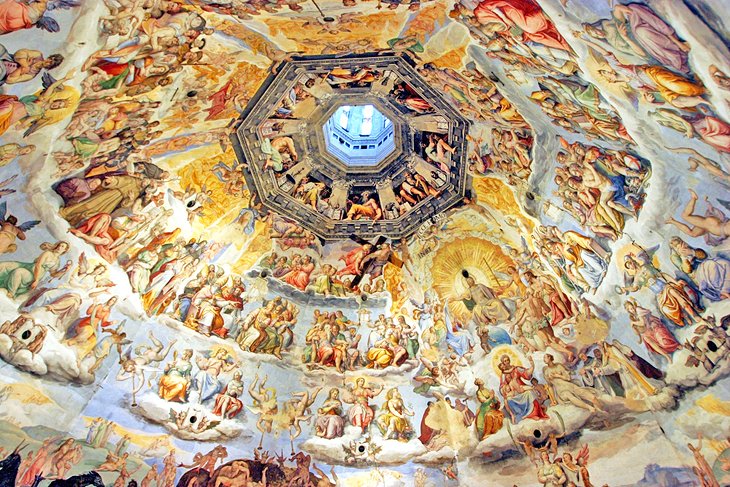
Under the dome is the choir with the high altar. The octagonal marble balustrade is decorated by 88 reliefs, and the crucifix on the high altar was made in 1495-1497 by Benedetto da Maiano. Your eyes will be drawn up by the sheer enormity of the dome, although you could be forgiven for a nervous glance at the stone columns that seem to support its weight so effortlessly.
Inside the dome is the great fresco of the Last Judgment by Giorgio Vasari, begun in 1572 and completed by Federico Zuccari in 1579. It's hard to imagine concentrating on work while suspended on the inside of this dome. At the foot of the pillars supporting the drum are eight statues of apostles.
Brunelleschi's Dome
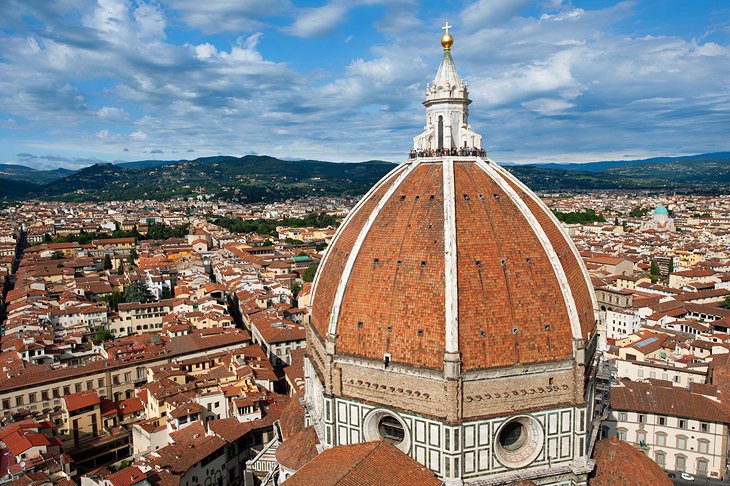
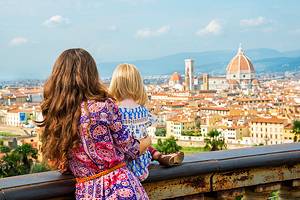
Entire books have been written on this one dome, and its immensity will take your breath away. So will the stairs leading up to it. After you've admired the world's most famous dome from below and from various points in Florence, there is still one more perspective: climbing between its inner and outer layers to the top.
As you make your way up the 463 steps, you have plenty of time to contemplate its construction, which was done entirely without a supporting framework (because of its height, 114 meters above the cathedral floor, building a wooden support was impossible). The method Brunelleschi used was to build a series of rings using bricks laid in an interlocking herringbone pattern. Each of the increasingly smaller rings supported itself, and the next one built upon it.
Once at the top, you can step out into the gallery of the 21-meter lantern (when it was added, Michelangelo said it looked like a cricket cage). The views cover the entire city and beyond to the Tuscan hills. The stairs to the dome start where the north aisle joins the apse. Note that this is not for anyone with acrophobia, claustrophobia, heart, or respiratory problems.
Cripta di Santa Reparata (Crypt)
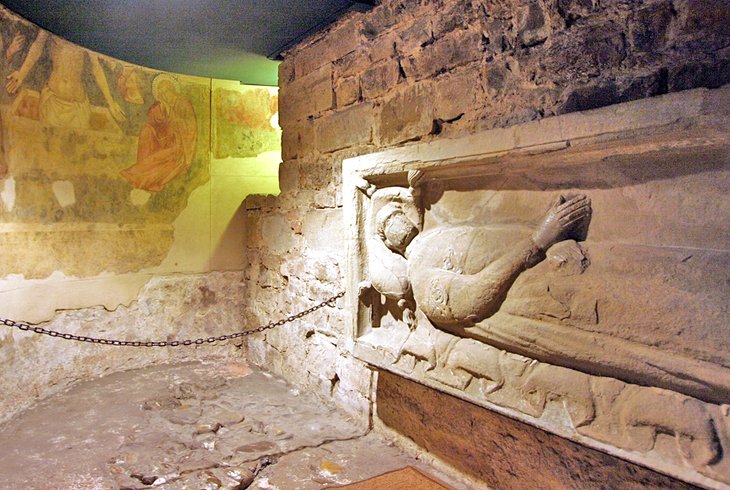
From the cathedral porch, stairs lead down into what is left of the earlier church of Santa Reparata. Built in the fourth and fifth centuries, then extended in the eighth and 11th centuries, the original church was at first just engulfed by the building of the cathedral, then finally demolished in 1375.
But the crypt beneath Santa Reparata was still there, and excavations began uncovering it in 1965. An unexpected find in 1972 was the tomb of Brunelleschi, which you can see here, along with a small museum relating to the original church.
Giotto Campanile (Bell Tower)
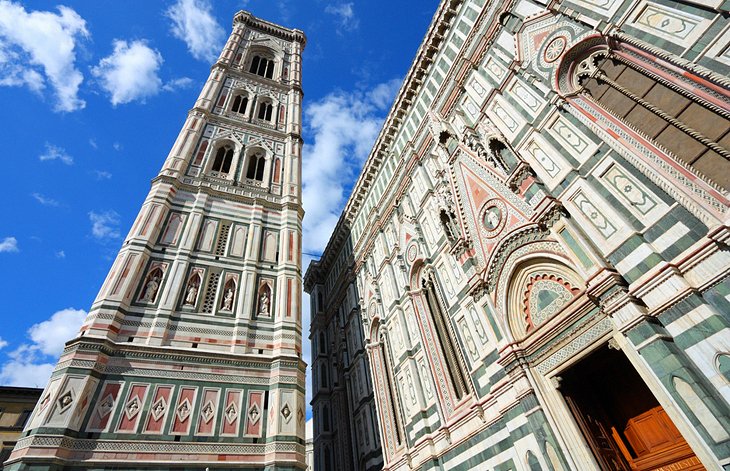
Second only to Brunelleschi's great dome as a landmark on the Florentine skyline is Giotto's Campanile, the 81-meter bell tower that stands barely detached from the cathedral façade. Begun in 1334 by Giotto di Bondone, the tower was continued after his death in 1337 by Andrea Pisano, who followed Giotto's plans.
Giotto's successor, Francesco Talenti, deviated somewhat from the original design and finished the tower in 1387. Like the Duomo façade that followed its style centuries later, it uses alternating colors of marble to striking effect. While the designs are intricate, and the tower is further decorated by relief panels and by statues in the niches (these are replicas of the originals, now protected in the Museo dell'Opera del Duomo), the tower's dimensions and the balance of its ornament give it harmony.
The trio of buildings–Duomo, Campanile, and Baptistery–make this one of the most beautiful architectural ensembles in the world. The decorative bas-relief panels are by Andrea Pisano (best known for his extraordinary carved stone pulpits in the cathedrals of Siena and Pisa) and Luca della Robbia, and show allegories of human work and art in the lower row, and of planets, virtues, liberal arts, and sacraments in the higher one. For the best view of the dome and a splendid view of the city, climb the 414 steps to the top.
Tips and Tours: How to Make the Most of Your Visit to Santa Maria Fiore
- Tours of the Dome: Visitors on a Skip the Line: Florence Duomo with Brunelleschi's Dome Climb can bypass the long lines to see the Cathedral and the Baptistery, then ascend to the top of the magnificent dome. A knowledgeable guide will also take you through passages and areas that are closed to the public.
- Tours of the Duomo, Bell Tower, and Museum: Learn about the architecture, artwork, and mosaics with a professional guide on the three-hour Florence Duomo Complex Small Group Tour. Pre-reserved tickets assure entrance to the Duomo; Giotto's Bell Tower; and the Museo dell'Opera del Duomo, where you can see many of the cathedral's original statues and Ghiberti's original Baptistery doors.
- Visiting Santa Maria Fiore on Your Own: Admission to the cathedral itself is free, but you can expect lines to be long spring through fall, especially on Saturday (the Duomo is closed to visitors on Sunday). All the other monuments – the baptistery, tower, and museum are included in a single ticket. You can rent audio sets inside the cathedral.
Tips for Visitors:
- Proper dress is required in the cathedral, which means those wearing shorts or tank tops won't be admitted.
- Backpacks and large bags are not allowed in the dome; you'll find a check room at the Museum Opera del Duomo.
- Those with a fear of heights or of dark and narrow spaces should be aware that the climb up the dome is in a narrow passageway between the inner and outer shells. Also, you will be looking down more than 40 meters to the floor below. There is a barrier for safety, but the view straight down can be unnerving.
- Be aware that the dome requires climbing 463 steps, some of them quite steep, and Giotto's Bell Tower with 414 steps.
More Related Articles on PlanetWare.com
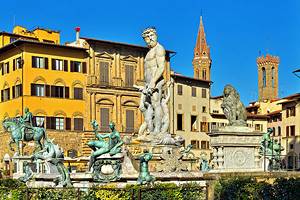
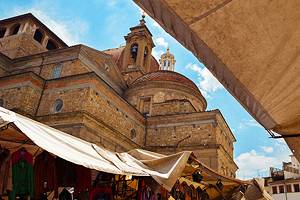
Places to Visit in Florence: After seeing the cathedral, you may want to explore Piazza della Signoria to see the Baptistery and the nearby Medici church of San Lorenzo. Several other top-rated churches in Florence are well worth seeing, as well.
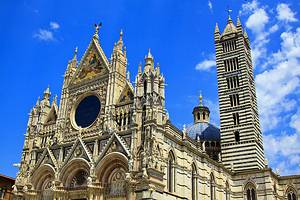
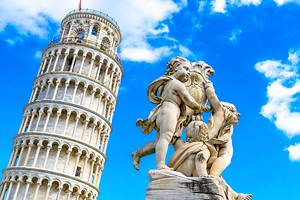
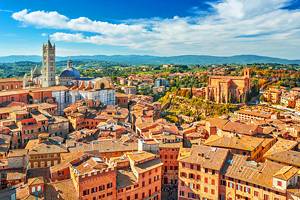
More Great Italian Cathedrals: The great cathedrals are among the most important tourist attractions in Italy, and two of the finest are easy day trips from Florence. Near the top of the list and nearby is Siena's Cathedral of Santa Maria Assunta, and in Pisa you'll find the magnificent cathedral next to the Leaning Tower. If you travel to Sicily, don't miss the great Cathedral of Monreale, near Palermo.