Exploring San Lorenzo in Florence: A Visitor's Guide
Among the major art achievements of the Western world, the Basilica of San Lorenzo, the Old Sacristy, the New Sacristy, the Princes' Chapel, and the Laurenziana Library combine priceless individual art treasures in a setting of outstanding architecture. Probably the world's greatest patrons of the arts, the Medici family brought together the masters of their age to build a church complex for their own worship and as a mausoleum for generations of the powerful family.
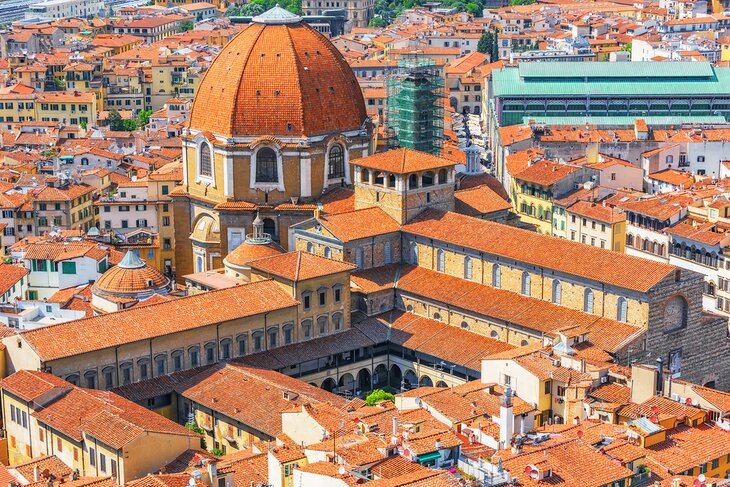
Thus it was that Brunelleschi, Donatello, and Michelangelo all had a hand in the building and decoration of San Lorenzo. Add the works by Andrea Verrocchio, Agnolo Bronzino, and Filippo Lippi and you have almost a who's who of 15th-century artists working in the city. For art lovers, this is one of the most important places to visit in Florence.
The original church on this site is thought to have been founded by St. Ambrose in 393 and had been rebuilt in the 11th century in the Romanesque style. In 1419, the Medici commissioned the foremost proponent of Florentine Renaissance architecture, Brunelleschi, to transform the church into what you see today. The work was completed in 1460, after Brunelleschi's death, but following his plans.
You will be sure to find all the highlights of this magnificent church complex with our visitor's guide to exploring San Lorenzo.
1. San Lorenzo Church
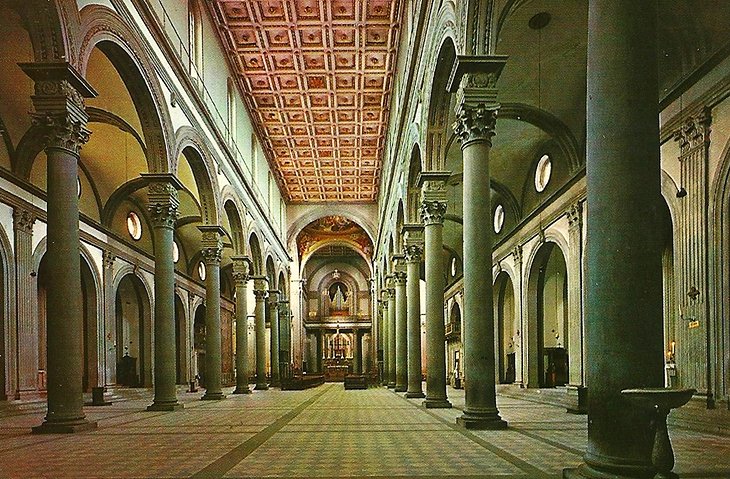
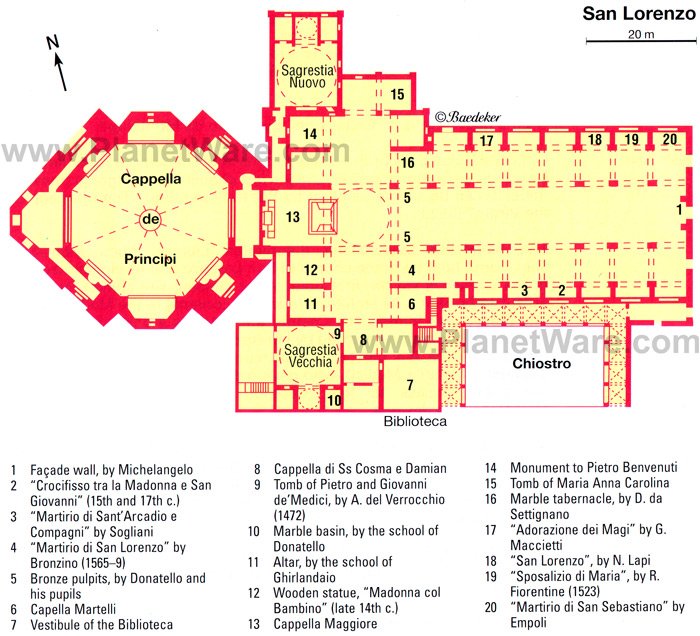
The light, harmonious interior that Filippo Brunelleschi created here is almost a textbook of his ideal of Renaissance architecture. Stand for a moment just to take in the beautiful marble pavement, the columns with Corinthian capitals supporting the broad arches, the intricate coffered ceiling with delicate rosettes, and the proportions of the nave and the aisles with their side chapels.
On either side at the end of the nave look up to see a pair of bronze pulpits by Donatello, the artist's final masterpiece, completed about 1460 by his students and vividly depicting scenes from the life of Christ and the saints. He is also thought to have designed the marble balcony over the door to the cloister in the left aisle.
Opposite Donatello's bronze pulpit is another of the church's art treasures, a fresco by Agnolo Bronzino, Martyrdom of St. Lawrence. On the altar of the Cappella Martelli (in the left arm of the transept as you face the high altar) is a diptych of the Annunciation by Filippo Lippi, done in 1440.
2. Sagrestia Vecchia (Old Sacristy)
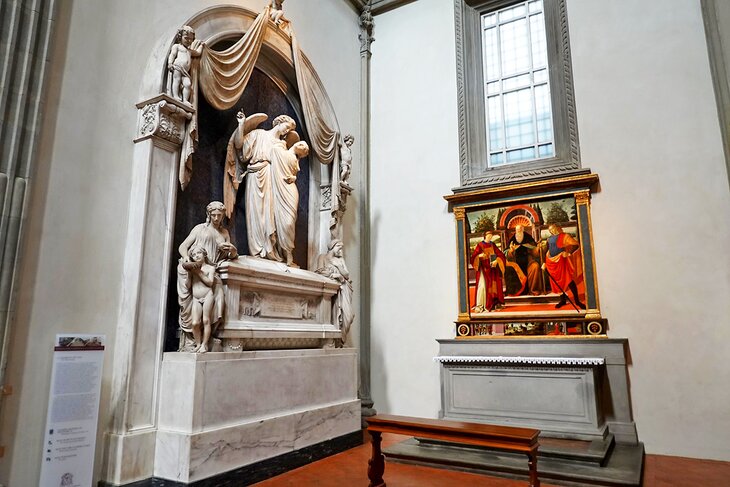
This left arm of the transept leads into the Sagrestia Vecchia, originally planned as a burial chapel as well as a sacristy. This was Brunelleschi's first complete architectural work (1420-1428) and it was to have a profound influence on European architecture.
As elsewhere in San Lorenzo, this sacristy is a whole piece, the impact of its architecture heightened by works of art. And the artists matched Brunelleschi's genius - the medallions and stucco reliefs of the Evangelists are by Donatello, as are the bronze doors. The magnificent tomb of Piero and Giovanni de'Medici (1472) is by Andrea Verrocchio.
Address: Piazza San Lorenzo, Florence
3. Medici Chapels and Tombs
Although the Medici chapels are part of San Lorenzo, you must visit them separately, through a different entrance. You'll come first to the crypt, with tombs of members of the Medici family, then into the memorial chapel of the Medici princes, the Cappella dei Principi.
For a better understanding of the art and history of the masterpieces here, reserve a Private Medici Chapels and San Lorenzo Square Guided Visit with an expert guide. The two-hour private tour includes admission fees and a close look at the Medici's neighborhood around Piazza San Lorenzo.
4. Cappella dei Principi
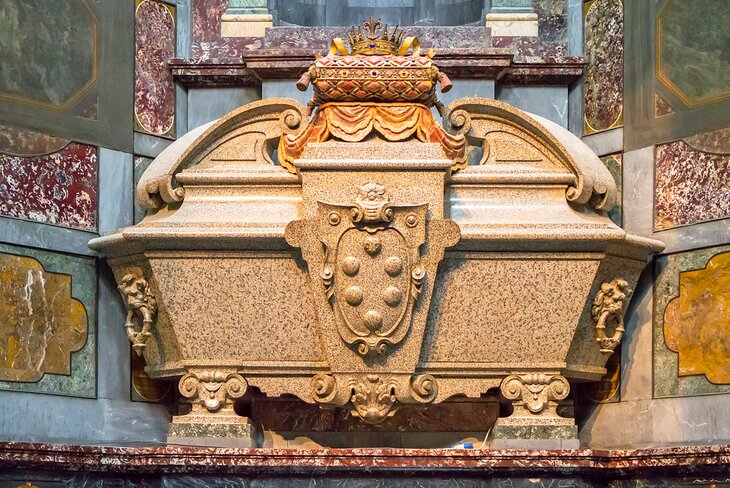
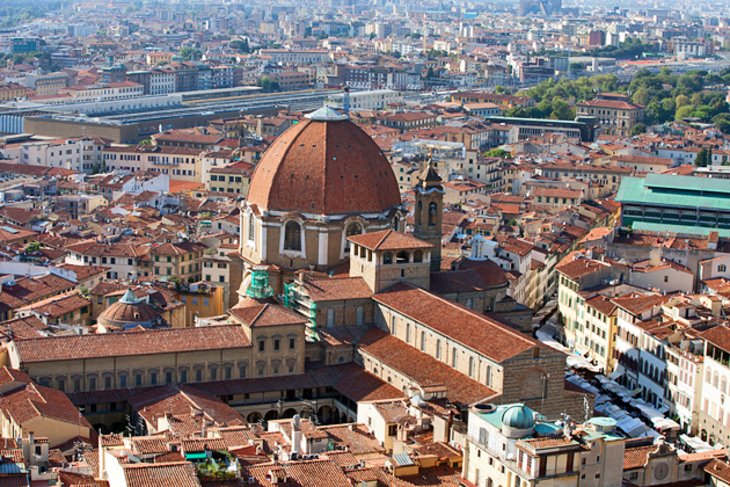
In 1602, Grand Duke Ferdinando I planned such a splendid family vault for the Medici dynasty that rumors spread that they were transferring the tomb of Jesus Christ from Jerusalem to Florence; such an extravagant sepulcher could not be intended for mortals, not even princes. The work was begun in 1604 by the architect Buontalenti and continued by others, but the chapel was not completed until the death in 1737 of the last Medici to rule Florence.
The huge dome was not completed until the 19th century. No expense was spared in this testament to Medici importance: paintings of biblical scenes, mosaics, marble, 16 coats of arms inlaid with semi-precious stones, and above it all a huge Medici coat of arms.
Six Grand Dukes are buried here and for all the skilled craftsmanship and fine materials, it has a distinct air of pomposity, suggesting that the heyday of Renaissance art came and went with the 16th century. Behind the altar is the entrance to the reliquary and treasure chapels.
5. Sagrestia Nuova
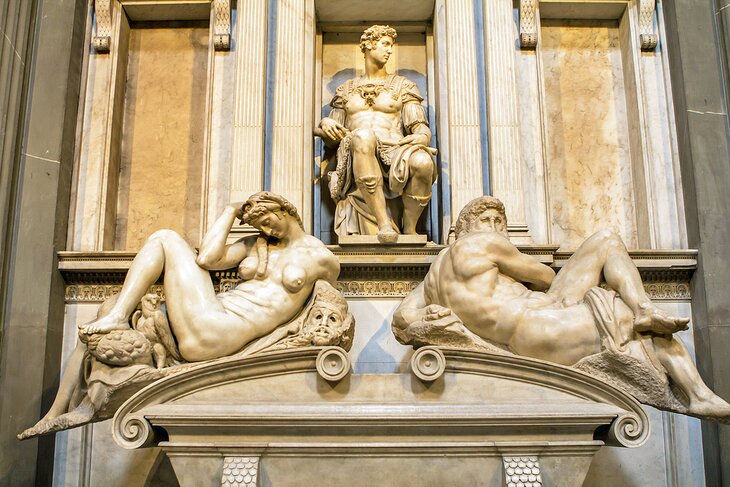
Beyond the Cappella dei Principi is the Sagrestia Nuova, the New Sacristy, built by Michelangelo between 1520 and 1534 to house more Medici tombs. This was Michelangelo's first work as an architect, and his plan also applied his talents as painter and sculptor.
The architectural elements — walls, niches, arches, and gables — are sculptural, accented by the dark gray and brilliant white marble lit by the windows in the dome. Michelangelo was also commissioned to sculpt the tombs, but only completed two before leaving permanently for Rome in 1534. Those two, however, are among his best known and most influential sculptures.
When chided that neither the statue of Giuliano, Duke of Nemours; nor Lorenzo, Duke of Urbino, on their tombs actually looked like the deceased, Michelangelo responded that in a thousand years no one would care what the two really looked like. He deliberately transcended portraiture to create timeless figures, naming them "la vigilanza" (Vigilance) and "il pensiero" (Thought).
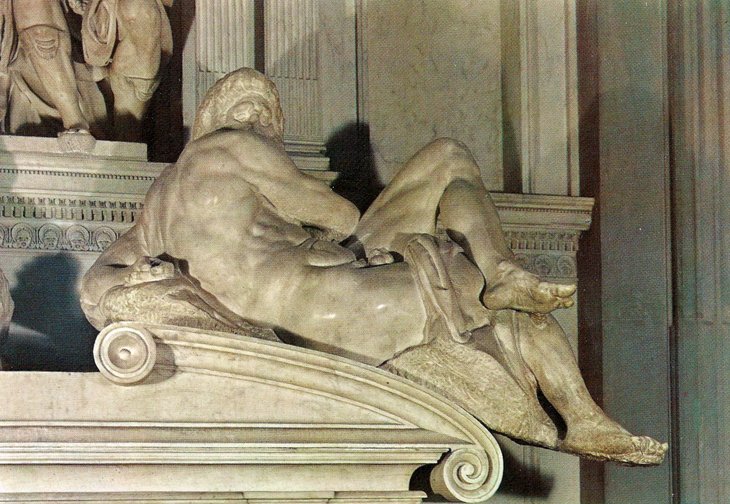
On the sarcophagus lid below Giuliano lie the figure of Night, with crescent moon and stars in her hair, and the unfinished figure of Day. Both figures are modeled on Classical lines, but with a new Christian philosophical dimension. Below the seated figure representing Lorenzo de Medici are the allegorical Dusk (left) and Dawn (right).
Like Giuliano, Lorenzo looks to the Virgin for redemption. The Virgin, in turn, is looking at the altar, symbolizing Christ's death and resurrection, and eternal life. All the figures communicate with one another, their interlocking gaze covering the room, an original concept of Michelangelo's.
Through architecture, sculpture, and painting together, he planned to reflect the path of life from the material world of river gods and sarcophagi via humanity to the life eternal in the resurrection fresco. Although Michelangelo's grand design for the work as a whole was never carried out, and the fresco of the Resurrection is not there to draw the eye heavenwards, the effect is still compelling, and the chapel is one of Florence's most memorable tourist attractions.
Address: Piazza Madonna degli Aldobrandini 6, Florence
6. Biblioteca Laurenziana (Library)
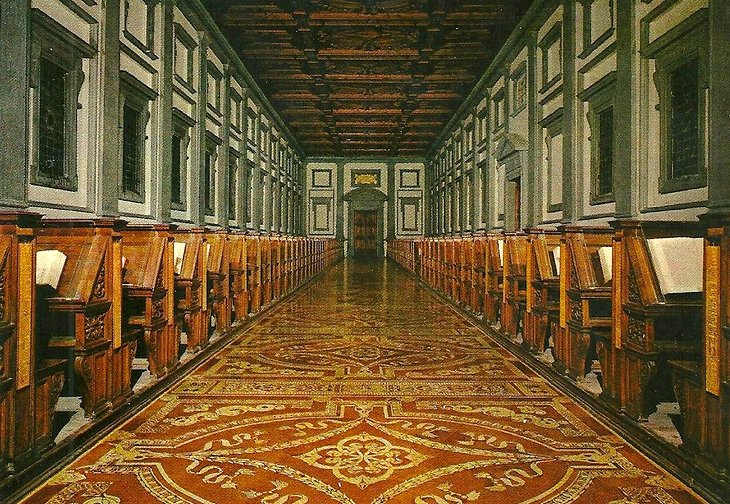
The Biblioteca Laurenziana, which you can reach via the cloister, was built on the foundations of a 13th-century monastery and designed to house the Medici's collection of documents and books. These had been moved to Rome, but Pope Clement VII (also a Medici) returned them to Florence and ordered a building for them, so they would be available to the public.
Work started in 1524 to Michelangelo's designs, and it opened in 1571. Although Michelangelo left Florence in 1534, he continued to take part in the building work through letters and models and was clearly at the height of his game as an architect. Here, you'll see all the decorative elements of Renaissance architecture.
You'll enter the library through a vestibule, where a curved staircase leads to the reading room. Michelangelo planned for it to be in walnut, but in 1559, Bartolomeo Ammannati used a fine-grained gray stone called pietra serena, following a wax model by Michelangelo. Its triple flight, with elliptical stairs on the central one, was quite unlike anything seen before.
The vestibule was not completed until the early 20th century when the ceiling was covered by painted canvas; be sure to see how it echoes the design of the Reading Room's carved wooden ceiling. The reading desks in this grand gallery were also designed by Michelangelo, its floors and ceiling by Tribolo. You'll need a separate ticket to visit the library, which is not always open.
Address: Piazza San Lorenzo 9, I-50100 Florence
Official site: http://www.bml.firenze.sbn.it/ing/tour_of_the_complex.htm
7. Cannon's Cloister and Treasury
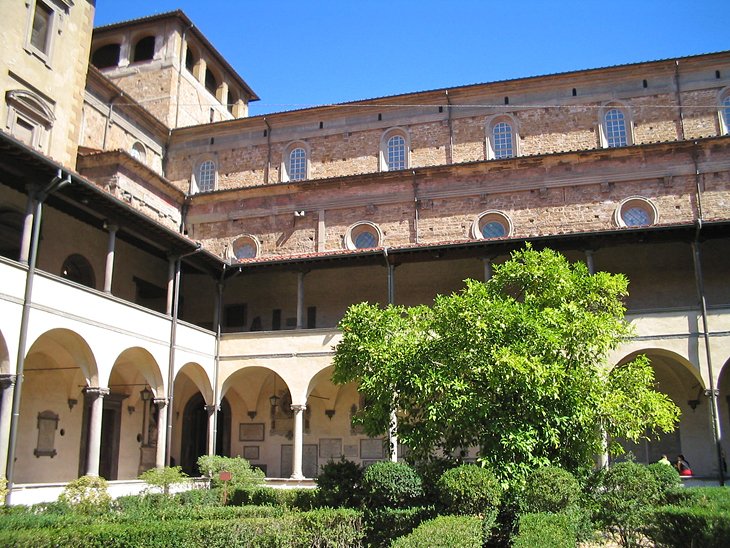
The enclosed garden through which you enter the church, called the Cannon's Cloister, was designed by Brunelleschi's colleague and student, Antonio Manetti Ciaccheri, following Brunelleschi's style. The two-story loggia was built between 1457 and 1460.
The cloister leads into both the church and the Treasury, filled with intricately embroidered vestments, silver and gold chalices, and reliquaries and crucifixes. Here, too, you'll find the tomb of Donatello, close to the curious tomb of his patron, Cosimo di Medici. The tomb takes the form of a column, where he is buried upright, symbolic of his position as a pillar of the church and the Medici family.
Piazza San Lorenzo
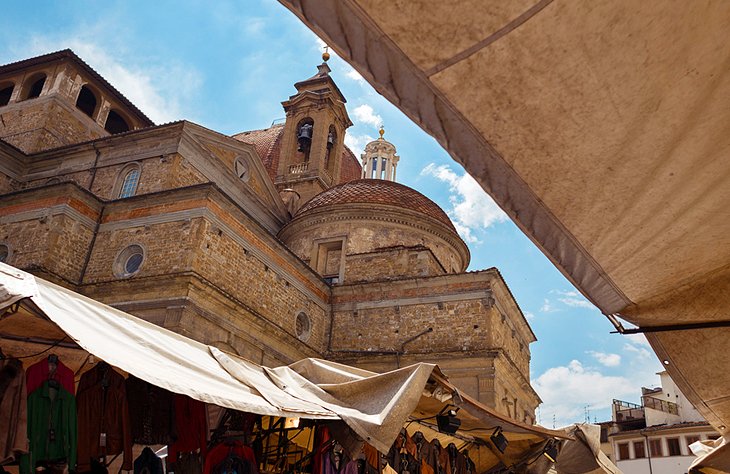
The square surrounding the Basilica of San Lorenzo is often almost completely obscured by the market stalls that fill it and spill out along Via Ariento, as far as Via Nazionale. You will be struck by the contrast between the chaotic San Lorenzo market, filled with everything from leather imports to knock-off sunglasses, and the finesse of the artistry that fills the majestic marble interior of the church.
Contrasting, too, is the interior grandeur with the rough brick façade. Michelangelo designed a façade - you can see his drawings and models in the Casa Buonarroti - but his plans were never implemented, so the bare bricks are still visible.
Near San Lorenzo: Palazzo Medici-Riccardi
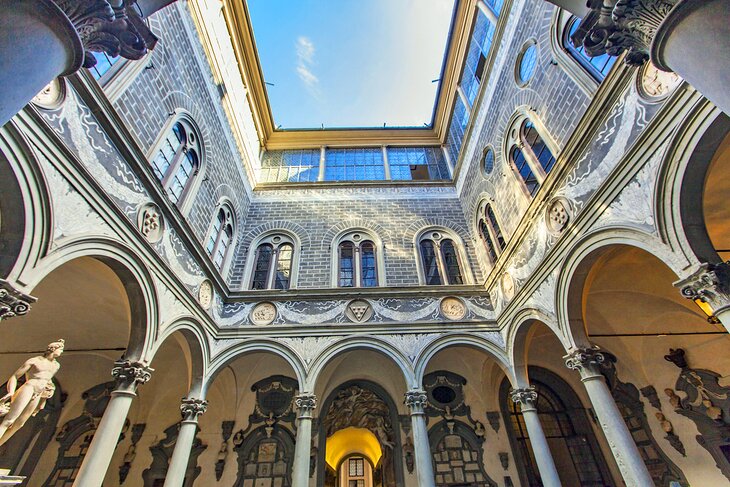
After you've witnessed the splendor of the Medici family's final resting place, you can see how they lived. Their early palace, Palazzo Medici-Riccardi, is right behind San Lorenzo, and represents the lifestyle of the early Medici princes, in the late 15th and early 16th centuries, before they moved to the Palazzo Vecchio.
Although lavish, it seems modest compared to the later generations' home at the Pitti Palace. The highlight of the palazzo is the chapel, its walls covered in well-preserved frescoes that give a vivid picture of court life in 15th-century Florence. The Procession of the Magi to Bethlehem, by Benozzo Gozzoli, incorporates portraits of leading figures of the time, including Lorenzo de' Medici, pictured as a boy on horseback.
On the ground floor, the Medici Museum occupies one of the original rooms (many others were renovated by later owners), with one of Filippo Lippi's most important works, Madonna and Child, painted in 1442.
Address: Via Cavour 1 & 3
Official site: www.palazzo-medici.it
Tips and Tickets
- Opening hours: With so many things to see and do in Florence, you'll want to plan according to open times and days, so it's important to know that San Lorenzo is not open to tourists on Sundays. Confusingly, the Medici Chapels are open different hours from the basilica, opening and closing earlier, and open alternate Sundays.
- Tickets: Buy tickets to the Basilica in the cloister. You can go back and forth between the cloister, treasury, and church on the same ticket; most visitors choose to see the church first.
- Tour: You can book a Private Medici Chapels and San Lorenzo Square Guided Visit. This is a two-hour guided tour led by an expert and is a great way to learn about what you are seeing. It includes your admission and the tour.
- Information: An English-speaking art historian is usually available in the central aisle of the basilica to answer questions on the art, architecture, and the Medici family.
More Related Articles on PlanetWare.com
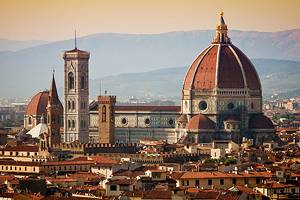
More Renaissance Art and Architecture: San Lorenzo is only one of more than a dozen Top-Rated Churches in Florence; be sure to also explore the Duomo of Santa Maria Fiore with our handy Visitors Guide.
Where to Go from Florence: Several beautiful towns are just an easy day trip away from Florence. You can take a train to see the Leaning Tower and other attractions in Pisa, or the charming walled city of Lucca.