15 Top-Rated Attractions & Things to Do in Lucca
One of the most charming towns in Europe, the walled center of Lucca is among the top attractions of Tuscany. Magnificent churches, many in the striking striped facades typical of Tuscan architecture, are filled with art treasures, and you can be sure of hearing the romantic chords of music by Puccini, Lucca's favorite native son.
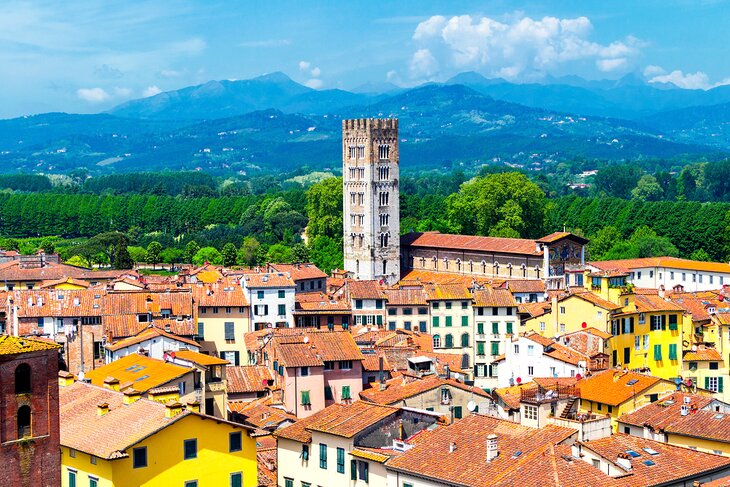
For all its many historic and architectural attractions, one of the most popular things to do here is simply to wander its narrow streets and spacious piazze, stopping in cafés to admire the beautiful buildings. The casual atmosphere and freedom from the crowds of nearby Florence and Pisa, make it a popular place for a getaway.
Although its early medieval churches, partly built with ancient material, were altered and restored in the 12th century, the churches you see today are among the most beautiful in Tuscany. Walk the encircling walls for an overview, then settle in to enjoy one of Italy's most endearing small cities. Discover the best places to visit with our list of the top tourist attractions and things to do in Lucca.
See also: Where to Stay in Lucca
- 1. Climb the Guinigi Tower
- 2. Discover the Hidden Anfiteatro Romano (Roman Amphitheater)
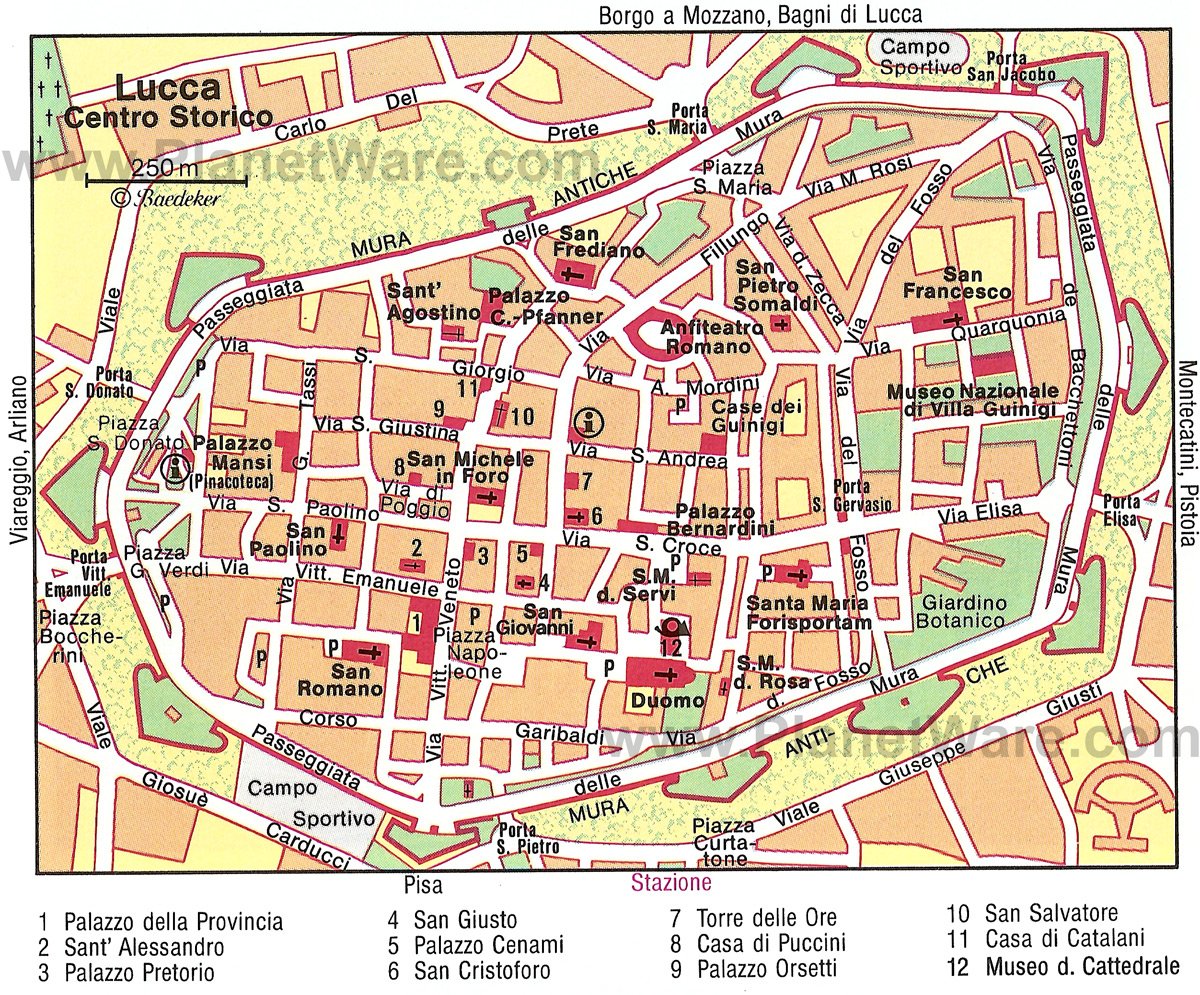
- 3. Walk or Bicycle the Town Walls
- 4. Cathedral
- 5. San Michele in Foro
- 6. San Frediano
- 7. Stroll through Piazza Napoleone
- 8. Linger in the Garden at Palazzo Pfanner-Controni
- 9. Museo Puccini
- 10. Explore the Gardens at Villa Reale di Marlia
- 11. Torre delle Ore
- 12. Ponte della Maddalena
- 13. Museo Nazionale (National Museum)
- 14. Listen to Music at the Church and Baptistery of San Giovanni and Santa Reparata
- 15. Take a Day Trip to Carrara
- Where to Stay in Lucca for Sightseeing
- Tips and Tours: How to Make the Most of Your Visit to Lucca
1. Climb the Guinigi Tower
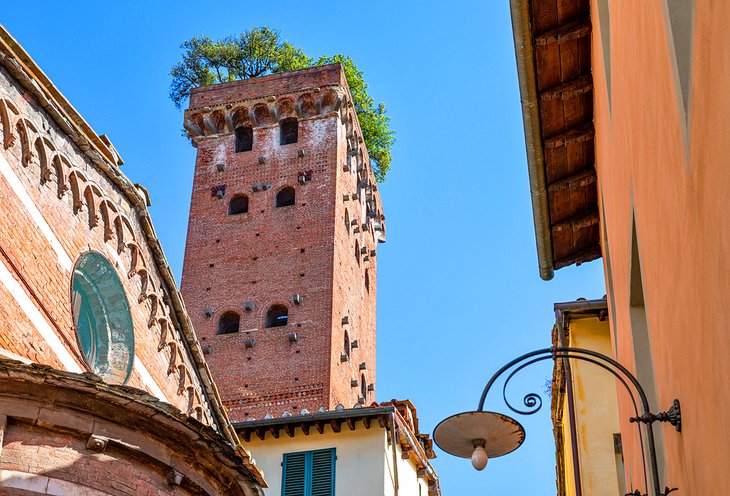
In the center of the walled old town, you can't help noticing a massive tower with holm oaks growing on the top. It belongs to the Case dei Guinigi, a complex of two mansions belonging to the noble family that brought Lucca a period of peace and prosperity at the beginning of the 15th century.
The two palaces, standing opposite one another, were built in the 14th to 15th centuries and later altered; one now houses the National Museum. You can climb the tower and view the city from beneath the trees at a height of 44.25 meters, certainly one of the most unusual things to do in Lucca.
Address: Via S. Andrea, Lucca
2. Discover the Hidden Anfiteatro Romano (Roman Amphitheater)
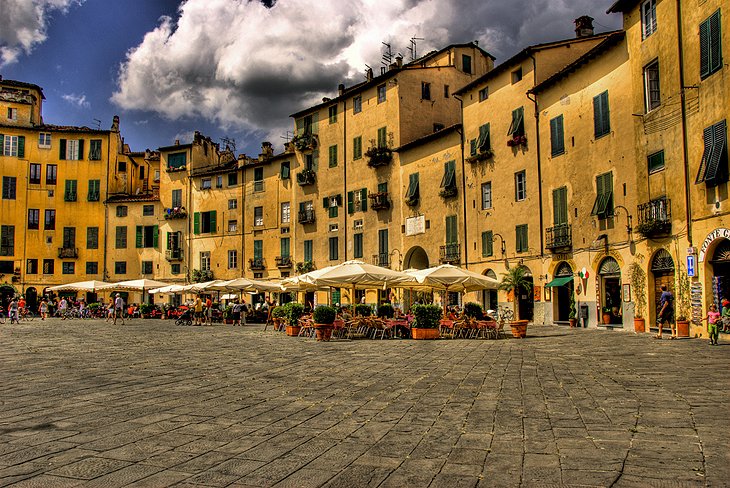
Strolling Lucca's historic center, you can't help noticing the peculiar curve of some streets. If you look closely, you'll see some unusual filled-in arches in the stonework of the buildings, and will eventually come to a passageway leading into Piazza del Mercato.
This odd oval space surrounded by multi-storied buildings was once the interior of Lucca's Roman arena, and the buildings follow the footprint of its massive stone walls, having been built into its remains.
The Roman amphitheater was built in the second century BC and was largely destroyed during the barbarian invasions; its remains now lie several meters below street level. During the Middle Ages, houses were built on the walls of the superstructure, preserving the oval outline of the arena.
3. Walk or Bicycle the Town Walls
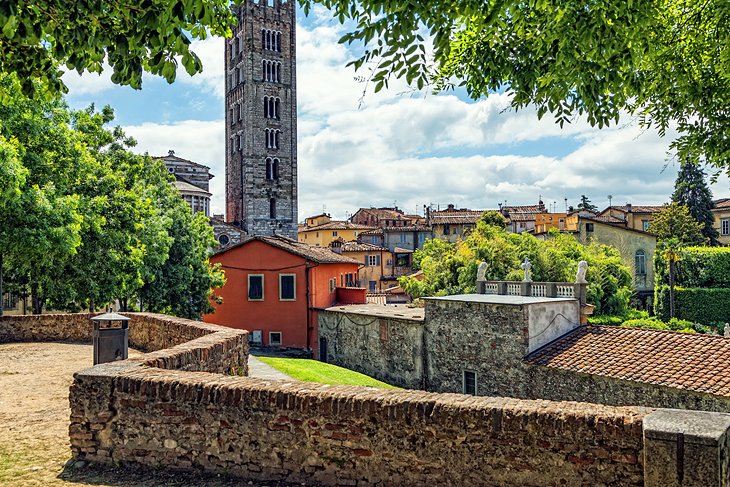
The old town of Lucca is enclosed within a circuit of walls 4.195 kilometers long with eleven bastions and six gates. These walls, which are 12 meters high and 30 meters thick at the base, were built by Flemish engineers between 1504 and 1645 to protect the rectangular area of the town.
Between 1823 and 1832, Maria Luigia of Bourbon (the sister of Napoleon, to whom he had given Lucca as part of the Duchy of Parma) had the old fortifications converted into a public garden.
Don't miss walking — or bicycling — around the tree-shaded ramparts for views of the old town with its palazzi and churches. On Sunday afternoons, it's one of the most popular places to go in Lucca. The old town gates are also interesting, in particular the Porta San Pietro on the south side, the Porta Santa Maria on the north side, and the Porta San Donato at the west end.
4. Cathedral
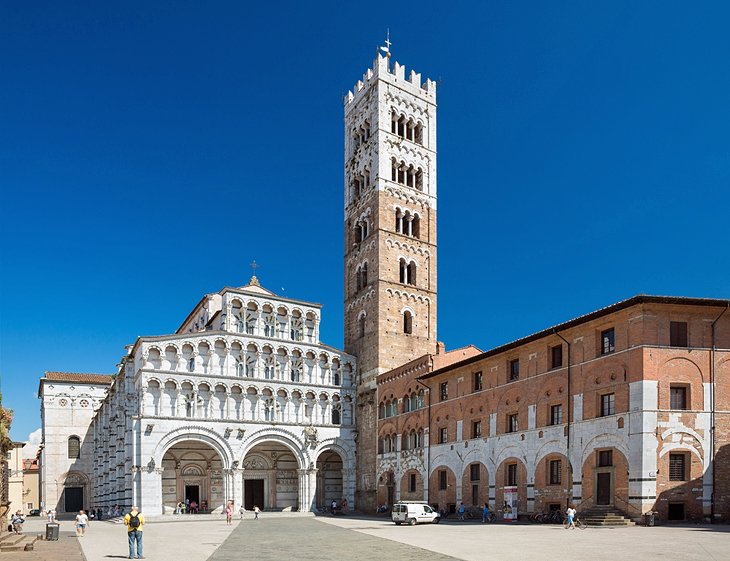
The marvelous Romanesque facade with arches and delicately carved columns is a clue to the treasures inside Lucca's cathedral, which was rebuilt in the 13th century from an earlier church. The portico was decorated in the mid-13th century with fine sculptures by Lombard artisans.
In the main doorway are four beautifully carved 13th-century scenes from the life of St. Martin, by Nicola Pisano. Attached to the right side is a massive campanile, 69 meters high, of light-colored travertine and brick. Carved into the right pier of the portico is a labyrinth, especially interesting because it may predate the famous Chartres maze of the same pattern.
Just inside on the right is the famous early 13th-century stone carving of St. Martin and the beggar, one of Lucca's finest examples of Romanesque sculpture. Other highlights of the richly endowed 14th- to 15th-century interior are the pulpit by Matteo Civitali (1494-98); paintings in the sacristy by Doménico Ghirlandaio; stained glass in the apse dating from about 1485; a statue of St. John the Evangelist by Iácopo della Quercia to the left of the sanctuary; and in the adjoining Cappella del Santuario, the beautiful 1509 Madonna by Fra Bartolommeo.
In the left transept is the impressive early 15th-century tomb of Ilaria del Carretto, a masterwork by Iácopo della Quercia. The cathedral's greatest treasure is the Volto Santo, an effigy of Christ on the Cross. Reputedly carved by Nicodemus from cedarwood, the venerated effigy is carried through the streets in a solemn procession each September 13th.
The cathedral museum has other treasures, such as medieval hymnals and intricate gold work, including a crucifix by Pisani.
Address: Piazza San Martino, I-55100 Lucca
5. San Michele in Foro
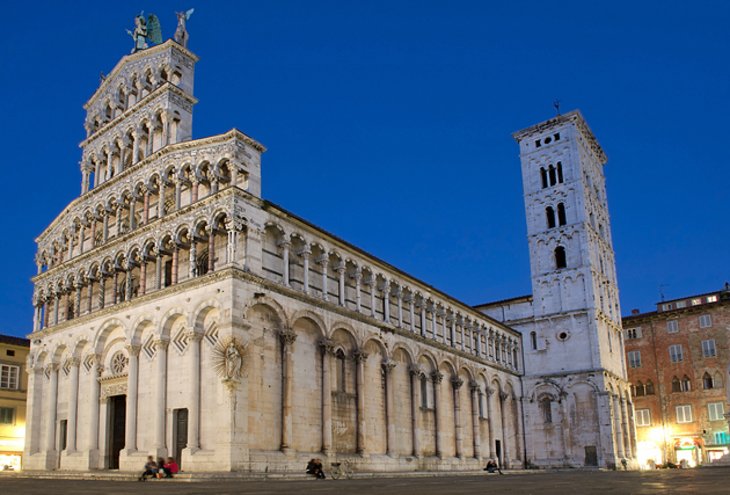
With its stunning façade rising in tiers like a decorated wedding cake and its placement in a broad piazza in the historic center of the city, it's no wonder that San Michele in Foro is so often mistaken for Lucca's cathedral.
Standing on the site of the Roman forum, the church of San Michele was built from the 12th to the 14th centuries, and its façade of carved and inlaid marble is breathtaking, seldom repeating a design on its four layers of intricately worked pillars.
Towering above them is a larger-than-life-size Archangel Michael. The Romanesque character of the interior has been preserved and is highlighted by the terra-cotta Madonna and Child by Andrea della Robbia and in the left transept, a 15th-century painted panel of saints Roch, Sebastian, Jerome, and Helen, one of Filippo Lippi's finest works.
Address: Piazza San Michele, Lucca
6. San Frediano
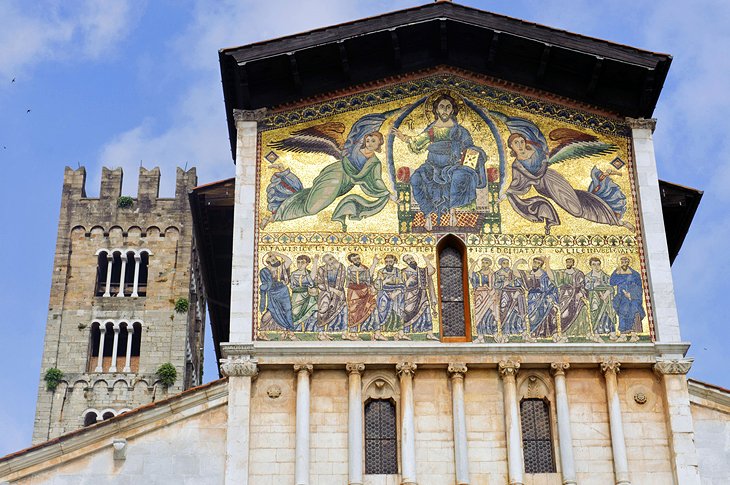
The Church of San Frediano, dedicated to a sixth-century Bishop of Lucca, was built between 1112 and 1147 and originally had the usual orientation, with the chancel at the east end. In the 13th century, however, it was heightened, and the baptistery and the Cappella della Santa Croce to the right and left of the present entrance were incorporated into the church.
A new apse with the altar was built on to the west end, reversing the orientation so the entrance wouldn't face the town walls, which by then had been erected. The lower part of the facade is plain, but above it is a huge mosaic of Christ flanked by two angels with the 12 Apostles below, worked in the Italo-Byzantine style and attributed to Berlinghiero Berlinghieri. This is one of only two churches in all of Tuscany with a façade decorated in mosaics (the other is San Miniato al Monte in Florence).
In the first chapel on the right is a very beautiful mid-12th-century font that was broken up in the 18th century and put together again in 1952. The fourth chapel on the left, the Cappella Trenta (1413), has a richly decorated Gothic marble polyptych with 15th-century bas-reliefs by Iácopo della Quercia, Madonna and Child with Saints.
Address: Piazza San Frediano, Lucca
7. Stroll through Piazza Napoleone
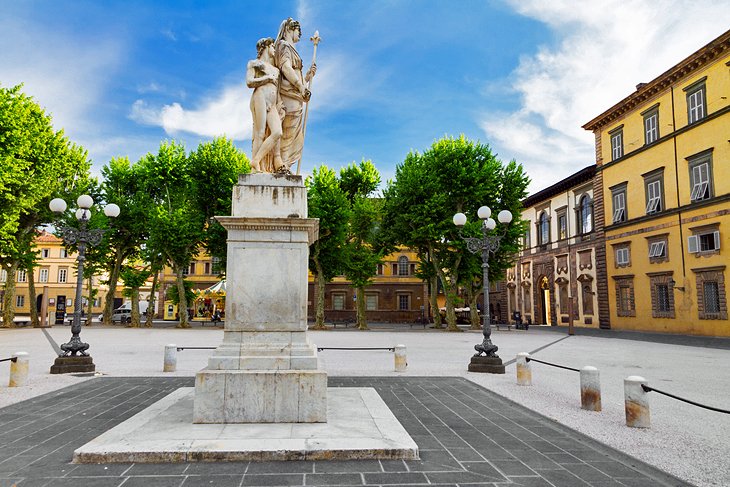
Lucca's main square is bounded on the west side by the handsome facade of the Palazzo della Provincia, built from 1578 onwards on the site of the earlier Palazzo. To the southwest of the Palazzo della Provincia is the Church of San Romano, built by the Dominicans in 1280; the facade is unfinished.
The church contains the Tomb of St. Romanus (1490). Near the northeast corner of the Piazza Napoleone is the little 12th-century church of San Giusto, with a severe facade of sandstone and bands of marble, as well as a richly decorated main doorway. The interior was remodeled in Baroque style in the mid-17th century.
8. Linger in the Garden at Palazzo Pfanner-Controni
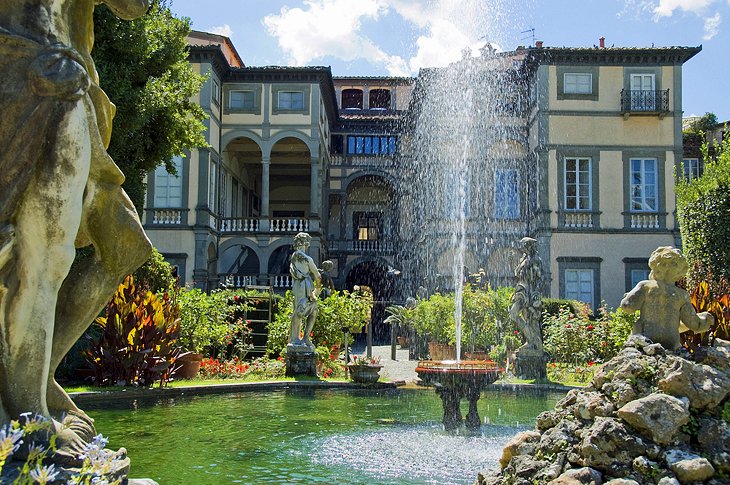
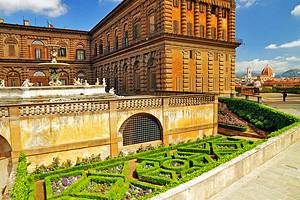
The Palazzo Pfanner-Controni, just inside the walls on the north side of the old town of Lucca, was built in 1667. It is noted for its open two-story loggia with a staircase, a harmonious Renaissance creation. The beautiful Baroque garden, one of the main attractions, was added in the 17th century and is attributed to Filippo Juvarra, the architect responsible for so many works in Turin.
Although not large, the garden manages to include monumental statuary, exotic trees, hedges, a lemon house, a pool, and a fountain in a harmonious arrangement that makes it seem much more spacious. Inside the palazzo are 18th-century frescoes by Pietro Paolo Scorsini, and a collection of medical implements.
Address: Via degli Asili 33, Lucca
Read More: Most Beautiful Gardens in Italy
9. Museo Puccini
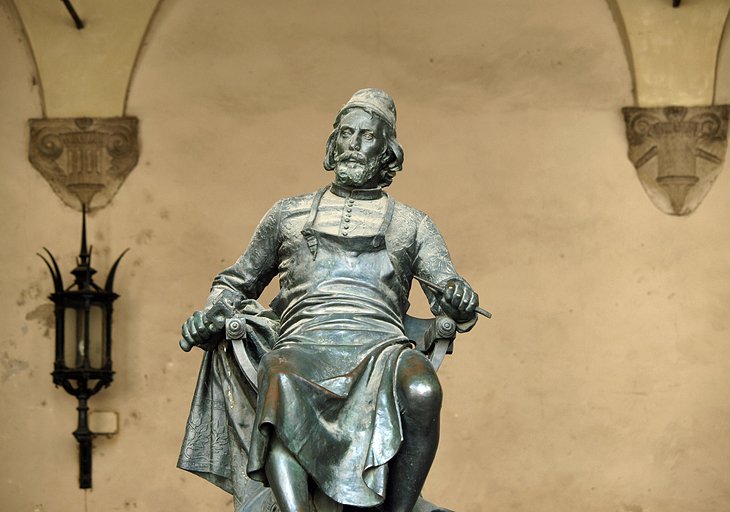
The house in which the famous composer Giacomo Puccini was born on December 22, 1858, is now the small Museo Puccini, filled with personal mementos of his life and work. Posters advertising his operas, musical scores, letters, and furnishings fill the small apartment, and a statue of the composer stands in the piazzetta outside.
Puccini fans should also look for Di Simo Caffè in Via Fillungo, a favorite of artists and musicians, including Puccini; it still looks much as it did when Puccini frequented it, with its original furniture. Puccini is such a local hero that almost any day of the year, you'll find something happening in Lucca that relates to his music.
Address: Corte San Lorenzo 9, Via di Poggio, Lucca
10. Explore the Gardens at Villa Reale di Marlia
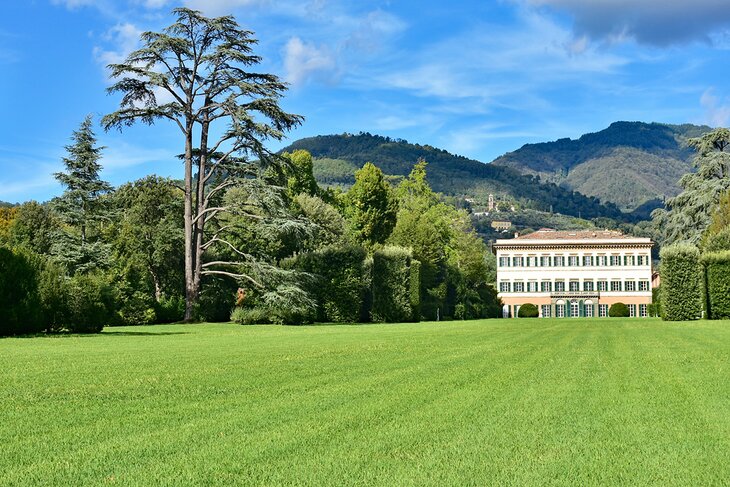
The late-Renaissance Villa Reale di Marlia, about 10 kilometers north of Lucca in Capannori, is surrounded by some of Tuscany's most beautiful and romantic gardens.
Camellia Walkways follow the winding path of a stream, and throughout the vast park, you'll find over 40 varieties of camellia japonica in various colors, at their height of bloom in March and April. Two gardens from the 16th century have been preserved, with features that include patterned parterres, topiary windows, pergolas, and a raised garden on a terrace with lawns surrounding an ancient magnolia tree.
The Spanish Garden, designed in the 1920s, is Art Deco in design, with geometric forms reminiscent of the Moorish gardens of Andalucía. Also added in the 1920s restorations are the swimming pool and Art Nouveau pool house and patio surrounded by hedges of bay. The two-level Lemon Garden contains more than 200 citrus trees in terra-cotta pots.
You can get to Villa Reale di Marlia from Lucca's Piazzale Verdi, on the Line 59 bus; show your bus ticket for discounted admission.
11. Torre delle Ore
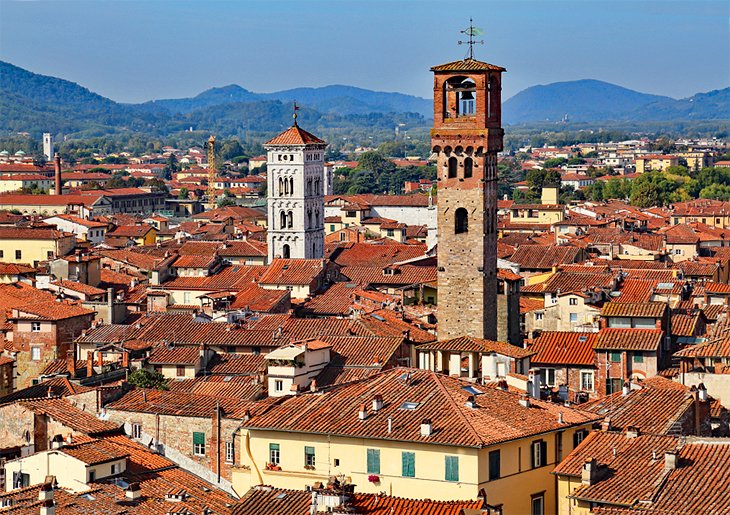
The Torre delle Ore (its full name is Torre dell'Orologio, but nobody calls it that) is a clock-tower, and the tallest of the several towers that mark Lucca's skyline. It has housed a clock since the late 14th century, and you can still see parts of the old mechanism at the top. It was replaced by a more modern clock in the 1700s, and that's the one that chimes the hour today.
You can climb the 200 steps for sweeping views of the city, but time it carefully to avoid being at the top when its bell tolls - the noise is deafening. Save money by getting a combined ticket for this and the Guigini Tower.
12. Ponte della Maddalena
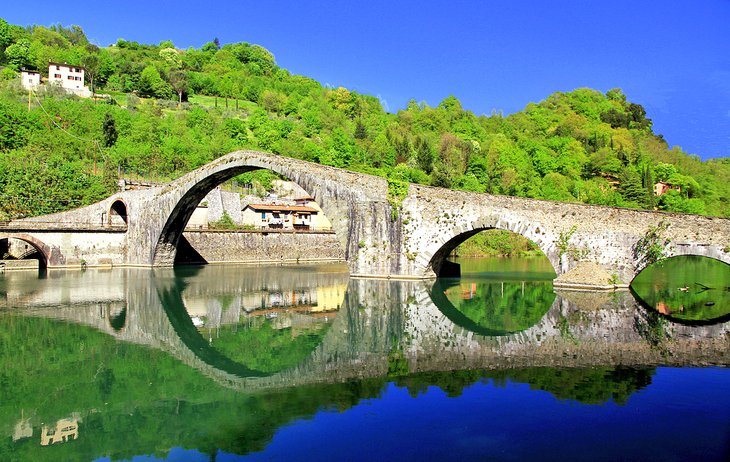
Crossing the Serchio river near the town of Borgo a Mozzano, Ponte della Maddalena is not just a marvel of early medieval engineering and construction, it's so lovely that it has inspired generations of artists. Its appeal is in its unusual and graceful shape, spanning the river in one tall arch and three smaller ones. The largest span is 37.8 meters, and the narrow stone-paved road rises and falls over its slender curving arch.
Thought to have been built in the late 11th century, this was an important crossing on the Via Francigena, an important medieval pilgrimage route bringing pilgrims from France to Rome. It was popularly known as Ponte del Diavolo, Devil's Bridge, and has a legend about a supposed deal between the builder and the devil (a legend common to medieval bridges throughout Europe).
The Ponte della Maddalena must have been even more dramatic a sight before the water level was raised by a dam in the late 1940s, but today its central arch forms an almost perfect circle when reflected in the river's surface.
You can get here from central Lucca by car, bus, or train in less than half an hour. Ponte della Maddalena is on the way to the thermal spa town of Bagni di Lucca, which with a stop at the bridge, makes a pleasant afternoon trip.
13. Museo Nazionale (National Museum)
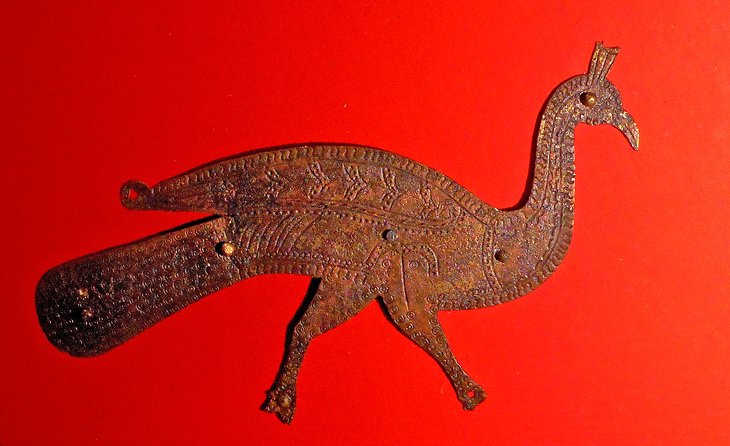
The Villa Guinigi was built for Paolo Guinigi, who ruled Lucca from 1400 to 1430, and now houses the National Museum's rich art collection. The building itself, with a loggia and sets of triple windows framed in arches, is typical of the Tuscan late Gothic style.
The museum has particularly impressive collections of Etruscan and Roman sculpture, much of the former unearthed from a necropolis discovered at San Concordio in 1982. There is sculpture and other art from Lucca's medieval churches, including the 13th-century painted panel of the Crucifixion by Berlinghiero Berlinghieri and works by other Tuscan artists.
Address: Via della Quarquonia, I-55100 Lucca
14. Listen to Music at the Church and Baptistery of San Giovanni and Santa Reparata
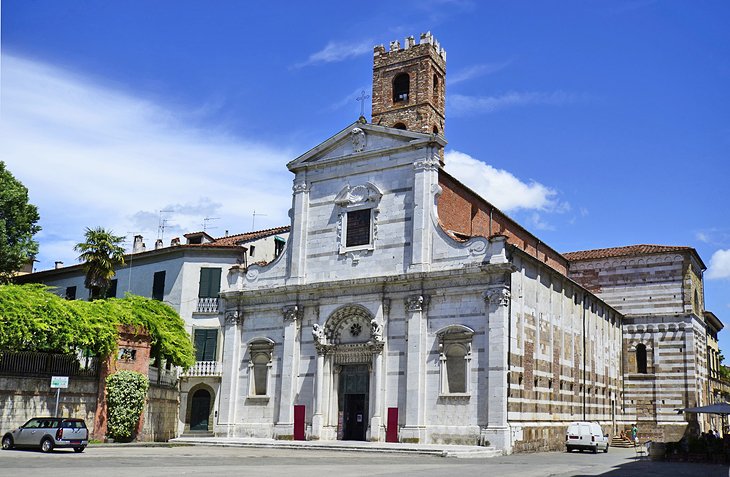
The deconsecrated church and its baptistry originated in the 4th century, when it was the cathedral, but subsequent renovations have made it fairly typical of Tuscan Romanesque style, with some later interior embellishments (including a 16th-century Baroque chapel and coffered ceiling).
The site was a Roman one, and if you look carefully at the capitals of the columns in the nave, you'll see recycled Roman stonework. There is more from the site's Roman and later history in the excavations beneath the church. Descend to find ruins and mosaic floors of a Roman home and first-century thermal baths, Longobard tombs from the 7th century AD, and a baptistery from the Early Middle Ages.
You can also climb the bell tower for views. In the evening, the church rings with Puccini arias, as the home of the year-round series of Puccini and his Lucca programs featuring singers and musicians who perform his work in nightly programs.
Address: Piazza San Giovanni
15. Take a Day Trip to Carrara
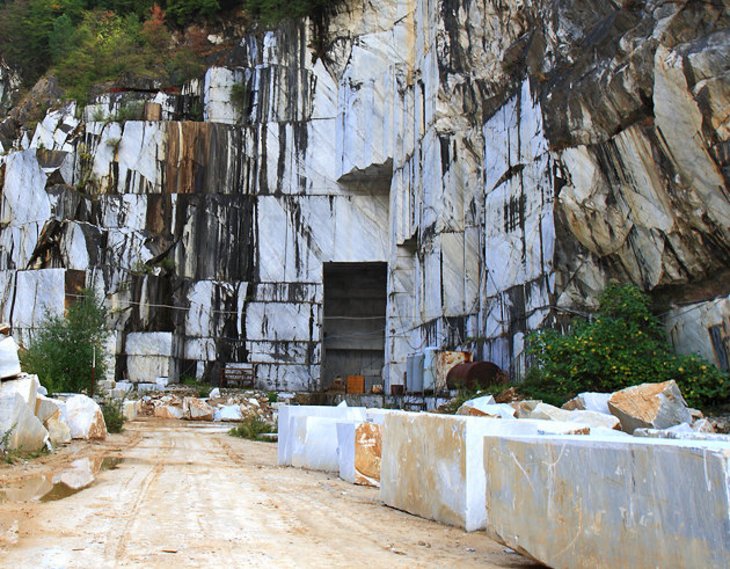
Above the coast north of Lucca, the town of Carrara is best known for its marble quarries, where Michelangelo went to personally choose perfect pieces for his works. The Cathedral of Sant'Andrea, built from the 11th through the 14th century, has a beautiful Romanesque and Gothic façade with a delicate rose window, carved from local marble, and a highly decorated doorway.
The Madonna delle Grazie church also has sumptuous marble decoration. Another worthwhile tourist attraction, the Museo Civico del Marmo (Marble Museum) shows the history of marble, from the time of the Romans to its present-day artistic and technical uses. Here, you can compare different varieties of marble and see why Michelangelo favored Carrara's almost translucent stone for his important works. You can also visit the stonemasons' workshops and quarries themselves, above the town.
Address: Via Fillungo, Lucca
Where to Stay in Lucca for Sightseeing
We recommend these charming hotels in Lucca, steps from the old town and the cathedral:
- On the upper end of Lucca's hotel prices, San Luca Palace Hotel has 26 elegantly furnished double rooms and suites inside the walled old town. Bikes and breakfast are both complimentary.
- Alla Corte Degli Angeli is an affordable boutique hotel, with rooms decorated in hand-painted murals. It's on a quiet street, and the tasty breakfast is included in the moderate rate.
- In the same mid-price range, and with a guest terrace overlooking the town walls, the family-run Albergo Celide sits at the edge of the pedestrian area, a short walk from all the attractions, but easy to access by car. While touring the city, leave your car in the private parking area and use the hotel's complimentary bicycles.
- The budget-priced Il Seminario Bed & Breakfast has family rooms, and all rooms have refrigerators; breakfast is included. The historic building in the center of the old town doesn't have an elevator.
- The even more budget-friendly Bed & Breakfast Anfiteatro is adjacent to the famous Piazza Anfiteatro, whose walls - formed by the ancient arena - are clearly visible from the guest sitting room. Rooms, many with exposed beam ceilings, are nicely decorated, and the breakfast is bountiful.
Tips and Tours: How to Make the Most of Your Visit to Lucca
- Walking Tour: A great introduction for your first visit is on a Walking Tour and Exploration of Lucca. The two-hour stroll through the streets and squares explores the city's Roman origins, medieval churches and towers, and its later Renaissance walls.
- Visiting Lucca from Florence: Get a good overview of this charming city and see its highlights, combining it with another of Tuscany's most popular destinations on a Pisa and Lucca Day Trip from Florence. The tour spends the afternoon in Lucca, where a walking tour visits the Cathedral, Guinigi Tower, and Piazza dell 'Anfiteatro.
More Related Articles on PlanetWare.com
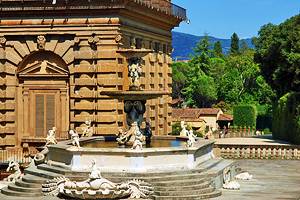
Places to Visit near Lucca: Lucca lies between Florence and Pisa, where you'll find many of the top-rated tourist attractions in Tuscany. In Florence, you can explore the best places to visit with the help of our articles on the Cathedral of Santa Maria del Fiore and the city's magnificent Renaissance palaces.
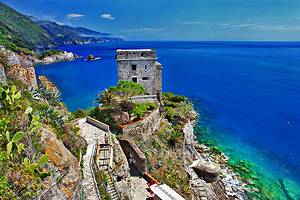
Exploring Tuscany and Liguria: South of Florence is Siena, where you can see beautiful works of art in the Cathedral of Santa Maria Assunta. San Gimignano is one of several small medieval hilltop towns in Tuscany, or you can follow the Mediterranean coast north into Liguria to visit the five towns of the Cinque Terre, one of the top things to do in Italy.