13 Top-Rated Attractions & Places to Visit in Bologna
Bologna, for all its size and importance as the capital of its province and of Emilia-Romagna, is an easy city to visit, and many visitors find it one of Italy's most appealing. Those who enjoy good food certainly do; it has the reputation as Italy's gastronomic capital.
Among Bologna's main industries are the manufacture of pasta and sausages, so be sure to try some while you're here. Along with visiting Bologna's tourist attractions, spend time absorbing the city's unique character: stroll beneath its long arcades - the famed portici, peek inside its elegant old shops, notice its architectural quirks and interesting brickwork, pause in one of the numerous cafés, and soak up some of the exuberance of its many students.
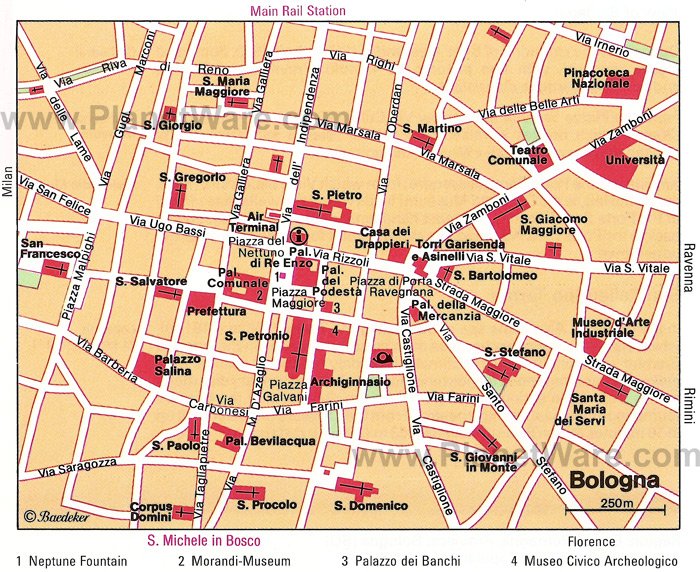
Most of its popular places to visit are within walking distance of Piazza Maggiore, and the arcaded streets make walking in Bologna pleasant in all kinds of weather. Find the best things to do in the city with our list of the top things to do in Bologna.
See also: Where to Stay in Bologna
- 1. Piazza Maggiore and Piazza del Nettuno
- 2. San Petronio (Basilica of St. Petronius)
- 3. Santo Stefano (St. Stephen Basilica)
- 4. Leaning Towers
- 5. Sanctuary and Portico of the Madonna di San Luca
- 6. Enjoy Bolognese Food
- 7. Archiginnasio Anatomical Theater
- 8. Bologna's Portici
- 9. San Domenico (St. Dominic Church)
- 10. Museo Civico Archeologico (Archeological Museum)
- 11. Oratory of Battuti
- 12. Basilica di San Pietro
- 13. Pinacoteca Nazionale (National Gallery)
- Where to Stay in Bologna for Sightseeing
- Driving in Bologna
- Map of Attractions & Things to Do in Bologna
- Bologna, Italy - Climate Chart
1. Piazza Maggiore and Piazza del Nettuno
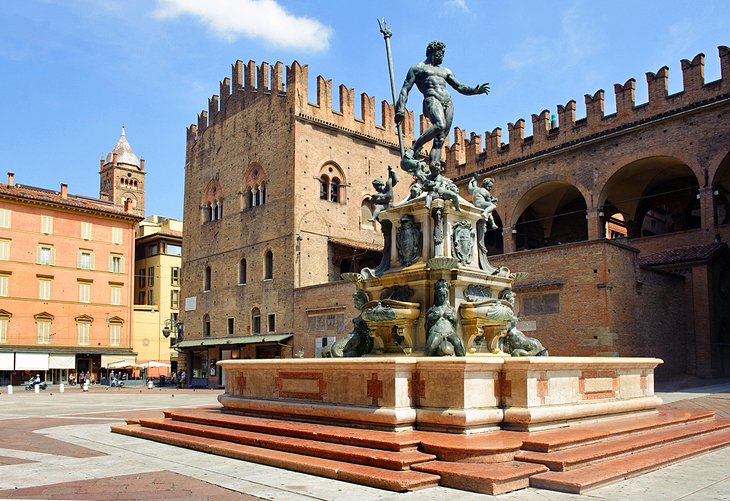
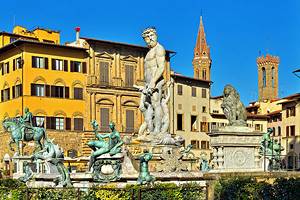
It may seem as though everyone in Bologna were meeting friends at the same time in these two adjoining squares in the heart of the city. Conversation and laughter blend with the sound of water splashing in the magnificent Neptune Fountain, which gives Piazza del Nettuno its name.
Created by Giambologna in the 16th century, it is one of the finest fountains of its period. Nearly every major attraction in the city is within a few minutes' walk, as are the most important streets - among them the busy shopping street, Via dell'Indipendenza, and Via Galleria with its many old aristocratic mansions.
Elegantly arcaded Via dell'Archiginnasio runs alongside the great Basilica of San Petronius; its still unfinished facade dominates one side of Piazza Maggiore. On the north side is the former Palazzo del Podestà (Governors Palace) with a tower, Torre dell'Arengo, dating from 1259. Under its vaulted dome, people whispering on one side can be heard by those on the opposite corner.
2. San Petronio (Basilica of St. Petronius)
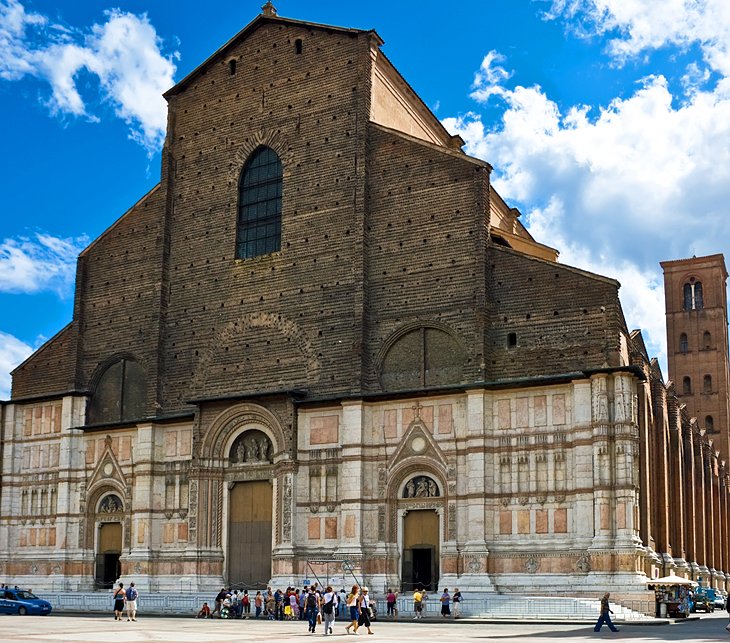
When construction of the massive church that dominates one side of Piazza Maggiore began in 1390, it was designed to be even bigger than St. Peter's in Rome, but never quite made it. In fact, it was never finished, and the facade remains incomplete. In the tiny museum at the back of the church, you can see the designs that were submitted for the facade, including those by the great architect Andrea Palladio.
The interior, which was finished, is often referred to as the epitome of Gothic architecture in Italy, and each of the side chapels seems like a small church. Look for the strange line cutting across the floor of the nave; it is a meridian line.
Address: Piazza Maggiore, Bologna
3. Santo Stefano (St. Stephen Basilica)
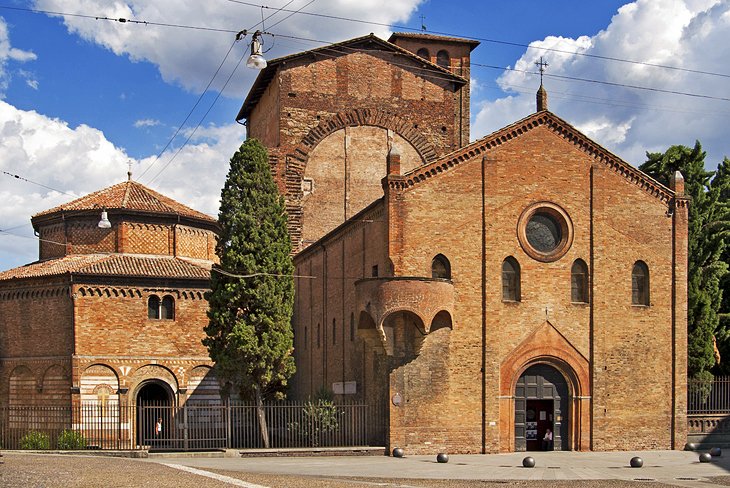
While Bologna has no shortage of interesting and art-filled churches, Santo Stefano is the oldest and the most atmospheric. The complex of eight buildings could be called the cradle of faith in Bologna, built by the Benedictines between the 10th and 13th centuries to house the remains of Bologna's early martyrs, Saints Vitale and Agricola.
Chiesa del Crocifisso, the principal church, has a 12th-century external pulpit and a crypt dating to 1019; octagonal Santo Sepolcro opens onto a pillared courtyard adjoining a two-story cloister. In the simple third church, look for the capitals of various styles recycled from previous Roman and Byzantine buildings and for the 6th-century mosaic floors.
Address: Via Santo Stefano 24, Bologna
4. Leaning Towers
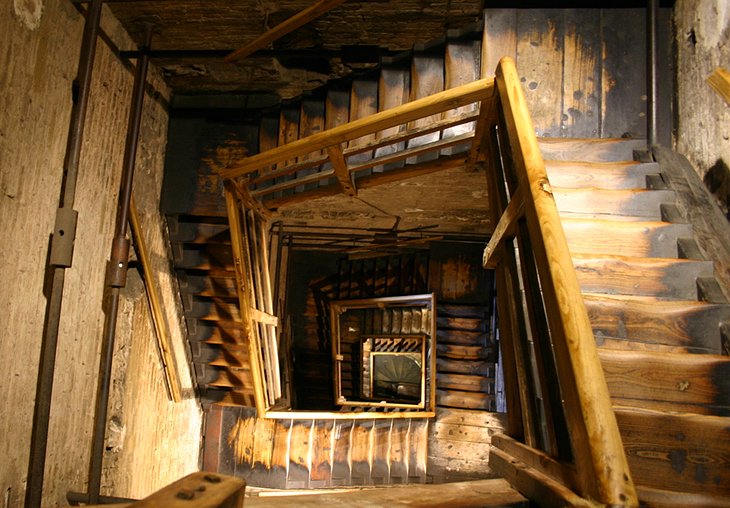
Pisa's may be more famous, but Bologna has a pair of towers that appear to tilt even more alarmingly because of their narrow shape. They are the best-known of the 20 towers that remain of the more than 100 that formed Bologna's 12th-century skyline.
Although they were necessary as both watchtowers and places of refuge in case of attack, their height also became status symbols for the noble families that built them. The 48-meter Torre Garisenda leans by more than 13 meters; you can climb the 498 steps inside Torre degli Asinelli for bird's-eye views of Bologna.
Address: Piazza di Porta Ravegnana, Bologna
5. Sanctuary and Portico of the Madonna di San Luca
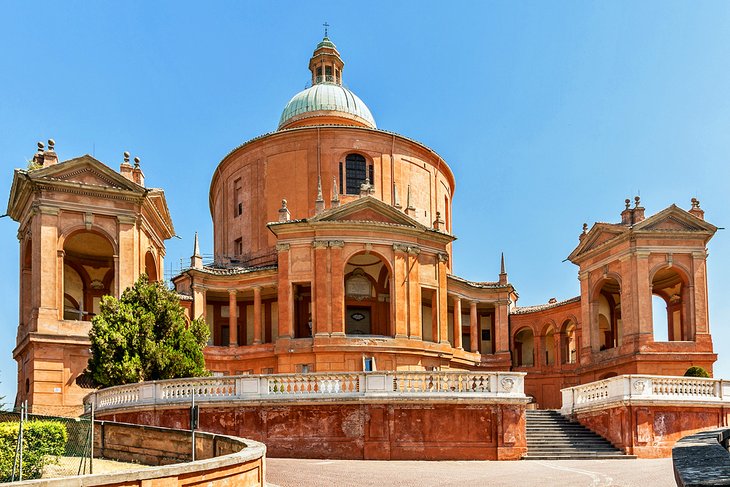
The basilica stands atop a hill that commands views across the city and the Po Valley landscape, its classical interior highlighted by the striking floor of inlaid black, white, and red marble floor. The chancel is lined in equally striking variegated black and white marble.
But what distinguishes this basilica from all the others in Italy is the 3.8-kilometer covered arcade that connects the sanctuary to the city. This monumental structure is the longest portico in the world, with 666 arches, and was built between 1674 and 1793 to protect the Byzantine Madonna with Child icon in its annual procession into Bologna. The icon, said to have been painted by Saint Luke, has traveled this route to Bologna's Cathedral of San Pietro since 1433, when it was brought from a hilltop convent in the hope of a miracle to stop harvest-threatening rains.
This scenic walk, beginning at Piazza di Porta Saragozza, is a favorite - and free - thing to do in Bologna on Sundays, or you can take the San Luca Express, a tourist "train" from Piazza Maggiore. For even wider views, the San Luca Sky Experience is a panoramic terrace reached by climbing into the basilica's cupola.
Address: Via di San Luca 36, Bologna, Italy
6. Enjoy Bolognese Food
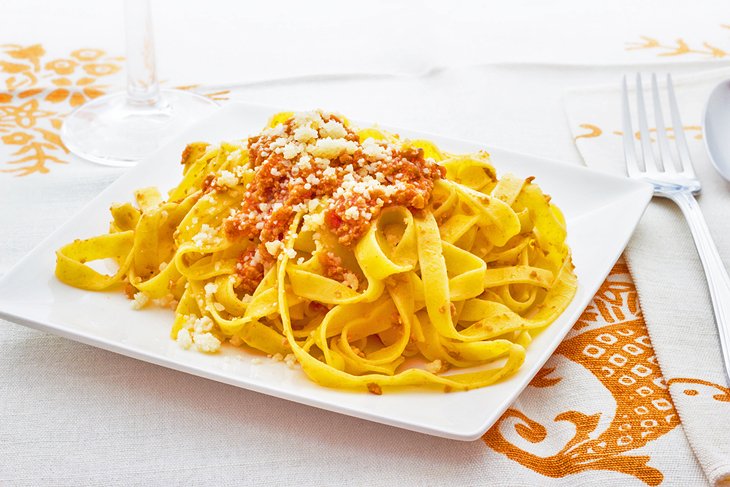
Perhaps Bologna's greatest appeal to tourists, and the source of its fame throughout Italy, is its reputation as a culinary center. It's known for tortellini, tagliatelle, and other pastas, and its classic dish, tagliatelle al ragu, is known elsewhere simply as tagliatelle Bolognese. Cured meats are a local specialty, and this region is the home of the incomparable Parmigiano Reggiano cheese.
You can experience and savor Bologna's culinary heritage. A good place to begin is in its markets and food shops. The narrow streets of the Quadrilatero, an area between Piazza Maggiore, via Rizzoli, via Castiglione, and via Farini, has been a market since Roman times, filled with little shops and outdoor stands selling all kinds of food, from garden produce, cheese, and fish to freshly made pastas and baked goods.
Opportunities to learn from Bolognese chefs and home cooks abound, from group classes to individual lessons on forming perfect tortellini. Another thing to do is join a specialized tour led by a local foodie. These will likely include visits to food markets and a number of traditional food shops, including a bakery, chocolatier, salumeria (deli), pasta maker, and gelato shop where you can sample some of Bologna's specialties.
7. Archiginnasio Anatomical Theater
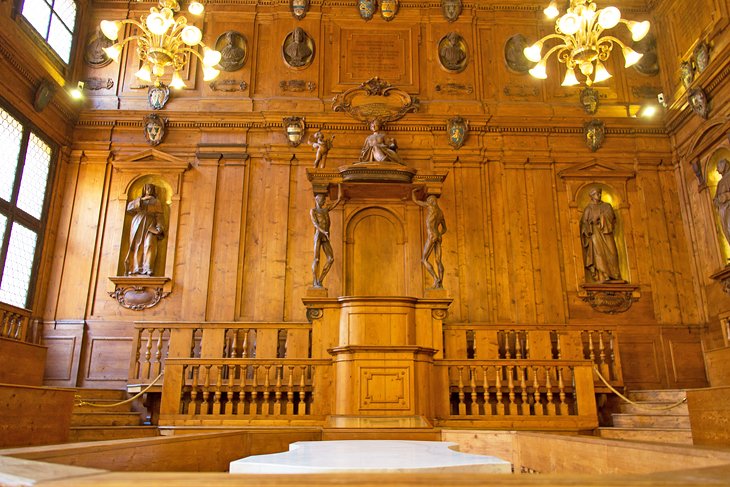
Once the main building of the University of Bologna, the Archiginnasio is now home to one of the most unusual places in Bologna, the classroom where medical students learned anatomy by watching as corpses were dissected. It's not this bizarre aspect that fascinates today so much as the exceptional interior and its unusual wood carving.
The highlight is Ercole Lelli's Spellati (Skinless), a life-sized wood sculpture of a man with the musculature and skeletal structure rendered in minute detail. Also in this building is the Stabat Mater lecture hall, its walls decorated with coats of arms. The University of Bologna, founded in the 11th century, is the oldest university of the Western world.
Address: Piazza Galvani 1, Bologna
Official site: http://www.archiginnasio.it/english_index.html
8. Bologna's Portici
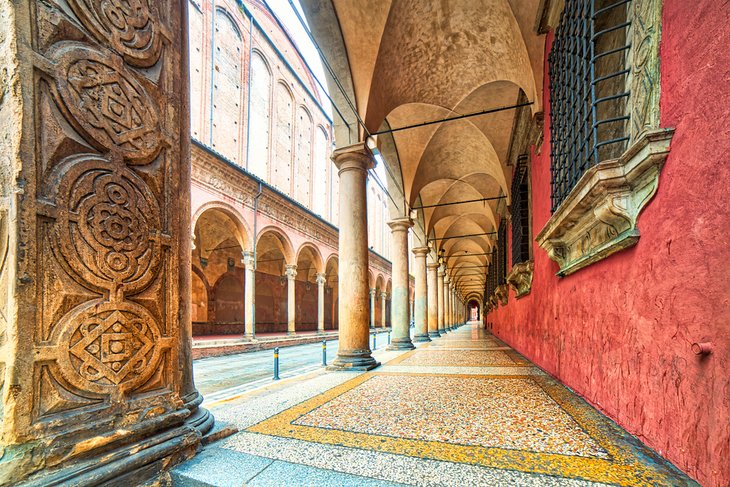
Visitors to Bologna can't help strolling under the portici, the arcades that line so many of its streets. They are a welcome relief from the summer sun and shelter from the rain, as well as providing extra space to shops, which often display goods under them.
They began in the 11th century as overhanging upper stories of buildings in the growing city center, adding more living and storage space over the shops and businesses on the street level. As they became larger, they needed support beams and posts, and gradually the arcades grew. In the 13th century, new arcades were required to be tall enough for a rider to pass through on horseback, a rule that led to the elegant arched arcades we see today.
These portici are one-of-a-kind, constructed at different times and in different styles, often embellished with stone carving or other decoration. In all, Bologna has about 40 kilometers of these portici, the longest of which is 3.8 kilometers and leads from the city to the hilltop Sanctuary of the Madonna di San Luca. Bologna's portici are a candidate for 2021 UNESCO World Heritage Site designation.
9. San Domenico (St. Dominic Church)
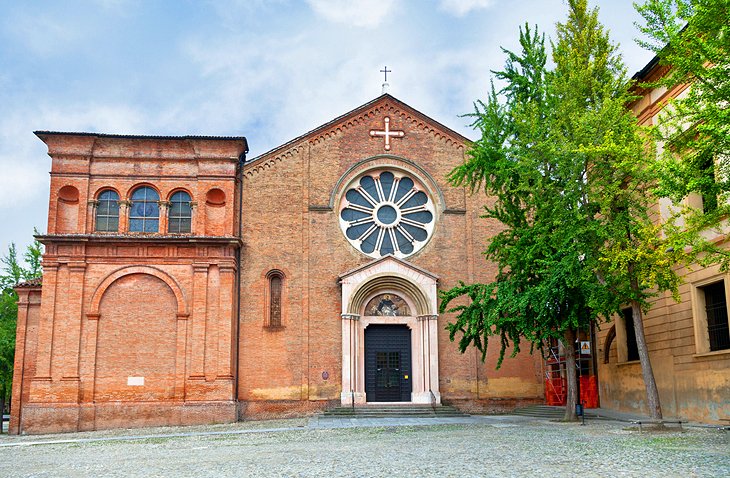
At the death in 1221 of Saint Dominic, in this convent of the order he founded, work began on the church that took several centuries to complete. The marble tomb that enshrines his remains is reason enough to visit, carved in minute details by the greatest artists of the day, including Michelangelo and Nicola Pisano. The church's art treasures don't end here.
The outstanding wood inlay by intarsia master fra' Damiano da Bergamo in the choir was hailed by Renaissance contemporaries as the eighth wonder of the world. Each first and second Saturday of the month, at 10.30am and 3.30pm, free guided tours are offered to the chapels, choir, Inquisition rooms, St. Dominic's cell, and other places not usually open to the public.
Address: Piazza di San Domenico 13, Bologna
10. Museo Civico Archeologico (Archeological Museum)
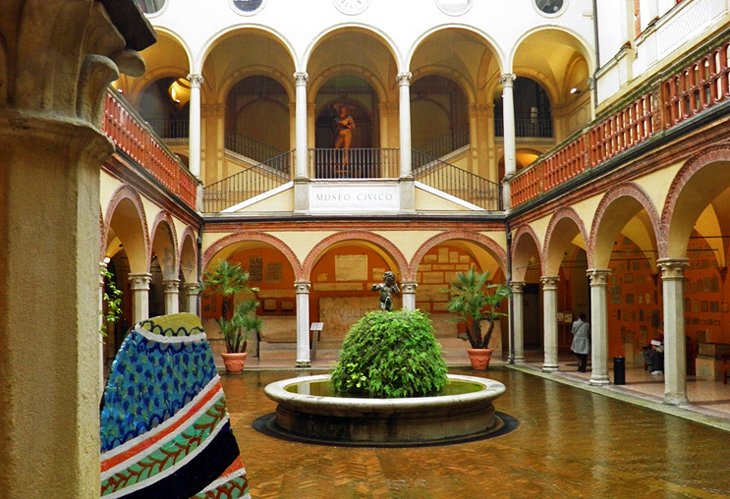
Even those who normally tune out at museums of antiquities will enjoy this remarkably up-to-date display of prehistoric and Etruscan finds from the surrounding area, as well as outstanding treasures from the Celtic, Greek, Egyptian, and Roman civilizations. There are only two other museums in Italy that can match its Egyptian collection.
The 15th-century Palazzo Galvani, close to Piazza Maggiore, has been skillfully repurposed to house the collections; no dry jumble of dusty relics here, but a modern museum of brilliantly displayed artifacts.
Address: Via dell'Archiginnasio 2, Bologna
11. Oratory of Battuti
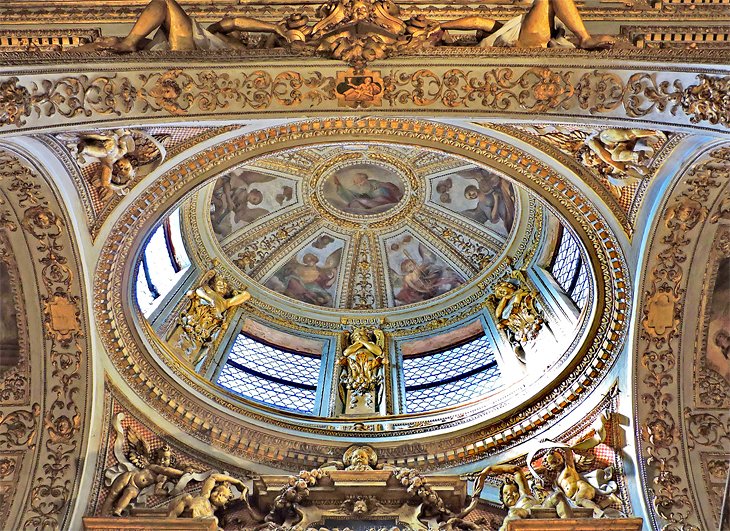
Climb the stairs to the room above the church to find one of Bologna's unsung treasures, a small oratorio decorated in Baroque paintings, frescoes, and gilded carvings. Avoid a stiff neck by taking advantage of one of the benches to stretch out and look up at the perfectly splendid ceiling.
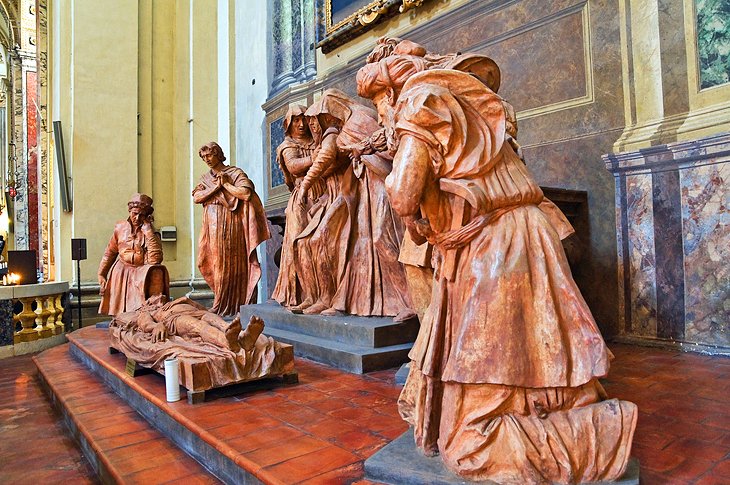
Around the room stand a group of 15 terracotta statues, Death of the Virgin, created by Alfonso Lombardi in the early 16th century. Watch for announcements of musical programs, which are held here because of the room's excellent acoustics.
Address: Via Clavature 8, Bologna
12. Basilica di San Pietro
The cathedral of San Pietro has undergone many changes since its founding in 910, including the addition of a choir by Pellegrino Tibaldi in 1575 and a nave, remodeled in the grandeur of the 17th-century Baroque style.
A door at the end of the side aisle on the left leads to a collection of artistic treasures donated over the centuries to use in religious celebrations. These include items belonging to several popes and a splendid processional cross given as recently as 1996.
Address: Via Indipendenza, Bologna
13. Pinacoteca Nazionale (National Gallery)
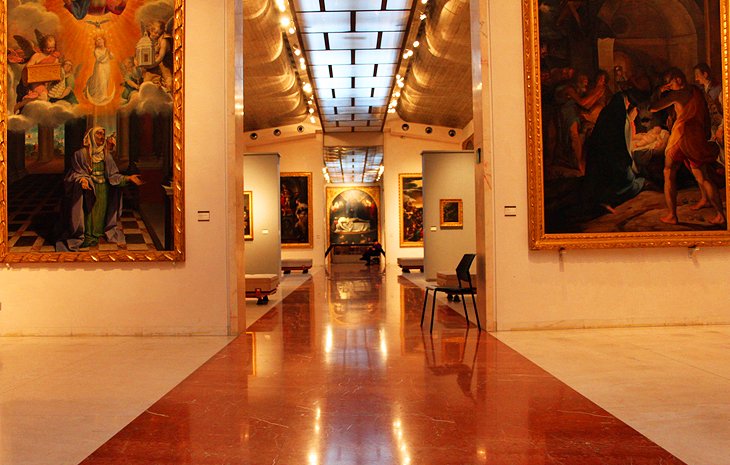
The Pinacoteca has a unique mission: to preserve and display works by artists who have lived and worked in Bologna and the Emilia-Romagna region, especially from the 13th to the early 19th centuries.
Some of the works have histories of their own, many have been rescued from churches that were closed or turned to other uses, and others have been returned to Bologna after Napoleon I carried them off to the Louvre in Paris. The museum collections include works by Raphael, Perugino, Tintoretto, and other Renaissance artists.
Address: Strada Maggiore 44, Bologna
Where to Stay in Bologna for Sightseeing
Piazza Maggiore and Piazza del Nettuno, the Basilica, the excellent Archaeological Museum, and the pair of leaning towers that lead Bologna's list of tourist attractions are all clustered within a very short distance. Two major churches, Santo Stefano and San Domenico, are only a few blocks away, making Bologna easy to visit from any central lodging. Here are some highly rated hotels in Bologna:
Luxury Hotels:
- The gleaming Grand Hotel Majestic Gia Baglioni, adjacent to the Basilica and Piazza Maggiore, has generous, well-decorated rooms in a beautifully restored historic building.
- In the middle of the old town, just under famous medieval towers, the boutique Hotel Corona d'Oro 1890 has rooms with parquet floors, marble baths, and balconies - some with tower views.
- Just off Piazza Nettuno and handy to shopping and restaurants, Art Hotel Orologio has traditional rooms in a converted historic mansion.
Mid-Range Hotels:
- Cleverly themed rooms at Al Cappello Rosso, just off Piazza Maggiore, are all different and stocked with luxuries that include slippers, robes, and a selection of different pillows.
- With bright, attractive rooms dressed in sleek, modern decor, Metropolitan Hotel is less than a five-minute walk from Piazza Maggiore, surrounded by restaurants and shops.
- Close to the train station and within easy reach of the central attractions, NH Bologna De La Gare offers 156 soundproof rooms, including nine spacious suites on the top floor with beautiful views of the city.
Budget Hotels:
- Filling the fourth floor of a classic building just off Piazza Maggiore, Panorama Hotel has large rooms with well-maintained shared baths.
- Only a short walk from the Piazza Nettuna, Albergo Centrale Bologna is a 3-star hotel with compact but comfortable rooms in the center of the city. Breakfast is included, and the hotel is surrounded by restaurants.
- The recently restored Il Canale Hotel overlooks the river and has a rooftop terrace with views over the city. An easy walk from Piazza Maggiore, the hotel has family-sized rooms.
Driving in Bologna
Like most cities in Italy, the historic center is closed to automobiles. If your hotel is within this area - called the ZTL zone - be sure to ask them where to park before your arrival. The usual procedure is that they will put your license number on the ZTL whitelist for the period of your stay, which allows you to drive to and from the hotel.
Map of Attractions & Things to Do in Bologna
Bologna, Italy - Climate Chart
| Average minimum and maximum temperatures for Bologna, Italy in °C | |||||||||||
| J | F | M | A | M | J | J | A | S | O | N | D |
| 5 -2 | 8 1 | 13 4 | 18 8 | 23 12 | 27 16 | 30 18 | 29 18 | 25 15 | 19 10 | 11 4 | 6 0 |
| PlanetWare.com | |||||||||||
| Average monthly precipitation totals for Bologna, Italy in mm. | |||||||||||
| 43 | 46 | 61 | 66 | 66 | 53 | 43 | 58 | 61 | 71 | 81 | 61 |
| Average minimum and maximum temperatures for Bologna, Italy in °F | |||||||||||
| J | F | M | A | M | J | J | A | S | O | N | D |
| 40 29 | 46 33 | 56 39 | 64 45 | 72 53 | 80 60 | 85 64 | 84 64 | 77 58 | 66 50 | 52 39 | 42 31 |
| PlanetWare.com | |||||||||||
| Average monthly precipitation totals for Bologna, Italy in inches. | |||||||||||
| 1.7 | 1.8 | 2.4 | 2.6 | 2.6 | 2.1 | 1.7 | 2.3 | 2.4 | 2.8 | 3.2 | 2.4 |
More Related Articles on PlanetWare.com
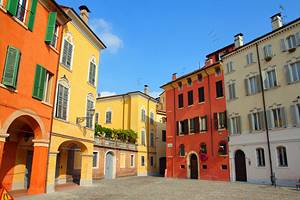
Nearby Food Capitals: After sampling the local delicacies of Bologna, you may want to explore the Reggio-Emilia region's other food capitals. You can visit the home of the world-famous Parmigiano Reggiano cheese, and see the top attractions of Parma and its surrounding towns. On the way (a major highway connects Bologna and Parma) stop in Modena, home of the best balsamic vinegar.
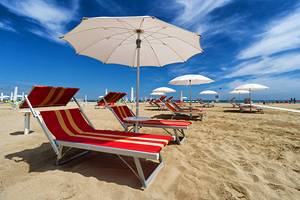
Exploring the Adriatic Coast: When you are in Bologna, you are within easy reach of a city whose art treasures are unique in Italy. Ravenna is filled with magnificent Byzantine mosaics, most of them in eight buildings that have been declared a UNESCO World Heritage Site. Not far south on the Adriatic coast are Rimini's well-preserved Roman sites and beaches. For more general ideas to help plan your trip, see our article on the best places to visit in Italy.