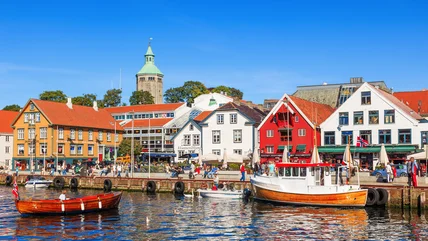
The port of Santander in Old Castile, chief town of its province and the see of a bishop, lies in a beautiful bay on the north coast of Spain, ringed by hills and within easy reach of the highest peaks in the Cantabrian Mountains, the Picos de Europa. Santander was a considerable port in Roman times, and is still one of the leading ports of northern Spain, handling a large export and import trade. In the Middle Ages it shipped the agricultural produce of Castile, and from the 16th to the 19th century it was involved in the American trade, particularly in the export of flour.
Nowadays its economic importance depends on the export of ore and coal and on the industry which has been attracted by the port. Its beautiful beach and mild climate also make Santander a popular holiday place - a tradition which began in the 19th century when it became a fashionable bathing resort and a summer residence of the Spanish royal family; and with the summer courses run by its University and its International Festival of music and drama Santander is also one of Spain's cultural metropolises.
The Town
After a great fire which destroyed forty streets in the city center on the night of February 15th-16th 1941 the area was rebuilt with wide streets and buildings restricted to a height of five stories. The central feature of Santander is now the broad Avenida de Alfonso XIII, which runs inland from the harbor, crosses the town's main traffic artery, the Avenida de Calvo Sotelo/Paseo de Pereda, and ends in Plaza Porticada.
The same building that houses the Municipal Museum of Art also contains the Menéndez y Pelayo Library, the library of 40,000 volumes assembled by the scholar of that name, with his study preserved in its original condition. On the far side of the garden is the house in which Menéndez y Pelayo worked and died, now a museum.
A little way north of the Puerto Chico the Regional Museum of Prehistory and Archeology has a large collection of finds from prehistoric caves, including the so-called ''bâtons de commandement'' made from stags' antlers, the function of which is not known. The collection includes Roman antiquities and some very interesting funerary stelae erected by the pre-Roman Celtic population of the area.
Address: Santander Regional Museum of Prehistory and Archeology, Calle Casimiro Sainz 4, E-39003 Santander, Spain
Hours:
June 16 to September 14: 10am-1pm, 4pm-7pm; Sun:10am-2pm, 4pm-7pm; Closed: Mon
September 15 to June 15: 9am-1pm, 4pm-7pm; Sun:11am-2pm, 4pm-7pm; Closed: Mon, Mon
Just to the west of the Avenida de Alfonso XIII, on the eastern edge of the old town, stands the Cathedral, originally Gothic (13th century), which was restored after the fire. In its large crypt, the Iglesia del Cristo (c. 1200), are the remains of two martyred saints, Celedonius and Emeterius. In the cloister (rebuilt) is the tomb of the Santander-born writer and scholar Marcelino Menéndez y Pelayo (1856-1912).
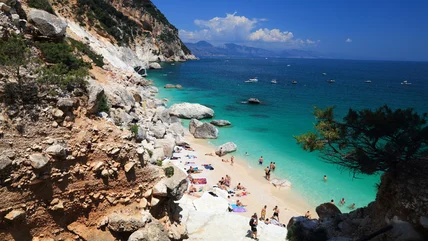
On the north side of the peninsula is the beautiful beach of El Sardinero, which still preserves something of the atmosphere of the Belle Epoque with its seafront terraces, and its numerous hotels and restaurants.
To the east and southwest of the Avenida de Alfonso XIII, extending along the Muelle de Maliaño and beyond this to the southwest, is the harbor, with the Custom House and the Marine Station (Estación Marítima). A specially cut channel allows large vessels to enter the industrial harbor of El Astillero, in the south of the bay.
This cultural event, a tradition which began in 1948, features music, dance and theater. It was originally designed as a cultural welcoming for students attending Menéndez Pelayo International University.
Address: Festival Internacional de Santander, Gamazo, E-39004 Santander, Spain
Calle Castelar and the Avenida de la Reina Victoria (fine views) continue east from the Paseo de Pereda to the peninsula of La Magdalena, on which is the summer palace of Alfonso XIII (1912), now occupied by Santander's International University.
From the Avenida de Alfonso XIII, going west along the Avenida de Calvo Sotelo and turning right into Calle Cervantes and then left into Calle Rubio, we come to the Municipal Museum of Art, which contains a portrait of Ferdinand VII and several etchings by Goya, as well as a rich collection of works by regional artists and Italian, Flemish and Spanish painters of the 17th and 18th centuries.
Address: Santander Municipal Museum of Art, Calle Rubio 6, E-39007 Santander, Spain
Hours:
June 16 to September 14: 10:30am-1pm, 4pm-7pm; Closed: Sun
September 15 to June 15: 10am-1pm, 5pm-8pm; Closed: Sun, Sun
From the Avenida de Alfonso XIII the Paseo de Pereda runs east, flanked by beautiful gardens, to the Puerto Chico (Little Harbor). At its east end is the Museo Marítimo del Cantábrico, an interesting museum and aquarium, with preserved specimens of marine fauna, objects and documents illustrating the life of fishermen and ship models.
Address: Santander Museo Marítimo del Cantábrico, Calle San Martín de Abajo, E-39004 Santander, Spain
Comillas is an old bathing resort, popular even in the time of Alfonso XII. The town centers around the Plaza Mayor and has several attractions of note, including a pavilion by Antonio Gaudí.
Location: Province of Cantabria; in the Pico del Castillo, southwest of Santander. Features: A maze of passages, with well preserved monochrome Palaeolithic paintings.
Location: Province of Cantabria; in the Pico del Castillo, near Puerto Viesgo, 22km/ 14mi southwest of Santander. Features: Several galleries (total length 300m/330yd); paleontological finds (in Prehistoric Museum, Santander); 750 figures of animals.
La Finca Puente San Miguel is on a miniature scale with Spanish and Islamic styles of gardening. The garden is surrounded by a large and romantic 18th century landscape park in which branches of unpruned trees sweep down to the ground. The collection included one of the largest Magnolia grandiflora in Europe which is over 200 years old that covers 700 sq. m, an exceptionally fine coastal redwood and many other good specimens.
Tips: It opens every first and third Wednesday from May to mid September.
Beyond Limpias is Laredo, beautifully situated in Santoña Bay, which has become one of the leading resorts on the Cantabrian coast, with a continually expanding modern district adjoining the crowded old town. The 13th century church of Nuestra Señora de la Asunción, with a 16th century doorway, contains some fine sculpture and pictures.
Address: Laredo Tourist Office, Alameda de Miramar, E-39770 Laredo, Spain
On June 24, every year, Laredo celebrates the Noche de San Juan, when the young men of the town dress in women's clothes and wash their feet in the sea.
N 634 continues through the fertile delta of the Río Asón to Colindres, where a road branches off on the right up the Asón valley to the pilgrimage center of Limpias (7km/4.5mi). In the parish church is the much venerated 17th Century image of Santo Cristo de la Agonía, which is said to have shed tears of blood in 1919.
Beyond Laredo the road begins to climb, with beautiful rearward views of the town and the wide sweep of Santoña Bay. Thereafter it follows a winding course to the Punta de Sonabia, after which there is a magnificent stretch along the rocky coast to Castro Urdiales. From there N 634 continues to Bilbao.
C 6316 finally joins N 634, which continues along the coast to La Revilla and San Vicente de la Barquera, an old-world little port town with a large beach which makes it also a popular holiday resort. It lies at the mouth of the Río Escudo, which is crossed on a long bridge. It preserves part of an old battlemented wall, a ruined castle and the fortress-like church of Santa María de los Angeles (13th-16th century), with a Romanesque doorway and Gothic monuments.
Address: San Vicente de la Barquera Tourist Office, Avenida del Generalísimo 20, E-39540 San Vicente de la Barquera, Spain
N 634 runs south from Santander and then round the Bahía de Santander in a wide curve to Solares, a little spa, beautifully situated on the Río Miera, which is also noted for its table water.