

11 Of Barcelona, Spain's Top-Tier Tourist Destinations You Can't Miss
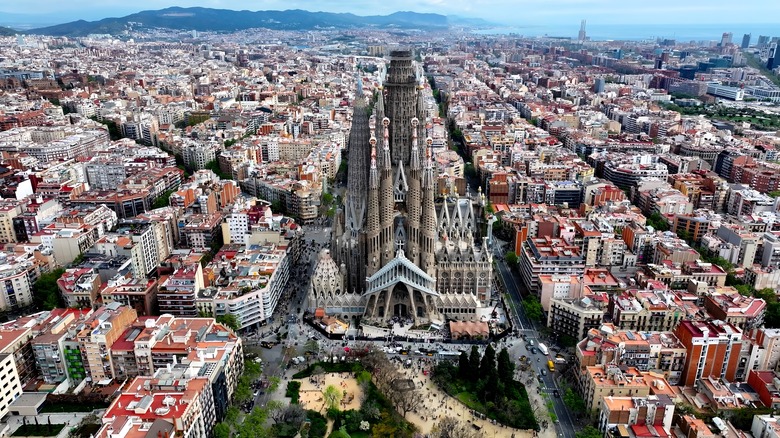
Arriving in Barcelona with my grandmother's hand-me-down backpack strapped to my back, it was immediately clear it's a backpacker's delight — minus the hills. Storied architecture that double as works of art sit on every corner, interrupted only by tapas bars serving everything from patatas bravas to garlic shrimp. Better yet, it was all centered with the view of the commanding Sagrada Família, which appeared to tower over everything else in the bustling city that burst into even more life after nightfall. But I quickly found that with so much to see, it was also overwhelming to decide what to add to my itinerary.
As such, this list of the top 11 tourist destinations in Barcelona covers historic landmarks, cultural hotspots, and even hidden gems. Ranging from the iconic Sagrada Familia, which has been a work in progress for a century, to a party-loving beach, this guide will be especially helpful if you're planning just a 3-day getaway to Barcelona. In order to land on our top picks, we evaluated the city's most and best-reviewed sites on TripAdvisor, focusing on which attractions have the highest ratings, and which experiences can satisfy travelers of all interests.
Barceloneta Beach
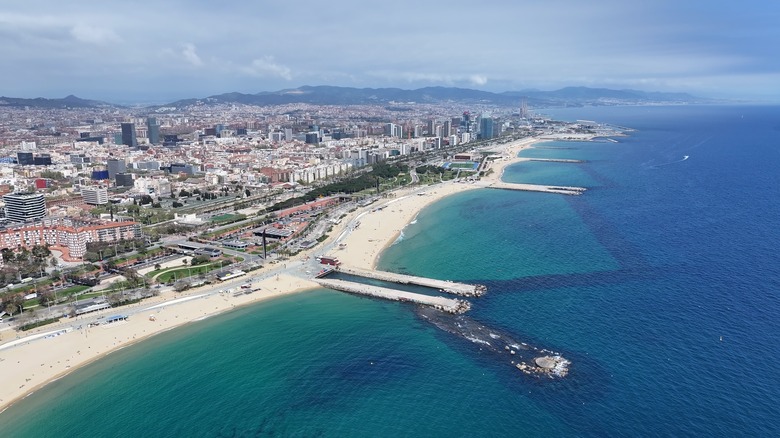
If you want to soak in Barcelona's party atmosphere seaside — as well as bask in the city's oldest and most beloved beach by tourists and locals alike — then Barceloneta Beach, in the Barceloneta neighborhood, is where it's at. There's nothing like building a beach vacation into your trip to Barcelona, and, at Barceloneta Beach, crowds are aplenty at nearly all hours — even after the sun goes down. Vendors walk the sand selling cold drinks and mojitos made towel-side, and there's also pretty much every amenity you can think of. From showers to changing rooms, beach volleyball, lifeguards, accessible bathrooms and parking spots, and even wi-fi, you won't have a hard time getting comfortable. Plus, there's also a nude section for visitors who want to skip the shorts and bikinis.
After you're done hitting the surf, you'll have your choice of restaurants and bars located just off the sand. The best part is that they're all easy to get to, since the beach is incredibly accessible. In fact, a quick electric boat can get you there from Drassanes Pier, and the metro and bus will, too. While you're wandering around, keep your eyes peeled for the gold fish sculpture made by famous architect Frank Gehry, as well as the stacked cube statue that pays homage to the neighborhood's former buildings. Beyond that, Barceloneta Beach also has plenty more (fictional) history, as it was here that Don Quijote fought his last battle against the Knight of the White Moon in the famed novel "Don Quixote," by Spanish writer Miguel de Cervantes.
Basílica de la Sagrada Família
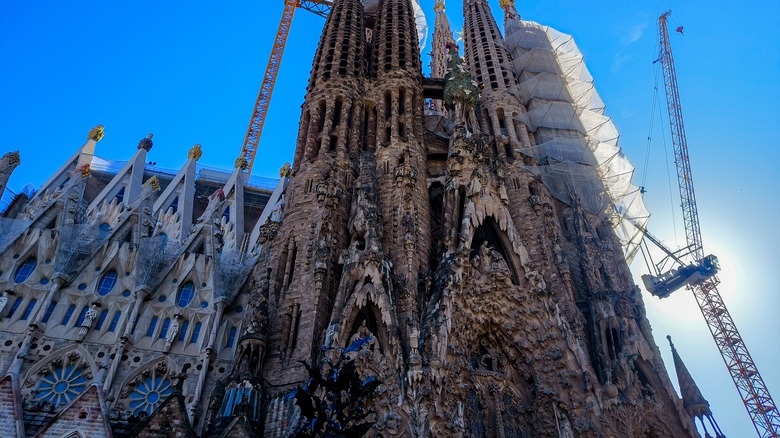
The Basílica de la Sagrada Família, which dominates the city skyline from all angles, will be the tallest church on the planet when it's finally completed in 2026. Yup, that's right: The most-visited site in the country, as well as the world's top travel destination for 2025, still isn't done.
The UNESCO-recognized structure was first designed in 1882 by Francisco de Paula del Villar before now-legendary Catalan architect Antoni Gaudí, whose expert work fills the city, took over just a year later. However, when Gaudí died after being hit by a tram on his way to the church in 1926, the project was only about 25% completed. Construction continued slowly, with various architects interpreting Gaudí's original plans. That said, it will all come full circle when the last stone is laid on the Gothic and Art Nouveau-style church on the 100th anniversary of his death. At that time, the highest of the church's 18 towers will stand at 566 feet tall.
Don't worry about the potential climb, though. Visitors with upgraded tickets can take an elevator to the top of one of the towers for incredible views of the city. Additionally, by visiting the inside of the Sagrada Família, visitors are also helping to fund its completion, as all admission ticket profits go directly to construction costs, since no government or church funds have been used. Once inside, check out the church's color-changing stained glass windows, three façades dedicated to Jesus' life, and curved lines that are iconic of Gaudí's style.
Casa Batlló
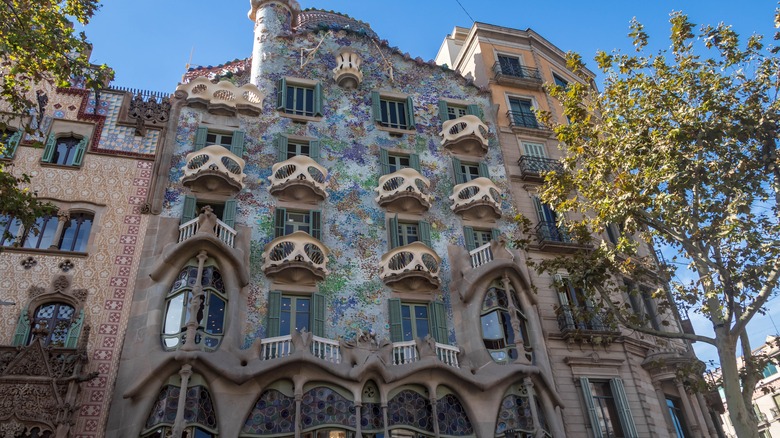
As one of his final projects before becoming the full-time designer of the Sagrada Família, Gaudí worked on Casa Batlló — a residential home owned by textile industrialist Josep Batlló. Battló wanted Gaudí to completely re-imagine the home that he bought in 1903, which, coincidentally, was built by one of Gaudí's professors in 1877. The architect and designer spent between 1904 and 1906 bringing new life — both artistically and practically — to the home, which is now considered a UNESCO World Heritage site.
What resulted was a façade covered in flowers, curved lines inspired by nature, and a roof that resembles a scaly, shiny dragon's back — all of which makes for a fanciful, Catalan Art Nouveau-style home. The roof even has a hole in it that opens to a picture-perfect view of the Sagrada Família, which is visible from the home's terrace.
With so many unique features, it's unsurprising that roughly 1 million people visit Casa Batlló annually after opening to the public in 1995. Located on the so-called "Block of Discord," which is home to several other modernist buildings designed by various architects who were all trying to one-up each other, Casa Batlló is surrounded by plenty of other interesting neighbors worth checking out, including Casa Amatller and Casa Josefina Bonet.
Casa Milà
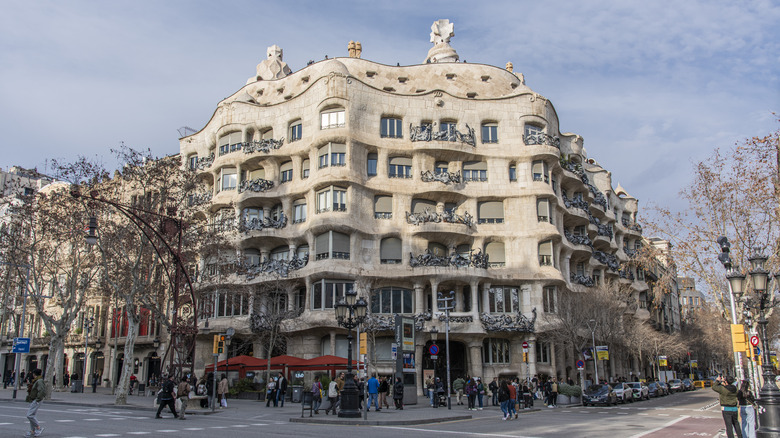
After Gaudí completed Casa Batlló in 1906, he immediately got to work creating Casa Milà, which he spent a six years building for industrialist Pere Milà and his wife, Rosario Segimon. The apartment complex is also referred to as La Pedrera, which translates to "stone quarry" in Catalan, as it was made with stone from the nearby towns of Garraf and Vilanova, and resembles a stone quarry.
Casa Milà was one of just three residential homes that Gaudí designed. Like with Casa Batlló, the Sagrada Família is also visible from Casa Milà's terrace. Although it was heavily critiqued and mocked during the early 1900s, the modern-style structure is now included in the list of UNESCO World Heritage Sites. It also doesn't appear exactly as Gaudí intended, since his original designs did not meet Segimon and Milà's standards. Despite this, Gaudí managed to incorporate innovative elements like recycled glass and ceramic, curved lines, underground carriage parking, a self-supported limestone exterior, floral murals, and 28 twisting chimneys.
Along with Segimon and Milà, many others — ranging from princes to spies and actors to military officers — once called Casa Milà home. These days, over 1 million annual visitors stop by the structure. And while part of the building houses a cultural foundation — including a museum dedicated to some of Gaudí's works — the other part is still used as a residential building.
Cathedral of Barcelona
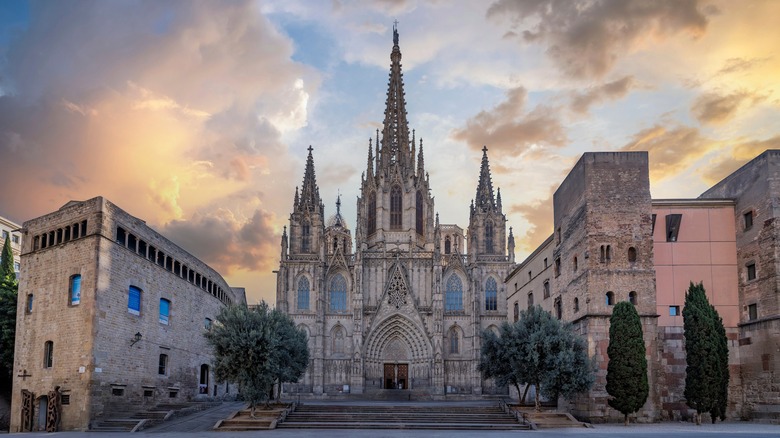
Long before the construction of Barcelona's most famous church, there was the Cathedral of Barcelona. Also referred to as the Catedral de la Santa Creu i Santa Eulàlia — which translates to Cathedral of the Holy Cross and Saint Eulàlia — the church is dedicated to Santa Eulàlia, Barcelona's most significant patron saint. A martyr, legend has it that the 13-year-old was tortured to death for her Christian beliefs in 303 A.D. Today, her remains are said to be laid to rest inside the cathedral's crypt, although her creation came many years after her supposed death. Along with this honor, the 13 white geese that can be seen in the cloister's garden are also said to represent Eulàlia's age at the time of her death.
The Cathedral of Barcelona was completed in 1448 on the site of another Christian church that had been destroyed, leaving behind nothing but its baptistery. Although it was originally designed in a Gothic style, many rebuilds over the next six centuries have led to several architectural styles. Inside, the church boasts over two dozen side chapels, stained glass windows, and an exhibition space featuring items like murals and altarpieces. Also within the cloister visitors can see gardens, fountains, and gravesites. Finally, for a front-row seat to the Cathedral of Barcelona's architectural details, as well as the city beyond, make sure you take the elevator all the way up to the rooftop.
Disfrutar
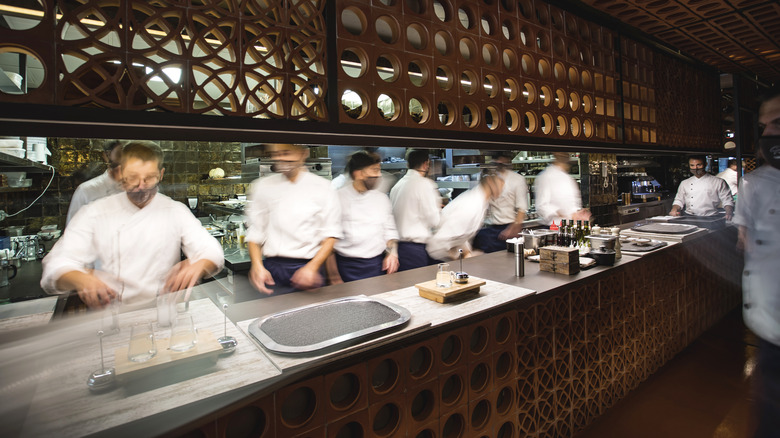
Foodies who love trying a little bit of everything will be huge fans of Barcelona's tapas scene. However, the city has something even more worthy of getting an early reservation for. Snagging the No. 1 spot on The World's 50 Best list in 2024 — after securing the No. 2 spot a year earlier — Barcelona is home to Disfrutar, a three-Michelin star restaurant with a name that fittingly translates to "enjoy" in Spanish.
Wowing diners since 2014, the spot is the brainchild of former elBulli chefs Eduard Xatruch, Oriol Castro, and Mateu Casañas. Featuring ceramic and wrought iron, as well as an open kitchen, all within a Mediterranean-inspired space, Disfrutar is known for its innovative molecular gastronomy, which involves reinventing popular dishes. For example, by creating a sandwich version of gazpacho, or turning salad into a liquid.
However, it'll cost you to try the chefs' cutting-edge culinary inventions. At the time of writing, Disfrutar's tasting menu is set at roughly $363 per person, while wine pairings will set you back an additional $196 per person. In terms of cuisine, patrons can choose between the classic tasting menu or the festival tasting menu, the latter of which offers seasonal dishes. Alternatively, for a once-in-a-lifetime experience, epicureans can book the Living Table Experience. Available for groups of four to six people, it allows the chefs to build a customized menu for each party based on their likes, dislikes, and allergies for about $507 per person.
Magic Fountain of Montjuïc
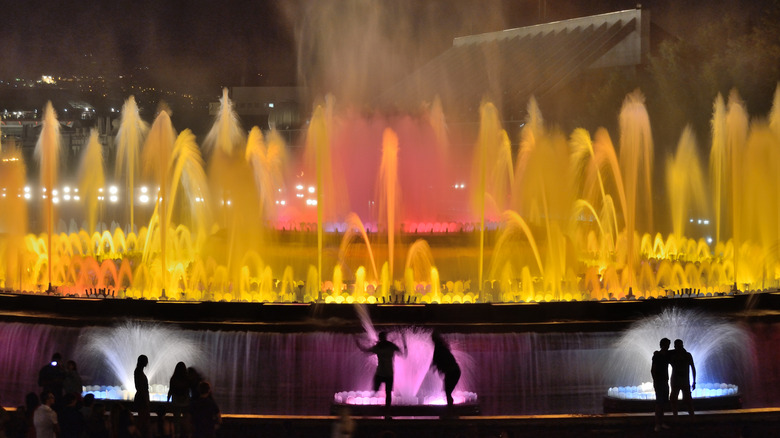
Ever since the 1929 International Exposition hosted in Barcelona, the Magic Fountain of Montjuïc, in the Plaça de Carles Buïgas, has presented a spectacular show of water, light, and music. Designed by architect Carles Buïgas, it took over 3,000 workers a year to construct. In 2022, the fountain's beloved shows came to a temporary halt, when the region's drought forced officials to close it down — alongside the more-than 300 other city fountains — for sustainable revamps.
That said, in September 2025, the fountain was finally turned back on. Better yet, its reintroduction coincided with the annual La Mercè festival, which is one of the most significant celebrations in the city and honors patron saint La Mare de Déu de la Mercè.
Today, the fountain shows off with over 7,000 lights and 3,600 water jets thanks to a roughly $3.5 million renovation. Visitors to Barcelona can see those lights and jets in all their glory during the fountain's free 20-minute shows, which take place on various days of the week and at different times depending on the season. If you want to sit on the stairs near the fountain or in the balustrades of the nearby bridge, we suggest you arrive early. Otherwise, it's standing room-only to see the show, which usually kicks off with a musical rendition of "Barcelona" by Freddie Mercury and Montserrat Caballé, and the rest of the songs range from opera to Catalan hits.
Mercat de la Boqueria
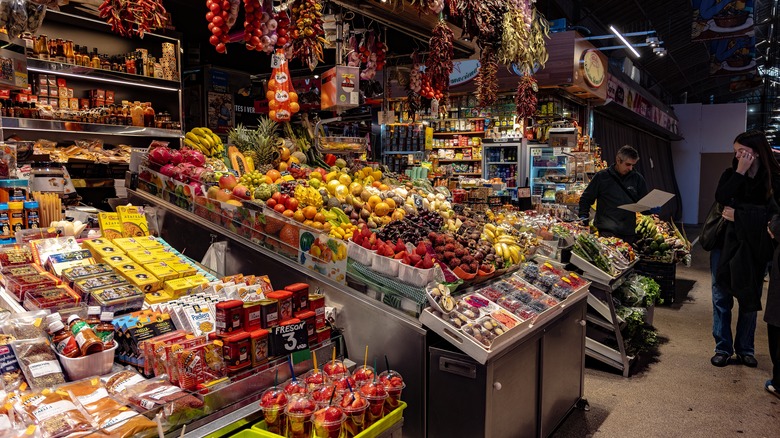
There are more than 8,000 restaurants to choose from in Barcelona, which makes deciding where to go for your three meals a day a difficult choice. However, one way to sample a little bit of everything is to walk the rows of Mercat de la Boqueria, a Barcelona food hall in the heart of the city. With a whopping 330 stalls behind a stained-glass Modernist gate, many vendors and tapas bars here sell ready-to-eat fare like baked snails with aioli, chargrilled spring onions in romesco sauce, and jamon ibérico de Bellota, a delicacy cured ham made from black-hoofed pigs. Be prepared to wait — especially at lunchtime — as the market can get busy midday. Alternatively, for a less crowded market, check out Mercat de Sant Antoni, an underrated attraction in Barcelona.
Open from 8 a.m. to 8:30 p.m. Monday through Saturday, the market dates back more than eight centuries, making it the oldest food market in the country. Prior to 1777, it was located by what is now La Rambla, an iconic Barcelona street every guidebook recommends (but that you might regret visiting). It's thought that the market's name was inspired by "boc," which translates to "male goat," as goat meat was likely sold there. After passing through several different locations, Mercat de la Boqueria found its home at the site of a former monastery that burned down.
Museu Picasso
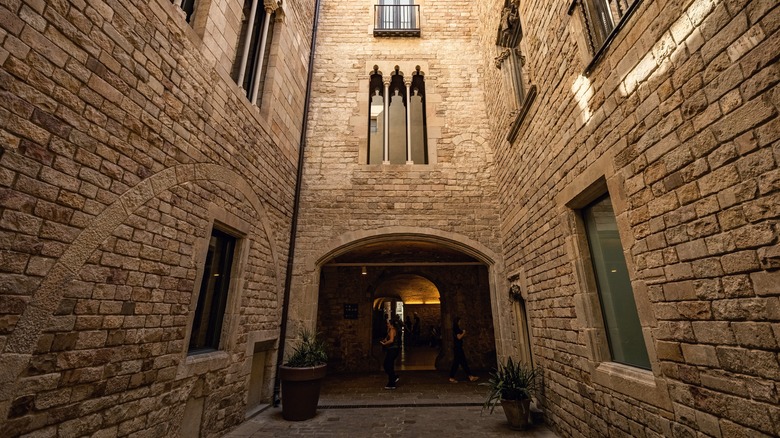
Although Gaudí might be the most famous artist in Barcelona, Pablo Picasso's presence is also felt throughout the city. This is especially true at the Museu Picasso, the first museum ever established in honor of the artist, as well as the one with the largest collection. The museum was founded in 1963 by Jaume Sabartés, Picasso's friend and secretary, and the artist even donated most of the works himself. Today, more than 4,000 of his works are displayed in the museum's five Gothic palaces in the Born neighborhood of the Old City, with spaces dedicated to various stages of his work.
A few of Picasso's works that you can expect to see at the museum include "Self Portrait," "First Communion," "Science and Charity," and "The Embrace." Limited-time exhibits are also often displayed. To see the best of the museum, visitors can purchase tickets to its 90-minute guided tour. With such a storied and sought-out collection, the museum is a popular one, and visitors are recommended to buy their tickets in advance. Or, to save a few bucks, they can also visit the museum for free on the first Sunday of every month, on Thursday afternoons, or during select dates throughout the year.
Palau de la Musica Catalana
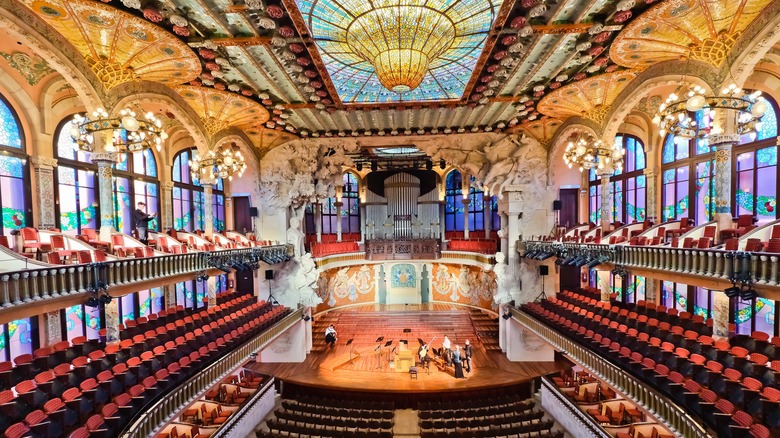
The Modernist architectural style — which combines several styles including sculpture, ceramics, and glass art — permeates the most famous buildings in Barcelona. That includes Palau de la Música Catalana, a concert hall designed by architect Lluís Domènech i Montaner for the Orfeó Català choir, a renowned Catalan music society. Domènech, who was one of the most famous Modernist architects, as well as Gaudí's teacher, started building the fanciful hall in 1905, and the space was inaugurated three years later. It has since become of home of one of the most unique concert halls on the planet, as well as the only Modernist concert hall to be named a UNESCO World Heritage Site.
Visitors will be welcomed into the Palau de la Música Catalana in between floral-adorned pillars, each topped with statues of musical geniuses like Beethoven and Bach. Inside, they'll head into the Concert Auditorium, the star of the famed venue. An organ on the stage is surrounded by statues of the 16 muses playing different instruments, symbolizing their mission to house all types of music. The auditorium, lined with stained glass windows and topped by a glass dome, is naturally lit by the sun. Music is also presented in the venue's Petit Palau, which features an auditorium built in 2004 with cutting-edge audiovisual equipment.
Parc Güell
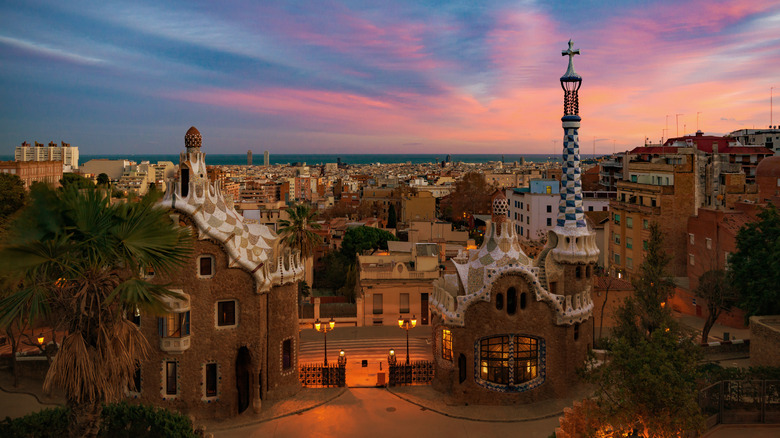
To see a concentration of Gaudí's architectural prowess, look no further than Park Güell, a housing development that the architect designed between 1900 and 1914. Ordered by businessman Eusebi Güell, the park was inspired by British developments he admired. However, despite the park's beauty and mysticism, its construction was abandoned due to the start of World War I, as well as the fact that it wasn't easily accessible. Even today, it's a 20 minute walk from the nearest metro station, although it's well-worth a visit for both locals and tourists alike. In 1926, Park Güell was opened as a city park, and, roughly 60 years later, it was designated as a UNESCO World Heritage Site alongside more of Gaudí's works.
One of the most iconic aspects of the park is the Serpentine Bench. Lining an outdoor terrace known as La Plaça de la Natura, where outdoor performances had been planned to take place, the structure is bursting with color thanks to the thousands of pieces of broken ceramic tiles that were used to create it. Boasting views of both the city skyline as well as the sea beyond, it's the perfect Barcelona photo-op. Another favorite spot is the Dragon Staircase, which features a mosaic salamander statue amid a double staircase lined with Doric columns. Finally, don't miss El Drac, another colorful salamander statue.
Methodology
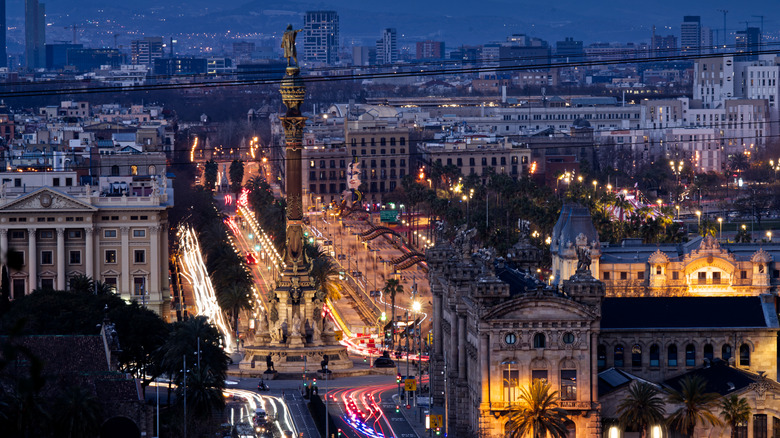
Barcelona is one of the most popular cities in Spain, let alone in all of Europe. And when you look at the long list of things to do and see while there, that's no surprise. This storied yet beautiful city is home to bustling food markets, the first Picasso-only museum ever established, and otherworldly homes that look like they're straight out of a fairy tale. That's why we wanted to make the planning a little easier for you.
To land on our top picks of the best things to do in Barcelona, we first evaluated which sites have the most and best reviews on TripAdvisor. That way, we could be sure that travelers just like you found their visit worthwhile. From there, we scoured official tourism websites to determine which destinations are the most well-known, giving you plenty to talk about back home. Finally, we considered which spots are designed to keep everyone happy — whether you're a history buff, an art fan, or a foodie — and settled on a handful of destination and experiences that you simply can't miss during your trip.