

Geneva's 10 Most Iconic Attractions And Destinations For Your First Trip
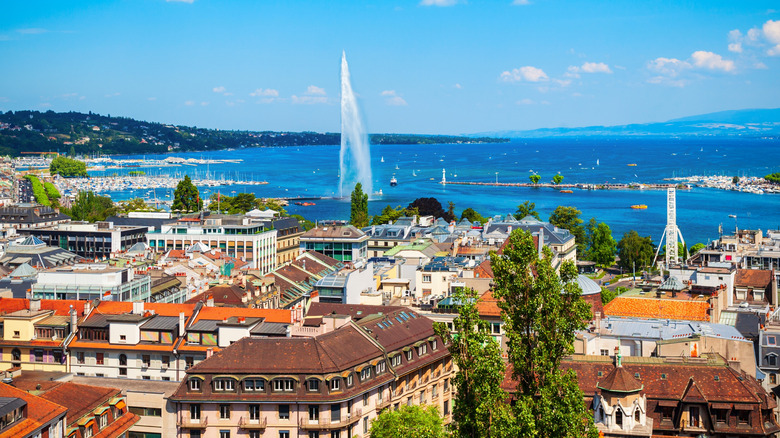
From its Celtic origins in 500 BC to its role as a player in the Roman Empire nearly 900 years later, Geneva is a city that has been shaped by diplomacy, culture, and deep historical significance. A location where international influence and classic Swiss heritage — think chocolate and clocks — come together in a perfectly picturesque setting, it doesn't take long for first-time visitors to discover that many of Geneva's most beautiful sights carry value far beyond the aesthetic. Plus, there's the added benefit of it being among the most budget-friendly cities in Switzerland.
In this guide, we'll take you through the 10 most iconic attractions and destinations that belong on every Geneva newcomer's travel itinerary. These places were chosen because they showcase Geneva at its most recognizable: from landmarks to museums, and historic districts you've probably seen in books and on travel documentaries. However, seeing them in person for the first time is an altogether different experience than looking at a page or a television screen. Together, these spots offer a memorable introduction to this city of about 650,000 residents.
Jet d'Eau
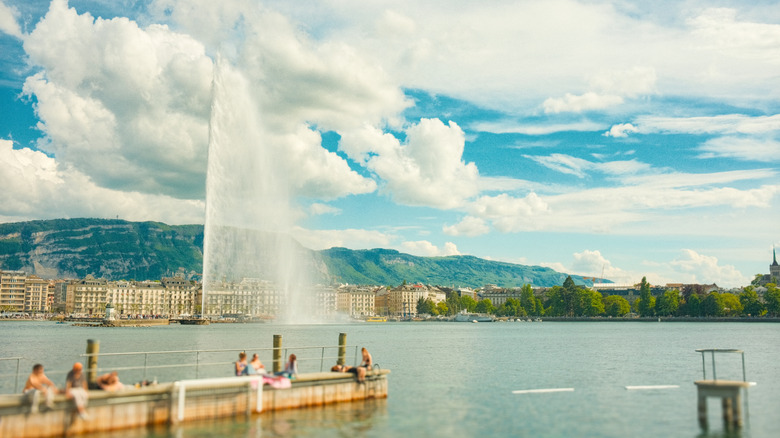
If there's one landmark most travelers closely associate with Geneva, it's the Jet d'Eau fountain. The history of this fountain — with its 459-foot-tall stream of water comprised of over 1,800 gallons at any given moment — is fascinating. The concept came about in 1886, when the city needed a safeguard to release the water pressure that built up in a hydraulic energy plant when workers were not present. The solution was a fountain that automatically released the unnecessary water. Thus, the original, albeit much smaller, Jet d'Eau was created. It wasn't until 1951, though, that the stream of water reached its current maximum height, and the Jet d'Eau truly became an iconic symbol of Geneva.
There are several ways for travelers to experience the Jet d'Eau in all its glory. As one of the closest shoreside spots to the fountain, the Jetée des Eaux-Vives offers an especially excellent view. If you want to splurge, consider making a reservation at Il Lago, a Michelin-starred lakeside restaurant at the Four Seasons Geneva. Or, to get up close to the famous fountain, climb aboard a boat. There are a variety of different cruise experiences on Lake Geneva — including lunchtime cruise options and daylong cruises that will allow you to admire many of the amazing attractions the Alps have to offer. Specifically, travel expert Samantha Brown recommends booking a Belle Epoque boat.
St. Pierre Cathedral
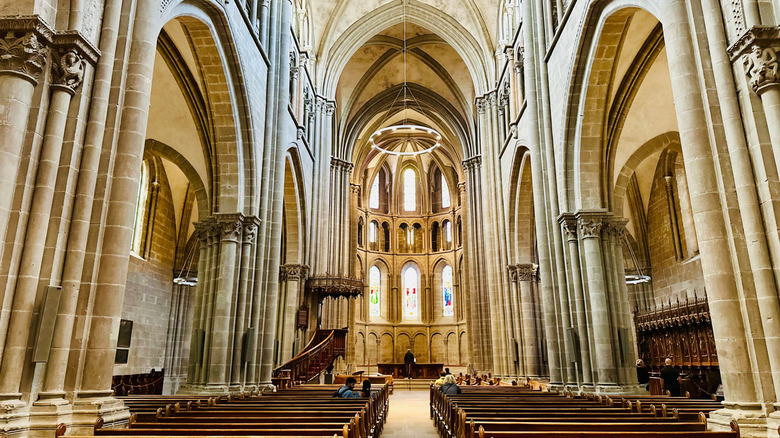
St. Pierre Cathedral is the centerpiece and highest structure in Geneva's Old Town district. Since the 12th century, this religious landmark has been making history. Originally a Roman Catholic place of worship, the church became Protestant in 1535 when authorities in Geneva banned Catholic Mass. It is perhaps best known for being the home church of Protestant Reformation leader John Calvin. In 2022, for the first time in hundreds of years, a Lenten Mass attended by 1,500 Catholic worshippers was held at St. Pierre's Cathedral. This marked a unique intersection of faith traditions in a place that has historically been sacred to both Protestant and Catholic Christians.
Visitors should take some time to appreciate this cathedral's unique architectural style. Originally constructed with Romanesque leanings, its updates over the centuries led to the addition of Gothic and Neoclassical elements. Attached, travelers will find the Auditoire de Calvin, where famed Protestant reformers like Calvin and John Knox once shaped the future of European religion. First-time visitors to St. Pierre's should make a point of scaling the 157 stairs to its tower. The view from the top is widely considered one of the best panoramic views in all of Geneva.
Below the church, travelers will find an extensive archaeological site. Home to fourth-century Christian structures and artifacts, and Celtic relics that are even older, this location will undoubtedly be of particular interest to anyone who is fascinated by religious history. Among the highlights are the remains of a crypt, mosaics, and various carved decorations featuring angels and other symbols. The archaeological site is open seven days a week from 10 a.m. to 5 p.m. for a nominal entry fee.
La Vieille Ville (Old Town)
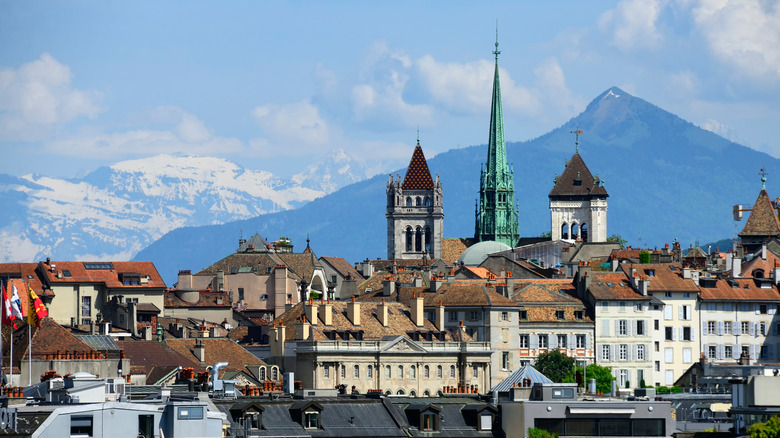
Although it is the most imposing structure in the district, St. Pierre's Cathedral is far from the only reason to visit Geneva's Old Town. Known as La Vieille Ville locally, visitors typically find themselves charmed by the area's cobblestone streets, antique stores, and exceptional restaurants and cafes. Start your trek through one of Europe's largest historic sectors at Place Bourg-de-Four. The city's oldest square is lined with spots to grab a coffee or a cocktail and take in the local architecture. Check out La Clémence — which has been a favorite for locals since 1950 — or Le Bistrot des Arts for a trendy lunch overlooking the plaza.
For travelers who want to shop til they drop, local boutiques like sustainable Bikkou and glitzy Purple and Gold Rain are great stops. First-time visitors will also want to make sure to stop by Maison Tavel. Once a massive private residence that belonged to the Tavel family in the Middle Ages, the structure now houses Geneva's Museum of Urban History and Daily Life. The museum — which is free to enter but encourages donations — is home to a variety of exhibits, but its most well-known piece is the 24-foot-long Magnin Relief Map.
Travelers can continue wandering to the Promenade de la Treille, which is home to the longest wooden bench in the world. Nearby, step into the Hôtel de Ville to immerse yourself in Geneva's geopolitical past. This spot, which was built in the 15th century, still serves as the local Town Hall, and played host to the first Geneva Convention. For those who want to take a deep dive into Old Town's historical significance, guided tours sanctioned by the city are available for a fee of about $350.
Palais des Nations (The United Nations Office at Geneva)

The Palais des Nations, which is in Geneva instead of Brussels, Belgium, thanks to a campaign by former U.S. President Woodrow Wilson, is the current European headquarters of the United Nations, and the former seat of the League of Nations. With wide-ranging foci — on everything from human rights to intellectual property regulations — UN Geneva is a critical cog in the United Nations' global ecosystem.
Situated in Ariana Park, which has a long history of use by both the League of Nations and the modern UN, the Palais des Nations is the second-largest United Nations complex in the world. For first-time visitors, this is a must-see Geneva destination that offers a rare first-hand glimpse of how world affairs are overseen on a daily basis.
The best way to experience the Palais des Nations is to join a one-hour guided tour of the facility. Throughout the tour, visitors will get to see various glass-enclosed documents and artifacts, enjoy the building's gorgeous Art Deco architecture, and discover the types of issues that are regularly handled during UN Geneva's 8,000 annual meetings. It is worth noting that, at the time of publication, the Palais des Nations is undergoing renovations that may impact its tour schedule. The facility recommends reserving your spot a minimum of three months before your visit.
Red Cross and Red Crescent Museum
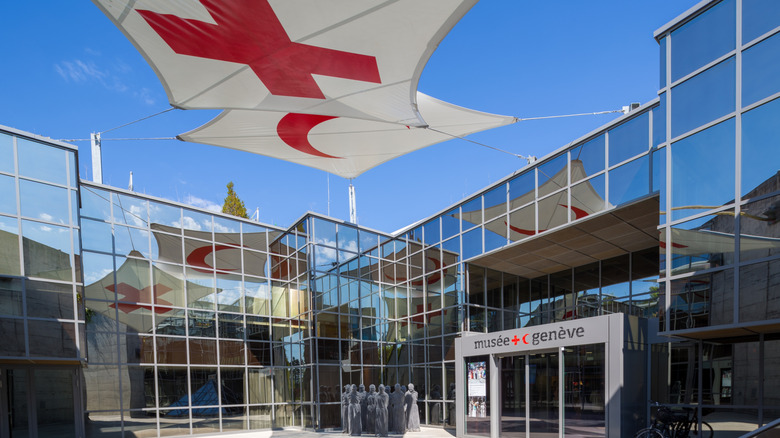
The Red Cross and Red Crescent Museum, which opened in 1988, has taught travelers from around the world about the Red Cross' mission for nearly 40 years. The city of Geneva has played a critical role in the history of the International Committee of the Red Cross (ICRC), from the organization's founding conference in 1863 to the humanitarian efforts conducted during the world-famous Geneva Conventions. The museum itself uses interactive exhibits and special events to spread awareness about numerous causes. It's a place where visitors can grasp the global scale of human need and the positive impact the Red Cross has on people worldwide.
The Red Cross and Red Crescent Museum's permanent collection, "The Humanitarian Adventure," first opened in 2013. It features three distinct segments: "Defending human dignity," "Restoring family links," and "Reducing natural risks." Via these thought-provoking exhibits, visitors are encouraged to consider how humanitarian crises occur and how even small acts can lead to change. In addition, the museum regularly hosts temporary exhibitions, such as a collection by Guatemalan artist Angélica Serech that is available through August 2026. For the most in-depth experience of the Red Cross Museum, first-time guests should consider reserving a one-hour guided tour.
Beau-Rivage Genève
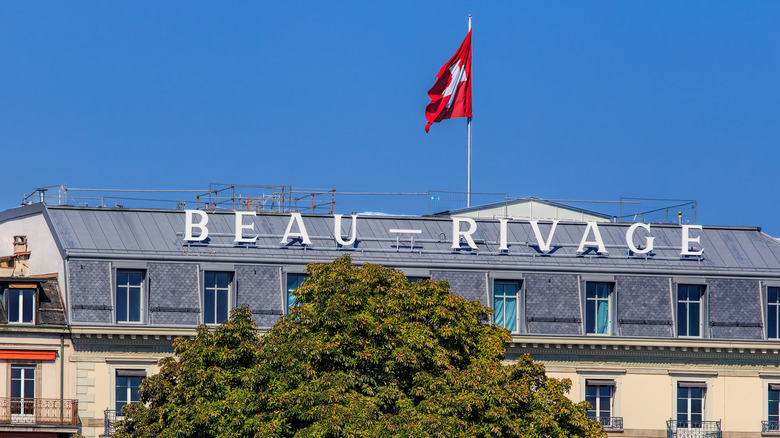
Since it opened its doors in 1865, the Beau-Rivage Genève has been one of this Swiss city's most storied addresses. Over the decades, it has welcomed everyone from the glamorous Elizabeth Taylor to French President Charles de Gaulle to dozens of luminaries in between. The hotel has also had its fair share of less-than-savory situations. During one incident, German politician Uwe Barschel was found dead in his suite's bathroom in 1987 under suspicious circumstances. The most famous death here, however, was that of Empress Elisabeth (Sissi) of Austria. Following a stabbing in 1898, she was brought to Beau-Rivage, where she passed away. Today, guests can book a stay in the elegant red-and-gold-accented Empress Sissi Suite.
Known for its impeccable service and attention to even the tiniest details, the Beau-Rivage offers a world-class experience amid stunning interiors. Updated between 2015 and 2017 by Pierre-Yves Rochon, the hotel maintains the old-world elegance that has always defined it. Even if travelers can't afford the $1,400-a-night price tag, the property is still worth a visit to take in the atmosphere. Non-hotel guests might want to drop by Rivage Café, where diners can enjoy a tapas menu, plus cocktails and mocktails with names like the "Vandage Volcanique" and the rather scandalous "Porn Star." For first-time visitors, this luxury hotel pulls back the curtain on Geneva's most luxurious side, while also serving as a time machine, of sorts, to a refined bygone era.
Patek Philippe Museum
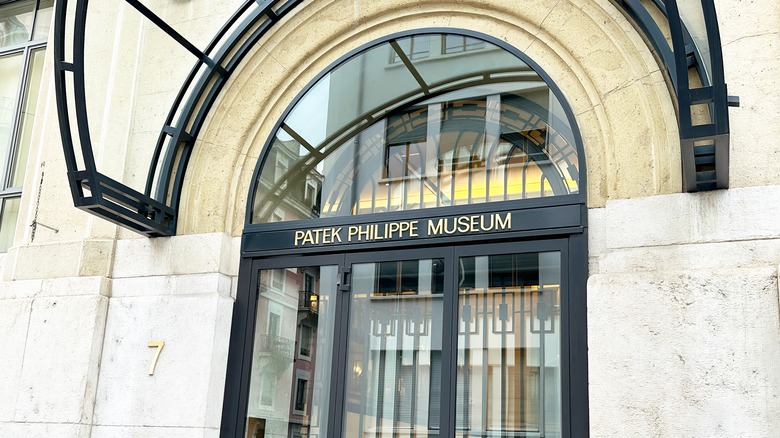
Whether one is a high-end design hound or a horophile — that is, a person obsessed with clocks — the Patek Philippe Museum is one of Geneva's most interesting attractions. Started in 1839 as Patek, Czapek & Co., this brand remains family-owned and deeply committed to making luxury timepieces. Its famous Nautilus watch series, for instance, can sell for over $200,000.
At the Patek Philippe Museum, guests will enjoy curated selections spanning the 16th century to today. Here, upwards of 2,500 items — featuring everything from jewel-encrusted pocket watches to automata familiar to those who have seen Tim Burton's "Hugo" — serve as examples of Patek Philippe's renowned craftsmanship.
In addition to viewing actual timepieces, guests can tour an exhibit that features 19th-century watchmaking desks and tools. This gives insight into the culture surrounding Switzerland's history as a horology hub. Additionally, the Patek Philippe Museum, which opened in 2001, is also a functioning restoration center, where contemporary master watchmakers revive historic pieces. For both dedicated collectors and those who are merely interested in the world of haute horlogerie, this museum is a must-stop that provides a wealth of information in a cultured setting.
Jardin Anglais and L'Horloge Fleurie (Flower Clock)
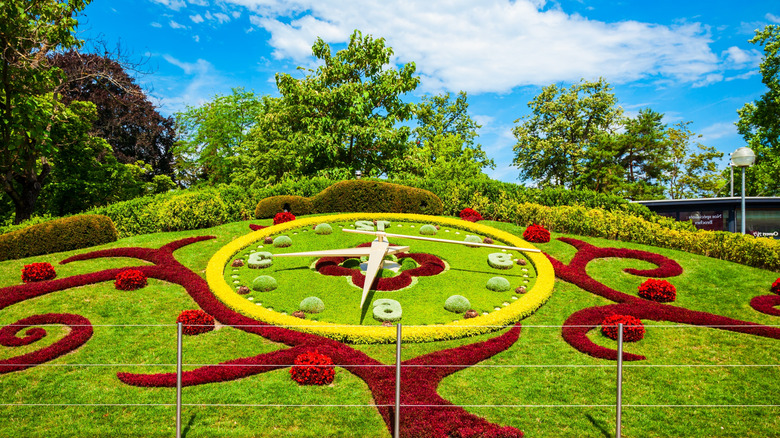
Anyone planning a trip to Geneva has probably seen a photo of the city's iconic Flower Clock, which can be found in the Jardin Anglais, or English Garden. Known as L'Horloge Fleurie in the nation's native French, this "living" timepiece first started ticking in 1955. Among the lesser-known facts about the Flower Clock is that it boasts the world's longest second hand! The appearance of this oversized timepiece changes with each season, but all of its iterations require about 12,000 blooms. For many years, Geneva's L'Horloge Fleurie was the biggest flower clock, but it has since been unseated from its throne by Tehran's version.
The Jardin Anglais at large provides a lovely setting for the clock, and offers other amenities for visitors. It is the perfect place to picnic or bike, and travelers should take a moment to look at the National Monument. This bronze Robert Dorer sculpture commemorates the Republic of Geneva joining the Swiss Confederation in 1814. Then, make sure you save time for lunch or dinner at La Potinière. This popular restaurant is located within the park, so it makes for a relaxing meal with lovely scenery. There is even live music several nights per week. The Jardin Anglais and its Flower Clock should be on the list for any traveler on a mission to see Geneva's most iconic sights.
Reformation Wall and the Parc des Bastions
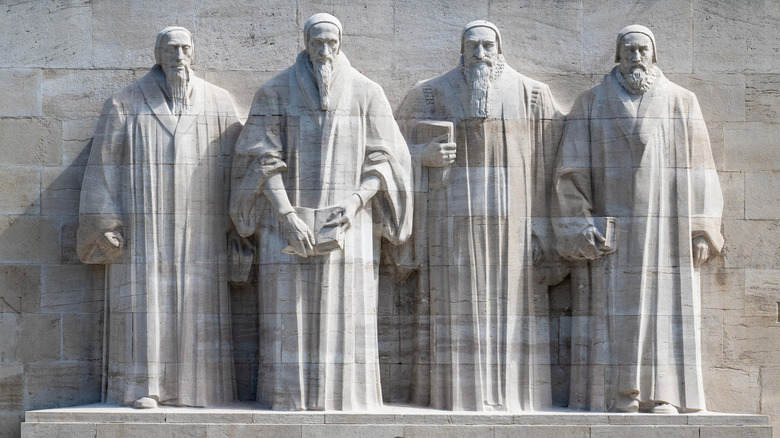
The Reformation Wall is a significant monument in Geneva's Parc des Bastions. It serves as something akin to the Mount Rushmore of the Protestant Reformation, with depictions of John Calvin, John Knox, Théodore de Bèze, and William Farel, among other Reformation leaders. Whether you're a history buff — the sculptures were carved directly into ancient Genevan walls — or a religious pilgrim, this photo spot has a powerful impact. And, for visitors whose faith traditions stem from Protestant beliefs, the Reformation Wall is an excellent place to meditate for a bit.
After viewing the wall, visitors should venture into the lovely Parc des Bastions. Known for its life-size chess sets, this is a whimsical green space where travelers can stroll away an entire afternoon. It's worth dining at Kiosque des Bastions, a glass-walled restaurant that looks out onto the gardens and is especially known for its Sunday brunch menu. Finally, spend some time exploring the various arts and cultural buildings that surround the park's Place de Neuve. The metropolitan opera house — or Grand Théâtre de Genève — is here, as well as the nation's first museum of fine arts, the Musée Rath, and the Maison des Arts du Grütli, which offers live theatre performances throughout the year.
Geneva's historic chocolate houses
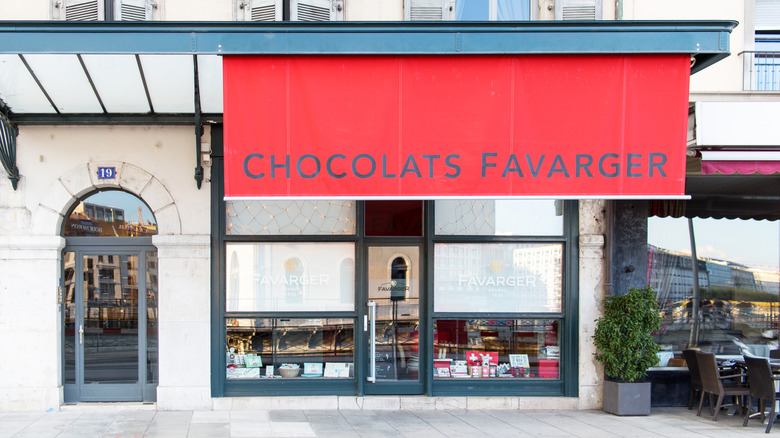
There are few exports more synonymous with Switzerland than chocolate. From Lindt to Toblerone, it's hard to visit an American grocery store without seeing Swiss chocolates lining the shelves. Thus, no first trip to Geneva would complete without exploring the city's local chocolate scene. The historic Favarger brand, founded in 1826, is perhaps Geneva's most iconic chocolatier. The company takes pride in every aspect of the chocolate-making process, and looks forward to celebrating a brand renewal to mark its 200th anniversary in 2026. Today, visitors are welcome to tour Favarger's chocolate atelier.
In addition to Favarger, Du Rhône Chocolatier, started in 1875, is a Geneva institution famous for its constant flavor innovations and delicious pralines. Meanwhile, Auer Chocolatier — slightly newer than its competitors — was founded in 1939 and is known for using proprietary recipes that have been passed through generations of the Auer family.
One of the best ways to experience all that Geneva's chocolate scene has to offer is purchasing the city's Choco Pass. This gives the bearer the ability to redeem chocolate tasting experiences at select shops within the Choco Pass-approved area. With the Discovery Pass, travelers try a sample from up to five different shops. An Unlimited Pass, however, allows visitors to obtain chocolates at all Choco Pass locations. There is also a specialty Kids' Pass. Another option is to book the Chocolate Flavours Tour, which takes guests on a three-hour chocolate immersion journey. Despite travel pro Rick Steves' belief that Geneva is overrated, the chocolate alone is reason to visit this Alpine city.
Methodology
To put together this guide, we primarily relied on Geneva's official tourism website, US News's travel section, MySwitzerland.com, and official websites for various locations — including the Palais de Nations, the Red Cross Museum, the Patek Philippe Museum, the Four Seasons Geneva, and Beau-Rivage. Additionally, we also obtained necessary details about these locations from high-authority sites like Forbes Travel, the Michelin Guide, Airial Travel, Coolturalia, Visit a City, and Collectability, as needed. Altogether, this mix of expert sources helped us create a reliable, well-rounded guide to the very best of Geneva.