12 Top Attractions & Things to Do in the Jungfrau Region
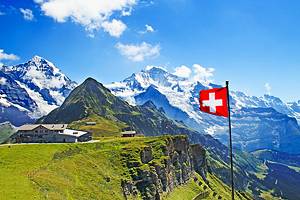
The Jungfrau massif, with its three famous peaks – the Jungfrau at 4,158 meters, the Mönch at 4,099 meters, and the 3,970-meter Eiger – has been the goal of climbers since the early 1800s and, more recently, of skiers who head for its 206 kilometers of slopes and runs, all set against the backdrop of the three peaks.
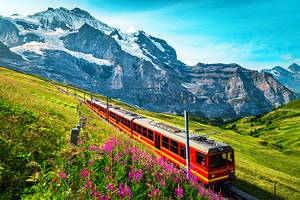
The rack-railroad to the Jungfraujoch opened in 1912, and its upper station is the highest railroad station in Europe at 3,454 meters. Known for their long runs – some as long as 12 kilometers – and reliable deep snow, it's no wonder the three major ski areas draw winter sports enthusiasts from around the world.
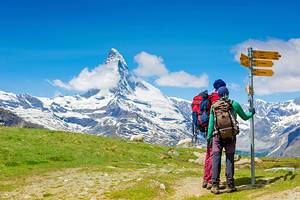
You'll find plenty of things to do outdoors besides skiing. Although there are plenty of technical climbs available, walking and hiking trails are not just for the intrepid. Some of the most beautiful views are from trails suitable for slow ambling or for young children. The postcard-pretty towns, scenic splendor, and natural attractions all add to the Jungfrau's appeal to tourists in any season. Explore this beautiful region with our list of the top tourist attractions in the Jungfrau Region.
See also: Where to Stay in the Jungfrau Region
- 1. Jungfraujoch and Aletsch Glacier
- 2. Lauterbrunnen
- 3. Wengen
- 4. Schilthorn and Piz Gloria
- 5. Skiing and Winter Sports
- 6. Trümmelbach Falls
- 7. Mürren
- 8. Hike the Blumental Panorama Trail
- 9. Grindelwald
- 10. Meiringen: Reichenbach Falls & Aare Gorge
- 11. Männlichen and Kleine Scheidegg
- 12. Faulhorn
- Where to Stay in the Jungfrau Region for Sightseeing
1. Jungfraujoch and Aletsch Glacier
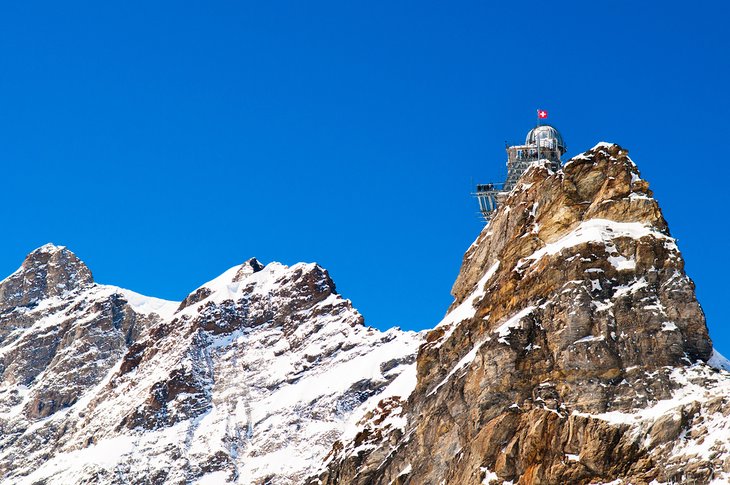
The highest railroad station in Europe at 3,454 meters, the Jungfraujoch is like a small village, with a hotel, restaurants, research stations, and underground passages leading to an Ice Palace carved from the glacier and to sports venues for skiing and dogsledding.
An elevator climbs even higher to a viewing platform at the 3,573-meter summit of the Sphinx, not far below the summit of the Mönch. To the south, you can see the Aletsch glacier, and to the north, the mountain world of the Alps. On clear days, the view extends to the Vosges in France and to Germany's Black Forest.
The Aletsch glacier, 22 kilometers long, is Europe's largest and is a UNESCO World Heritage site, and like glaciers throughout the Alps is seriously threatened by the warming of the planet. Although it is visible from other locations, the best view of the glacier is from the Sphinx viewing platform.
The Jungfraubahn railway begins its climb at the Kleine Scheidegg, which you can reach from Lauterbrunnen or Grindelwald. The best plan is to go one way and come back the other. The rail line from Grindelwald to the Kleine Scheidegg runs below the treacherous north face of the Eiger, the most dangerous rock wall in the Alps. The first stop on the Jungfraubahn is Eigergletscher (Eiger Glacier), at 2,320 meters and surrounded by magnificent, wild scenery.
Farther on is the Eismeer (Sea of Ice) at 3,160 meters on the south face of the Eiger, with views over the much-crevassed surface of the glacier towards the Wetterhorn, the Schreckhorn, the Fiescherhörner, and the great crevasse under the Mönchsjoch. From here, it is a journey of 50 minutes along the rack-railroad to the Jungfraujoch.
2. Lauterbrunnen
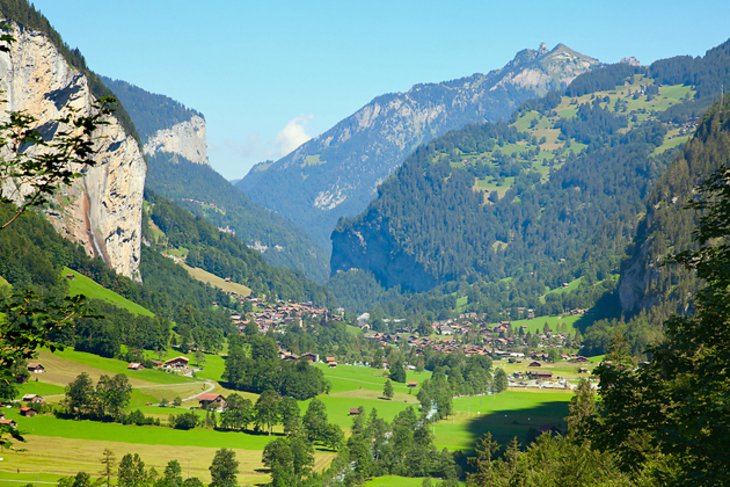
The Lauterbrunnen valley extends from Zweilütschinen to the foot of the Breithorn in the Jungfrau massif. The typical high alpine valley is enclosed between sheer rock walls over which several magnificent waterfalls drop in frothing ribbons. Plunging into the village itself are the Staubbach falls, which tumble from an overhanging crag in a sheer drop of 300 meters. The falls inspired Goethe to write Song of the Spirits over the Water, later set to music by Schubert.
Lauterbrunnen is a popular summer resort and the starting-point of the funicular to the Jungfraujoch. The valley is a walkers' and skiers' paradise offering beautiful climbs in all skill levels and ski-runs as long as 17.5 kilometers. You can see a collection of agricultural tools in the museum.
3. Wengen
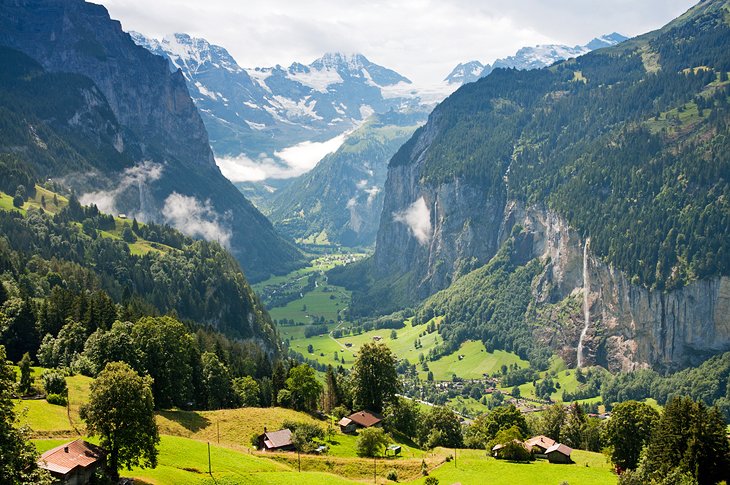
A car-free resort halfway up the Eiger and overlooking the Lauterbrunnen Valley, Wengen can only be reached on foot or on the Wengernalpbahn, a rack railway from Lauterbrunnen that was built in 1893. The town is beautifully set at the foot of the Eiger, Mönch, and Jungfrau and is an ideal base for walks and climbs in the mountains and alpine meadows of the Bernese Oberland.
You can climb to the Wengernalp, either directly in less than two hours or by way of the Mettlealp, immediately opposite the Jungfrau, in three hours. You can also take the railway to the Wengernalp, where you'll find splendid views of the Trümleten valley and the Jungfrau. Each January, the Lauberhorn Downhill Ski Race, one of the most spectacular in the World Cup circuit, is held in Wengen.
4. Schilthorn and Piz Gloria
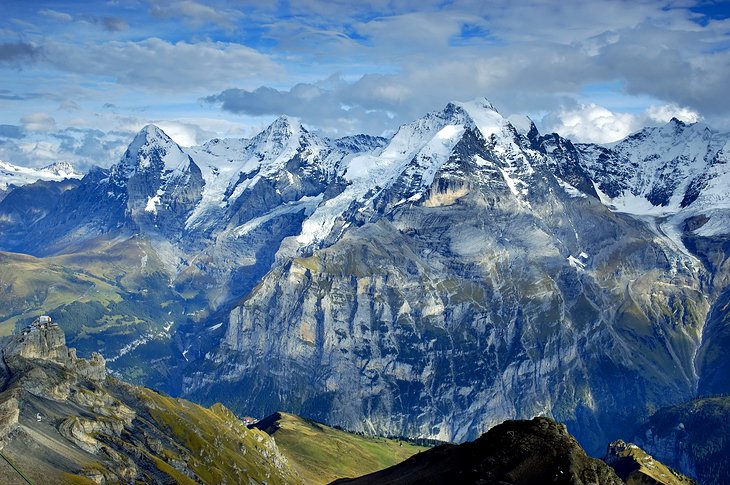
The Schilthornbahn, a 6,967-meter-long cableway, ascends in 34 minutes via three intermediate stations to the Schilthorn, at an elevation of 2,970 meters. The views are spectacular, and the ski trails from here run all the way back to Lauterbrunnen, 12 kilometers below.
But what makes a trip to this peak one of the favorite things to do in the Jungfrau region is its revolving restaurant, Piz Gloria, and its associations with James Bond. In the late 1960s, when location scouts were looking for a spot to film Ian Fleming's On Her Majesty's Secret Service, they found this revolving restaurant under construction.
Its futuristic shape caught their imaginations, and they saw it as the perfect setting for Piz Gloria, the mountaintop hideout of the film's villain Blofeld. The producers helped finance its completion, and it featured prominently in the film, afterwards taking the name of the fictional hideout. Today, Piz Gloria makes the most of the Bond experience with a special Bond Breakfast menu, interactive Bond exhibits, memorabilia, and film clips.
Apart from the James Bond connection, the magnificent 360-degree panorama from the summit rewards the trip, encompassing the trio of the Eiger, Mönch, and Jungfrau, and reaching to Mont Blanc and into Germany's Black Forest.
5. Skiing and Winter Sports
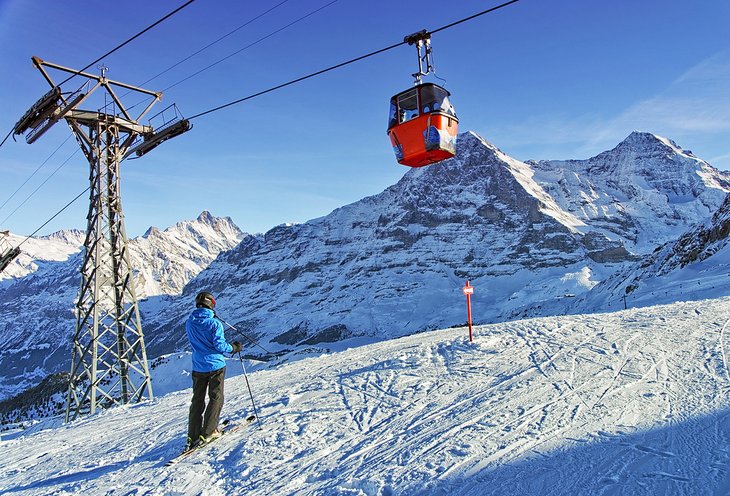
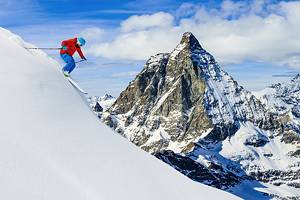
On the Alpine slopes of the Jungfrau massif's three peaks are 206 kilometers of slopes and runs for skiers and snowboarders, making this region one of the top ski resorts in Europe. Dozens of lifts and cableways give skiers and sightseers access to the mountains, and to runs as long as 12 kilometers.
Beginners will find the slopes near Wengen the best for learning to ski, while experts will find Murren's slopes the most challenging in the Jungfrau region. Grindelwald-First's freestyle superpipe is the favorite for snowboarders.
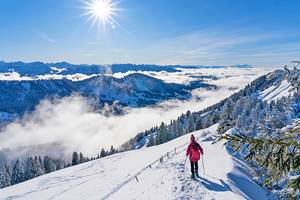
Non-skiers will find winter hiking and snowshoe trails, ice-skating rinks, cross-country skiing. And dedicated sled runs suitable for all ages. Next to the skating rink in Wengen is a curling rink, with instructors to teach you how to play.
6. Trümmelbach Falls
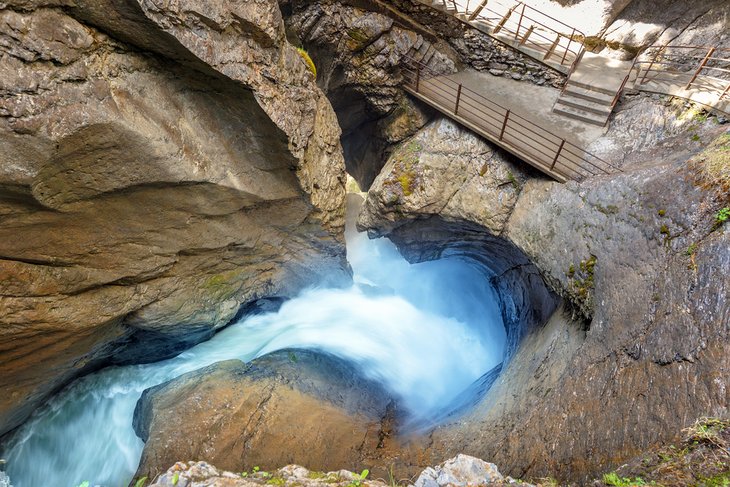
Almost hidden inside the Schwarze Mönch, the Trümmelbach Falls plunge down in five rushing cascades that swirl through a corkscrew-shaped vertical gorge carved out by the meltwaters from the giant ice walls of the Eiger, Mönch, and Jungfrau.
Elevators take you inside the mountain and to a series of walkways to view the individual waterfalls. It's easy to see how their force has worn away the rock, as they thunder and swirl down through the mountain at a volume of 20,000 liters per second, carrying rocks and gravel with them. These are the world's only underground glacier waterfalls that are accessible by lift, galleries, tunnels, and platforms inside the mountain.
7. Mürren
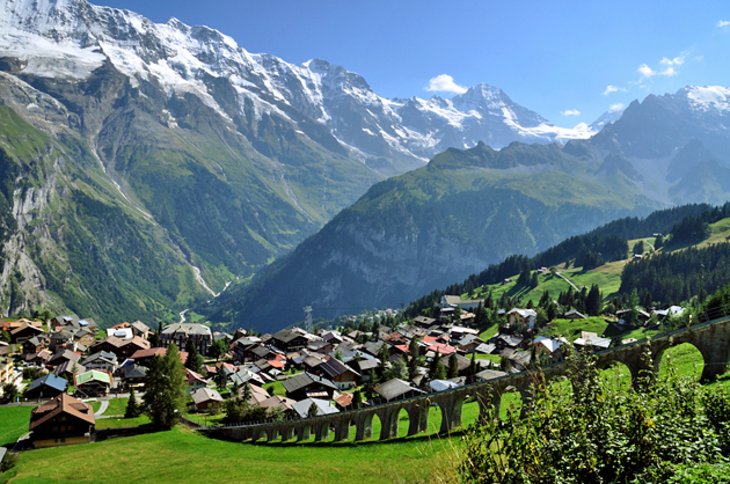
At the foot of the Schilthorn, a sunny terrace above the Lauterbrunnen valley, Mürren maintains its 19th-century atmosphere by allowing no private vehicles on its narrow streets. Access to this rustic chalet village is from Lauterbrunnen by funicular to Grütschalp and from there by a 5.5-kilometer narrow-gauge railroad or from Stechelberg by a cableway that goes past waterfalls and craggy rock faces into the center of the village. Wengen, on the rocky plateau opposite, is also accessible by cableway.
Mürren developed during the 19th century into a popular resort, particularly among the British, who founded the Inferno Race. It is the biggest amateur ski race in the world, and still takes place here annually on the famous black-diamond Inferno run down the Schilthorn. From the town are magnificent views of the Jungfrau, and a half-hour walk or a cable car ride takes you to Allmendhubel, at 1,938 meters, with panoramic views.
Mürren is a popular starting point for Via Ferrata adventures along high ledge faces, using imbedded metal rods as footholds and secured by harnesses and a cable wire. The Via Ferrata to Gimmelwald includes a zipline, suspension bridge, ladders, and long stretches of metal rungs along the sheer rock wall.
8. Hike the Blumental Panorama Trail
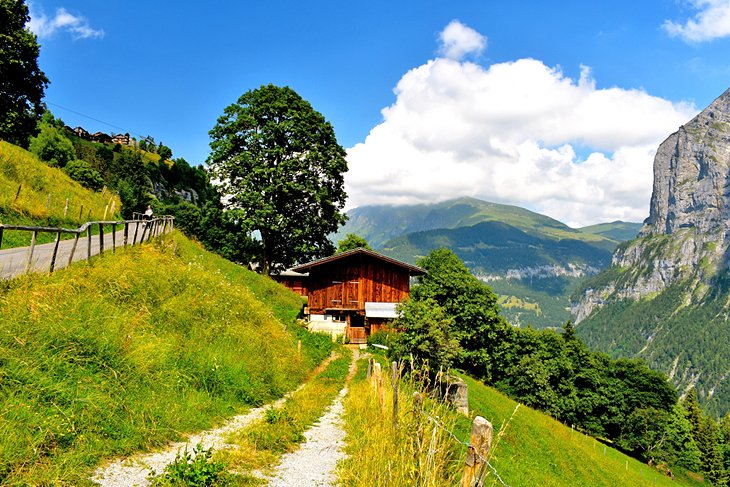
A variety of walking trails crisscross the mountainsides and valleys, and one of the favorites leads from Allmendhubel thru the Blumental Valley down to Mürren, an easy downhill hike of between two and three hours. To begin, take the Allmendhubel funicular to the top and follow the signposts down through the valley to Mürren.
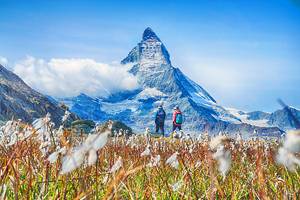
The route is a gentle one with a lot of variety. Between stunning Alpine vistas of the Eiger, Mönch, and Jungfrau are stretches of woodland path, walks along a rushing stream, wooden bridges to cross, and meadows filled with wildflowers.
9. Grindelwald
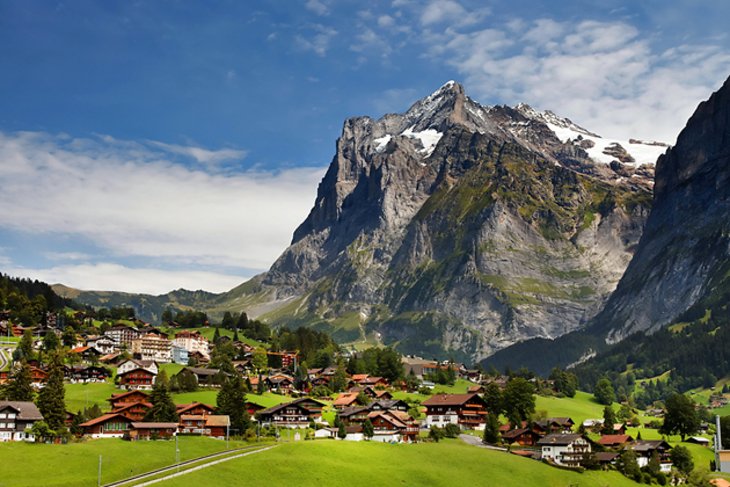
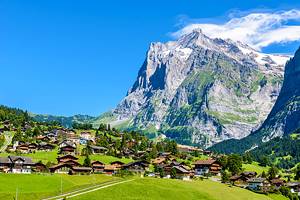
A village of narrow streets and picturesque chalets set among alpine meadows, Grindelwald lies at the foot of the dramatic ledges of the Eiger's sheer north face. To the left of the Eiger is the 3,104-meter Mettenberg and the 3,701-meter Wetterhorn, the most characteristic landmark of the Grindelwald valley.
Between the three mountains are the two Grindelwald glaciers. The Upper Glacier, about a 1.5-hour walk from the village, has an ice cave carved into its right-hand side. The Lower Glacier is reached through the impressive Lütschine Gorge, where you can see glacial potholes carved into the rock by meltwater.
In the village of Grindelwald, you can visit a small museum to learn about Alpine life, local cheese-making, and the history of skiing and mountaineering in the valley. At the Bergsteigerzentrum (mountaineering center), you can join tours and courses for both beginning and advanced climbers and hikers.
The best views in Grindelwald are from the Terrassenweg, a panoramic path that branches off the road about 20 minutes' walk above the church and runs along the mountainside above alpine meadows.
In late January each year, Grindelwald hosts the World Snow Festival, when artists from all over the world carve blocks of snow into the shapes of animals, birds, buildings, and sculptural shapes.
10. Meiringen: Reichenbach Falls & Aare Gorge
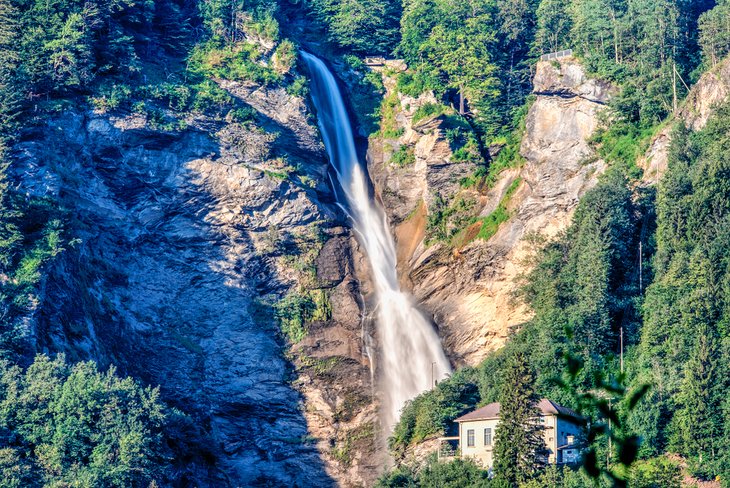
Meiringen has a place in both culinary and literary history. It is believed that meringues were invented here by an Italian chef in the late 17th century. But it is the fame of neighboring Reichenbach Falls that brings lovers of Sherlock Holmes stories to Meiringen.
The site where Sir Arthur Conan Doyle chose for the death of his main character has become a pilgrimage site for mystery fans; there's even a plaque at the very spot from which he was pushed into the rushing waters. A funicular takes visitors to the spot, and the adventuresome can climb the path to the top of the falls. The town itself has a Sherlock Holmes Museum and a bronze statue of the detective in his deerstalker hat, smoking his pipe.
As dramatic as Reichenbach Falls is the Aare Gorge (Aareschlucht), also just outside Meiringen. Carved in the limestone by meltwater from the Aare Glacier, the gorge is accessible by a trail, wooden walkways, and tunnels through the rock walls.
11. Männlichen and Kleine Scheidegg
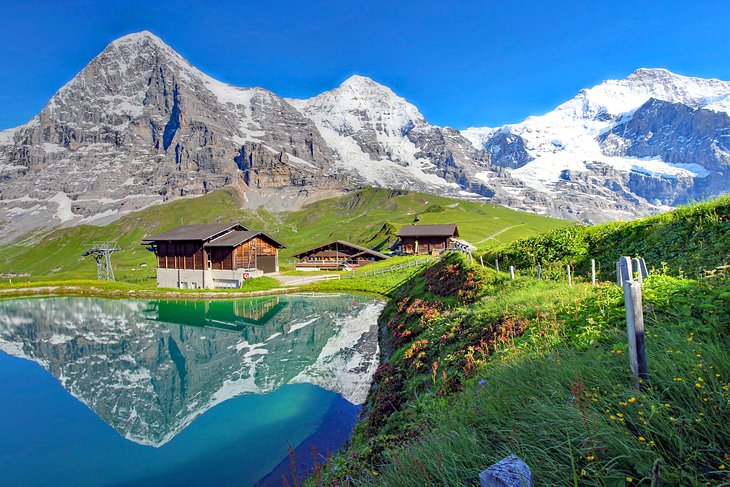
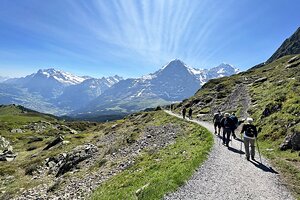
The walk from Männlichen to Kleine Scheidegg packs a lot of value for the effort, with wonderful views of a dozen snowcapped peaks as a reward for about two hours of leisurely walking on a trail that's easy enough to be done without hiking boots.
Take the cable-car from Grindelwald or Wengen to Männlichen – a beautiful ride in itself – and return on the train from Kleine Scheidegg. Alighting from the cable car at Männlichen, follow the Royal Walk to the summit (about 20 minutes) for photos, then follow the Panoramaweg (Panorama Trail) to Kleine Scheidegg. Along with a continuing panorama of the Jungfrau, Eiger, and Mönch, you'll see cows grazing and a multitude of Alpine wildflowers.
12. Faulhorn
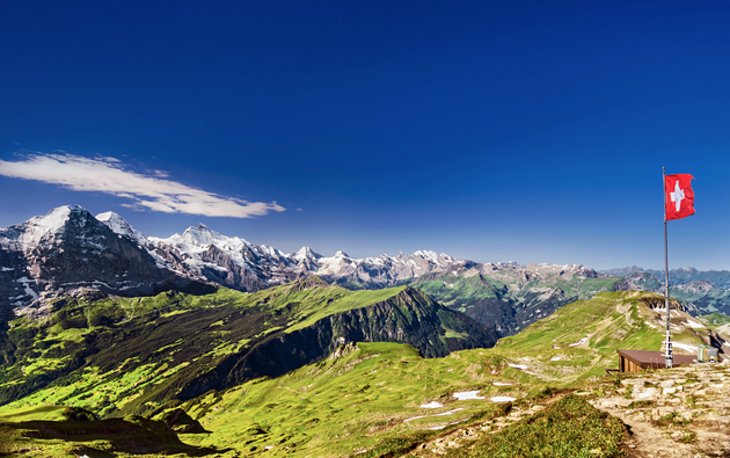
The 2,681-meter Faulhorn is one of Switzerland's most renowned viewpoints, where you can see the giant peaks of the Bernese Oberland in all their magnificence. To reach it, take the cable car from Grindelwald to the First station and from here, it's an hour's walk north to the Bachalpsee, at 2,264 meters. The Faulhorn summit is another 1.5 hours' climb.
You can also walk 3.5 hours from Grindelwald to the Bachalpsee and then climb to the Faulhorn summit. At the top is the Berghotel Faulhorn, one of the oldest mountain hotels in the Alps, and essentially unchanged since its construction in 1830.
Where to Stay in the Jungfrau Region for Sightseeing
With Switzerland's excellent transportation network of funiculars, cable cars, and railroads, you can get around easily between these mountain towns. All hotel stays include a visitor card that entitles you to free travel and discounts on activities throughout the entire region for the duration of your stay. These hotels in Wengen, Grindelwald, Mürren, and Lauderbrunnen are within easy reach of the best tourist attractions and things to do in the Jungfrau region.
Luxury Hotels:
- Surrounded by a park and beautiful views just above the center of Wengen, Beausite Park Hotel has beautiful rooms and plenty of resort facilities, including a spa with a sauna and whirlpool, fitness and game rooms, a swimming pool, and outdoor swimming pond for summer. The mountain railway is within walking distance.
- In Grindelwald, Hotel Gletschergarten is a great choice for skiers, with a ski run leading almost to its door and the cable car station only a few minutes' walk away. The chalet-style hotel is family run and offers free pickup from the rail or bus station. The hotel has a sauna and steam room, and guests have free access to the sports center's indoor pool and an ice-skating rink.
Mid-Range Hotels:
- The family-owned Hotel Eiger in Murren includes breakfast in the rate for its charming rooms with balconies and has an indoor pool with a sauna. There is also a restaurant with panoramic views.
- In the heart of Lauterbrunnen, only a five-minute walk from the train station, Hotel Oberland is close to the town's famous Staubbach waterfall. It has the cozy feel of a mountain lodge, and the roomy family suites have kitchenettes and balconies.
- Dating from 1894, Mürren's Hotel Jungfrau is a ski-in, ski-out hotel right at the foot of the ski school slopes. From the balconies are views of the Jungfrau massif, and in the summer, hiking trails begin at the door. Rates include a full hot breakfast and free entrance to the swimming pool and ice rink at the sports center. The restaurant is renowned for the cheese fondue.
- The small chalet-style Hotel Tschuggen in Grindelwald is centrally located, but its south-facing family rooms and apartments are quiet, with balconies overlooking the Eiger North Wall. The generous breakfast is included, as is entrance to the swimming pool and ice rink at the nearby sports center.
Budget Hotels:
- Wengen's Hotel Edelweiss is a homey family-run lodging with daily, budget-friendly dinner specials in its restaurant. Balconies have beautiful views, and the train station is about a five-minute walk away.
- Views from the Eiger Guesthouse in Mürren include the Eiger, Mönch, and Jungfrau mountains, and rooms include both en-suite family rooms and money-saving options with shared baths. There's a restaurant and games room.
More Related Articles on PlanetWare.com
More Places to Visit in Switzerland: Discover more tourist attractions in Switzerland to help plan your trip and itinerary. For ideas on what to do at individual destinations, see our pages on the best attractions in Zurich and top day trips from Zurich, as well as our articles on attractions in Basel, Bern, and Lausanne.
More Places to Ski: After seeing the ski resort towns in the Jungfrau, you might like to see St. Moritz, the resort that first promoted winter vacations, and the postcard ski town of Zermatt, in the Valais region. These are two of the top-rated ski resorts in Switzerland, and you can learn about other ski regions of the Alps in our articles on the best ski resorts in Italy, top ski resorts in Austria, and our page on the Top-Rated Ski Resorts in France.