Exploring Munich's Frauenkirche (The Cathedral of Our Lady)
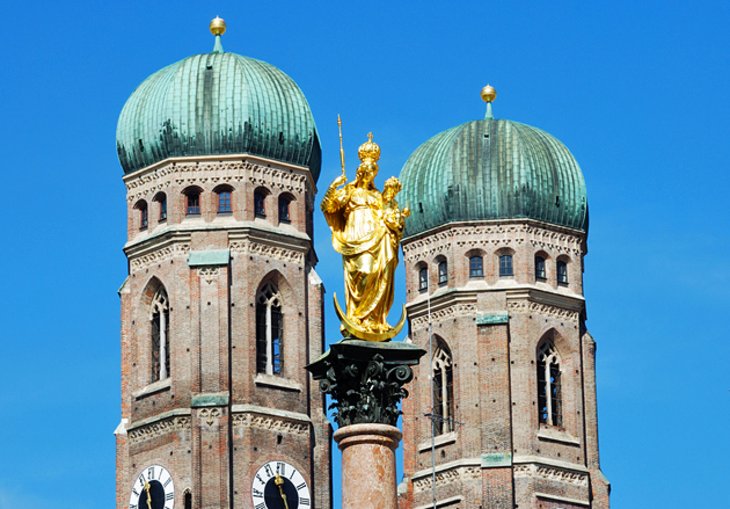
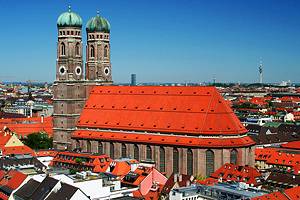
Munich's Frauenkirche - the Cathedral of Our Lady - has been the main church and cathedral of southern Bavaria's ecclesiastical provinces since the establishment of the archbishopric of Munich and Freising in 1821. This impressive brick-built Late Gothic building, constructed between 1468-88 on the site of an earlier church dedicated to the Virgin, measures some 109 meters by 40 meters and is notable for its high walls, clear articulation, and lack of ornament. Its sheer size, as well as its sturdy domed towers - one reaching 100 meters in height, the other 99 meters - makes it one of Munich's best known landmarks.
Munich Cathedral: Interior Highlights
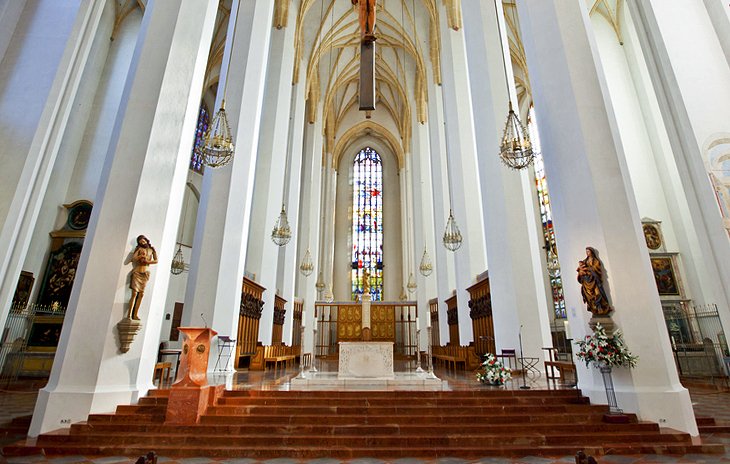
The interior of the aisled Frauenkirche, with its 22 tall octagonal pillars arranged in two rows, was remodeled in Renaissance style in 1601 but reconverted to a Gothic design in 1858. After the destruction of WWII, it was given a simply conceived but very effective whitewashed interior. Viewed from the porch with its larger than life-size figure of St. Christopher from 1520, the aisles and side windows are invisible, while the octagonal pillars of the nave have the appearance of a wall. At one time the window of the choir was also obscured by the high altar, and legend has it that the Devil, after inspecting the cathedral, was so delighted that the windows had been forgotten that he stamped his foot, leaving a print in the porch that can still be seen to this day. Other interior highlights include the sacristy entrance with its altarpiece of the Assumption by Peter Candid from 1620, the Baroque font in red marble with its early 14th-century Sorrowing Christ in the Baptistery, and the modern pulpit by Blasius Spreng from 1957. Also of note in the choir are the high altar by Hubert Elsässer from 1971, the cross in the choir arch by Josef Henselmann from the 1950s, and the old busts and statues by Erasmus Grasser dating from 1502.
The Cathedral's Many Chapels
The Frauenkirche boasts more than 20 individual chapels dedicated to everything from saints and the apostles to local trades and guilds. In the North Tower Chapel is a lovely relief of the Virgin and the Patron from 1475, while in the Apollonia Chapel is a modern-day epitaph to Cardinal Döpfner by Hans Wimmer, added in 1981. Of note in St. Lantpert's Chapel are the re-worked Gothic figures of the apostles and prophets in wood, salvaged from the former choir stalls, along with an imposing marble triptych of the aristocratic Barth family, while in the Chapel of the Seven Sorrows is The Seven Sorrows of Mary, a stained glass window added in 1959.
In the Main Choir Chapel is a painting of the Virgin of Mercy with the patrons and the Sanftl family from Munich by Jan Polack around 1500, along with stained glass by Peter Hemmel of Andlau from 1493 and reliefs by Ignaz Günther from 1774. St. Benno's Chapel is where you'll find reliquaries and a silver bust of St. Benno dating from 1601, as well as stained glass with scenes from the life of St. Agnes and St. Sebastian from the 15th century, while in the Chapel of the Magi is an interesting altarpiece of the Magi by Ulrich Loth from 1628, as well as some Late Gothic stained glass.
Other chapels of note include the Chapel of St. Anne and St. George, with its monumental 16th-century figures of Saints Rasso and George and a fantastic stained glass window depicting the Annunciation from around 1500; the Sacramental Chapel with its exceptional paintings from the Memminger altar by Strigel, also from the early 1500s, along with a notable stained glass window of the martyrdom of St. Catherine from the same period; and St. Sebastian's Chapel with the painting The Baptism of Christ by Friedrich Pacher from 1483 along with some fine stained glass.
Notable Tombs
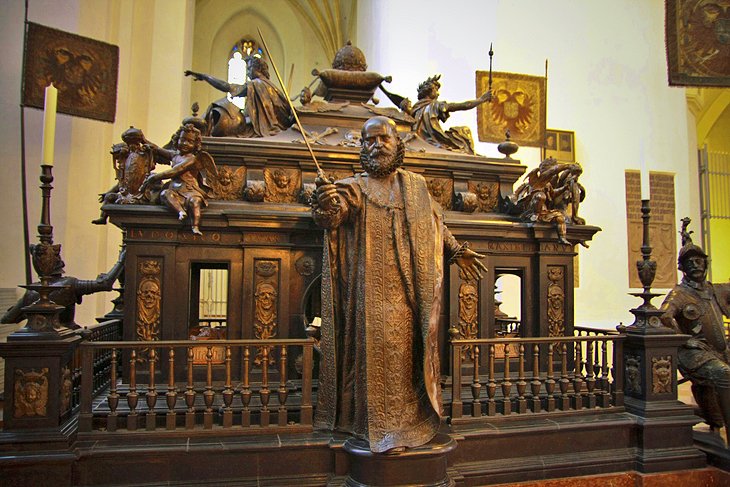
Given its important role as the main church of southern Bavaria, Munich's Frauenkirche has long been the final resting place of some of the region's most famous historic figures. While many of these tombs are to be found in the crypt, including those of Archbishop Michael Cardinal Faulhaber from 1952, Joseph Cardinal Wendel from 1960, and Julius Cardinal Döpfner from 1976 - along with numerous members of the wealthy Wittelsbach family - many of the most well known are in the chapels in the main part of the cathedral. Notable examples include the Tomb of the Emperor Ludwig the Bavarian, a free-standing monument erected in 1622 in black marble with magnificent bronze figures of Dukes Wilhelm IV and Albrecht V and, at the four corners, armor-clad standard-bearers made by Hubert Gerhard. In the South Tower Chapel is the Tomb of Jörg Halspach (known as Ganghofer), architect of the Frauenkirche, while in the North Tower Chapel is the Tulbeck Tomb from 1476. Also of interest is the 14th-century tombstone of the aristocratic Ligsalz family in the Chapel of the Immaculata.
Touring Munich's Frauenkirche
Munich's Frauenkirche - the Cathedral of Our Lady - offers one-hour tours of the building. Cathedral tours are conducted by staff from the Munich Educational Institute, and run from May to October on Tuesdays, Thursdays, and Sundays at 2pm. All tours begin at the organ loft. Occasional biblical-themed tours are conducted, each lasting 45 minutes and focusing on a specific area of the cathedral (free admission). The cathedral is also a staple of the many private tours of Munich's tourist attractions.
Tips and Tactics: How to Make the Most of Your Visit to Munich's Frauenkirche
The following tips and tactics will help ensure you get the most out of your cathedral visit:
- Services: Visitors are welcome to participate in the cathedral's daily services, including Holy Mass (morning and evening) and Midday Prayers.
- Special Viewings: If visiting in August, each Monday at 11am church staff open the Island Altar for a short time for viewing prior to noon prayers (free admission).
- Shopping: From April to October, a small shop is open in the South Tower Chapel selling a variety of religious items and souvenirs.
- Concerts: The cathedral offers frequent concerts and organ recitals, so be sure to check for times and availability when visiting (admission fees vary).
Getting to the Frauenkirche
- On Foot: Munich's cathedral is conveniently located in the city center at Frauenplatz 12, close to many of the city's major tourist attractions.
- By Subway / U-Bahn: The cathedral is well served by the Marienplatz U-Bahn station (look for trains U3 U6).
- By Bus and Tram: The cathedral is accessible by overland public transit, including buses and trams.
- By Train: Munich's main rail terminus is München Hauptbahnhof - one of the busiest train stations in Europe. From here, it's about a 14-minute walk to the Frauenkirche.
- By Road: As with most major European cities, much of the old city center of Munich is designated as pedestrian only. If driving is a must, park on the city's outskirts and use public transit.
- Parking: Very little on-street parking is available, and public car parks are often crowded and costly.
Address
Frauenplatz 12, 80331 München, Germany
What's Nearby?
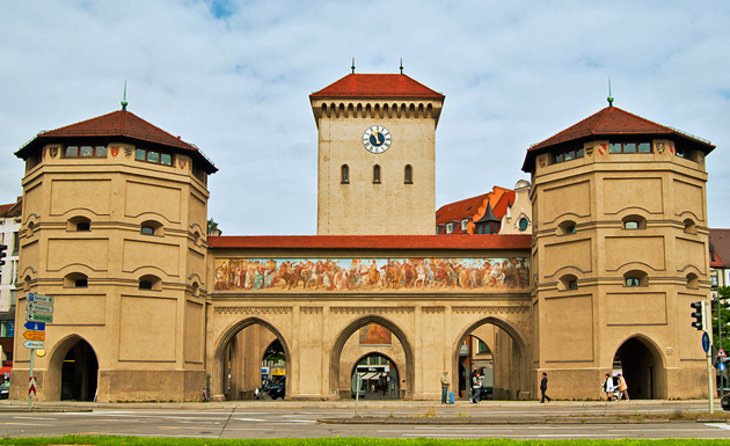
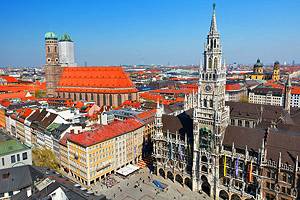
Thanks to its location in the very heart of Munich's always bustling old city district, the Frauenkirche is close to many of the city's other major attractions, as well as numerous superb restaurants, hotels, and pedestrian-friendly shopping opportunities. Particular attractions within an easy walk include Marienplatz, for centuries Munich's central square and home to many splendid 19th- and 20th-century buildings, and the famous Virgin's Column (Mariensäule), erected in 1638 in thanks for the preservation of Munich and Landshut during the Swedish occupation of 1632. Also worth a look is the nearby Isartor, Munich's only surviving gate-tower and a part of the fortifications erected by Ludwig the Bavarian in the early 14th century, and the New Town Hall, a striking building decorated with figures from Munich's rich history.