

Ulm, Germany's 10 Prime Tourist Attractions You Should Never Skip
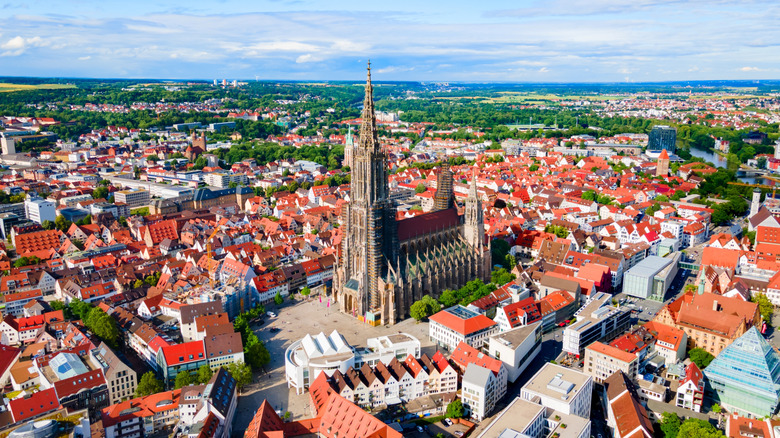
If visiting Germany for the first time, chances are your itinerary includes at least one huge, historic urban hub like Berlin, Munich, or Hamburg — the latter of which is a bit of an underrated German gem known as the "Venice of the North." But sandwiched between Stuttgart and Munich, in the southern part of the country, you'll find the charming city of Ulm. Better yet, because the drive takes less than two hours from either city, along with being easily reached via straightforward train routes, Ulm is a fantastic choice for a day trip or a weekend getaway.
Ulm is the birthplace of one of the world's most famous scientists, Albert Einstein, who was born here in 1879. Although he and his family moved to Munich when he was only a year old, his presence is remembered in the form of a quirky, artist-designed fountain outside the historic arsenal, or Zeughaus, at the edge of the city center. Look for his iconic portrait with his tongue sticking out, seen emerging from a snail shell. And while the sculpture has been a tourist attraction since 1984, Ulm is also home to a small museum dedicated to the Einstein family, which opened in 2024 in the Altstadt, or Old Town.
The southern German city also holds the distinction of hosting a large church, Ulm Minster, which boasts the tallest ecclesiastical tower in the world. Steeped in history, visitors can also explore Renaissance architecture in Ulm, as well as take in remarkable views over the Danube River from centuries-old fortifications, and immerse themselves in a dynamic food culture. Below, find 10 fantastic tourist attractions that highlight the best of Ulm.
Peer up at the soaring Ulm Minster
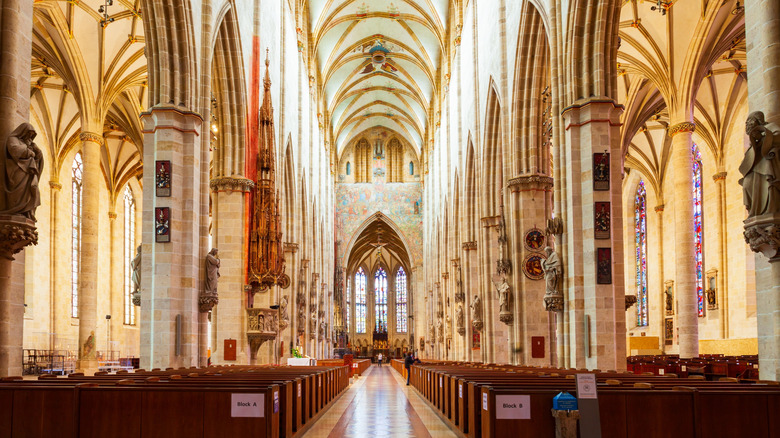
Ecclesiastical architecture harbors a wealth of different classifications for different types of buildings. What makes a cathedral, a cathedral? Or a basilica? The answer lies in who serves there or its purpose. A cathedral is where the bishop or archbishop of a diocese is based, while a basilica is so named because the Pope declares the church to be particularly significant. So where does a "minster" fall in all of this? More specifically, the famously tall Ulm Minster? Although not a cathedral, at its soaring scale, you would be forgiven for assuming it is. However, a minster is a type of important church — its name derived from an Old English word, "mynster" — indicating a religious community.
The construction of Ulm Minster, or at least the laying of the very first stone, began on June 30, 1377. In 1492, blocks from the unstable tower crashed into the church during a service, revealing structural issues. Due to lack of funds, though, repairs were halted in 1543. However, in the mid-19th century, a renewed love for medieval style swept across Europe, and construction began anew in 1844. Finally, on May 31, 1890 — more than 500 years later — the tower was finally finished. Today, it measures 530 feet tall and remains the tallest church tower in the world. That is, at least until La Sagrada Familia — a beloved Barcelona landmark named as the world's top travel attraction for 2025 — is officially finished.
Entry to Ulm Minster is free, and climbing the tower is also free. There are a whopping 768 steps to get to the viewing platform, but the views from the top will blow you away. The church's surrounding Münsterplatz is also charming to wander around, especially on market days.
Stroll the old Fishermen's and Tanners' Quarter
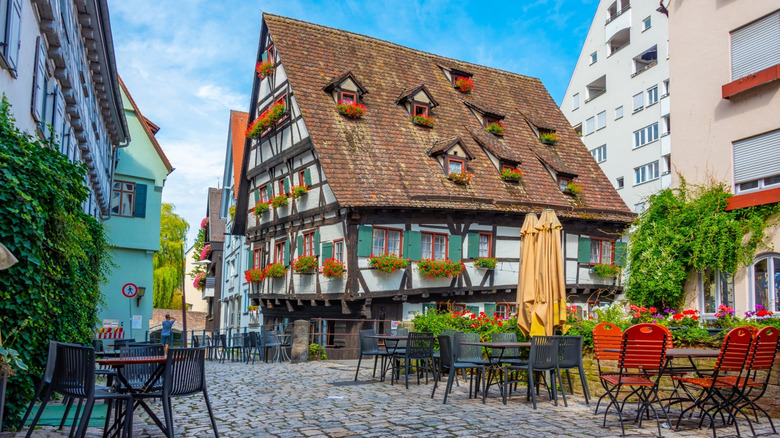
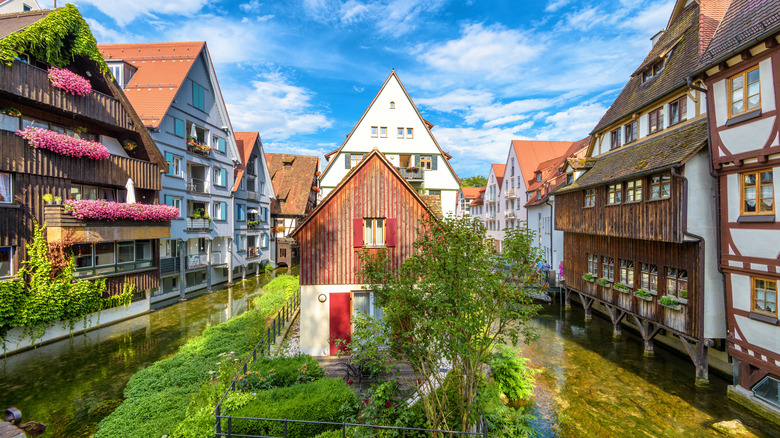
If you can't resist a walk through history, a wander through Ulm's Fishermen's and Tanners' Quarter won't disappoint. There, you'll be treated to Renaissance architecture, bridges and waterways, and plenty of quaint cafes and shops. Half-timbered houses, flower boxes, cobbled streets, and charmingly shuttered windows mean a photo op in every direction.
This area, often referred to as the Fischerviertel, is also home to the iconically slanted "Crooked House," which was renovated in 1995 as a guesthouse with its dramatic lean left intact. Known as The Schiefes Haus Hotel, visitors can book a night here to experience modern comfort in a much-beloved and quirky building overlooking the Blau River.
Two branches of the Blau River run through the Fishermen's and Tanners' Quarter. This is perhaps unsurprising when you consider the name of the area, since the historic trades were dependent on the availability of water. From the 15th to 17th centuries, buildings' foundations were built right into the water, which has led to some leaning and shifting over time — all part of what makes it unique and a joy to wander around. You'll also have plenty of options for atmospheric restaurants to grab a bite or enjoy a glass of German beer, like Gaststuben Im Zunfthaus Der Schiffleute, with its timber interior, and Gerberhaus, with its similarly comforting wood-paneled feel.
Travel back in time at the Rathaus
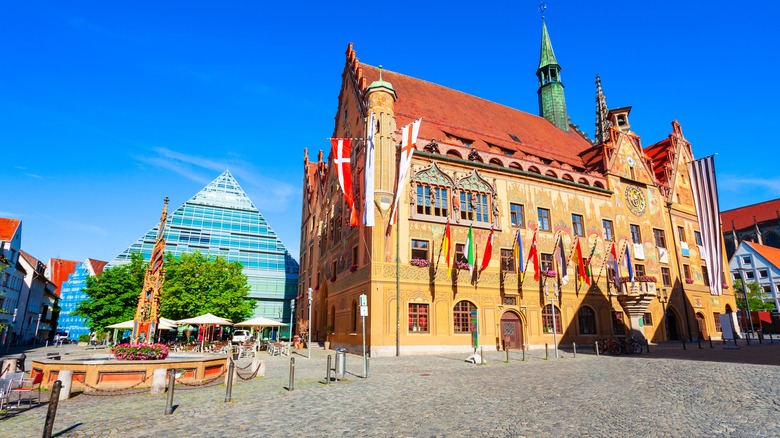
An unmissable feature of Ulm's historic city center is its ornate 14th-century Rathaus, or Town Hall. Its decor and murals include a gilded astrological clock that was installed on the east gable in 1520, along with opulent narrative murals that survive from the mid-16th century. The clock includes the movements of the sun, moon, and the zodiac constellations, with a total of 14 esoteric functions or routines. The gables are also framed with elaborate, gingerbread-like embellishments made of brick.
The building that eventually became the Rathaus was actually originally constructed as a warehouse in 1370, and it was later expanded. The structure was adopted as the town hall around 1419, during which the characteristically pointed Gothic windows were added. Part of its attraction is that it's so large, encompassing a street corner and including a covered arcade alongside numerous dormer windows in the steep-gabled roof. It also strikes a unique contrast to the modern, glass-clad, pyramid-shaped Central Library nearby.
Inside the Rathaus, visitors can see a reproduction of an 1811 flying machine devised by Albrecht Berblinger, known as one of the first people to attempt flight nearly a century before the Wright brothers were successful. The town hall building is open weekdays from 8 a.m., and is free to visit.
Take in views from the Old Town Walls
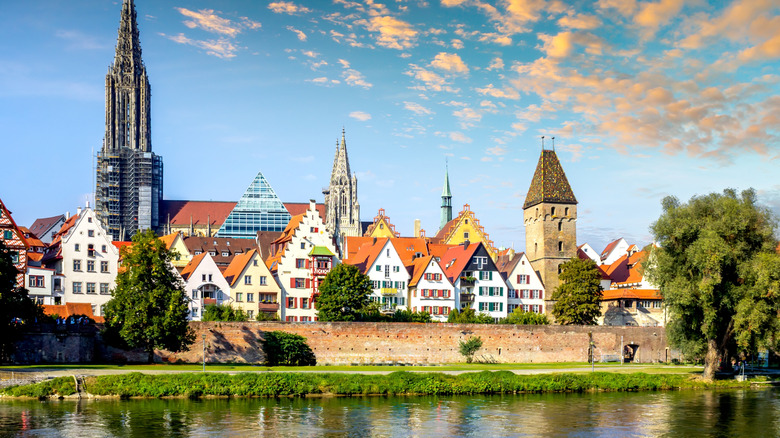
Germany is chock-a-block with stunning medieval town centers, like those you'll find in Heidelberg or Bamberg, a beautiful town spread across seven hills that's also considered one of Europe's most beautiful. And Ulm is no exception. On the north bank of the Danube River, combine beautiful views of the city with 15th-century history in one go during a visit to the Old Town Walls, also known as Ulmer Stadtmauer.
Built in the late 1400s, the tall stretch of masonry, located just south of the Fishermen's and Tanners' Quarter, stretches along a green space that would have originally been part of the river. Notably, one key hint that the walls once protected the city at the water's edge is the existence of iron rings that would have likely been used to moor sailing vessels.
The wall was even taller before Napoleon seized the city in the early 19th century by way of the 1805 Battle of Ulm, which reduced its overall height. During his conquest, he also demolished all but one of the towers. The one that remains is called the Metzgerturm, a tall — and slightly askew — medieval stone tower erected in 1349. Today, some of the city's most beautiful views of the Danube and its old town can be seen from the promenade, with blossoming trees in the park and lovely sight lines down the river. The park is also a fantastic place to bring a picnic in the summer.
Explore Museum Ulm and Kunsthalle Weishaupt
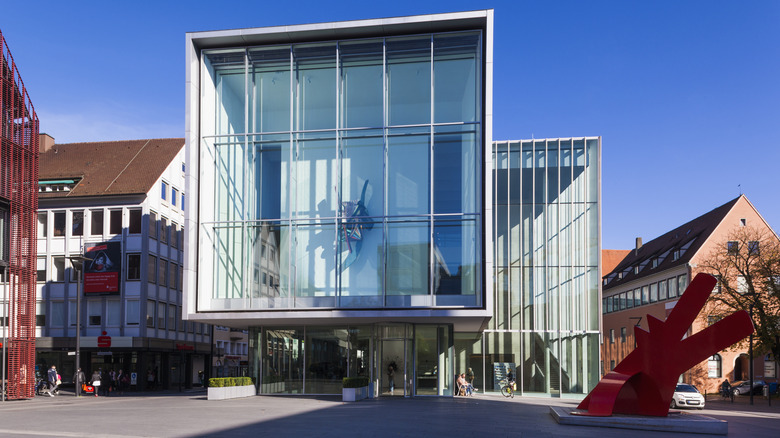
For lovers of the arts, history, and culture, Ulm has no shortage of things to see. This includes a couple of fantastic museums perfect for an in-depth look at the region. Museum Ulm, for one, is located within a complex of buildings with architectural histories ranging from the 16th to the 20th centuries, and its collection boasts art and cultural heritage from Germany, Europe, and around the world. One of the key items in its holdings is a figure known as the "Lion Man," one of the oldest artworks ever found. Carved from a mammoth tusk — yes, the animal! — around 40,000 years ago, it depicts a human figure with a lion's head. The piece was discovered in a cave in the Lone Valley — part of the mountainous, UNESCO-designated Swabian Jura area — and is considered the first-known depiction of a mythical figure. That said, it's just one of numerous Ice Age finds that have emerged from caves in the area.
Museum Ulm is currently closed for a major renovation, but the space is expected to reopen in late 2026. In the meantime, check out Kunsthalle Weishaupt, which offers a completely different way to delve into the world of art in the city. The museum is the fruit of the Weishaupt family art collection, amassed over the course of five decades, which has been transformed into a museum that's open to the public. The permanent collection consists largely of American and European modernist and contemporary works created since the 1960s, with an emphasis on bold hues and geometric abstraction. Moreover, family-established museums such as this one offer a unique opportunity to see privately collected artwork by acclaimed artists which could just as easily be hidden away, out of public view.
Take a day trip to Wiblingen Abbey
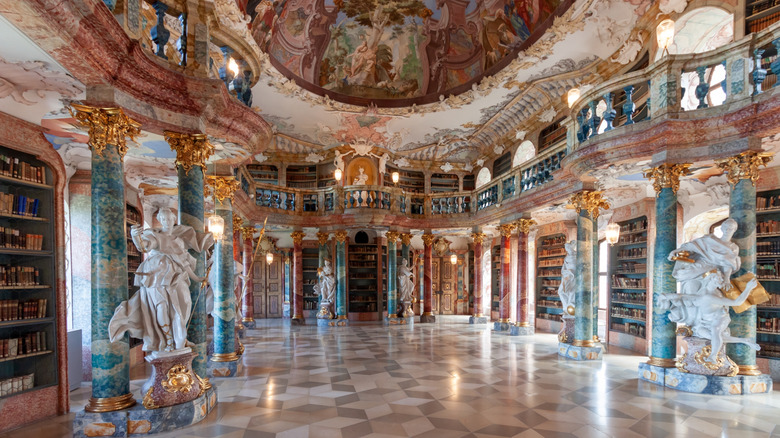
When we think of monasteries, we often think of places that eschew ornamentation for simpler decor that encourages contemplation and devotion. That's not the case with Wiblingen Abbey, a remarkable example of Baroque architecture that features elaborately embellished Rococo interiors. The church, with its famous library, traces its history back to 1093, when it was more modest and served by Benedictine monks. In 1714, a project set out to expand the church into a work of art. As a result, the ornate library is constructed from various colors of marble with gilded Corinthian columns and contains romantic statues, an undulating mezzanine, and an expansive ceiling mural. Similarly, the monastery's gilt confection of a church, Saint Martin's Basilica, is also crowned with late 18th-century frescoes by a regional artist named Januarius Zick.
Wiblingen is only a 10-minute drive south of central Ulm, and well worth a visit for an afternoon escape from town. The church is undergoing major renovation works, so it's closed entirely until sometime in early 2026, with parts of it covered in scaffolding through 2028. That said, the library and monastery museum remain open. Adult admission costs around $7 — visits to the church are free — and hours vary by season. During the warmer months, you can visit between Tuesday and Sunday; meanwhile, during the winter, the monastery is only open on weekends.
Take part in tradition at the Oath House
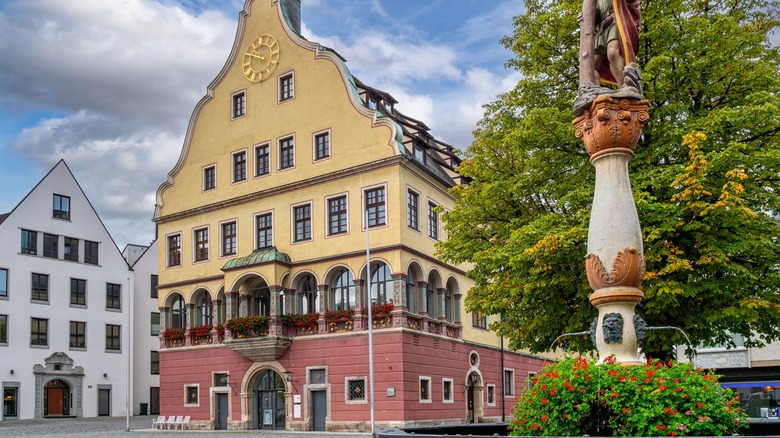
Just three blocks from the singular historic building known as the Rathaus, another unique structure continues to fascinate visitors and locals alike. The Schwörhaus, or Oath House, has a long story steeped in tradition. Its roots go back to 854, when a royal palace sat on the site. Within a few centuries, the wine trade flourished in this part of town — notable in local street names like Weinhof, which means "winery" — and over the years, as buildings came and went, the chapel of the palace survived to see the early 1600s. Eventually, it was augmented by an arcade known as the "Little Oath House," when both elements were totally replaced with a building much like we see today. It's been rebuilt a couple of times — once in 1785 after a fire, and another time in 1944 after it sustained damage during World War II.
Every July, on the second-to-last Monday, the Oath House becomes the highlight of a very Ulm holiday known as Schwörmontag, or Oath Monday, during which the Lord Mayor addresses the town with a report about the previous year. Happening annually since at least 1345, it's a traditional legal holiday and cause for great celebration around the city. If you're in town the week before, a wide range of festivities lead up to Oath Monday, including an 11-day carnival and the splendid "Serenade of Lights" on the prior Saturday, when thousands of lights float down the Danube in a dazzling display.
Explore the Danube Swabian Central Museum
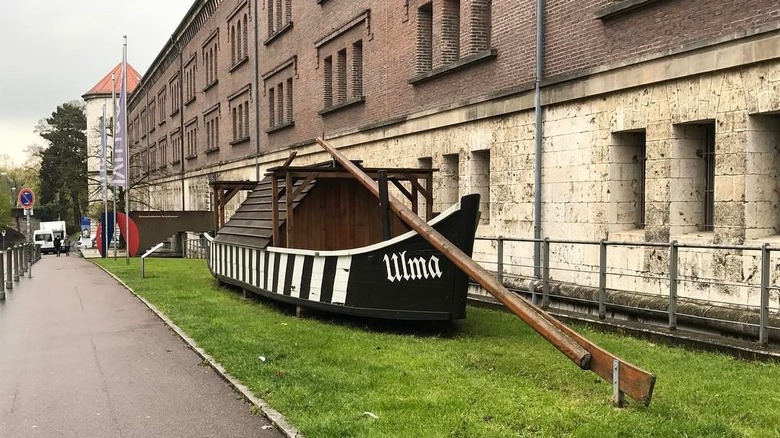
There are some museums in Europe that Rick Steves warns are total tourist traps, but one of the perks of visiting a less touristy destination like Ulm is that the museums are often crowd-free and just as rewarding to visit. Furthermore, regional museums about a city or state's local cultural heritage also offer a wonderful way to gain insight into the place you're visiting. Such is the case with the Danube Swabian Central Museum, a small institution dedicated to the science and history of the people who have lived along the Danube River since the 18th century.
Swabia was a region in southern Germany that is now defined by Baden-Württemberg, Bavaria, and parts of Switzerland and the Alsace region of France. Danube Swabians, or Donauschwaben, are descended from settlers in the region who moved to the Danube valley as a result of war. The museum highlights this emigration through a wide-ranging collection of Swabian historical objects, photographs, and other archival materials.
A total of 13 rooms lead visitors through the story of the settlers' arrival to their communal life within the riverine landscape, and the effects of evolving politics throughout the 20th century. Adult admission is roughly $6, and the museum is open every day of the week except Monday.
Sink your teeth into the Museum of Bread and Art
In our era of supermarkets and convenience stores, and in our daily lives, certain food staples like bread and grain are things we tend to take for granted. But our relationship with grain has always been significant — from small-scale farming methods developed centuries ago to high-tech genetic modifications to armies that have won battles due to their ability to cut off their enemies' supply.
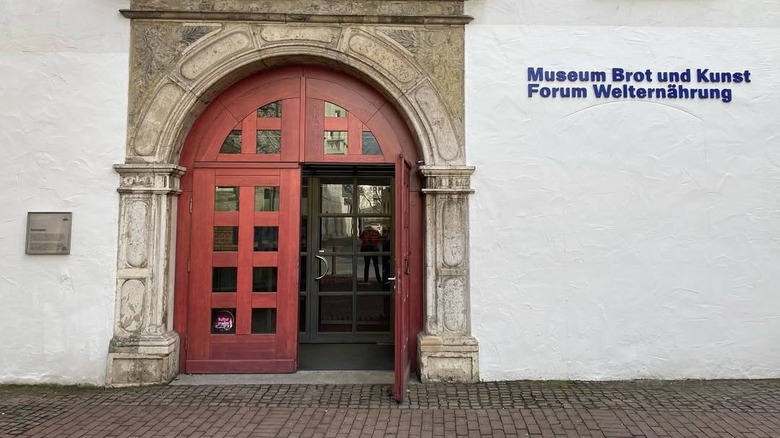
Ulm's unique Museum Brot und Kunst, formerly known as the Museum der Brotkultur, is a unique look at the science, history, and art of bread. It's a great spot inside a wonderful historic building that's a great addition to your itinerary, especially if you're into checking out super-specific or weird museums around the world.
Through 16,000 objects, the museum imparts the story of how grain sustains us, focusing on its nutritional characteristics as well as its cultural significance around the world. The other facet of the museum is its fairly impressive art collection, which includes works by art historical titans like Rembrandt, Marc Chagall, Salvador Dalí, Pablo Picasso, and more. Special exhibitions explore bread through the lens of art and pop culture — think Andy Warhol's 1982 performance titled "Eating a Hamburger" — with surprising curatorial rigor considering the museum's deceptively simple premise. Overall, the Museum Brot und Kunst provides a thoughtful look at the crucial and increasing issue of food scarcity and nutrition around the world.
Find fresh food at the Farmer's Market
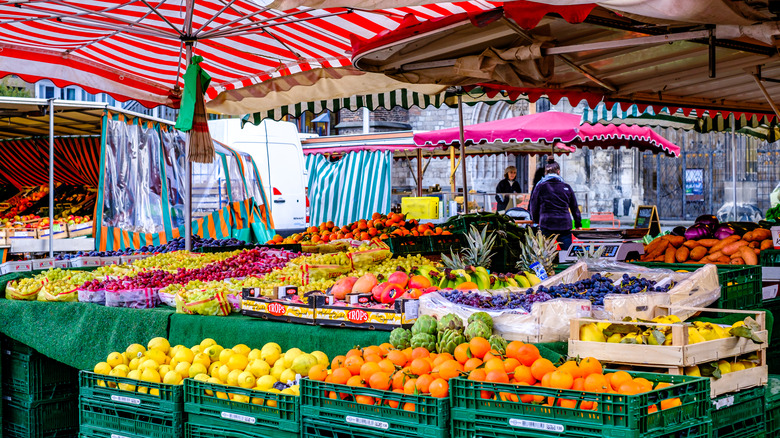
There's nothing quite like the experience of hand-selecting your own produce or bakery item from a stall in a farmer's market, whether you're a regular at a local event or you're visiting a new city for the first time. And considering Europe is well-known for its markets, which range from small outdoor pop-ups on city blocks to massive indoor shopping experiences, you'd be remiss to pass them by. Ulm is no exception when it comes to a great open-air market, which is known locally as Ulmer Wochenmärkte. Rather than stick to one spot, however, the market pop ups on different days of the week in different parts of town.
On Wednesday and Saturday mornings, stop by the largest and most frequent market in Münsterplatz, where dozens of stands feature fresh fruits and vegetables, meat and sausages, cheese, bakery, and more. Münsterplatz is also the home of Ulm Minster, so you'll not only be treated to great eats, but also splendid views of the city and its major landmarks. While you're there, grab lunch or a coffee at Sicilian-inspired Spresso Caffébar Cucina.
Other farmer's markets are programmed throughout the week in suburbs like Wiblingen and Söflinger, with a schedule available on the official website. Even if you're staying in a hotel and don't have any way to prepare fresh meals, it's well worth a stop for snackable delicacies and to support local farmers and producers. That said, make sure you keep an eye out for the hidden price difference travel pro Rick Steves notes can lead to costly mistakes. And speaking of markets, don't miss a chance to experience Ulm's very festive holiday market in the Münsterplatz during the month leading up to Christmas.
Methodology
To round up the top 10 things to do on a visit to Ulm, we consulted regional and national tourism sites like Tourismus.Ulm.de, Visit-BW.de, and Germany.Travel. Additionally, we gleaned local information like opening times and historical context from official destination websites like Ulmer-Muenster.de, MuseumUlm.de, Kloster-Wiblingen.de, and DZM-Museum.de.
For additional historical information and data, we researched Britannica.com, Lonely Planet, Frommers.com, Universität Ulm, UNESCO, and Atlas Obscura to verify historical accuracy and provide comprehensive insights. Finally, we also relied on recommendations and reviews from visitors on sites like TripAdvisor and Google Maps to ensure we were truly highlighting the city's must-see attractions.