Churches in Florence
Along with being places of worship, Florence's churches and convents hold as much precious art as many museums. In fact, some no longer serve as churches at all and have been turned into civic museums. Several active churches are among the city's most important tourist attractions, and you won't want to leave without looking up into Brunelleschi's great dome in the Cathedral of Santa Maria del Fiore or seeing Michelangelo's Medici Tombs in San Lorenzo.
But don't overlook some of the less famous churches, where you'll discover astonishing works of marble inlay, fresco, mosaic, stone carving, and architecture by the leading Renaissance masters and others before and after them, who together have made Florence's churches among Italy's most beautiful.
In some churches, where major artworks are in dim side chapels, look for the boxes along the side walls near the front of the chapel, where you can light the room by depositing coins into a meter. Learn more about where to see some of the city's most famous works of art with our list of the top churches in Florence.
Cathedral of Santa Maria del Fiore
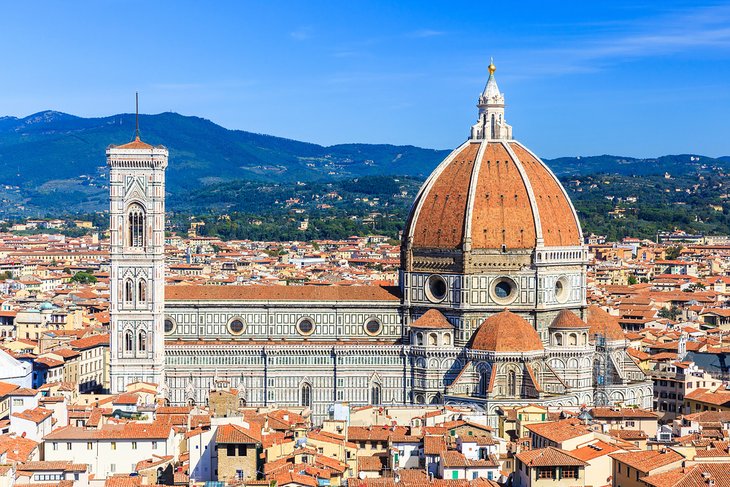
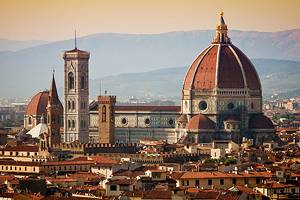
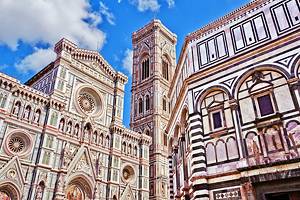
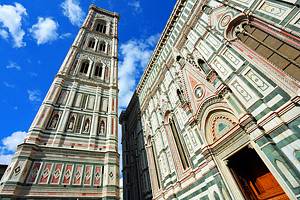
Most of the greatest artists of the Italian Renaissance had a hand in creating Florence's monumental architectural icon, the cathedral complex of the church, baptistery, and campanile. Ghiberti's exquisite bronze doors on the baptistery, Giotto's graceful bell tower, and Brunelleschi's magnificent dome are only the beginning of the treasures of the most famous church in Florence.
So rich are the cathedral's treasures that an entire museum is filled with the overflow. Because this is the most popular thing to see in Florence, the lines for admission are formidable. You can avoid these, and be sure of seeing everything in the great cathedral - including some places that are not open to general tourists - on a skip-the-line tour.
Santa Maria Novella
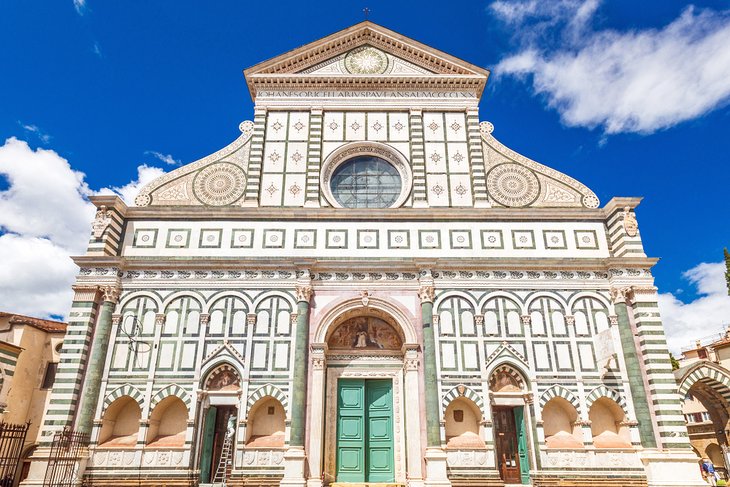
One of Florence's most important churches, the Dominican church of Santa Maria Novella was begun in 1246 and completed over a century later. The dramatic facade of inlaid colored marble, added yet another century later, makes it the focal point of the large square that spreads out in front of it.
Architect Leon Battista Alberti combined Romanesque-Gothic and Renaissance styles to give it the distinctive shape. The interior also shows elements of both styles, combining the Gothic height with the open concept of the Renaissance. The rose-window is the oldest in Florence, and the interior is yet another who's who of Florentine artists.
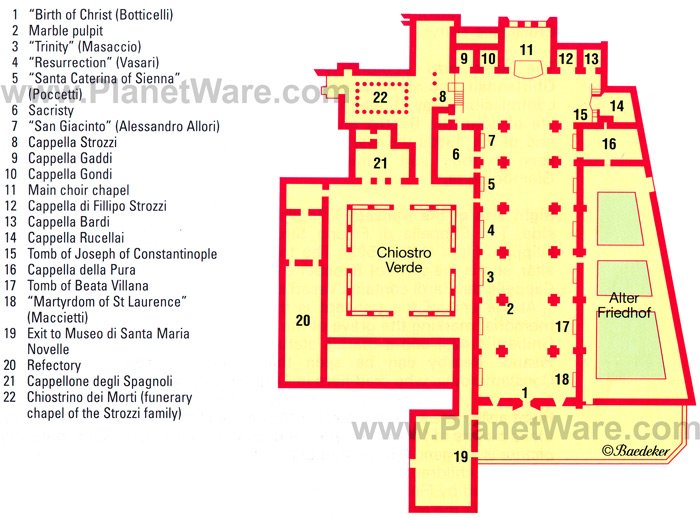
The marble pulpit at the second pillar in the left aisle was designed by Brunelleschi in 1443. The fresco of the Trinity on the third altar is considered one of Masaccio's finest works (notice the perfect perspective).
In the sacristy, the Crucifixion scene above the door is an early Giotto from about 1290. The altar painting in the Cappella Gaddi is Bronzino's Christ raising the Daughter of Jairus, and in the adjacent Cappella Gondi is the celebrated wooden crucifix by Brunelleschi (1410-1425), the first depiction of Christ without a loincloth and the artist's equivalent of Donatello's realistic, peasant-like Christ in Santa Croce.
The apse was completely covered in frescoes by Domenico Ghirlandaio and his assistants between 1486 and 1490. These scenes from the life of John the Baptist and the Virgin, the last great cycle of 15th-century frescoes, have been beautifully restored to their original soft, luminous colors. Be sure to notice how he shows the biblical figures in Renaissance clothing and rooms. The bronze crucifix is by Giambologna.
In the left arm of the transept, the Cappella di Filippo Strozzi is decorated with frescoes by Filippino Lippi, and the adjoining Cappella dei Bardi contains Vasari's Rosary Madonna. The bronze memorial in the Cappella Rucellai is by Lorenzo Ghiberti.
To the left of the church façade is the entrance to the cloisters and chapels of the former convent, where the Green Cloister takes its name from the green tones of Paolo Uccello's frescoes of Old Testament scenes: look especially for his depiction of the flood.
But the highlight of the convent is Cappellone degli Spagnoli, the Spanish Chapel, where Andrea di Bonaiuto's frescoes are among 14th-century Italy's greatest works of art. The entire chapel is lined with detailed depictions on the theme of salvation and damnation.
Address: Piazza Santa Maria Novella 18, Florence
Official site: www.chiesasantamarianovella.it/en
Santa Croce
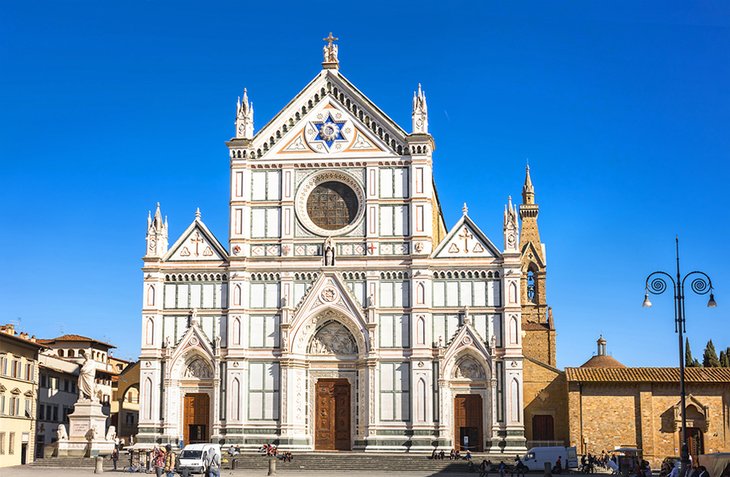
The Franciscan church of Santa Croce was built in the late 14th and early 15th centuries, its facade of inlaid colored marble added in the 1800s. Along with its exceptional frescoes and other artistic attractions, it is notable as the burial place of Florentine luminaries, including Michelangelo and Galileo.
Although Santa Croce is Gothic, its interior is wider than most of that age, more open and spacious, with an open painted-timber ceiling. Look in the side aisles to find the major tombs: Galileo's and a memorial tablet marking the burial place of Lorenzo Ghiberti (of baptistery door fame) are in the north aisle to the left as you enter the church. Michelangelo and the composer Gioacchino Rossini are on the right, along with Machiavelli, last chancellor of the Florentine Republic whose name is invoked to this day in describing ruthless political tactics.
Three muses sculpted by Vasari mourn Michelangelo - Painting, Architecture, and Sculpture. Also in this south aisle is a monument to Dante, erected in 1829, 508 years after his death in Ravenna, where he lived after being exiled from Florence. In this aisle, look for the delicate relief of the Annunciation by Donatello (1435).
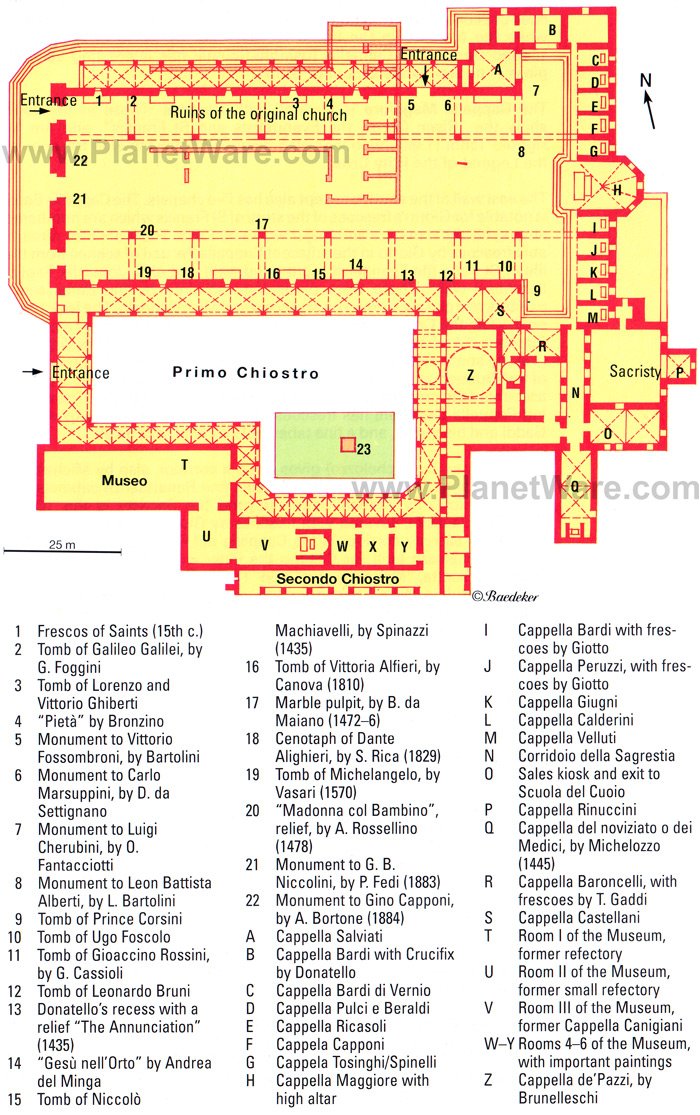
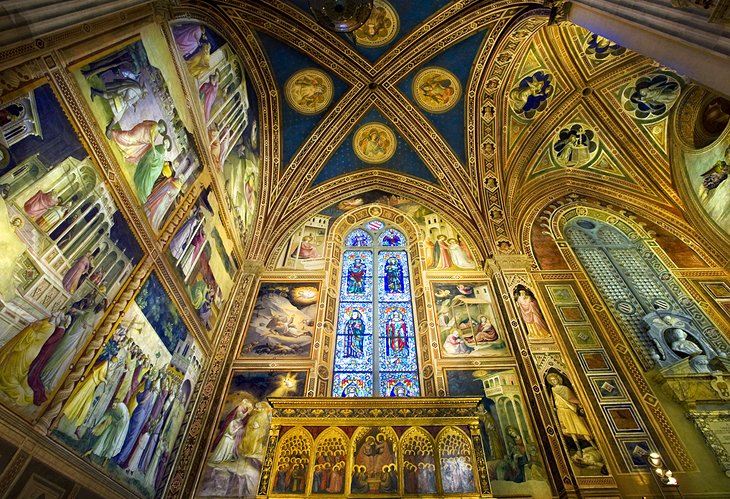
A row of chapels fills the east wall. At the end of the north transept is the Cappella Bardi, with Donatello's Christ Crucified, criticized by Brunelleschi as looking like a peasant, but now considered one of the finest examples of humanism in the Florentine Renaissance. The Cappella Tosinghi-Spinelli has interesting stained-glass windows by the school of Giotto.
The Cappella Maggiore is covered with frescoes; those in the vault include the Risen Christ, the Evangelists, and St. Francis by Agnolo Taddi (1380) who was also responsible for the wall frescoes of the Legend of the Holy Cross. The cross above the main altar, painted by Maestro di Figline, was one of the first works of art placed inside Santa Croce church and has been beautifully restored.
In the south transept, look for the Cappella Bardi, where Giotto's frescoes of the story of St. Francis are among his major works, done about 1320. You'll find more of Giotto's remarkable frescoes in the adjacent Cappella Peruzzi, where scenes from the life of St. John the Evangelist cover the right-hand wall, while scenes of St. John the Baptist are on the left. Renaissance painters, including Masaccio and Michelangelo, admired and studied these.
The last chapel on the left, the Cappella Velluti, has some damaged frescoes by a student of Cimabue and Giotto's Coronation of the Virgin. One of the artistic highlights of Santa Croce is at the far end of the transept, the Cappella Baroncelli. The frescoes of the Prophets at the entrance and of the Life of the Virgin on the walls are considered the greatest work of Taddeo Gaddi, who studied under Giotto.
Through a doorway, a corridor leads to the sacristy, where you'll find perhaps the most famous artwork in the entire church. Sadly, the magnificent Crucifix by Cimabue was badly damaged in the 1966 flood and gained even greater fame as the most important single art work damaged in the disaster. After long and painstaking restoration, Cimabue's masterpiece is again on display.
This was one of the first Florentine works to break away from the rigid Byzantine styles and foretell the naturalism and humanism of the Renaissance. It was to influence painters from Cimabue's own student, Giotto, to Michelangelo and Caravaggio.
Address: Piazza Santa Croce 16, Florence
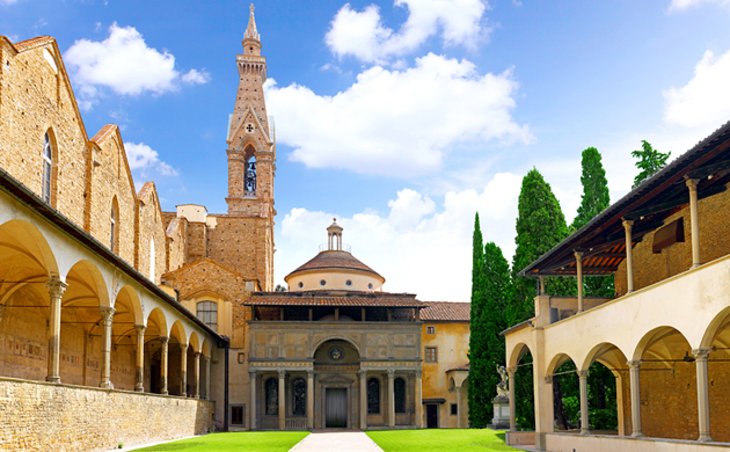
To the right of Santa Croce is the entrance to the monastery buildings, where the first cloister leads into the Cappella dei Pazzi. Brunelleschi worked on this from 1430 until his death in 1446, as a burial chapel for the Pazzi family and chapterhouse of the Franciscans.
The cupola has beautiful rosettes by Luca della Robbia, who also carved the Relief of St. Andrew (1445) above the wooden doors. His four terra-cotta medallions show the seated evangelists, and the 12 tondi of the apostles are in white ceramic on a blue ground.
The two-story Chiostro Grande, the Great Cloister, was designed by Brunelleschi. Don't miss seeing the refectory, with Taddeo Gaddi's huge Last Supper, and above it, the Tree of the Cross.
The Scuola del Cuoio was founded by the monastery in the aftermath of World War II, to teach war orphans a trade. Today, they still train students in the art of the fine leatherwork that Florence is famed for, and you can visit the workshops to watch students fashion leather jackets, handbags, wallets, and boxes. Their shop helps support the school.
Address: Piazza Santa Croce 16, Florence
Official site: http://www.santacroceopera.it/en/
San Lorenzo
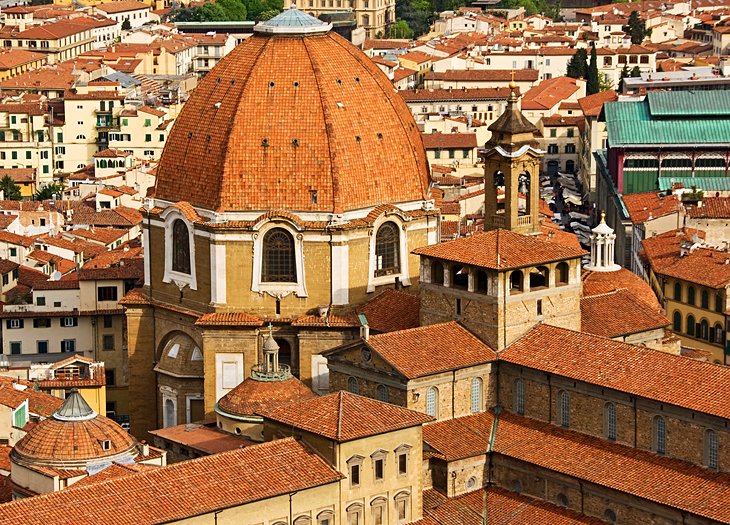
The Medici family didn't do things by halves, but even they couldn't have dreamed that their family church and mausoleum would, more than five centuries later, still be considered one of the world's greatest artistic achievements. And its highlight - Michelangelo's New Sacristy - was never even finished.
In the church itself, Brunelleschi created the ideal of Renaissance architectural harmony and it was decorated by Donatello, Lippi, and other masters. Their combined artistry, and especially Michelangelo's Medici Tombs, make San Lorenzo one of the top places to visit in Florence.
San Miniato al Monte
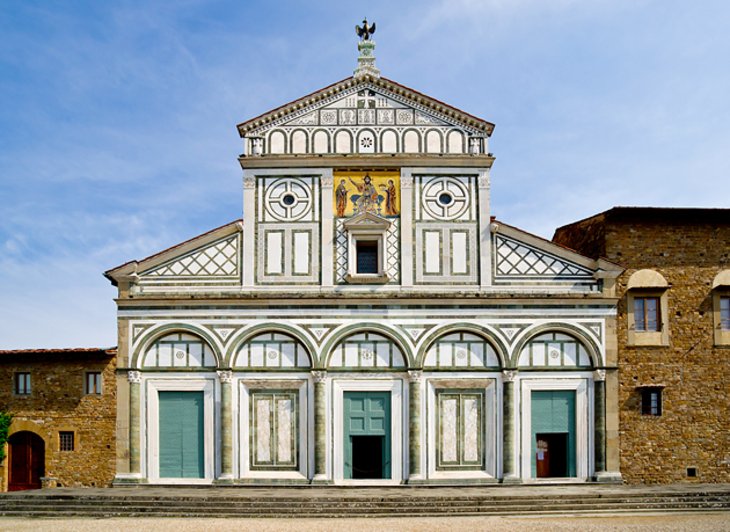
With all the outstanding churches right in the center of Florence, you might ask why you should take a bus or climb to this one, high above the city on the opposite side of the Arno. The answer lies both in the church and its location above Piazzale Michelangelo, the city's best viewpoint and one of the most popular things to see in Florence.
After touring churches and museums, you'll want a break, and the trip to San Miniato, and the view, will restore your enthusiasm. Even the inlaid green-and-white marble façade - the first in Florence and soon copied by other churches - is different, framing a large gold mosaic. You'll see how styles were already blending in the late 11th and 12th centuries, with Byzantine mosaics and echoes of Classical Rome in the Romanesque Tuscan architecture.
It's the interior decoration that really sets San Miniato apart. The choir and main altar rise high above the nave, which is wide and open, with a mosaic floor (look for the zodiac motifs) and painted wooden ceiling.
Step forward into the Renaissance, in Michelozzo's Cappella del Crocifisso at the end of the nave, whose glazed terracotta ceiling is in Luca della Robbia's signature blue and white. Back in the late Romanesque, the 12th-century marble pulpit and richly decorated choir screen are among the church's highlights, along with the mosaic in the apse, again showing Byzantine influence.
Below the altar is the crypt with frescoes by Taddeo Gaddi and columns recycled from Roman buildings. Saving the best for last, to the right of the high altar is the sacristy, completely lined in Spinello Aretino's 14th-century masterpiece, Life of St. Benedict. Vibrant colors and the intricate detail used in decorating the groining that frames the scenes make this one of the most splendid rooms in Florence.
Address: Via delle Porte Sante, 34, Florence
San Marco
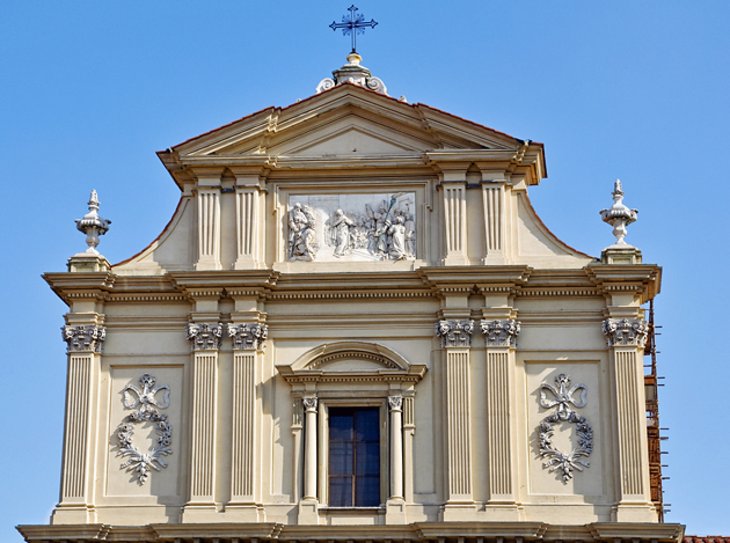
The 1299 church of San Marco was largely reconstructed and the monastery completely rebuilt by the architect Michelozzo in the mid-15th century. Giambologna added the side altars, the Chapel of St. Antonino, and the Salviati Chapel in 1588. Although you'll find some notable art in the church itself - the funerary chapel of St. Antony is considered Giambologna's main architectural work, and the Byzantine mosaic Virgin in Prayer from a Rome oratory dates to 705 - the convent is why you should visit San Marco.
The monastery owes its fame to the Dominican monk Fra Angelico, who painted the monastery rooms between 1436 and 1445, leaving us a "natural" museum. Throughout the monastery are works of this brother, along with a few others, but look especially for these frescoes. Just opposite the entrance to the Cloister of St. Antonino is Fra Angelico's fresco St. Dominic at the Foot of the Cross; in the lunette diagonally opposite the entrance is Ecce Homo.
In the Great Refectory is Fra Bartolomeo's Last Judgment, and in the Sala dei Lavabo is his large 1510 panel Madonna with St. Anne and other Saints. One entire wall of the chapter house is filled by Fra Angelico's fresco The Crucifixion. In the Small Refectory is a famous Last Supper by Ghirlandaio.
But what you will remember the most are the more than 40 monks' cells adorned with frescoes by Fra Angelico and his students. His style is unmistakable, tenderly transforming the austere rigidity of the medieval saints into gentle, human saints that radiate piety and innocence. Look especially for the highly intimate Annunciation opposite the stairs.
Address: Piazza San Marco 3, Florence
Cappella Brancacci and Santa Maria de Carmen
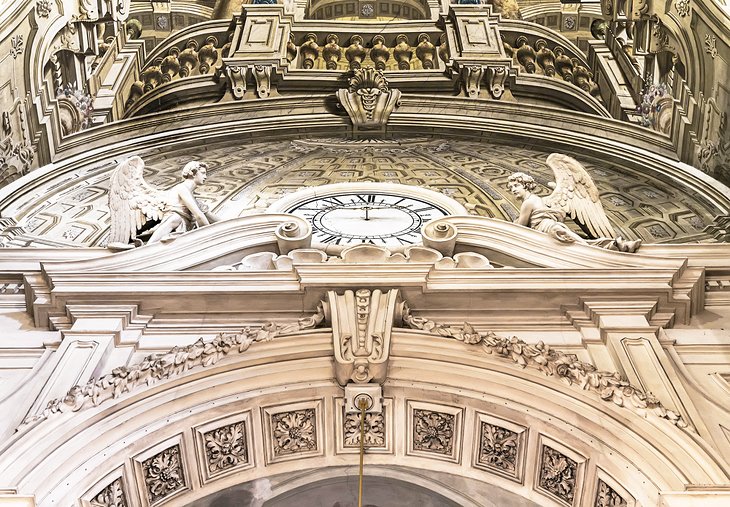
The plain unfinished façade of Santa Maria de Carmen gives no clue to the treasures inside. Neither, in fact, does the first view of its Baroque interior, with its carvings and trompe-l'oeil ceiling. These are the result of rebuilding, after a fire in 1771 destroyed the interior. Fortunately it did not destroy the exquisite attached chapel, the Cappella Brancacci, whose interior is decorated by 15th-century frescoes illustrating the life of St. Peter and other Biblical scenes.
Designed and begun by Masolino da Panicale with his pupil Masaccio, they were completed after Masaccio's death by Filippino Lippi. Recent removal of layers of candle soot have revealed intense colors and made the differences in the work of the different artists more apparent. Masaccio's realism and use of perspective inspired the 15th-century Florentine painters.
Address: Piazza del Carmine 14, Florence
Santo Spirito
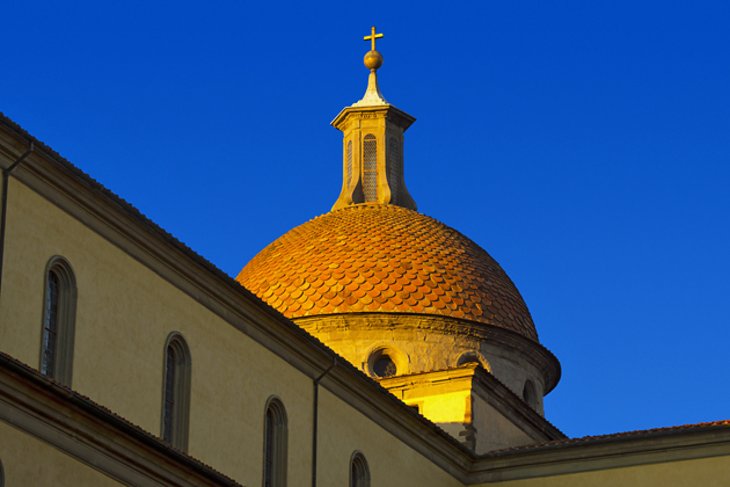
Several wealthy Florentine families commissioned Brunelleschi, the city's famous architect, to design and build a new church in the Oltrarno, and by the time of his death in 1446, building had progressed as far as the vaulting. It was completed, but not entirely to his original plans, so the austere exterior gives no hint that inside is one of the purest Renaissance churches. The side altars in the nave are resplendent with paintings, statuary, and reliefs; be sure to look back up at the rose window in the façade, Descent of the Holy Ghost, designed by Perugino.
The transept chapels hold some of the greatest treasures. In the first chapel of the left arm, look at the window and at Ghirlandaio's Ascent of Calvary, and in the Cappella Corbinelli, exquisitely designed by Andrea Sansovino in 1492, note his sculptures as well. The right arm of the transept holds the most important work in the church, the 1490 altarpiece Madonna and Child with Saints and Donors by Filippino Lippi.
Where the transepts meet in the crossing is Caccini's early Baroque baldachin altar, richly ornamented with pietra dura, the intricate mosaic of semi-precious stones in which Florentine artists excel. In the left aisle is the entrance to a beautiful vestibule built by Cronaca (1492-1494) and the octagonal sacristy, designed by Giuliano da Sangallo in 1495, a masterpiece of European architecture.
Look to the left of the church for the entrance to the Cenacolo, the refectory that is the only remains of the old Augustinian monastery. It contains the fresco of The Last Supper from about 1360 by Andrea Orcagna. Although it's badly damaged, it is one of the most sublime 14th-century works of art in Florence.
Address: Piazza Santo Spirito 30, Florence

Santissima Annunziata (Church of the Annunciation)
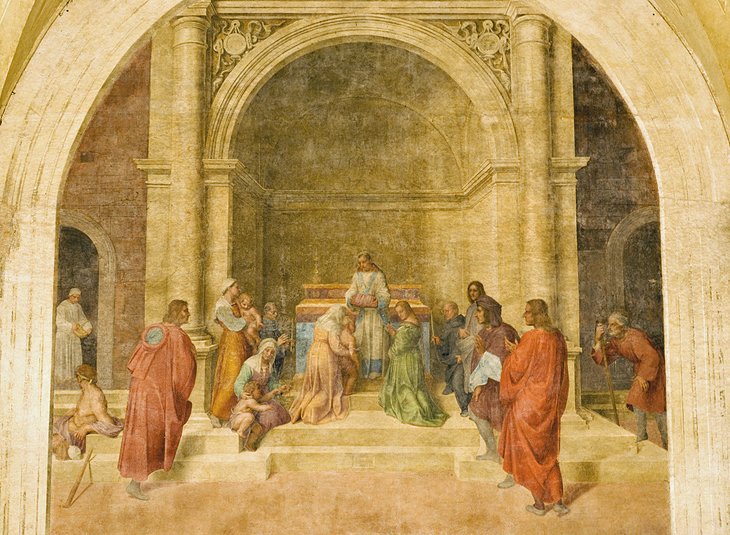
Completely rebuilt between 1444 and 1481 by Michelozzo, the church is considered his architectural masterpiece and contains some superb works of art, although some of the artists may not be universally familiar names.
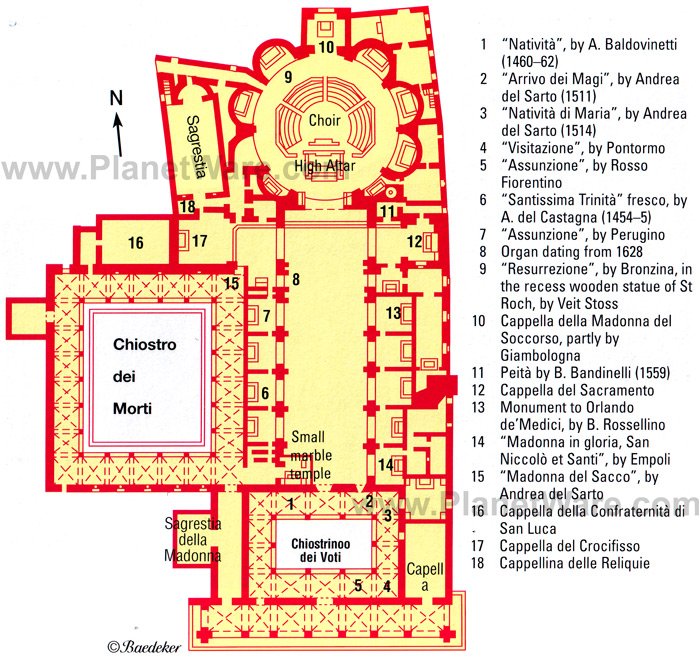
The rotunda, divided into nine chapels, was begun by Michelangelo in 1444 and completed in a different style by Leon Battista Alberti. Close to the entrance, on the left, the small marble temple by Michelozzo was commissioned for the miraculous picture of the Annunciation (the miracle involves the 13th-century monk Friar Bartolomeo, who fell asleep while painting it and awoke to find that angels had completed the face of Mary). The miracle drew pilgrims who left so many votive offerings that the church had to be enlarged to accommodate them. Florentine newlyweds still come here today to leave the bride's bouquet.
Also on the left is the Cappella Feroni with Andrea del Castagno's fresco, Redeemer and St. Julian (1455). His Trinity is in the second chapel, and the fourth chapel has a panel by Perugino, Ascension of Christ. The Cappella della Madonna del Soccorso was designed by Giambologna between 1594 and 1598 as his own tomb and is adorned with frescoes, statues, and reliefs.
A door from the left side of the portico leads into the Chiostro dei Morti, where the fresco Madonna del Sacco is a major work of Andrea del Sarto (1525). Adjoining it are the chapterhouse, several chapels, and the sacristy. The right-hand door in the portico leads into chapels and the Chiostrino dei Voti (Votive Cloister), known for its frescoes. From the left, these include masterpieces by Andrea del Sarto (scenes from the life of St. Filippo Benizzi); Cosimo Rosselli (Summoning and Robing of St. Filippo Benizzi); Alesso Baldovinetti's Nativity; del Sarto's Coming of the Magi and one of his finest, Birth of the Virgin (1514).
Address: Piazza SS Annunziata
Ognissanti (All Saints' Church)
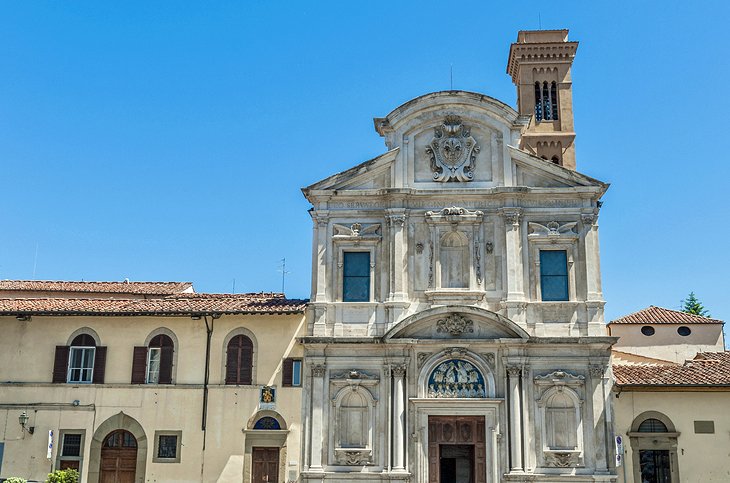
The church of Ognissanti, one of the first Baroque churches in Florence, dates back to a 13th-century building but was completely renovated in the 16th and 17th centuries and restored after damage by the flood of 1966.
At the second altar on the right, in Domenico Ghirlandaio's Madonna della Misericordia (1470), look for the young Amerigo Vespucci, the navigator for whom two continents are named. This was his family's parish church, and Ghirlandaio included him among the parishioners pictured, long before his illustrious career began.
The sacristy contains a painting on wood, Christ Crucified, in the style of Giotto and a fresco of the Crucifixion by Taddeo Gaddi. Enter the cloister through the transept to see 17th-century frescoes with scenes from the life of St. Francis. Beyond is the Cenacolo del Ghirlandaio, the refectory with its fresco of the Last Supper by Ghirlandaio, which takes up the whole of the rear wall. Also here is Ghirlandaio's St. Jerome in his Chamber (1480) and Sandro Botticelli's famous Saint Augustine at Study.
Address: Piazza Ognissanti 42, Florence
San Michele in Orto (Orsanmichele)
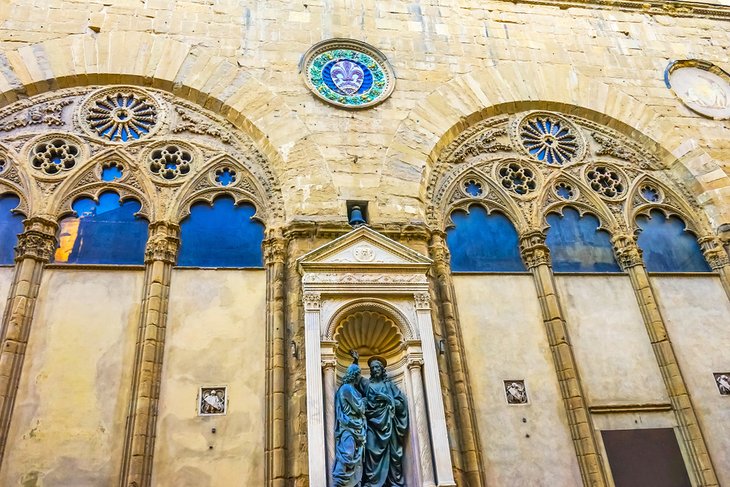
This well-preserved 14th-century building developed from an oratory and a grain trading hall, which held a miraculous picture that attracted more worshippers than buyers. So in the late 14th century, the building's religious significance predominated and it became a church, also known as Orsanmichele.
It wears some of its most famous art on the outside. Before entering, walk around it to admire the delicate stonework in the window arches and niches that mark its architecture. On the Via dei Calzaiuoli side (on the left) is Lorenzo Ghiberti's St. John the Baptist (1414), the first great Renaissance statue in bronze. The next niche (by Donatello) holds Andrea del Verrocchio's major work, Incredulity of St. Thomas, and St. Luke by Giambologna (1600) is on the right.
On the Via dei Lamberti (south) side is Donatello's early St. Mark and on the west facade is Lorenzo Ghiberti's most important large statue, St. Matthew (1419-1422), and his St. Stephen. On the north side is Donatello's St. Peter. The interior is worth a look for its frescoes, paintings, and stained-glass windows. The right-hand nave ends with Orcagna's famous Gothic marble tabernacle from 1349-1359, with the miraculous 1347 picture of the Madonna by Bernardo Daddi in 1347.
Address: Via dell'Arte della Lana, Florence
Sant'Ambrogio
One of the earliest surviving churches in Florence, Sant'Ambrogio was built sometime prior to AD 1000, honoring St. Ambrose, a 4th-century bishop of Milan. Built on the site where the saint stayed when visiting Florence, the church has ecclesiastical significance as the site of two Eucharistic miracles. The first, in 1230, was interpreted as proof of the doctrine of transubstantiation, which was only newly recognized by the church.
In the Cappella del Miracolo is the 15th-century Tabernacle of the Holy Sacrament, containing the blood that miraculously appeared in the chalice as the priest was celebrating Mass. The reliquary is by Mino da Fiesole, and the 15th-century frescoes on the chapel walls are by Cosimo Roselli. On the outside of the church is a painted terra-cotta tabernacle of St. Ambrose in benediction.
Throughout the church are frescoes and other works of art by Giovanni della Robbia, Agnolo Gaddi, Masaccio, Filippo Lippi, Sandro Botticelli, Fra Bartolomeo, and other Florentine masters. Filippo Lippi's "Incoronation of the Virgin," now in the Uffizi Gallery, was painted for the church's main altar in the mid-15th century.
Address: Piazza Sant' Ambrogio, Florence
Santa Trinità
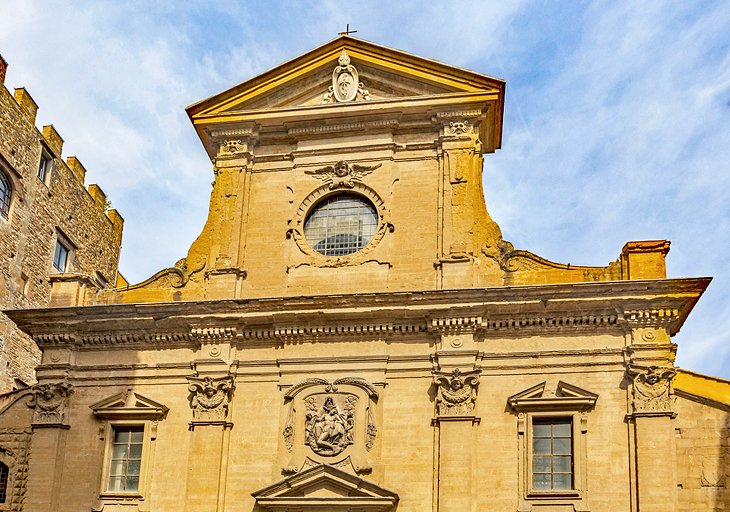
Florentines are especially fond of this venerable church, founded as early as the 11th century and rebuilt in the 13th century (probably by Niccolò Pisano) as Florence's first Gothic church. It was rebuilt yet again in the late 14th century, and the facade, designed by Buontalenti, is from the late 16th century.
Inside, you'll see a fine example of 14th-century Florentine Gothic, along with some outstanding works. Primary among these is the Cappella Sassetti, in the right arm of the transept, where you'll find frescoes by Domenico Ghirlandaio (1483-1486) of the life of St. Francis. The best known of these is Confirmation of the Rule of the Order, where the artist incorporated contemporary personalities and buildings: Lorenzo the Magnificent, Ghirlandaio himself (he's the one with hand on hip), the Piazza della Signoria, and Piazza della Trinità.
The 1485 altarpiece Adoration of the Shepherds is also by Ghirlandaio. In the left arm of the transept is the marble tomb of Bishop Benozzo Federighi, one of Luca della Robbia's finest works.
Address: Piazza di Santa Trìnita, Florence
Cenacolo di Sant'Apollonia
Visit this former convent, now part of the university, to see the beautiful cloister and the refectory with Andrea del Castagno's Last Supper. Painted about 1457, this fresco has an important place in Renaissance painting. Castagno was among the very first to achieve accurate perspective and also among the first to capture the physical drama of a scene.
Above it are Castagno's Crucifixion, Entombment, and Resurrection, as well as his two lunettes Pietà and Christ Crucified with the Virgin, St. John, and Saints, all discovered beneath coats of whitewash when the convent buildings were secularized.
Address: Via XXVII April 1, Florence
Santi Apostoli
Although this church and its works of art were badly damaged in the 1966 floods, the Church of the Holy Apostles is worth seeing for the large terra-cotta tabernacle by Giovanni della Robbia in the left aisle and a panel of the Immaculate Conception by Vasari (1541) in the third chapel of the right aisle. The green marble columns have composite capitals, the first two of which are thought to be from the nearby Roman baths.
Thanks to Michelangelo, this is one of the best-preserved examples of a Romanesque church in Florence. When churches were being "modernized" in the 15th century, he is said to have urged the architect to retrain his changes and leave the basic structure intact.
Along with the della Robbia tabernacle and the Vasari panel, treasures of the church include the "Pietre del Santo Sepolcro," brought to Florence in 1101 by a returning crusader. The stones are believed to have been struck to light the lamps in the tomb of Jesus.
Address: Piazza del Limbo, Florence
Map of Churches in Florence
More Related Articles on PlanetWare.com
Exploring More of Renaissance Florence: Along with the masterpieces in its churches, Florence preserves a tremendous largess of Renaissance art in its palaces. You can learn about the palaces in Florence, and explore two of them in depth with our Visitor's Guide to Palazzo Vecchio (Palazzo della Signoria) and our articles on Exploring the Pitti Palace & Boboli Gardens in Florence.
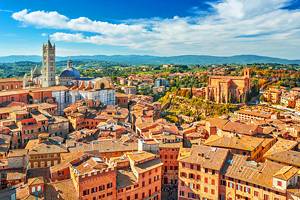
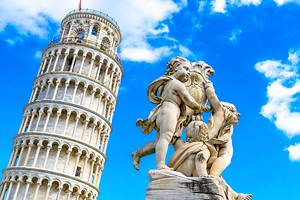
Discovering Other Tuscan Churches: Close to Florence are a number of other towns with outstanding examples of Tuscan churches, baptisteries and bell towers. The best known of these is the cathedral in Pisa, with its famous leaning tower, and Siena's Cathedral of Santa Maria Assunta is also filled with the work of Italian masters. You'll discover churches in other nearby towns on our Day Trips from Florence page.