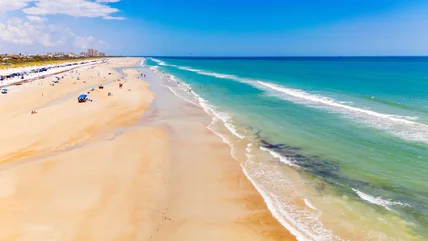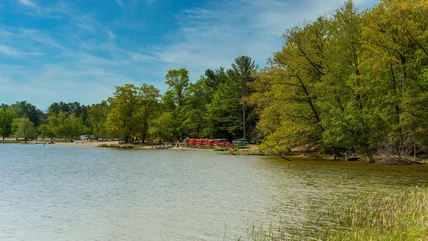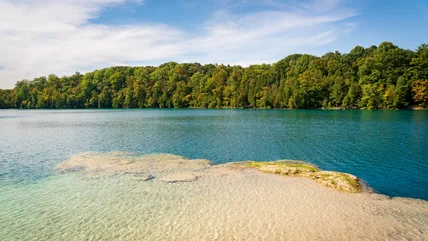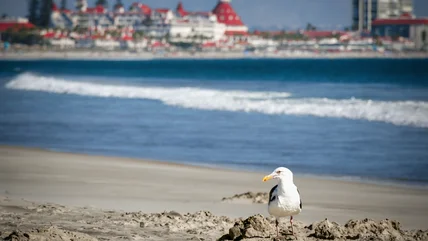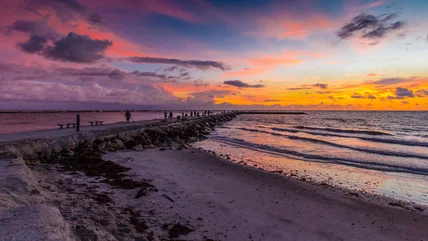
The Micmac Indian legend tells how the god Glooscap painted all of the world's beautiful places then dipped his brush in every colour and created Abegweit, his favourite island. Canada's smallest province, but one of its loveliest, Prince Edward Island's natural beauty lies in its gently rolling hills and scenic beaches of powdery white sand in the north, and edged with red sandstone cliffs in the south. Its pleasant climate, good beaches and rural charm make it a favourite with holidaymakers who swell its population every year to well over half a million.
Unlike its neighbours, most of the island's countryside is farmland, thanks to its exceptionally fertile, brick-red soil.
The island nestles in the Gulf of St Lawrence, separated from the mainland by the Northumberland Strait, only 14 km (81/2 mi.) across at its narrowest point. It extends between longitude 61° and 64° and between latitude 45° and 47°.
It stretches 224 km (139 mi.) and is from 6 km (4 mi.) to 64 km (40 mi.) across. The coastline is broken up by a mass of bays and inlets, and its highest point, at 150 m (492 ft), is in Queens County.
Prince Edward Island is very young in geological terms. Its sandstone was formed by sediment deposited about 250-300 million years ago. The oldest sediments were found in the Miminegash region and the striking redness of the soil is due to the high iron oxide content. The whole island bears the imprint of the Ice Age. As the ice retreated about 15,000 years ago the sea level rose, and the three small islands that appeared in the Gulf of St Lawrence gradually grew together to form the present landmass.
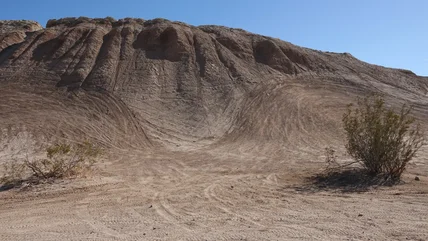
The most spectacular morphological change is currently along the coastline, where the erosive forces of wind and rain, waves and frost have created long beaches and sandbanks, and vulnerable sandstone can be worn away at the rate of several inches a year.
Thanks to its position in the Gulf of St Lawrence, Prince Edward Island has pleasantly moderate temperatures, although it can become very cold in winter. In high summer the thermometer can climb up to 30°C (86°F). The precipitation of 1090 mm (43 in.) falls on only 160 days of the year. July and August are the driest and warmest months, when the water around the island can be as warm as 21°C (70°F).
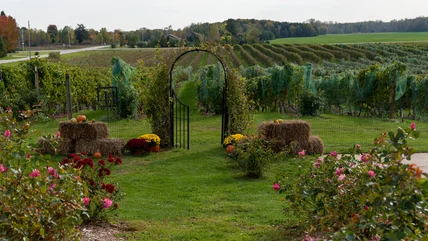
About 90 per cent of the land on the island is farmed. Potatoes are the main crop, but some cereals and other vegetables are grown as well. There are sizeable orchards, but no real woodland.
Over 300 bird species have been recorded on Prince Edward Island. These include albatross, petrels, cormorant, gannet, heron, osprey, etc.
The mainland Micmac Indians, who came here about 2000 years ago and named the island "Abegweit". As nomadic people they lived in small groups, fishing in summer and hunting on the mainland in winter.
France laid claim to the island as early as 1523, even before Jacques Cartier sailed here in 1534. He was fascinated by the glorious beauty of the island. The French named it Île St Jean, and the first of them arrived in 1663. In 1719 the first influx of immigrants of any size settled in Port de la Joie, now Fort Amherst. Jean-Pierre de Roma founded a settlement at Three Rivers, Brudenell Point, in 1732, and French Acadians came here in 1755, driven out of Nova Scotia by the British. Apparently the Micmac and the early French settlers managed to live in relative harmony with one another.
After the French fortress of Louisbourg on Cape Breton Island fell into British hands in 1758 many of the local French settlers fled to Prince Edward Island, prompting the British to occupy the island and deport the Acadians because of their questionable loyalty to the British crown. They were sent either to British North America, or to England to be returned to France after the war. The few who remained on the island escaped deportation by fleeing into the woods.
Under British rule, St John's Island (as the British called it) was annexed to the colony of Nova Scotia in 1763. In 1764/65, General Samuel Holland divided the island into three administrative districts and 67 lots, each of 20,000 acres, and these were drawn for in London by wealthy Englishmen at a grand lottery for the distant colony. This led to a century of struggle against absentee landlords and harsh rent collectors until finally, in 1853,the Land Purchase Act enabled the island government to buy back most of the land. When Prince Edward Island joined the confederation in 1873, the rest of the land was acquired and sold. In 1769 the island won independence from Nova Scotia and became a British colony in its own right.
Many British settlers, mostly Scots, came here during the 18th and 19th c. The Montgomerys arrived around 1770, and early Scottish immigrants settled in Scotchfort and Tracadie. After 1803 the Selkirks from the Scottish Highlands settled around Eldon, to be joined on the island by many loyalists who moved north following the American War of Independence.
The legislative assembly named the island Prince Edward in 1798 after the Duke of Kent who was later to become the father of Queen Victoria, and who was commander of the English troops in Halifax at that time, and the island got its own government in 1851.
The Conference of Charlottetown was held in 1864 to discuss Canadian Confederation, but it was 1873 before the islanders reluctantly decided to join the Union, after the still relatively new federal government had promised to set up communications with the mainland.
Prince Edward Island is Canada's smallest but most densely populated province. About two-thirds of its people live outside the towns.
There was a big increase in population after the American Revolution, when the British loyalists fled to Canada.