14 Top-Rated Attractions & Things to Do in Pamukkale
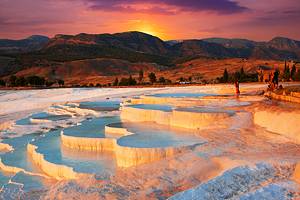
Pamukkale is a surreal natural wonder of rippling semi-circular, pure-white travertines that sit among green farming fields. This pure white hillside is one of Turkey's most photographed spots and the country's most famous natural tourist attraction.
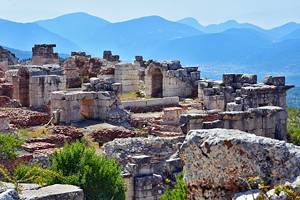
Although most visitors come here for the travertines alone, the vast and rambling ruins of the Roman spa town of Hierapolis sit on the travertine hill's summit, making this one of Turkey's best places to visit for historically minded travelers.
The top thing to do within the ancient site is to enjoy the mineral-rich waters of the renowned hot spring pool, but beyond, you'll find Hierapolis' grand, well-preserved theater, various temples and monuments, and a large necropolis area.
Discover more places to visit with our list of the top tourist attractions in Pamukkale.
See also: Where to Stay in Pamukkale
- 1. Walk Up or Down The Travertines
- 2. Explore Hierapolis City Ruins
- 3. Admire Hierapolis Theater
- 4. Pamukkale Antique Pool
- 5. Visit Hieropolis Museum
- 6. Discover Hierapolis' Christian Remnants
- 7. Ramble through the Northern Necropolis
- 8. Discover the Ruins of Laodikeia
- 9. Explore Aphrodisias
- 10. Take to the Skies Over Pamukkale
- 11. Spend Time at the Caravanserais near Pamukkale
- 12. Visit the Smaller Archeological Sites Nearby
- 13. Soak in the Karahayit Hot Springs
- 14. Ride the Denizli Cable Car
- Where to Stay in Pamukkale for Sightseeing
- Tips and Tactics: How to Make the Most of Your Visit to Pamukkale
- Map of Attractions & Things to Do in Pamukkale
1. Walk Up or Down The Travertines
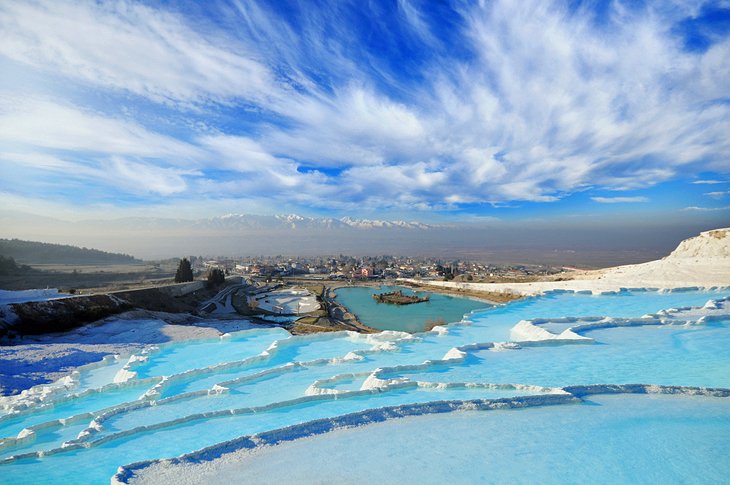
The dazzling white calcite cliff of Pamukkale was created by calcium deposits from the area's hot springs. In the same way that stalactites form within limestone caves, the deposits grow on the steep slopes, gradually fanning out to form natural terraces.
Pamukkale means "cotton castle," and the blinding white color of these travertines do look like a bizarre natural fortress of sorts.
The best way to experience the travertines is to walk up or down the terrace ridge section that leads from the hills base in Pamukkale village to the central entrance to the Hierapolis ancient site on the summit. This is the only section that you can walk on, and you are only allowed onto the travertines barefoot.
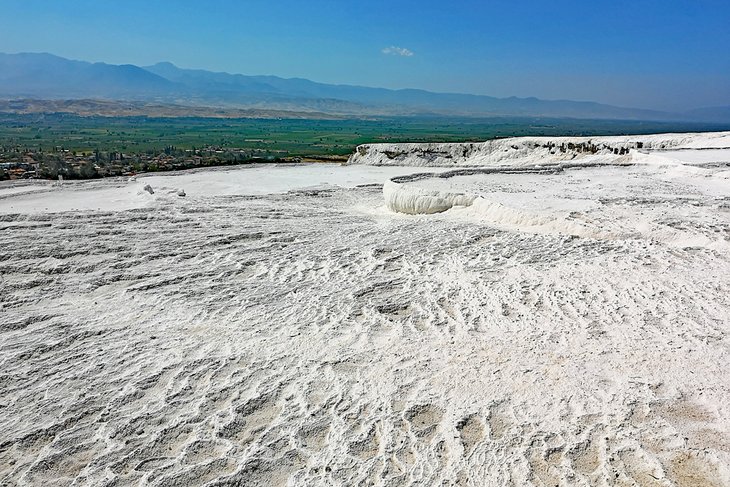
At the upper levels here, the half-circle shaped terraces hold pools of water that you wade through (most are from ankle to mid-calf deep) to reach the summit.
Once on the top of the hill, there is a wooden walkway that winds most of the length along the top edge of the travertines from where you can get panoramic photos of the travertine hill and the countryside beyond.
2. Explore Hierapolis City Ruins
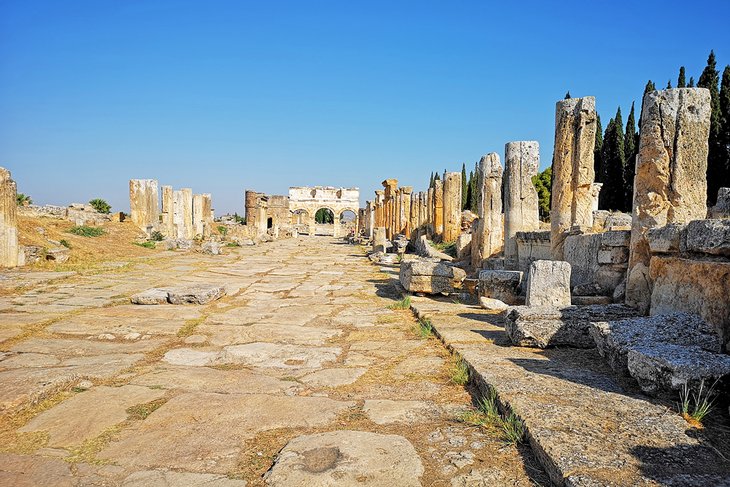
First founded by King Eumenes II of Pergamon soon after 190 BCE, Hierapolis was originally a fortified military colony. The original city was destroyed by an earthquake in 60 CE, and it was after the rebuilding that its glory days began.
The city enjoyed its greatest prosperity during the 2nd and 3rd century when, with its on-tap natural hot springs, it became an important spa center.
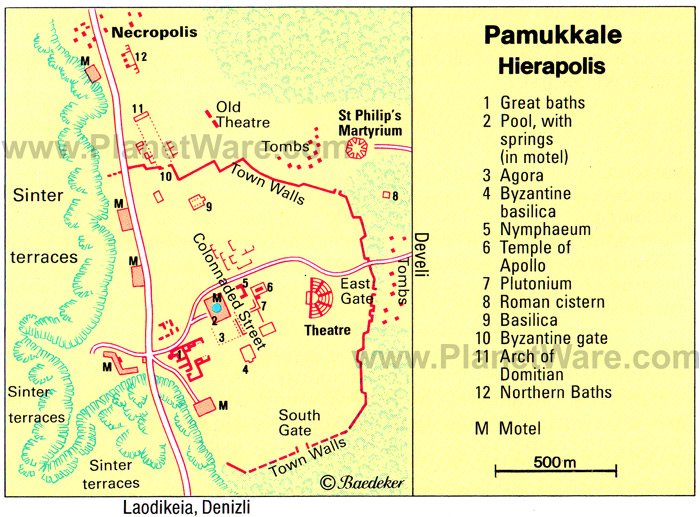
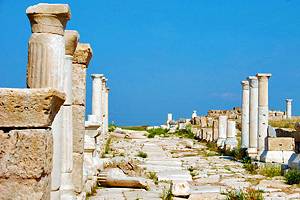
The remains of a grand colonnaded street run parallel to the travertines below for just over one kilometer, extending between the necropolis to the north and a Byzantine church at the southern end.
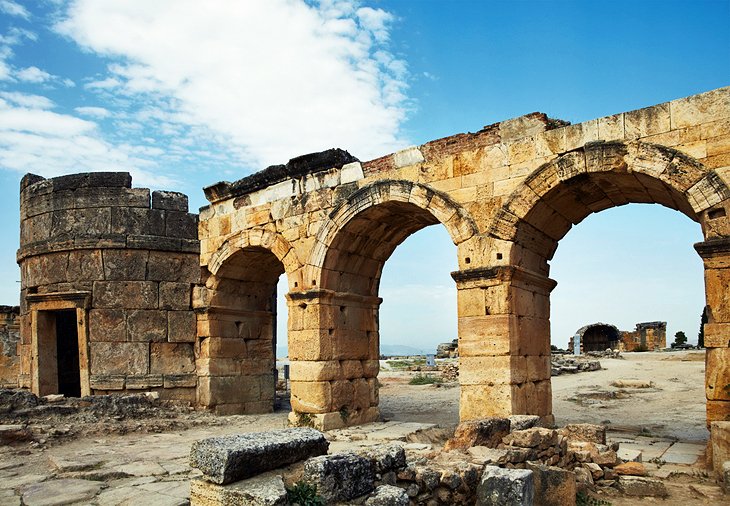
From the church, if you take the eastern path, you come to the Temple of Apollo and its famed Plutonium (a cave beneath the temple that was a source of poisonous gas). Here, the priests would consult the oracle, bringing in birds and small animals killed by the rising gas.
Both the temple and Plutonium are undergoing an extensive restoration and should be reopened for visitors at some stage in 2021.
3. Admire Hierapolis Theater
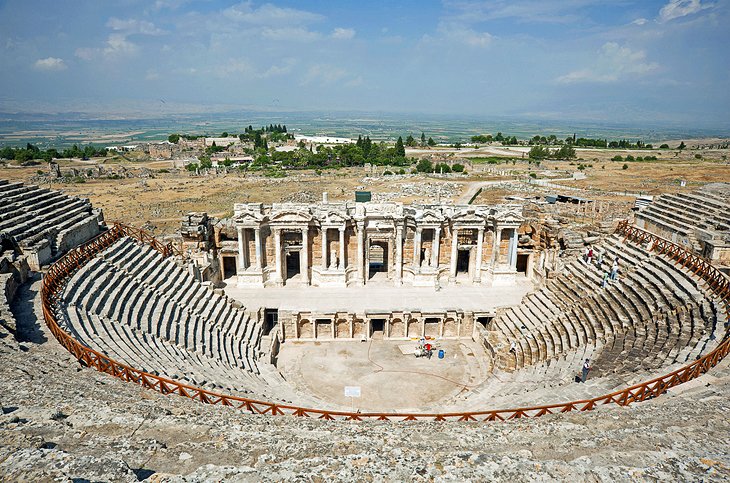
On a slope looking over the vast amount of the Hierapolis ruins is the city's mighty theater, with its facade over 100 meters long and two tiers of seating, each with 26 rows.
Built during the reigns of the Roman Emperors Hadrian and Septimius Severus, the theater is incredibly well-preserved. It has retained much of its original detail, with the imperial boxes (where VIP guests would have watched the entertainment) and some decorative panels along the stage still surviving. There are fine views from the top seating tiers.
If you don't fancy the walk up the hill to see the theater, you can hire one of the drivers of the large golf-cart-type vehicles that wait in front of the antique pool complex to zip you up and then back down again.
4. Pamukkale Antique Pool
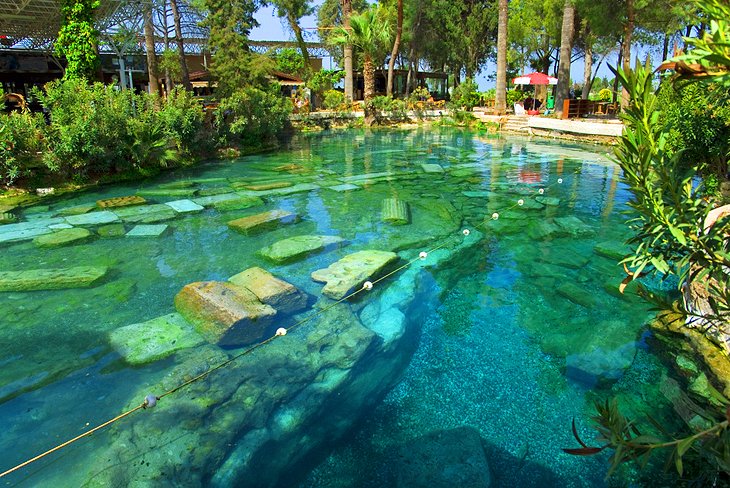
If you want to partake in some restorative hot-pool soaking just like the Romans did - but without the togas - then look no further.
Pamukkale's Antique Pool, between the museum and the Temple of Apollo, right in the middle of the site, allows you to soothe those weary travel muscles in mineral-rich hot spring water that is a steady 36 degrees Celsius.
It's possibly the most atmospheric hot spring experience you'll ever have, with half-submerged columns and chunks of fallen marble scattered in the water all around you, but it's also very popular, so prepare for crowds.
Many of the big tour buses that visit Pamukkale do very little in the Hierapolis site except the antique pool and the theater, so if you want to soak without the crowds, try to come early or late.
5. Visit Hieropolis Museum
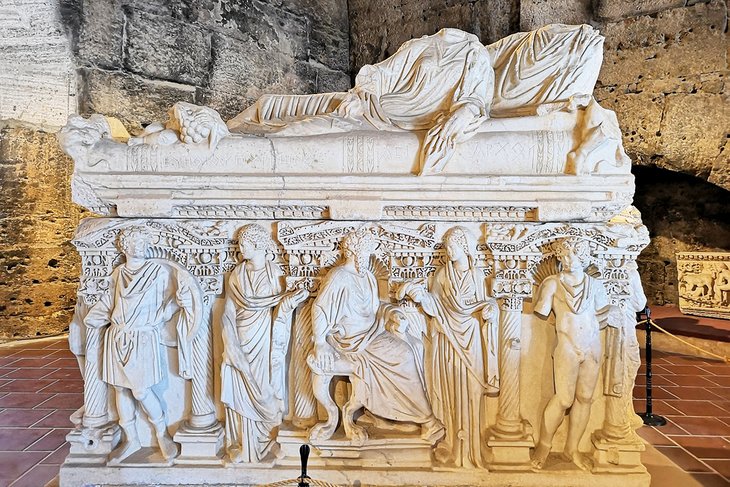
This small but excellent museum dedicated to Hierapolis is housed inside the ancient city's former Roman bathhouse, which sits in front of the antique pool complex and just behind the central entrance into the site that leads up from the travertine path.
A visit here will help bring the city to life, with the exhibits showcasing some of the beautiful artistry and cultural heritage of this once important city.
The museum's three rooms display a variety of finds from the site, including gorgeous and intricate stone reliefs, sarcophagi, and statuary.
More stele, column capitals, tombs, and inscribed stone reliefs are displayed in the garden outside.
6. Discover Hierapolis' Christian Remnants
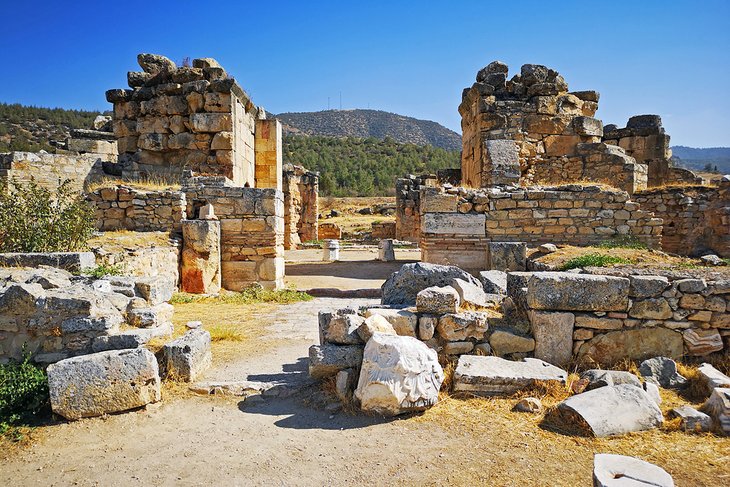
The major surviving Byzantine-era site within the Hierapolis ruins is the Martyrium of the Apostle Phillip, built on the spot where the saint and his children were supposedly martyred after he remonstrated with the pagan worshippers of Hierapolis.
The martyrium sits on a ridge, high above the rest of the excavated site and is accessed by a trail that leads from both the trail heading up to the theater and from behind the main city ruins.
The martyrium lies across three levels. At the lowest level is a modern bridge that plays the role of the original 4th-century bridge that pilgrims had to cross to access the site. Across the bridge are the remnants of an octagonal Byzantine baths complex.
From the baths complex, you climb a staircase to the middle level, where you'll find the pilgrims' fountain and the remains of the Church of the Sepulchre of St. Phillip.
Within the scant ruins of the church is a Roman-era tomb dated to the 1st century CE, thought to be the tomb of St. Phillip.
Another set of stairs, leads up to the Martyrion, thought to have been built over the site where St. Phillip was martyred. The octagonal layout of the church's interior core can still be easily defined due to the preservation of the archways.
There are excellent views across Hierapolis and the travertines from the summit here.
7. Ramble through the Northern Necropolis
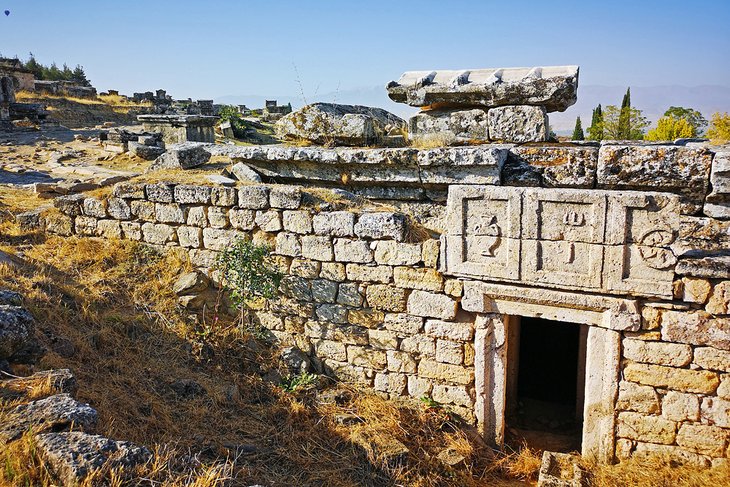
Many visitors don't make it out to Hierapolis' northern necropolis, which is a shame because the area is one of the most photogenic sections of the ancient city, with a huge variety of tombs scattered across the hillside.
The necropolis holds tombs ranging in age from the 2nd to 3rd centuries. The grander monuments are built like small houses, with multiple chambers and inscribed entranceways. In particular, look out for the Tomb of the Gladiator, with its gladiator relief above the entrance.
The northern necropolis leads to Hierapolis' northern entrance. As it's one of the ancient site's quieter areas, it's a good place to either start or end your visit.
8. Discover the Ruins of Laodikeia
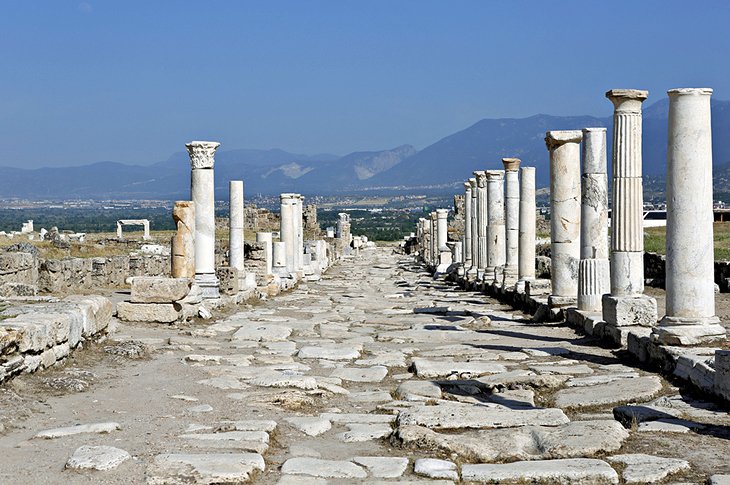
Lovely Laodikeia, about 12 kilometers south of Pamukkale, was once home to Cicero. This Roman commercial center was a bustling city of industry, medicine, and trade.
As Christianity began to take over from the earlier pagan religions, a large population of Christians and Jews lived here.
The ruins are highly photogenic, and there's an interesting mix of remnants from the temples and theaters of early Roman settlement to the later Christian early-Byzantine era.
It's a bit off the normal Pamukkale area itinerary (the vast amount of tours here usually just visit the travertine terraces and Hierapolis), so the site is refreshingly uncrowded. If you come early or late in the day, you're likely to get the entire site to yourself.
9. Explore Aphrodisias
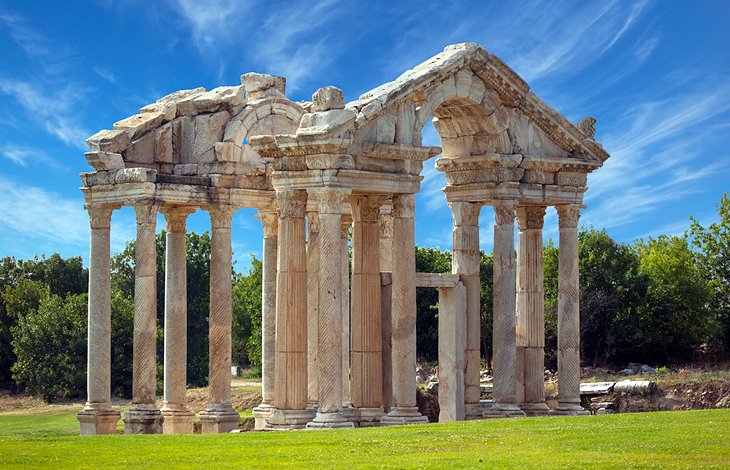
Modern research has transformed Aphrodisias from a place few visited into one of the most important historic sites in Turkey.
About 97 kilometers southwest of Pamukkale, the site produced Chalcolithic finds, which show the area was settled in the 4th millennium BCE, and early Bronze Age pottery finds also suggest there was an Assyrian trading colony here during the Hittite period.
The settlement's golden age though was in the Hellenistic and Roman eras, when its sanctuary became the center of the wide-spread Aphrodite cult, and the city also became famous for its schools of sculpture, medicine, and philosophy.
The Temple of Aphrodite was built in approximately 100 BCE and still has 14 standing columns (two with architraves in place). In the 5th century, the Byzantines converted this pagan temple into a three-aisled basilica.
To the north is the mammoth and well-preserved Stadium, which could hold 30,000 spectators. To the south of the temple is the bouleuterion, decorated with reliefs and statues, the best preserved monument in the site.

10. Take to the Skies Over Pamukkale
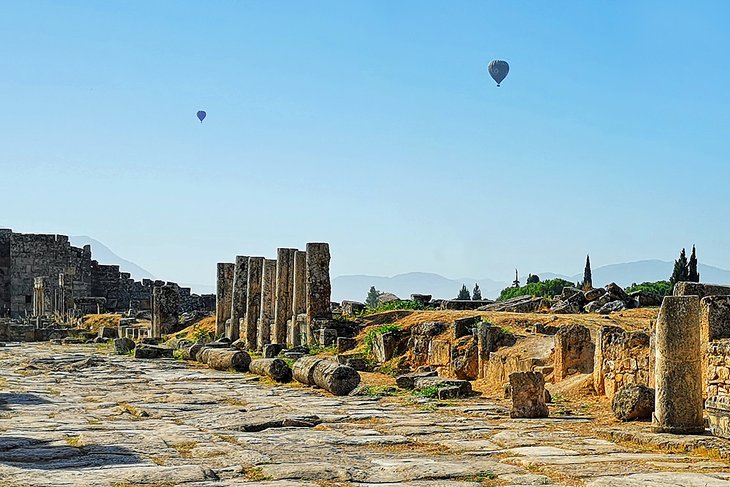
In recent years, both paragliding and hot air ballooning have both been launched as things to do in Pamukkale.
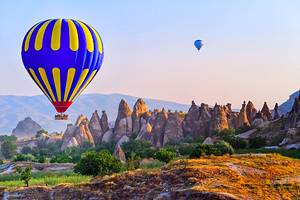
Although not as famous as Turkey's major hot air ballooning site in Cappadocia, ballooning here offers bird's-eye views over the Hierapolis ruins, the calcite terraces, and the lush green countryside of patchwork fields.
Ballooning is a morning activity, taking place just after sunrise, so you'll need to get up early for this aerial sightseeing.
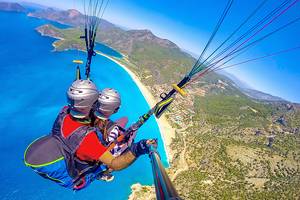
Alternatively, tandem paragliding takes place throughout the day. Paragliders launch from the summit that rises up behind Hierapolis and the travertine hill and glide over the site and the terraces on their way to land below.
11. Spend Time at the Caravanserais near Pamukkale
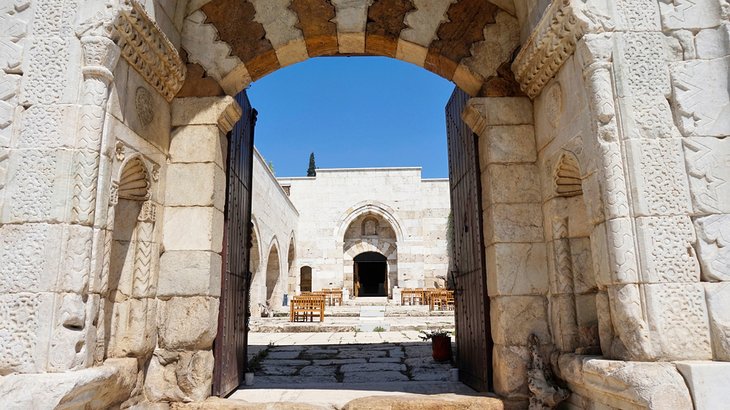
Caravanserais (roadside inns also known as hans) dot the plains of the region surrounding Pamukkale, a relic of the days when this area was part of a major trade route through to central Anatolia.
On the road from Denizli to Dinar stands the Akhan, a Seljuk caravanserai founded in 1253 by Emir Karasungur. It has a marble-faced east facade, an arcaded courtyard, and a triple-aisled winter hall.
Near the town of Çardak, 55 kilometers east of Denizli, is the Çardakhan. This Seljuk caravanserai has two massive towers and an inscription flanked by two lions above the portal. It was endowed in 1230 by the general Rasideddin Iyaz.
12. Visit the Smaller Archeological Sites Nearby
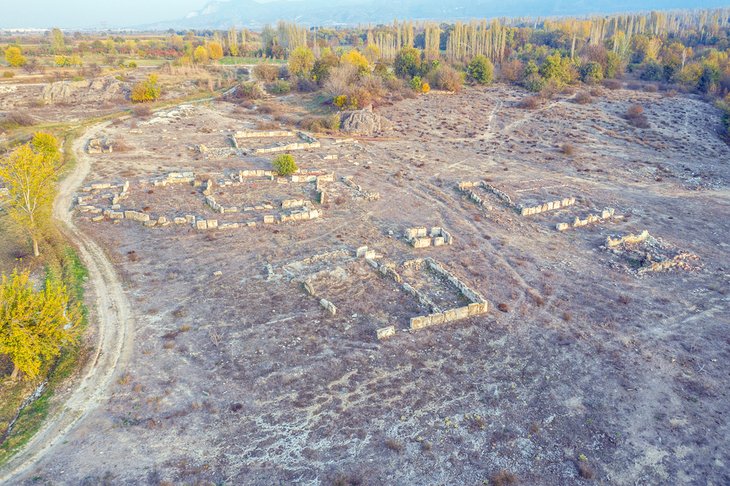
First excavated in the 1950s by Lloyd and Mellaart, the Beycesultan Tepesi archaeology site (10 kilometers south of the provincial town of Çivril) is an important prehistoric settlement.
For the Stone Age alone, 21 layers have been found within 11 meters of sediment.
Evidence of settlement here has been found up to the early Bronze Age (1250 BCE) and again from 400 years later, up to the Byzantine era.
In Layer V (1900 BCE), the remains of a palace have been found, and in the Bronze Age layers, traces of a shrine with sacrificial vessels, a blood altar, and statuettes of the goddess Cybele have been unearthed.
Çivril is about 103 kilometers northeast of Pamukkale.
For the enthusiastic amateur archaeologists, the scanty remains of the once great Phrygian city of Colossae (also known as Kolossai) lie in the Lykos Valley, near the Lykos River, 20 kilometers east of Denizli. Its great age was during the Hellenistic period.
By the time the Romans had taken control over the region, it was increasingly overshadowed in importance by the cities of Laodikeia and Hierapolis and the town eventually lost its prominence.
Nevertheless, the city's name remained known because of St. Paul's epistle to the Christian community here. There's not much to see, but the views over the rolling fields out to the mountains beyond are quite lovely.
The town of Saraykoy, at the western edge of the Hierapolis valley, about 25 kilometers west of Pamukkale, is probably old Karura (or Kyorara), which lay on the border between Phrygia and Cara.
It was known for its hot springs and Herophilian medical school. Herophilus was a 4th-century BC doctor, considered the most important doctor of antiquity after Hippocrates.
If you have a car, it's easy to include Sarayköy in a loop of the sights and attractions around Pamukkale, also taking in Laodikeia, Aphrodisias, and Colossae on the same trip.
13. Soak in the Karahayit Hot Springs
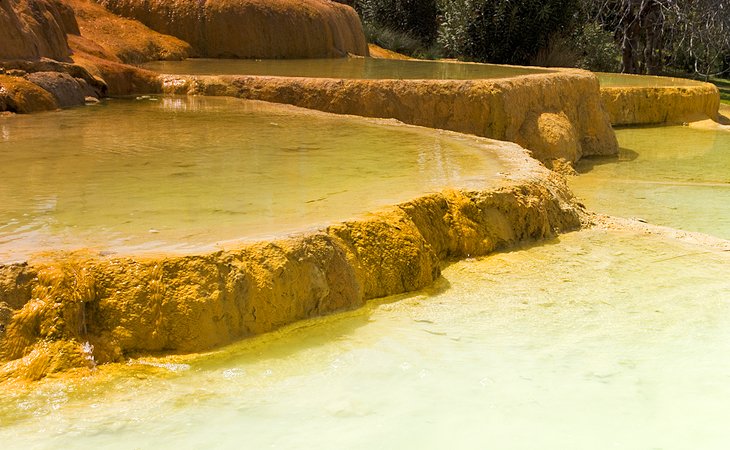
These scorching mineral-rich hot springs (temperatures up to 55 degrees Celsius) bubble up from the chalk-coated rocks only five kilometers from Pamukkale.
The presence of various oxides (including iron oxide) in the water has tinged the calcium carbonate of the springs with a variety of colors.
Beneath the springs is a small bathing pool where you can soak until your heart's content. This is a great place to soothe weary travel muscles and take a break from the road for an hour or two.
It's very popular with local tourists but not really on the big tour bus itineraries, so only gets a handful of visitors compared to Pamukkale's antique pool.
14. Ride the Denizli Cable Car
Everyone passes through Denizli on their way to Pamukkale, but few stop here. This thoroughly modern town is the provincial capital and grew into a bustling center during the 14th century.
The great medieval Arab traveler Ibn Battuta described the town as a fine commercial center, with seven mosques, baths, and bazaars, as well as a resident prince.
Denizli was twice destroyed by earthquakes, once in the beginning of the 18th century and again in 1899. This has left the town with no buildings of historical interest.
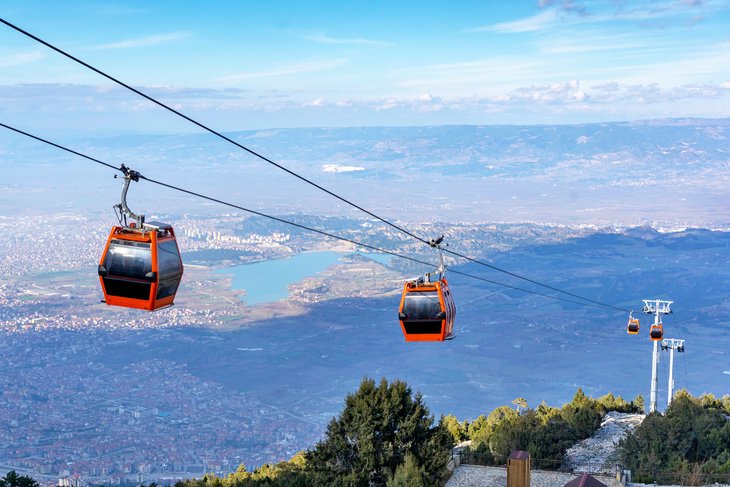
On the outskirts of town, though, is the Denizli teleferik, a cable car that shuttles up to a 1,500-meter-high mountain summit. The views from the top, across the entire plain and out to Pamukkale beyond, are well worth the ride.
Denizli is about 17 kilometers south of Pamukkale
Where to Stay in Pamukkale for Sightseeing
Mid-Range Hotels:
- The Melrose House Hotel is a friendly family-run guesthouse just a short stroll from the travertines. The lovely gardens have a pool, the included breakfast is excellent, and evening meals can be provided.
- Nearby, the Venus Hotel is another good-value guesthouse with modern, well-appointed rooms and a good-sized pool in the garden. Breakfast is included.
Budget Hotels:
- The family-run Bellamaritimo Hotel offers a great central location close to both the travertines and the facilities of the village, a small pool, an included breakfast, and good-sized rooms with private balconies.
Tips and Tactics: How to Make the Most of Your Visit to Pamukkale
- Escape the Crowds: Early morning and late afternoon are the best times to visit. The site gets busy with tour buses between 10.30am and 3pm. If you stay overnight in Pamukkale village, you can get here early or late and beat the crowds. It's also a good idea to enter from the middle gate (at the base of the hill) rather than from the gate at the summit. Tour buses always enter from the summit, and many tourists don't bother walking down the full extent of the terraces from the top.
- Explore the Area: Hiring a car to explore the surrounding countryside and its scattering of ancient ruins is an excellent idea.
- Tours from Selçuk and Izmir: Day tours allow you to see the travertines and ruins of Hierapolis on a day tour from Izmir, with lunch included and the service of an English-speaking guide. Transport is typically by air-conditioned coach.
Map of Attractions & Things to Do in Pamukkale
More Related Articles on PlanetWare.com
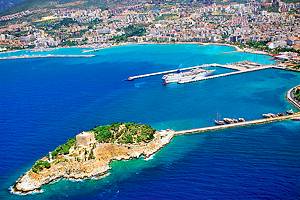
More Things to Do in the Region: Head towards the coast for Selçuk with its bundle of Byzantine-era ruins right in town and the vast ruins of Roman Ephesus. For a fun-in-the-sun beach break afterwards, Kusadasi, with its castle, is the closest resort.
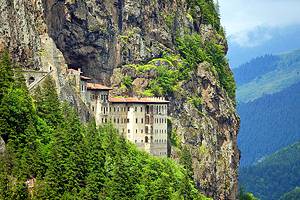
More Natural Wonders: Inland, you'll find the volcanic landscape of Cappadocia, with its valleys of rock cones winnowed by wind and water. On the Black Sea coast, you can visit Karaca Cave, one of Turkey's most interesting cave networks, crammed with stalactites and stalagmites.