Tourist Attractions in Burgos
Celebrated for its magnificent cathedral, the medieval town of Burgos was an important stop on the Way of Saint James pilgrimage trail to Santiago de Compostela. Burgos was also the capital of the Castilla-Leon region from the 10th through the 14th centuries. This intriguing historic town has preserved its old-world charm, seen in the exquisite ancient monuments, quaint cobblestone streets, and shaded promenades.
Burgos is a pleasant place to discover the sights, from the ruins of the old castillo (castle) on the hilltop to the inviting riverside restaurants. Other attractions are numerous monasteries and churches. Visiting these sanctuaries offers an inspiring spiritual experience, as well as a chance to see masterpieces of medieval and Renaissance art. Find more places to visit in this fascinating city with our list of the top attractions and things to do in Burgos.
Catedral de Burgos: A UNESCO World Heritage Site
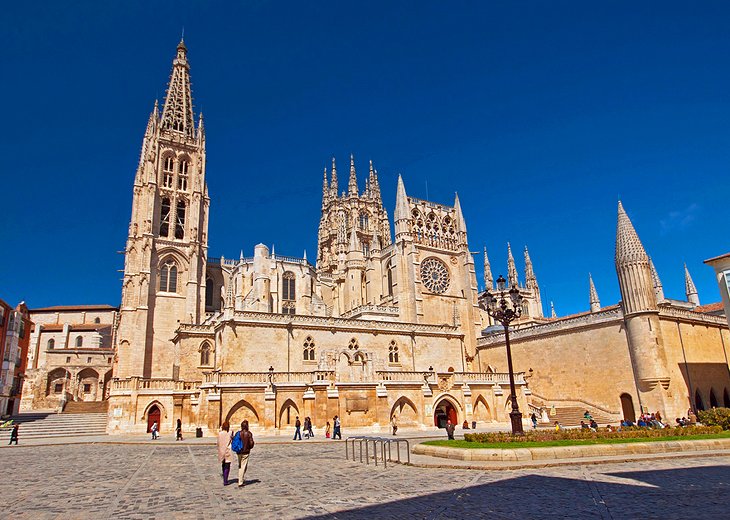
At the foot of Burgos' castle hill stands the UNESCO-listed Cathedral of Burgos, a masterpiece of Spanish Gothic architecture. The profusion of sculptural decoration and grandiose proportions make this cathedral one of the most impressive in Spain and the third largest after the cathedrals of Seville and Toledo. Built from white limestone, the cathedral is renowned for its elegance and sense of harmony.
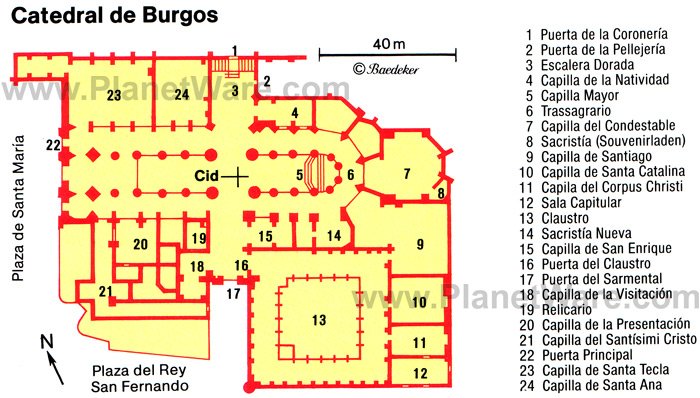
Although predominantly Gothic, the building reveals other artistic styles that represent later additions (construction was over an extended period from 1221 to 1795). The cathedral's main façade features the Puerta del Perdón doorway with a gallery of statues of the Castile kings. Above the doorway is a beautiful star-patterned rose window called an estrellón. On the Puerta del Sarmental facade are the cathedral's most exquisite sculptures, depicting figures of the apostles and evangelists.
The awe-inspiring interior is distinguished by the dome of the main nave, which features a lovely Mudéjar (Moorish-style) vault, and the 16th-century Italian Renaissance-style Escalera Dorada (Golden Staircase) by Diego de Siloé. Within the immense sanctuary are 19 chapels in the side naves, and throughout are valuable altarpieces, paintings, and sculptures. In the center of the nave is the stunning cimborio (lantern), a marvelous example of Plateresque art, richly decorated with sculpture and coats of arms, a gilded balustrade, and superb reliefs.
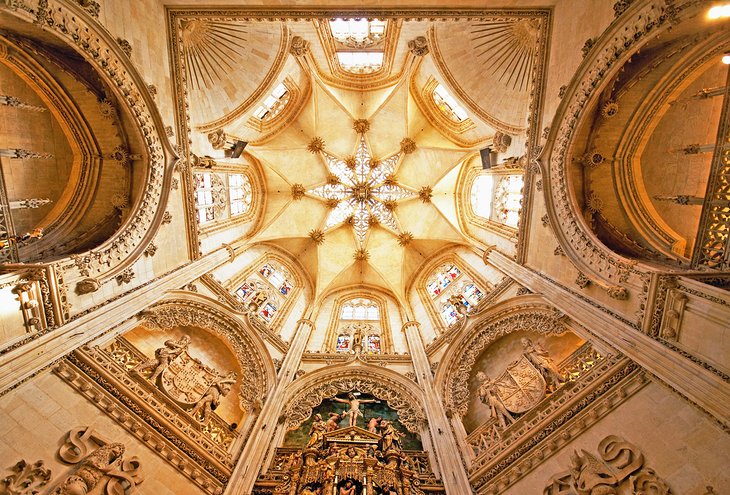
Behind the ambulatory is the 15th-century Capilla del Condestable (Constable's Chapel), another example of ornate Plateresque style. The chapel houses the tombs of the Constable and his wife Doña Mencia de Mendoza, with lifelike figures carved from Carrara marble. The Capilla de Santa Tecla (Chapel of Saint Thecla) is also noteworthy for its artworks. Be sure to see the 13th-century claustro (cloister), which contains the monumental tombs of Ferdinand III and his wife Beatrice of Swabia.
Address: Plaza de Santa María, Burgos
Monasterio de Santa María la Real de Las Huelgas
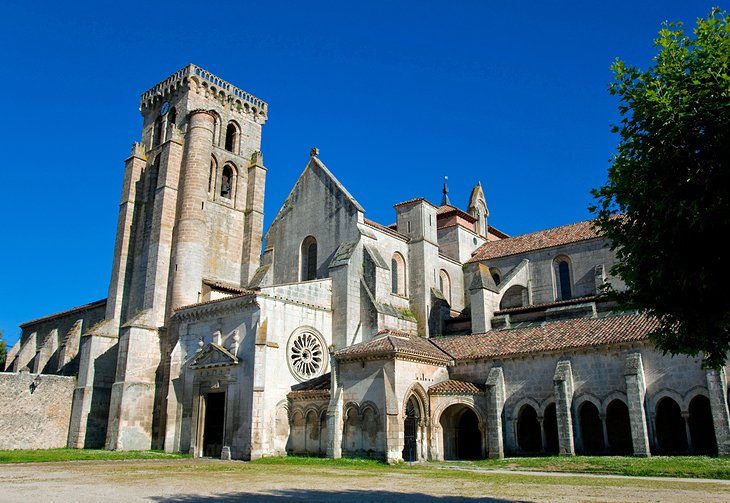
A must-see historic attraction, Las Huelgas is a medieval Cistercian monastery and Royal Pantheon of the Castile monarchs. The Monasterio de las Huelgas was originally a country residence of the kings of Castile. The Spanish word huelga means "repose/relaxation." King Alfonso VIII and Queen Dona Leonor converted the building into a Cistercian convent for noble women (descendants of the royal family) in 1187 at the request of his wife Eleanor, daughter of Henry II of England.
The monastery exemplifies the austere architecture of the Cistercian order, with the church, the cloister, and the chapter house. The original church of the 12th-century was built with a Mudéjar Almohad style, resembling the architecture of Andalusia. This church is now the Chapel of the Assumption, which contrasts with the Romanesque cloister (Claustrillas) and Gothic additions built in the 13th century. The monastery also displays a collection of precious medieval tapestries.
Address: Calle de Compases, Burgos
Museum of Human Evolution
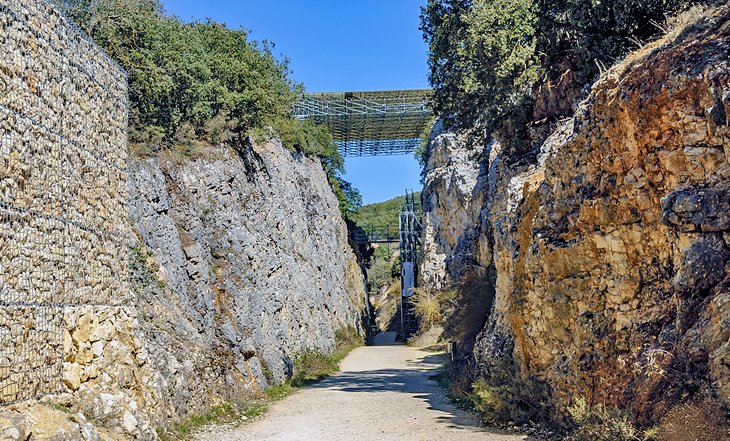
Housed in a sleek modern building, this fascinating paleontology museum was created as a place to display fossils found in the fields of the Sierra de Atapuerca. Among the highlights of the collection are an 850,000-year-old hominid fossil and El Bifaz "Excalibur," the oldest symbol of human intelligence. The museum also offers educational exhibits such as theories about the first Europeans.
Realistic reproductions of prehistoric human species are displayed as wax models. This incredible exhibit features the earliest known human ancestors and shows the progression of evolution. The museum is allied with the Palaeontology and Prehistory departments at the University of Burgos, who continuously add to the collection and exhibits as new discoveries are made.
Address: Paseo Sierra de Atapuerca, Burgos
Castillo de Burgos
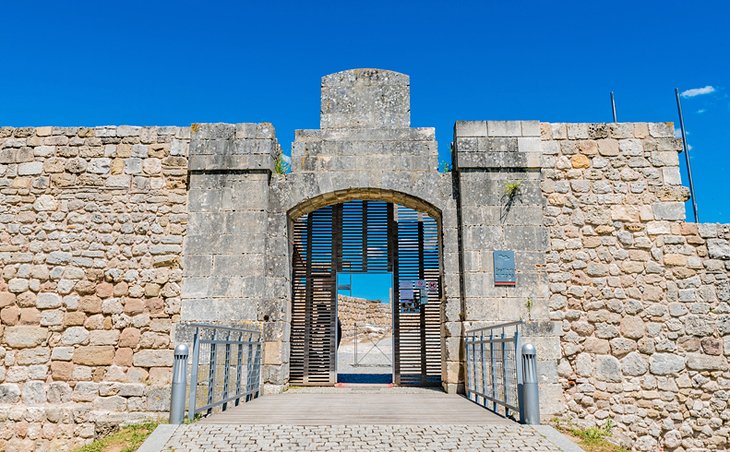
At the top of the hill in the Parque de Castillo sit the ruins of Burgos' old fortifications, where tourists can see the original castle foundations and some of the remaining structure. The castle was first built on this spot in the year 884, when the city was founded, and was expanded significantly in the early 16th century. It has endured many attacks and disasters, most notably a fire in 1736 and a devastating assault in 1813 by Napoleon's army.
At the site, tourists can also visit a small museum about the history of the town and the castle, and nearby there is an excellent mirador, or outlook point, which affords great views of the city and the Catedral de Burgos.
Arco de Santa María
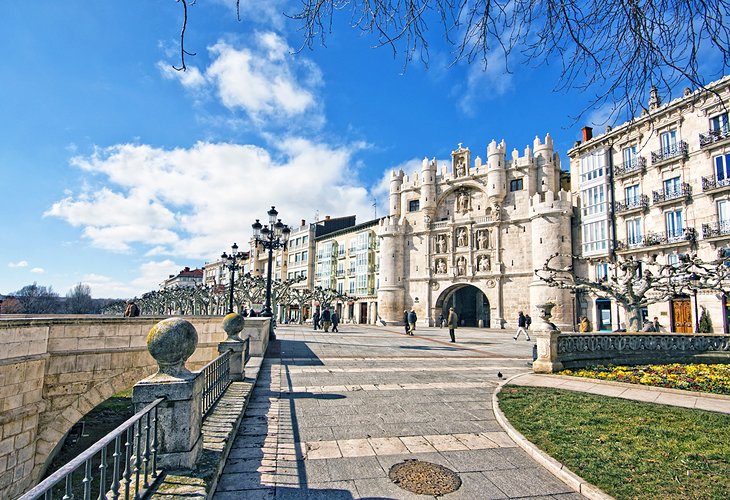
Guarding and allowing entrance to the old town, the Gate of Santa Maria stands at the end of the Paseo del Espolón opposite the Puente de Santa María (bridge) spanning the Arlanzón River. The Arco de Santa María was originally built in the 14th century as a triumphal arch in honor of Emperor Carlos V. In 1552, the gate was renovated by Juan de Vallejo and Francisco de Colonia in Renaissance style.
The massive arch is flanked by two semicircular towers, giving it the appearance of a castle. The gate features statues of Castilian heroes and kings: in the center of the lower row is Diego Porcelos, the town's founder, next to Nuño Rasura and Lain Calvo, the first judges of Castile; in the upper row are the Cid, the Emperor Charles V, and Count Fernán González.
Walking through the arch, visitors will reach the Plaza del Rey San Fernando on the southern side of the cathedral. The interior is often used to display temporary art exhibitions.
Address: Plaza del Rey San Fernando, Burgos
Cartuja de Miraflores
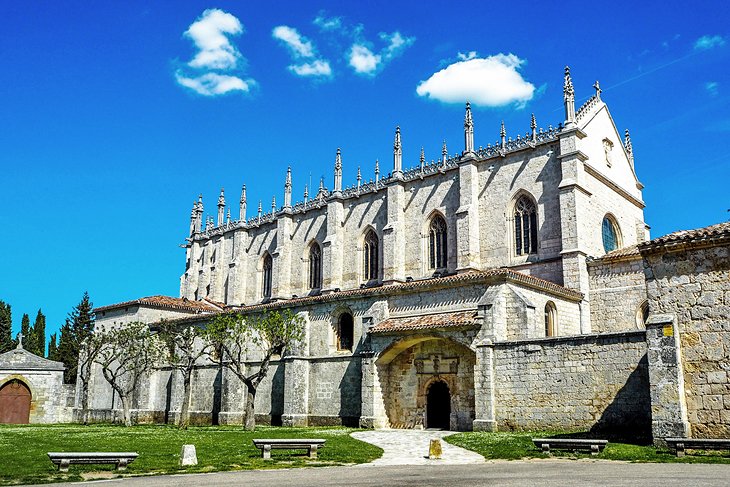
This Carthusian monastery lies about three kilometers outside the historic town of Burgos. The building was originally the hunting lodge and recreational palace of Henry III of Spain. The palace was restored by his son, King John II, and renovated again during the reign of Queen Isabella by renowned architects.
The Carthusian monastery is a gem of 15th-century Gothic architecture. The monastery's exquisite Gothic church is one of the most important monuments of Burgos and contains the mausoleum of King John II and his wife Queen Isabella. Guided tours are available in summer.
Address: Carretera de la Cartuja, Burgos
Explore the Atapuerca Archaeological Site
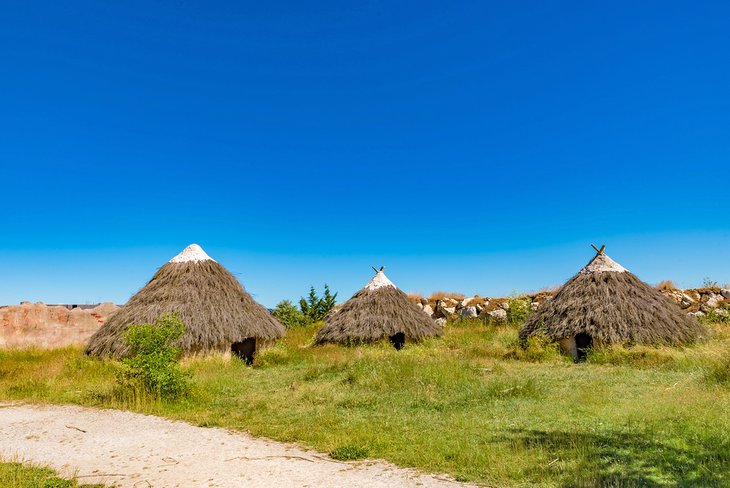
The limestone caves at Atapuerca contain Europe's oldest and most varied fossils, dating back as far as 1.1 million years to represent some of the earliest hominids.
Its most impressive feature is the Sima de los Huesos cave, where archaeologists have discovered over 1,600 fossils of hominid remains. These fossils date between 300,000 and 600,000 years old and have characteristics of both Neanderthal and modern humans, demonstrating an important stage in evolution.
In addition to human remains, the site contains evidence of tools and even early cave art depicting both humans and animals. This site contains Europe's earliest evidence of early human societies, and was designated as a UNESCO World Heritage Site in 2000. Tours of the site, which is located about 20 kilometers from Burgos, can be arranged through the Museum of Human Evolution.
Casa del Cordon
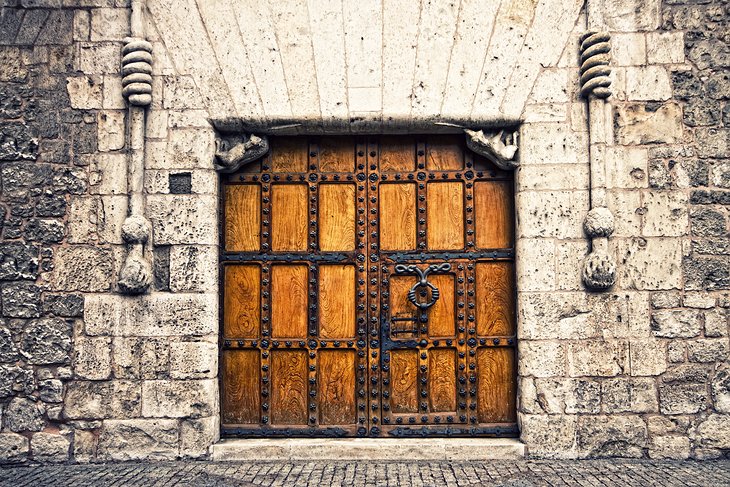
This historic landmark, also known as the Palace of the Constables of Castile, was originally built in the 15th century, and now sits in the city's historic center overlooking Plaza de la Liberdad. Its common name, which translates to "House of the Cord," is a result of the carved Franciscan cord which is on the main door-an indication that a king has slept within.
This Gothic-style building is known for its architecture, including two towers and a cloister, and the numerous heraldic shields that adorn the interior, as well as the main door. It also has historic significance as the place where Spain's Catholic monarchs greeted Christopher Columbus upon his return from the New World. Today, it holds an exhibit hall and other cultural facilities.
Address: Plaza de la Libertad, Burgos
Museo de Burgos
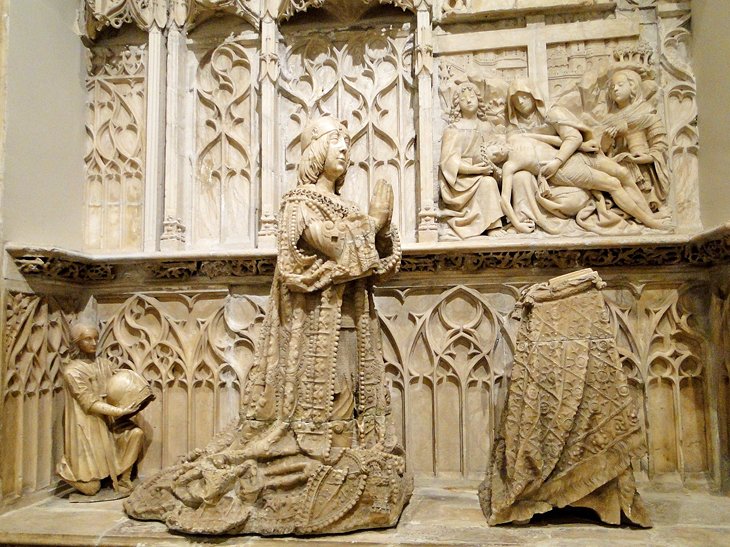
Located in the Casa de Miranda, an elegant 16th-century palace, the Burgos Museum displays a diverse collection and series of exhibits that follow the cultural and historic evolution of the region. The collection includes exhibits of archaeology, many of which are discoveries from the Atapuerca archaeological site, and there is an extensive exhibit dedicated to prehistory in the Burgos region.
Collections also include antiquities from the province of Burgos during the 4th through 1st centuries BCE, as well as a fine arts section that focuses on the Middle Ages. There is also an exceptional assortment of Baroque paintings of the 17th century, as well as modern art of the 19th and 20th centuries.
Address: 13 Calle Miranda, Burgos
Take a Stroll on the Paseo del Espolón
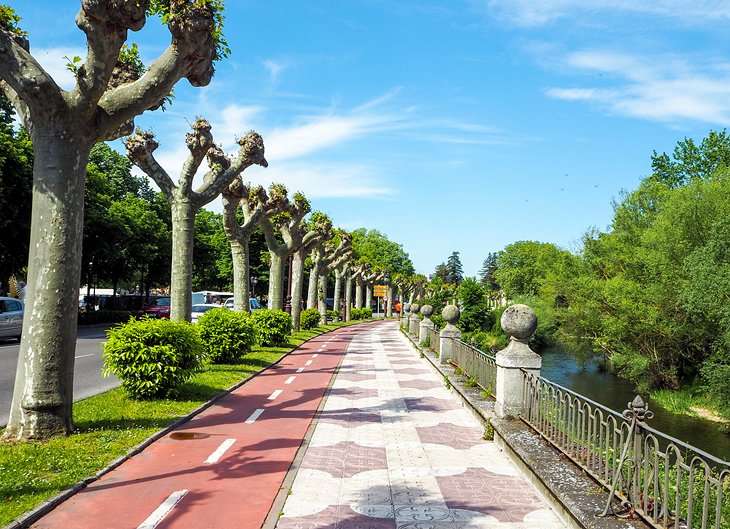
Shaded by plane trees and lined with cafés and shops, the Paseo del Espolón is the favorite promenade of Burgos residents. This pleasant pedestrian promenade extends along the Río Arlanzón from the Puente de Santa María to the Puente de San Pablo, not far from Burgos Cathedral. The Museum of Evolution is also nearby, and just steps from the promenade, tourists will find La Casa de los Gigantillos, a small but fascinating museum featuring larger-than-life figures representing cultures from around the world.
Opposite the Paseo del Espolón, along the riverbanks, is a quiet garden of meadowland and banks of reeds filled with frogs, a truly peaceful pastoral scene. The Paseo del Espolón is a wonderful place to take an afternoon stroll or relax on one of the park benches.
Visit the Churches of Burgos
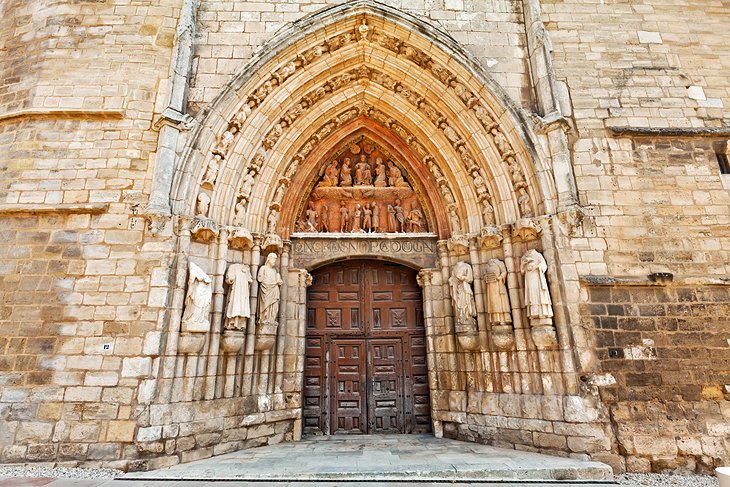
Located in the Plaza de San Juan is the Gothic Iglesia San Lesmes. The church was built in the 15th century to house the remains of San Lesmes, patron saint of Burgos, who took care of pilgrims who stopped in the town on the "Way of Saint James" trail to Santiago de Compostela in northern Spain. In the 16th century, the church was renovated in the architectural and decorative style of the era. Tours of the church are available when mass is not in session.
One of the most beautiful Gothic churches in Burgos, Iglesia San Gil on Calle San Gil dates to the 14th century. The highly decorated interior has many chapels; the most noteworthy are the finely vaulted Nativity chapel and the Buena Mañana chapels. Tours of the church are available before and after worship hours.
A short walk northeast of the Iglesia de San Nicolás is the Gothic Iglesia de San Esteban, built between 1280 to 1350. This ancient church has an impressive facade with a richly sculptured west doorway. A beautiful rose window illuminates the sanctuary, with ethereal light filtered through the stained glass. The church also has an interesting Baroque retablo and a noteworthy Early Gothic cloister.
Museo del Libro Fadrique de Basilea

An absolute dream for any bibliophile, the Museum of Books in Burgos includes exhibits about the history and evolution of books, as well as an astounding collection-which, for the most part, is also for sale. For the right price, the museum will sell individual works or even collections.
The museum is divided into four main exhibit themes including the Origin of the Book, which explores the very first written texts and ancient writing; an exhibit on monastic scripts of the Illuminated Middle Ages; the "Gutenberg Universe," which looks at the evolution of the printing press and its impact from the 15th to 18th centuries; and another exhibit that focuses on the 19th and 20th centuries.
Address: Travesía del Mercado, 3 (El Hondillo), Burgos
A Day Trip to the Historic Town of Palencia
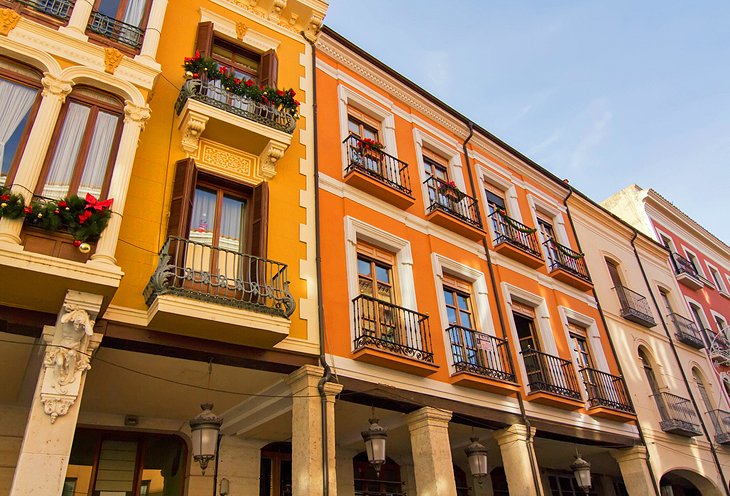
Tourists can travel 90 kilometers from Burgos to explore the historic town of Palencia. This ancient town was destroyed several times throughout its history, first by the Romans, then by the Visigoths, and finally by the Moors. In the 11th century, Palencia was rebuilt and had its heyday in the 12th century, when it was the residence of the kings of Castile and the meeting place of the Castilian Parliament. In the 13th century, King Alfonso VIII of Castile founded Spain's first university in the town.
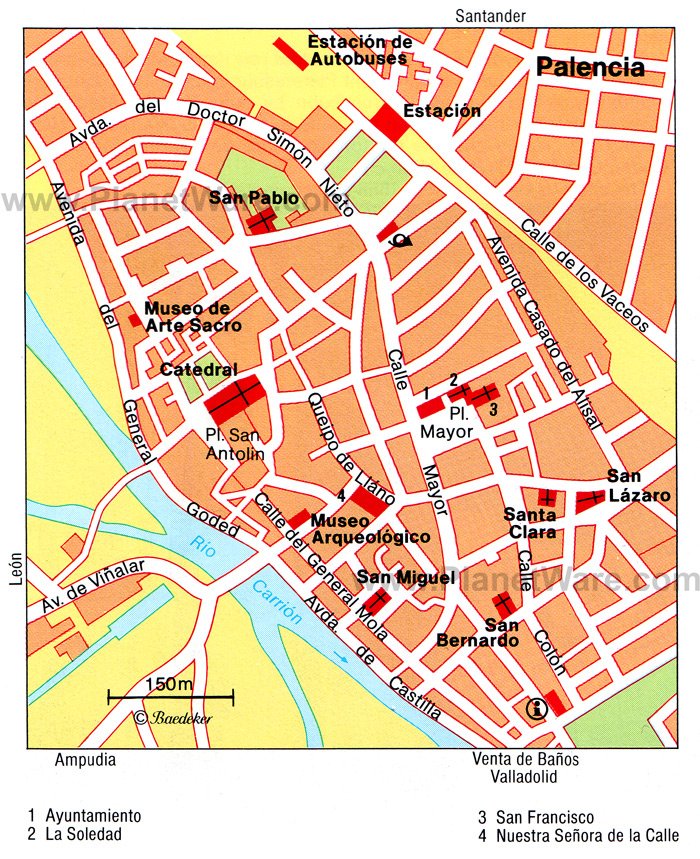
Palencia has a striking cathedral on the Plaza de la Inmaculada. The Catedral de San Antolín was built between 1321 and 1516 and incorporates the remains of a seventh-century Visigothic chapel. Housed in the cloister and chapter house, the Cathedral Museum displays valuable religious art. The collection includes precious 15th-century Flemish tapestries, paintings by El Greco, Zurbarán, and Cerezo, religious sculptures, and monuments.
To learn more about the town's heritage, visit the Palencia Museum, which occupies a 16th-century Renaissance house at the Plaza del Cordón. This museum exhibits archaeological findings of the Castile-León region, from the prehistoric era through the Middle Ages. The classical Roman period is especially well represented.
Attend the International Folk Festival
Burgos is renowned for its International Folk Festival, an outstanding cultural event. The festival is held the third week in July and hosts hundreds of folk groups from Spanish-speaking countries all over the world. Festivities include musical performances, dancing, and traditional costumes, and in addition there are a variety of things to do, including craft workshops, parades, and, of course, plenty of food.
Performances take place in public squares and historic venues such as the Plaza de San Juan Square, the Paseo del Espolón Pavilion, and the Principal Theatre. Performers reflect a wide range of artistic traditions from diverse countries including Italy, Honduras, Bolivia, Mexico, Venezuela, and the Philippines.
Iglesia de San Nicolás
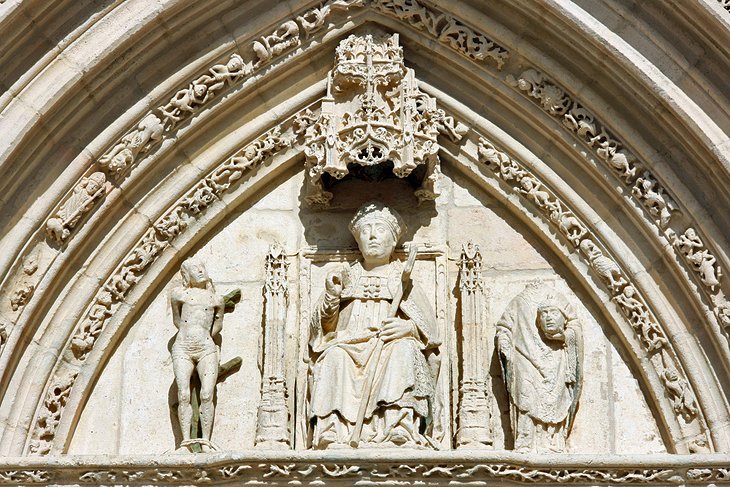
Just steps away from the cathedral, the Church of San Nicolás is reached by taking a flight of steps via the Plaza de Santa María. The 15th-century church was restored to its former glory with a renovation project in 1911. The church interior is noteworthy for its fine vaulting and impressive tombs.
The church's greatest treasure is the sumptuous 16th-century High Reredos by Francisco de Colonia. This monumental sculptural piece features reliefs of Old and New Testament biblical scenes with a special focus on the life of San Nicolás and the miracles he performed. With incredible attention to detail, the piece features 465 figures. The reredos was commissioned by a wealthy merchant who wanted the work of art to reflect his stature in the community.
Address: Calle Fernán González, Burgos
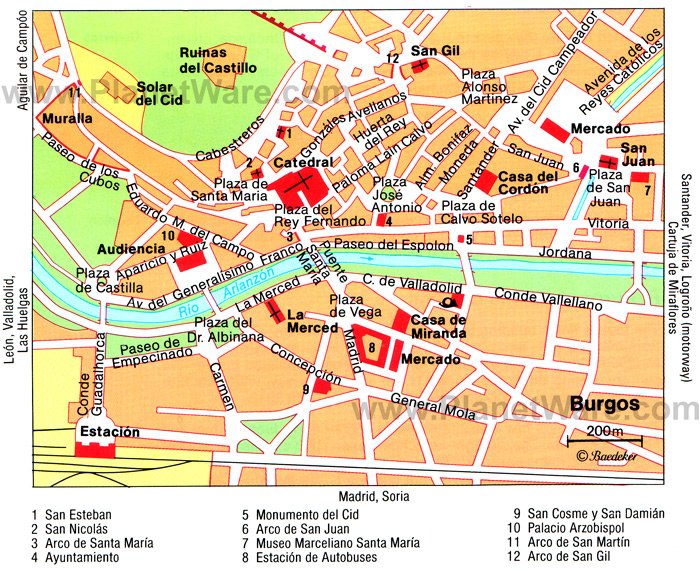
Map of Attractions & Things to Do in Burgos
More Related Articles on PlanetWare.com
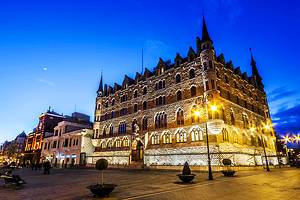
Lovely León: Another important town along the pilgrimage trail to Santiago de Compostela via the Way of Saint James, the city of León is also known for its cathedral and monastery, among other historic attractions. León is also home to a great deal of architectural beauties, including the Romanesque Collegiate Church of Saint Isidore and the Neo-Gothic Casa de Botines.
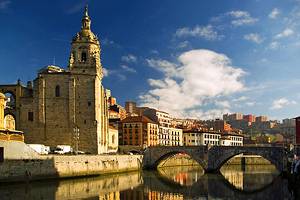
Bilbao's Art & Architecture: Those interested in art and modern architecture will want to visit the northern city of Bilbao, home of the Guggenheim Museum, as well as several other excellent museums, including fine arts, history, archaeology, and even a maritime museum.