21 Top-Rated Tourist Attractions & Things to Do in Milan
While Milan (Milano) may not be the first city a tourist thinks of when planning a trip to Italy, it has more than its share of attractions, not to mention history. For all its workaholic reputation as the money and business center of Italy, it's a city with an influential past and a rich cultural heritage.
Consider that St. Augustine was baptized in a basilica that stood at what is now Piazza del Duomo; artists Michelangelo and Leonardo da Vinci, the composer Verdi, the great tenor Enrico Caruso, and designer Giorgio Armani all lived and worked here; Toscanini conducted regularly at La Scala; Napoleon was crowned (actually, he crowned himself) inside the Duomo; Mussolini founded the Fascist party here; and the entire fashion world looks to Milan's catwalks twice a year for the season's cutting-edge styles.
All this history, not to mention the considerable wealth generated by its favored commercial position, has left Milan with an abundance of art, cultural, and architectural treasures for you to enjoy.
The large Piazza del Duomo in front of the cathedral is Metro hub, and you'll find plenty of things to do near the Duomo. In tiny Piazza dei Mercanti, you will feel as though you've stepped back into the Middle Ages as you stand beneath the stone market arcade in front of the 13th-century Palazzo della Ragione.
Jump forward several centuries to enter the elegantly domed Galleria Vittorio Emanuele II, facing the Duomo. Walk through it to emerge in front of the world's most famous opera house. It's all within a five-minute walk. You'll find these and more of the best places to visit with this handy list of the top attractions in Milan.
- 1. Il Duomo (Milan Cathedral)
- 2. Leonardo da Vinci's Last Supper
- 3. Browse in the Galleria Vittorio Emanuele II: Luxury Shops and Elegant Cafés
- 4. Castello Sforzesco
- 5. Pinacoteca di Brera
- 6. See an Opera at Teatro alla Scala
- 7. Sant'Ambrogio
- 8. Cimitero Monumentale
- 9. San Maurizio and the Archaeology Museum
- 10. Spend an Evening in Naviglio
- 11. Santa Maria Presso San Satiro
- 12. Poldi-Pezzoli Museum
- 13. Museo Bagatti Valsecchi
- 14. Leonardo da Vinci National Museum of Science and Technology
- 15. Parco Sempione
- 16. Triennale di Milano (Palazzo dell'Arte)
- 17. Sant'Eustorgio
- 18. Indulge Your Inner Fashionista
- 19. Pirelli Hangar Bicocca
- 20. Civica Galleria d'Arte Moderna (Modern Art Gallery)
- 21. Porta Nuova
- Where to Stay in Milan for Sightseeing
- Tips and Tours: How to Make the Most of Your Visit to Milan
- Map of Tourist Attractions & Things to Do in Milan
- Milan, Italy - Climate Chart
- More Things to See and Do near Milan
1. Il Duomo (Milan Cathedral)
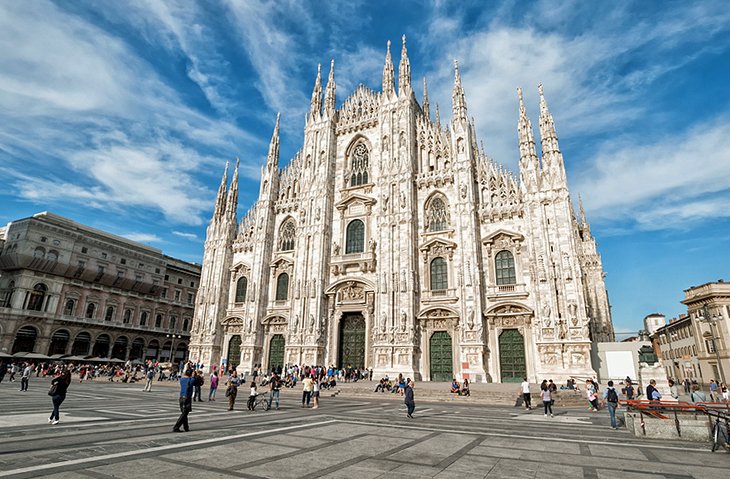
The massive Cathedral of Santa Maria Nascente, which the Milanese call just "Il Duomo" is among the world's largest (it holds up to 40,000 people) and most magnificent churches, the ultimate example of the Flamboyant Gothic style. It was begun in the 14th century, but its façade was not completed until the early 1800s, under Napoleon.
The roof is topped by 135 delicately carved stone pinnacles and the exterior is decorated with 2,245 marble statues. The dim interior, in striking contrast to the brilliant and richly patterned exterior, makes a powerful impression with its 52 gigantic pillars. The stained-glass windows in the nave (mostly 15th-16th centuries) are the largest in the world; the earliest of them are in the south aisle.
Highlights include the seven-branched bronze candelabrum by Nicholas of Verdun (c. 1200) in the north transept, the 16th-century tomb of Gian Giacomo Medici, and the jeweled gold reliquary of San Carlo Borromeo in the octagonal Borromeo Chapel leading off the crypt. Behind the high altar, the choir has deeply carved panels, and misericords under the seats.
In the south sacristy is the treasury with gold and silver work dating from the fourth to the 17th century. A walk on the roof of the cathedral is an impressive experience, offering views across the city and extending on clear days to the snow-covered Alps. (An elevator ascends all but the last 73 steps to the platform of the dome).
At the front of the Duomo, near the central doorway, you can descend under Piazza del Duomo into the foundations of the Basilica di Santa Tecla (fourth-fifth and seventh century) and the fourth-century baptistery, Battistero di San Giovanni alle Fonti, which were discovered during the construction of the Milan Metro system.
Ticketing Tips: There's a bewildering variety of tickets, with options both for the attractions included and for the length of wait time. In short, you pay the least to wait the longest. You will want to avoid "Queue 1" by purchasing tickets ahead of time online, but you may still need to wait up to a half hour in "Queue 2," which is located just to the right of the entrance.
If you're not booking online, it's still a good idea to take a peek at the options before you go — there are ten ticketing choices offering access to various areas individually or in combination, so it can get overwhelming trying to decide on-the-spot with a long queue behind you.
If you're short on time, you can get tickets separately to visit the roof (terrace) only, including "skip the line" options. You can choose between taking the stairs or the lift, but note that even if you pay extra to ride the elevator to the top, you will still have to descend via the stairs.
Address: Piazza del Duomo, Milan
2. Leonardo da Vinci's Last Supper
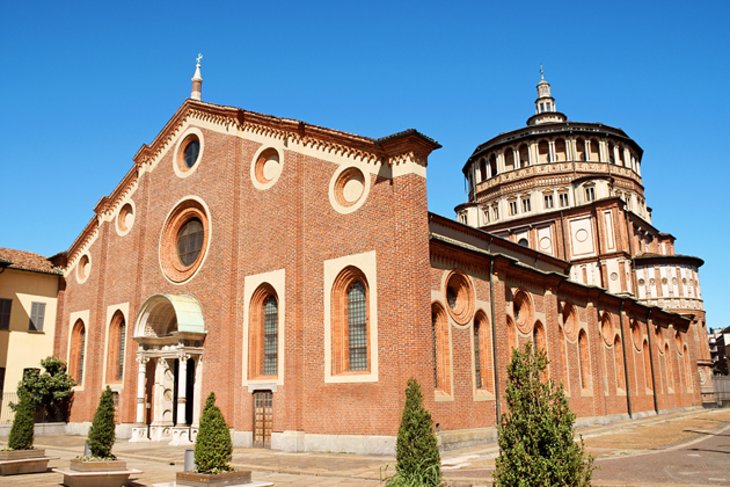
The Gothic brick church of Santa Maria delle Grazie, in the Corso Magenta, was begun about 1465, and its massive six-sided dome in the finest Early Renaissance style was designed by Bramante, one of Italy's most influential Renaissance architects.
The church - and adjoining refectory, which holds Leonardo da Vinci's Last Supper - were badly damaged in World War II, and during the repair work, old sgraffito paintings in the dome were brought to light. At the end of the north aisle is the Baroque chapel of the Madonna delle Grazie, with an altarpiece of the Madonna.
But the reason most tourists visit Santa Maria delle Grazie is to see da Vinci's most famous work, painted on the refectory wall of the former Dominican monastery. The Cenacolo Vinciano, as it is called here, was painted on the wall in tempera between 1495 and 1497.
Instead of earlier static representations of Christ's last meal with his disciples, da Vinci presents a dramatic depiction of the scene, which was quite novel and marked an important new stage in the development of art. The painting, which had already begun to flake off before the destruction of part of the room left it exposed to weather, has been restored several times, a process which will probably never be fully completed.
Entrance is limited and restricted to those with advance-timed tickets. An easy way to see this and the other most famous sites in Milan is on a Milan Half-Day Sightseeing Tour with da Vinci's The Last Supper. This 3.5-hour walking tour takes you to several key attractions and includes admission to La Scala and an entrance ticket to see The Last Supper.
Author's Tip: Before your visit, you will need to buy your ticket online, which will have a set entry time. You will need to arrive well before your assigned time — at least 30 minutes — to avoid forfeiting your spot.
Address: Piazza Santa Maria delle Grazie 2, Milan
3. Browse in the Galleria Vittorio Emanuele II: Luxury Shops and Elegant Cafés
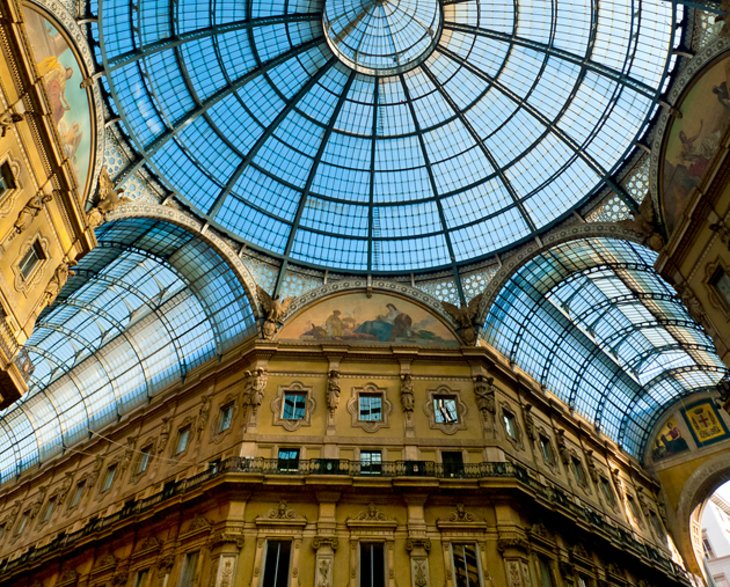
Forming one side of Piazza del Duomo and opening on the other side to Piazza della Scala, the grand Galleria Vittorio Emanuele II was designed by Giuseppe Mengoni and built between 1865 and 1877. It was then the largest shopping arcade in Europe, with a dome soaring 48 meters above its mosaic floor.
Marking the beginning of modern architecture in Italy, today it stands as a splendid example of 19th-century industrial iron and glass construction. And it's still a beautiful, vibrant place where locals meet for lunch or coffee in its elegant cafés and browse in its luxury shops. It is so much a part of local life that the inhabitants of Milan refer to it as "il salotto" (the salon).
Address : Piazza del Duomo, Milan
4. Castello Sforzesco
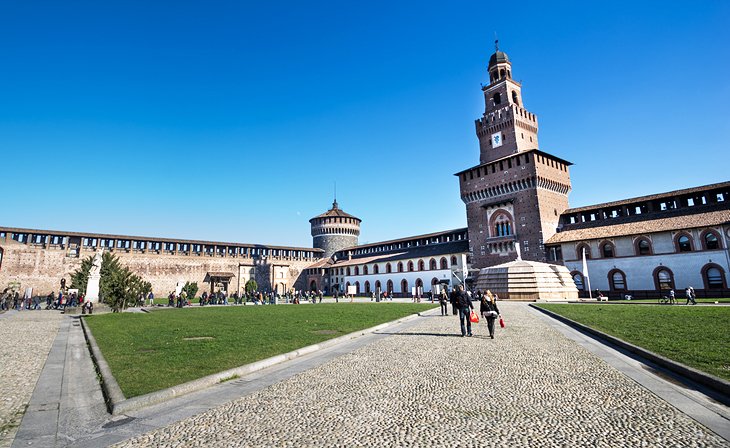
The Castello Sforzesco, held by the Visconti and the Sforza families who ruled Milan from 1277 to 1447 and from 1450 to 1535 respectively, was built in 1368 and rebuilt in 1450. The 70-meter Torre de Filarete is a 1905 reproduction of the original gate tower.
The Castello houses the Musei del Castello Sforzesco, a series of museums, one of which features sculpture. The collection includes the Pietà Rondanini, Michelangelo's last masterpiece, brought here in 1953 from the Palazzo Rondanini in Rome.
Other museums feature a collection of decorative art, prehistoric and Egyptian antiquities, a collection of musical history, and an armory of weapons and medieval armor.
The picture gallery includes paintings by Bellini, Correggio, Mantegna, Bergognone, Foppa, Lotto, Tintoretto, and Antonello da Messina. Between the two rear courtyards of the Castello, a passage leads into the park, originally the garden of the dukes of Milan and later a military training ground.
Address: Piazza Castello, Milan
5. Pinacoteca di Brera
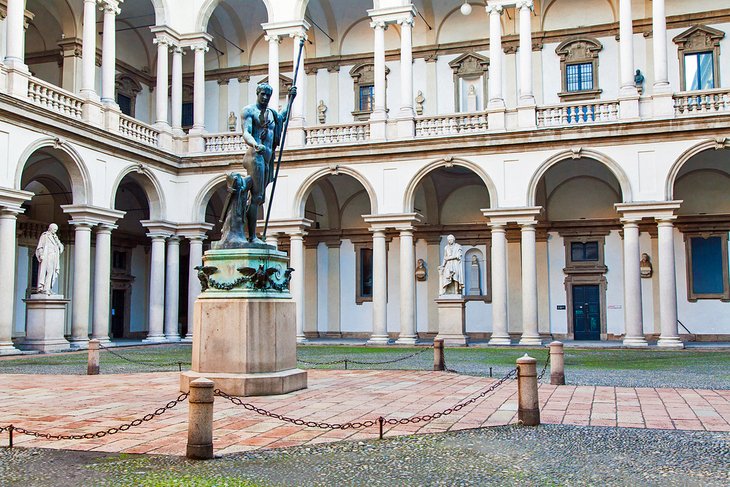
The Renaissance Palazzo di Brera, built between 1651 and 1773, was originally a Jesuit college, but since 1776 has been the Accademia di Belle Arti (Academy of Fine Arts). Along with a library and observatory, it contains the Pinacoteca di Brera, one of Italy's finest art museums.
Much of the art was acquired as churches closed or were demolished, and the museum is especially strong in paintings by northern Italian masters. As you enter through the courtyard, you'll see an 1809 monument to Napoleon I by the sculptor Canova.
Notable among 15th-century pictures are works by Mantegna (Madonna in a Ring of Angels' Heads and Lamentation). The Venetian masters are represented by Giovanni Bellini (Lamentation and two Madonnas), Paolo Veronese, Titian (Count Antonio Porcia and St. Jerome), and Tintoretto (Finding of St. Mark's Body and Descent from the Cross), and portraits by Lorenzo Lotto and Giovanni Battista Moroni.
The Lombard masters, disciples of Leonardo da Vinci, are well represented, as are artists of the Ferrarese school. Correggio of Parma is represented by a Nativity and an Adoration of the Kings. Artists of the Umbrian school include Piero della Francesca (Madonna with Saints and Duke Federico da Montefeltro) and Bramante (eight frescoes Christ of the Column).
The most famous picture in the gallery is Raphael's Marriage of the Virgin (Lo Sposalizio), the finest work of his first period. Outstanding among foreign masters are Rembrandt (portraits of women, including The Artist's Sister), Van Dyck (Princess Amalia of Solms), Rubens (Last Supper), and El Greco (St. Francis).
It's not all old masters - you'll also find works here by Picasso, Braque, and Modigliani, too. Most visitors miss the Brera's little secret: the Orto Botanico di Brera, a charming garden in one of its inner courtyards, a hidden oasis of exotic trees, pools, and flower beds with a 19th-century greenhouse.
Address: Via Brera 28, Milan
6. See an Opera at Teatro alla Scala
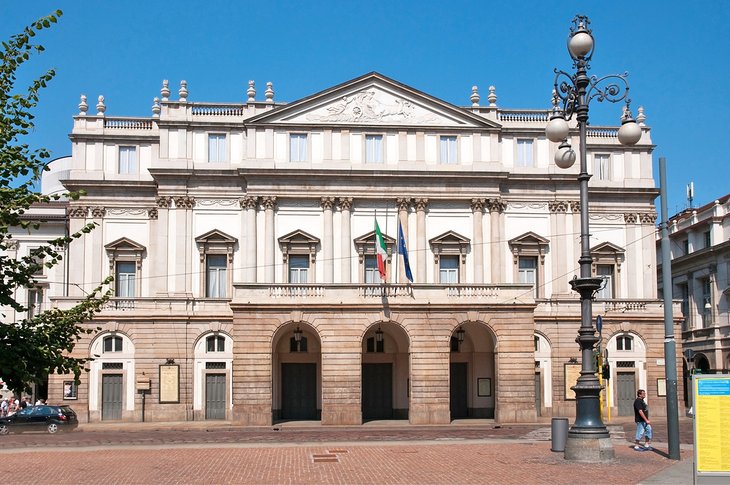
Considered the most prestigious opera house in the world, Teatro alla Scala has rung with the music of all the great operatic composers and singers, and its audiences - the theater seats 2,800 people - are known (and feared) as the most demanding in Italy.
The season begins in early December and runs through May, but tickets are often difficult to come by. The best way of getting tickets is through your hotel concierge, but it's worth checking at the box office.
In the same building is the Museo Teatrale alla Scala, where you'll find a collection of costumes from landmark performances and historical and personal mementos of the greats who performed and whose works were performed at La Scala, including Verdi, Rossini, and the great conductor Arturo Toscanini.
If there is not a rehearsal in progress, the museum offers access to see the inside of the opera house itself, one of the world's grandest.
Address: Piazza della Scala, Milan
7. Sant'Ambrogio
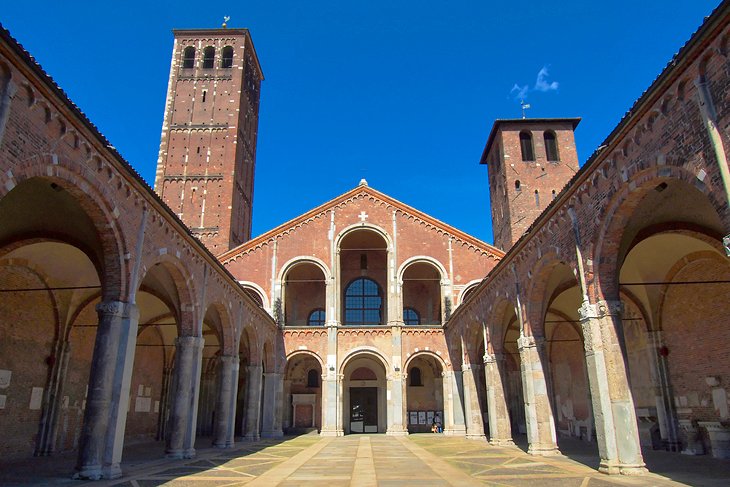
The church of Sant'Ambrogio was founded in 386 by St. Ambrose, who was born in Milan and is the city's patron saint. The present church is a masterpiece of Romanesque architecture, built in the 12th century around the choir from an earlier ninth-century church.
There's a lot to see here, beginning with the large portico, also from the ninth century, and the atrium, whose carved stone capitals and portal rank it high among Europe's best examples of the Romanesque period.
Inside, be sure to see the pulpit with late Romanesque carving, and the richly carved 4th-century Stilicone sarcophagus underneath it. The casing (paliotto) of the high altar is a masterpiece of Carolingian art made in 835 at either Milan or Rheims. It's easy to miss the mosaic dome of the original 4th-century Sacello di San Vittore, accessed through the last chapel on the right.
Address: Piazza Sant'Ambrogio 15, Milan
8. Cimitero Monumentale
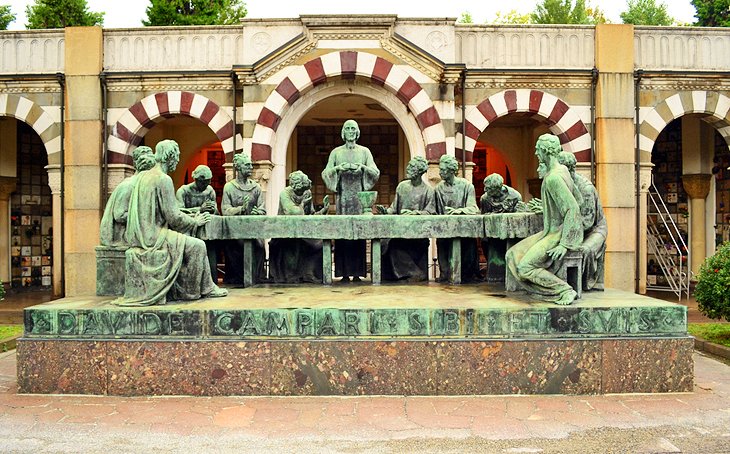
With all of Italy's magnificent architecture and art from Ancient Greek and Roman, medieval, and Renaissance eras, it's easy to forget that Italy also has some outstanding examples from the Art Nouveau period, known here as Stile Liberty.
Cimitero Monumentale, near Stazione Porta Garibaldi rail station, is an outdoor gallery of Art Nouveau sculptures, many by noted Italian sculptors. Behind a monumental and flamboyant striped marble portico, these monuments mark the tombs of Milan's rich and famous from the late 1800s through the mid-20th century. A map in English helps you find the most outstanding examples.
Address: Piazzale Cimitero Monumentale, Milan
9. San Maurizio and the Archaeology Museum
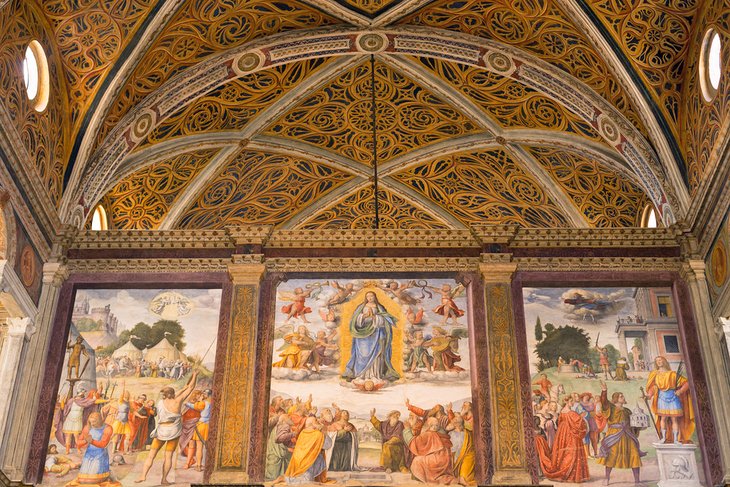
To many, the interior of the church of San Maurizio is the most beautiful in Milan. Built in the early 1500s as the church for a convent of Benedictine nuns, the entire interior is covered in frescoes of biblical scenes.
Not only are these by some of the best Lombard artists of the 16th century - principally Bernardino Luini and his sons - but the colors of the paintings are as vivid as if they'd been painted yesterday. The long nave is divided into two sections, the rear one reserved as the nuns' choir.
The extensive monastery was built over the ruins of the Roman circus and portions of the Roman walls, all now part of the Civico Museo Archeologico (Archaeology Museum), where you can see these excavated remains of Roman Milan.
Along with the ancient history of Milan, you'll find Greek, Etruscan, and Roman finds from elsewhere in Italy, including sculptures in stone and bronze. Particularly good are the third-century sculpture of Maximilian, a bronze head, and a female statue with folded drapes.
Address: Corso Magenta 15, Milan
10. Spend an Evening in Naviglio
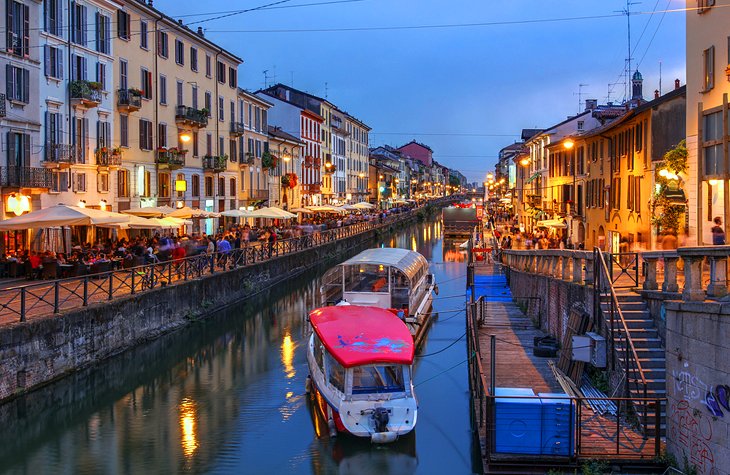
For the young people who frequent the canal-side cafés and music clubs, Naviglio is one of the top things to do in Milan at night. Although it's the most active in the evening, go in the daytime for the boutiques and artists' workshops, and for the restaurants and frequent festivals held here.
In April, the neighborhood along the canal is filled with flowers for the Festa Di Fiori, and the Festa del Naviglio brings concerts, processions, crafts, and an antique market. Barges along the canals are decorated in mid-June for the Sagra di San Cristoforo (Festival of Saint Christopher), and the Orchestra Sinfonica di Milano Giuseppe Verdi performs about 50 concerts on Thursday and Friday evenings and Sunday afternoons at the Auditorium di Milano.
Address: Corso San Gottardo, Milan
11. Santa Maria Presso San Satiro
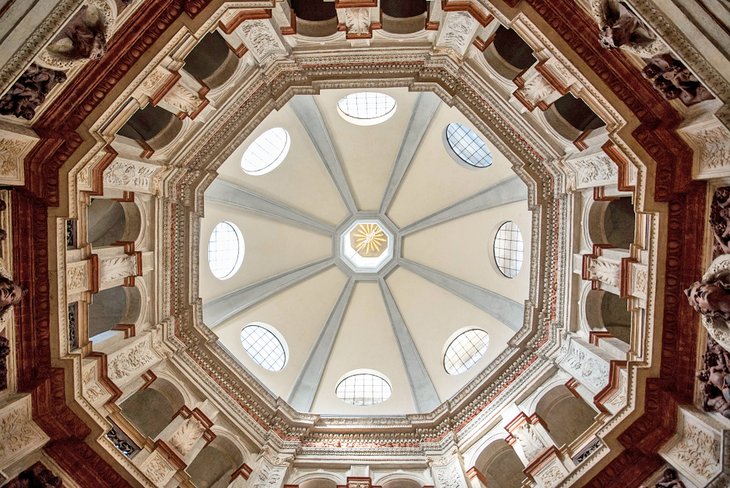
From the outside, this church on a shopping street not far from Piazza del Duomo seems relatively small and unimpressive. Step inside to see that it is quite grand, its majestic, deep, vaulted sanctuary stretching into an apse that's nearly the length of the main part of the church.
Or is it? Keep your eyes on it as you walk forward, and watch as it melts into an almost completely flat wall behind the altar. It's all an optical illusion, a very clever trick played by the architect Bramante to give grandeur to a church with only a limited space.
Address: Via Torino 9, Milan
12. Poldi-Pezzoli Museum
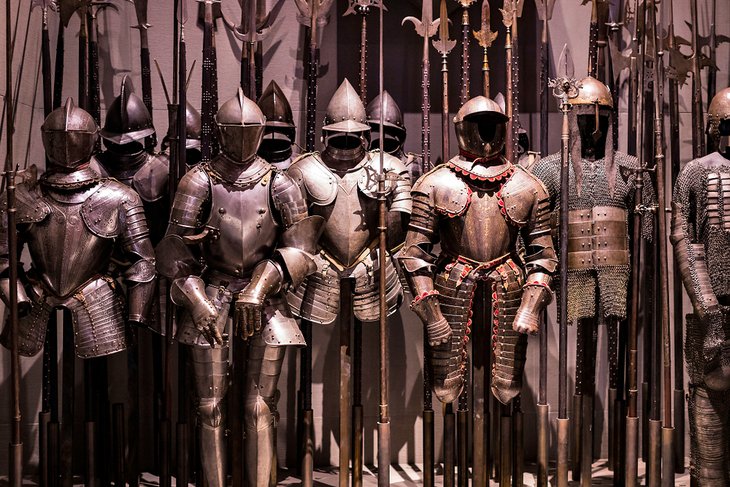
An elegant old patrician house is the setting for this art museum, which originated in the 19th century as the private collection of Gian Giacomo Poldi Pezzoli and his mother, Rosa Trivulzio. Highlights are paintings by Botticelli, Mantegna, Piero della Francesca, Guardí, and other artists, as well as jewelry, silver, bronzes, porcelains, Etruscan pottery, armor, and weapons.
Textiles in the museum include Flemish and Persian carpets, tapestries, a large collection of hand-worked lace, and a very rare embroidery designed by Botticelli.
The house itself is worth seeing, as artworks and other collections are shown in a combination of room settings and gallery spaces; many of the rooms were redecorated in the mid-1800s to showcase the collections. Poldi-Pezzoli Museum is one of four houses that form the Circuito delle Case Museo di Milano, Milan Museum House Network, with admission on a single ticket.
Address: Via Manzoni 12, Milan
13. Museo Bagatti Valsecchi
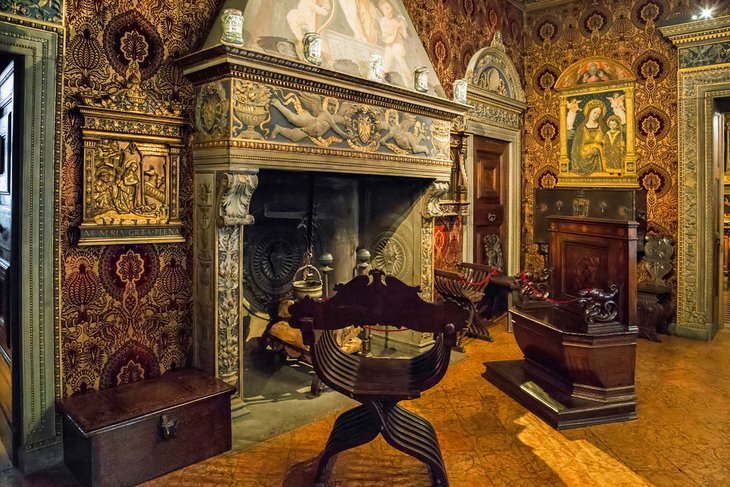
Several things make this an especially interesting place to visit. Two brothers in the 19th century spent their lives collecting furnishings and decorative arts to make the interior of their Renaissance palazzo look as it might have appeared originally.
Not only will you see a home of that era in a livable state, as opposed to just rooms of display cases and walls of paintings, but you can follow their collecting process through the excellent English signage. So you get to share a bit of the excitement of the chase amid the historical and artistic information about each piece.
Most of all, though, it's nice to see the furniture, tapestries, glassware, books, children's items, and paintings by Renaissance masters in a household setting. The museum is also part of the Circuito delle Case Museo di Milano, four distinguished houses accessed with a single ticket.
Address: Via S Spirito 10, Milan
14. Leonardo da Vinci National Museum of Science and Technology
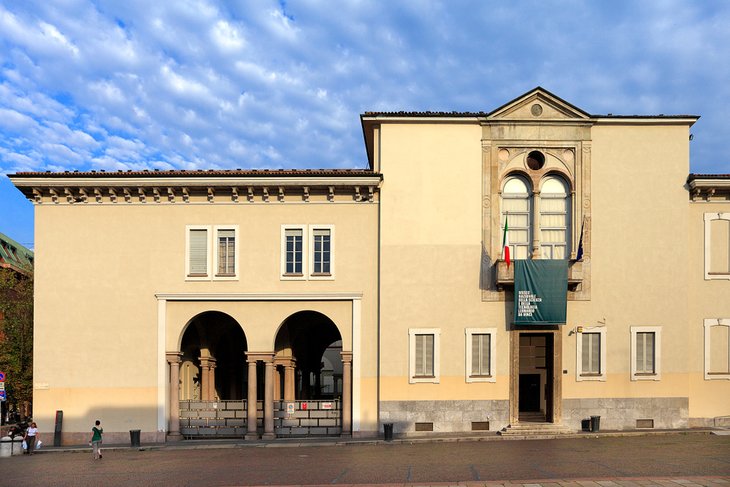
Housed in a former Olivetan monastery, the Leonardo da Vinci National Museum of Science and Technology illustrates the history of science and technology from the work of early scientists into modern times. Of particular interest is the Leonardo da Vinci Gallery with working models of many of his inventions and machinery, created from da Vinci's drawings.
In the physics exhibits are apparatus used by Galileo, Newton, and Volta, and there are sections relating to optics, acoustics, telegraphy, transport, shipping, railroads, flying, metallurgy, motor vehicles, timekeeping, and timber. In all, more than 15,000 technical and scientific objects represent the history of Italian science, technology, and industry.
Address: Via St Vittore 21, Milan
15. Parco Sempione
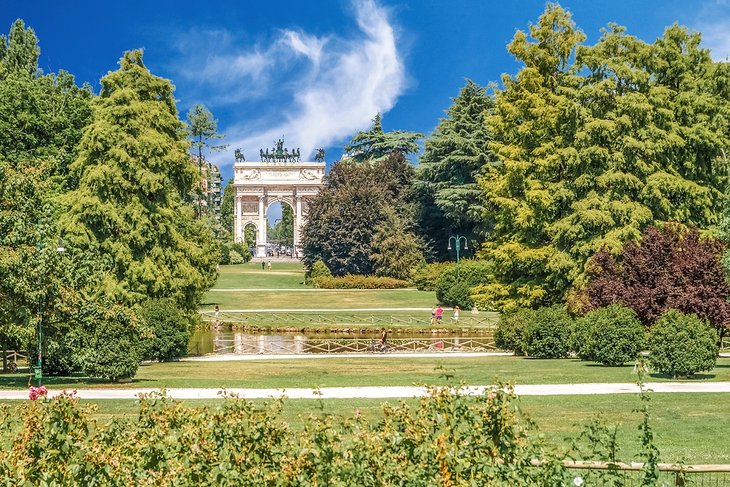
The English-style landscape of Parco Sempione is a good place to rest your eyes after they've overdosed on stone and architecture, and to wander the curving pathways. Walkers, joggers, local office workers with their lunches, and parents with children in tow all enjoy the park. In the summer, concerts are held here.
At the entrance is the monumental Arco della Pace, Peace Arch, and towering high above the park is the Torre Branco, designed by famed architect Gio Ponte in 1933. On a clear day, views of Milan and the Alps are spectacular. If you like Art Nouveau, be sure to see the fanciful aquarium pavilion at the Via Gadio edge of the park.
Address: Corso Sempione, Milan
16. Triennale di Milano (Palazzo dell'Arte)
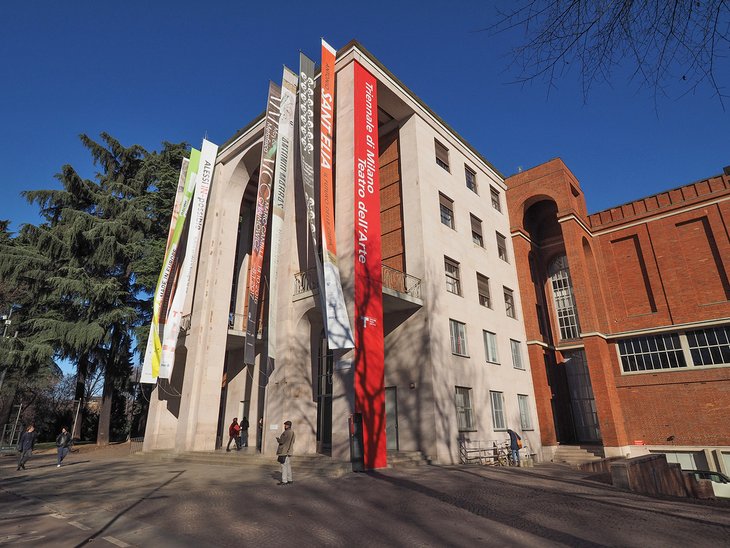
The building beside Parco Sempione, constructed in 1933 to house the premier Italian design show, is a textbook example of Fascist-era architecture (the style is properly known as Stripped Classicism, but in Italy, it is almost always a product of the Fascist regime, whose leaders favored it).
But it works well as a showcase for art and design, and inside are always high-level shows and exhibitions, often international in scope. They can range from retrospectives of a great name in modernism, such as Andy Warhol or Gio Ponte, to examinations of the roots and themes of tribal art or even food design.
The permanent exhibitions at the Triennale di Milano (Palazzo dell'Arte) showcase Italian design, featuring the best Italian-designed products throughout the ages.
Address: Viale Emilio Alemagna 6, Milan
17. Sant'Eustorgio
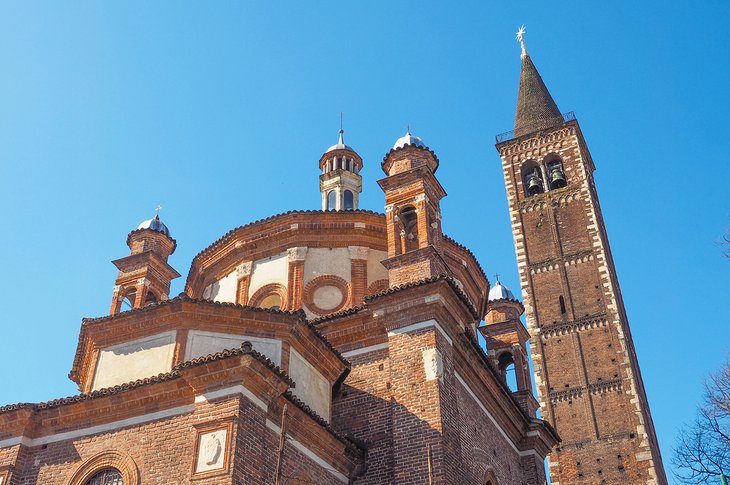
The Romanesque Basilica of Sant'Eustorgio was built in the 12th and 13th centuries, and its fine campanile was added a century later. The facade was not added until 1863. Look beyond the choir to find the Cappella Portinari, by Michelozzo in 1462-68, one of the earliest examples of Renaissance architecture. The frescoes are by Vincenzo Foppa.
Not far from Sant'Eustorgio is another church, San Lorenzo Maggiore, dating from the Early Christian period. Its Renaissance dome was added in 1574, but the mosaics in the chapel of St. Aquilinus are from the fourth century. In front of the church, the portico of sixteen Corinthian columns is the largest surviving monument of Roman Mediolanum.
Address: Piazza Sant'Eustorgio, 1, 20123 Milan
18. Indulge Your Inner Fashionista
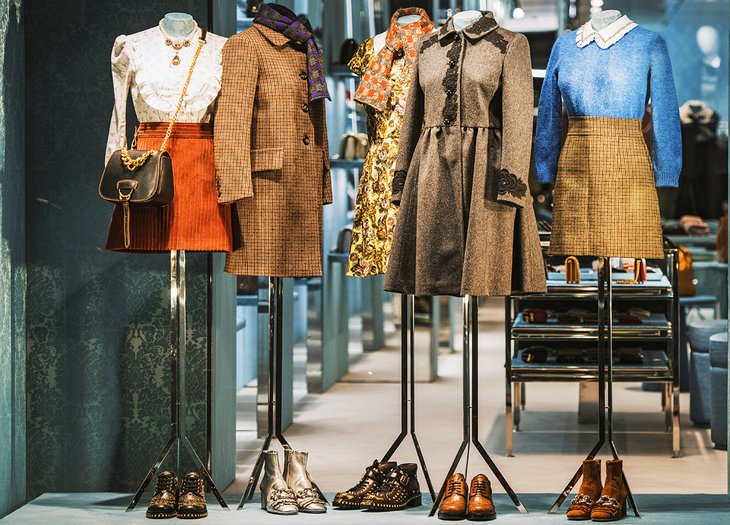
The Quadrilatero della Moda is Milano's high fashion shopping district, where the most famous Italian – and other – designers have their smartest shops. The four prime streets are Via Montenapoleone, Via della Spiga, Via Manzoni, and Corso Venezia, lined with a succession of windows displaying the latest designs and fashion trends.
This is one of the most famous designer shopping streets in the world, right up there with the Avenue des Champs Élysées in Paris, and you'll see all the best names here: Prada, Armani, Fendi, Valentino, Missoni, Trussardi, and the rest. Remember that casual browsing inside the shops is not welcome unless you dress the part. Most tourists simply browse the eye-catching windows, where the displays are as dramatic as the fashions.
Each autumn, Milan designers – the cream of the international fashion houses – send their top fashion models out to strut down the catwalks at Milano Moda Donna, Milan Women's Fashion Week. It's the highlight of the fashion year, and although you can't get into the shows without credentials, it seems as though everyone in Milan becomes a fashion model for the week; it's a great time for people-watching.
19. Pirelli Hangar Bicocca
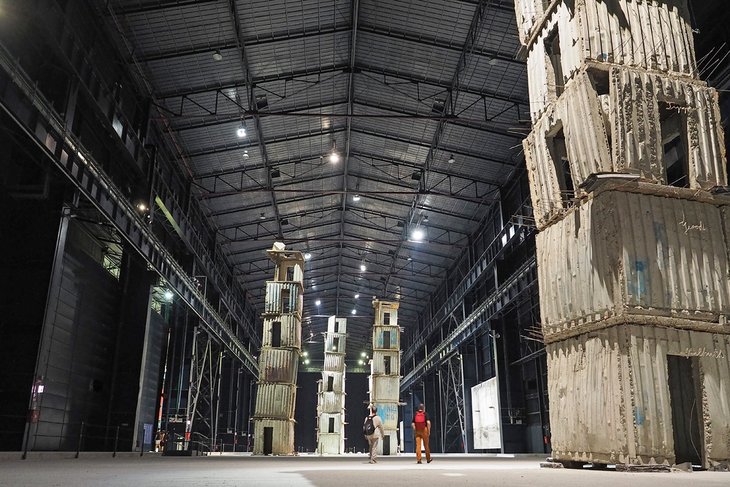
In one of the most dynamic and popular of the arts neighborhoods emerging from former industrial districts, a former locomotive manufacturing plant has been converted into the Pirelli Hangar Bicocca, a center for contemporary art and cultural projects.
Changing temporary exhibitions fill two of the three galleries, while the third houses the dramatic permanent installation, The Seven Heavenly Palaces. A collection of concrete towers by the German artist Anselm Kiefer towers over visitors, and accompanying the exhibition are "Bubbles" with in-depth texts, videos, audio, and interactive events relating to the exhibitions or to contemporary arts.
Address: Via Chiese 2, Milan
20. Civica Galleria d'Arte Moderna (Modern Art Gallery)
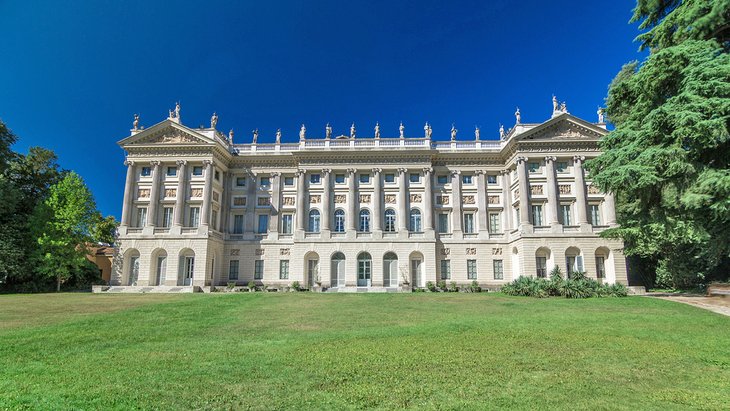
Napoleon's residence when he occupied Milan, this palace facing the Giardini Pubblici was new when Napoleon commandeered it. Today, it retains its original stucco work and decorative details inside, which adds to its interest as a showcase for Milan's extensive collection of modern art.
The emphasis at the Civica Galleria d'Arte Moderna (Modern Art Gallery) is on Italian art, from 19th-century Romanticism to post-impressionists, but the collections are far broader, with works by Renoir, Picasso, Matisse, Rouault, Modigliani, Dufy, and Vuillard. There is an extensive group of Neoclassical sculptures by Canova and his contemporaries.
On the grounds are an English-style garden and a botanic garden, and adjoining it are the lawns, flower gardens, and playgrounds of the public gardens. Also adjoining the Giardini Pubblici is the Museo Civico di Storia Naturale (Museum of Natural History), where the biodiversity of the earth is shown in nearly 100 detailed dioramas. Especially strong is the paleontology section, highlighted by a spectacular pliosaurus hanging from the ceiling.
Address: Via Palestro 16, Milan
21. Porta Nuova
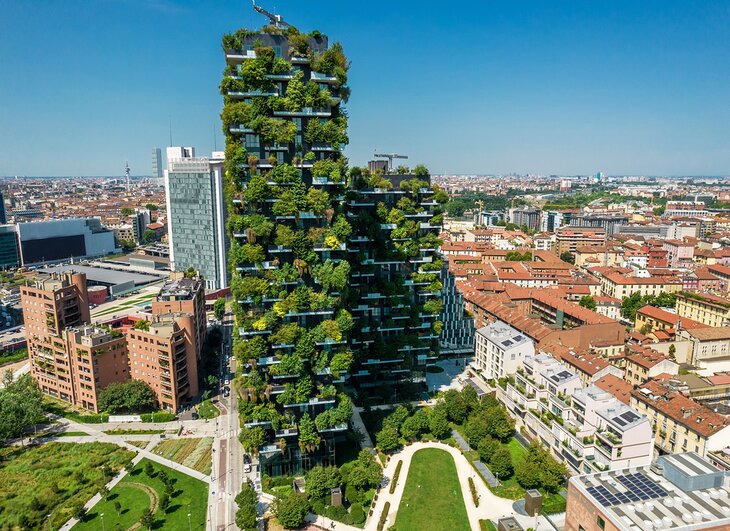
Once occupied by train yards and factories, the Porta Nuova is now Milan's stylish business district. Beautifully designed pedestrian areas are surrounded by towering modern architecture including the tallest building in Italy (the UniCredit tower) and the Palazzo Lombardia, which offers stunning views from an observation area on the 39th floor.
Tourists looking for high-end shopping and dining will want to head to the Corso Como, a bustling traffic-free street lined with cafes, restaurants, and plenty of luxury boutiques and name-brand shops. After shopping, use the footbridge to access the Piazza Gae Aulenti to admire its fountain.
While here, be sure to take a few minutes to admire the Bosco Verticale (Vertical Forest), a pair of residential skyscrapers that are home to over 700 trees that grow from its plentiful terraces. Part of an urban forestry initiative in bio-architecture, the building uses special soil that allows the terraces to support the weight of these trees. Along with shrubs and flowering plants (over 2,000 species total), the buildings help to reduce the city's heat island and combat air pollution.
Where to Stay in Milan for Sightseeing
Big, sprawling Milan can be overwhelming when you look at a map. It's not nearly so daunting when you notice that most major things to do are within walking distance from the Duomo, itself Milan's prime attraction. And they line up conveniently, so walking to the outermost of them takes you past one or two others. These highly-rated hotels in Milan are close to the important tourist attractions:
Luxury Hotels:
- Steps from Piazza Duomo and medieval Piazza Mercanti, art-filled Hotel Spadari al Duomo has a contemporary décor.
- By contrast, Grand Hotel et de Milan is a historical classic. Between La Scala and the Monte Napoleone designer shops, it is convenient for both opera lovers and fashionistas.
- Park Hyatt Milan is right beside the Galleria Vittorio Emanuele II shopping arcade, between the Duomo and La Scala opera house.
Mid-Range Hotels:
- On a quiet side street and with impeccable service, Gran Duca di York radiates an air of serenity, despite its location just off busy Piazza Duomo.
- The Square Milano Duomo is near a Metro stop, surrounded by restaurants and within easy walking distance of the Duomo; in good weather, enjoy the included breakfast on the rooftop terrace.
- In the same neighborhood, the rooms at Hotel Dei Cavalieri are contemporary in style, but in a heritage building; there's a rooftop terrace here, too.
Budget Hotels:
- The hospitable Antica Locanda Leonardo is near Santa Maria delle Grazie and The Last Supper, an easy walk to the science museum and historic San Ambrogio.
- With Metro connections to Piazza Duomo, about a 30-minute walk away, Hotel Berna is a five-minute walk from Centrale Station, terminus for service from Malpensa and Linate airports, and trains for Lake Como and all parts of Italy.
- Adjacent to the Public Garden and its museums, and a five-minute walk from the shopping strip of Corso Buenos Aires, Hotel Sanpi Milano is also a short walk to the Quadrilatero della Moda, Milan's fashion district.
Tips and Tours: How to Make the Most of Your Visit to Milan
- Swiss Alps Day Trip: One of the best ways to see some beautiful mountain scenery near Milan is from the comfort of a train. The Swiss Alps Bernina Express Rail Tour from Milan offers a fabulous trip through the Bernina Pass to St. Moritz, including free time in Tirano and St. Moritz. This is a 12.5-hour day that includes transportation via coach from Milan to Tirano, where you will begin the rail journey. Spending a day at Lake Como is another popular excursion.
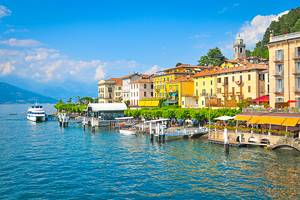
- Lake Como Day Trips: The Lake Como and Bellagio Day Trip from Milan is a nine-hour trip that offers transport to Como, a guided walking tour of the town, and a Lake Como Cruise; in the summer, the tour also includes a stop in Bellagio. A slightly longer tour, the Italy and Switzerland in One Day: Lake Como and Lugano includes a cruise on Lake Como, with a stop in Bellagio, and then continues on to Lugano for an afternoon of exploring the sights or shopping.
Map of Tourist Attractions & Things to Do in Milan
Milan, Italy - Climate Chart
| Average minimum and maximum temperatures for Milan, Italy in °C | |||||||||||
| J | F | M | A | M | J | J | A | S | O | N | D |
| 5 -2 | 8 0 | 13 3 | 18 7 | 22 11 | 26 15 | 29 17 | 28 17 | 24 14 | 18 8 | 10 4 | 5 -1 |
| PlanetWare.com | |||||||||||
| Average monthly precipitation totals for Milan, Italy in mm. | |||||||||||
| 64 | 64 | 81 | 81 | 97 | 66 | 69 | 94 | 69 | 99 | 102 | 61 |
| Average minimum and maximum temperatures for Milan, Italy in °F | |||||||||||
| J | F | M | A | M | J | J | A | S | O | N | D |
| 40 28 | 46 32 | 55 37 | 63 44 | 71 52 | 79 59 | 84 63 | 81 62 | 75 56 | 64 47 | 50 38 | 41 30 |
| PlanetWare.com | |||||||||||
| Average monthly precipitation totals for Milan, Italy in inches. | |||||||||||
| 2.5 | 2.5 | 3.2 | 3.2 | 3.8 | 2.6 | 2.7 | 3.7 | 2.7 | 3.9 | 4.0 | 2.4 |
More Things to See and Do near Milan
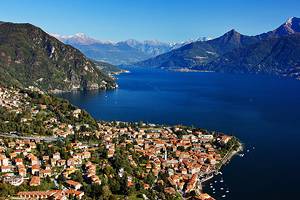
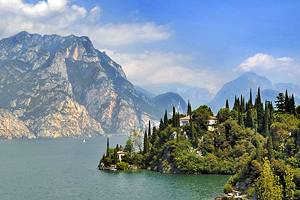
Where to Go near Milan: Milan is well connected by train or car to the highlights of northern Italy. A short train ride brings you to within a short walk of the landing for boat excursions around beautiful Lake Como, which makes a perfect day trip from Milan.
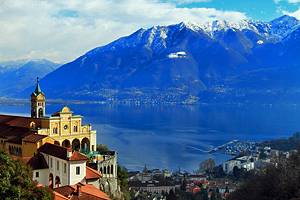
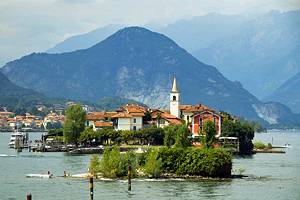
For more lake and mountain scenery, Lake Maggiore is only a short distance north of Milan; an hour's train ride along its shore will bring you to Stresa, where a boat takes you to the fabulous palace and gardens of the Borromean Islands.
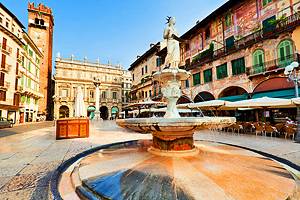
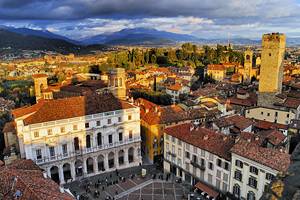
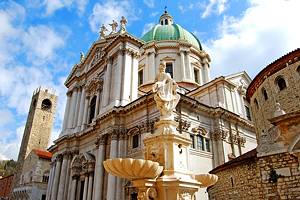
Places to Visit from Milan: Milan is the starting point for a rail or car journey through some of northern Italy's most historic and art-filled towns: the beautiful small city of Bergamo is on a direct rail line, and beyond it is Brescia, filled with ancient Roman sites and treasures. From here, it's a short train ride to Verona, home of the best-preserved Roman arena in Italy.