Sharon Plain Attractions Emeq Sharon
|
|
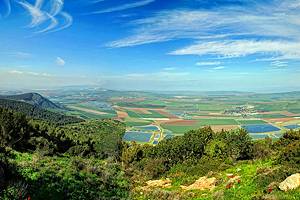
Situation and characteristicsThe plain of Sharon is the large coastal plain which extends for 60km/37mi from the south side of Mount Carmel to the river Yarqon (Tel Aviv) and from the Mediterranean to the hills of Samaria.Sharon owes its fertility to its abundance of water, supplied mainly by its perennial rivers. In all ages, however, the sand-dunes along the coast, have impeded the flow of water into the sea, leading to the formation of malaria-ridden swamps unless constant attention was given to drainage. The mouth of one of the old drainage canals can be seen at Herzliya. In modern times the drainage problem has been completely resolved, and as a result the region is intensively cultivated (citrus fruits) and densely populated.HistoryThe plain of Sharon was settled by man from early Canaanite times. Weapons and tools dating from that period were found in 1962 in the tell of Kefar Monash (9km/6mi northeast of Netanya), a moshav founded by British ex-servicemen in 1946 and named after the Australian General Monash.The old settlements were destroyed by the Assyrians and Babylonians (seventh-sixth century B.C.); then in the fifth century B.C. the site was occupied by Phoenicians. Around 100 B.C. Sharon was incorporated in Judaea. In 25 B.C. Herod founded the port of Caesarea, which in Roman and Byzantine times became capital of the province. After the Mameluke invasion in the 13th century the drainage system fell into disrepair and the plain reverted to marshland, which was almost completely uninhabited. The situation began to change when Jewish settlers established themselves in the area. In 1878 they founded Petah Tiqwa on the banks of the Yarqon to the south, and in 1890 Hadera to the north. Thereafter the drainage of the area was systematically pursued, and since then numerous new settlements have been founded, including large towns like Herzliya and Netanya.
Hefer Plain
Situation and characteristicsThe plain of Hefer, formerly known as the Wadi Hawarith, extends along the Mediterranean coast between Hadera and Netanya, forming part of the plain of Sharon. Watered by streams flowing down from the hills of Samaria, it is a fertile and flourishing tract of land with numerous settlements.HistoryDuring the occupation of the Promised Land by the Israelites the king of Hepher, along with thirty other Canaanite princes, was defeated by Joshua (Joshua 12,17). The Biblical town stood on the tell near the kibbutz of Mabarot. In the 10th century Solomon's court was supplied with victuals from the land of Hepher (1 Kings 4,10). Later the plain degenerated into marshland in which malaria was rife and permanent settlement impossible. In the 19th century this inhospitable region was inhabited only by a few Egyptian fellahin brought in by Ibrahim Pasha in 1830.SettlementsIn 1929 the Jewish National Fund acquired the area, and in the following year the draining of the marshes began. Thereafter the Hefer plain developed into one of the most fertile regions in Israel. Many settlements were established, beginning with Kefar Vitkin in 1933, and an agricultural college was founded. Some villages are named after famous personalities, like Kefar Monash (after the First World War general of that name) and Kefar Yedidia (after the Jewish philosopher Philo of Alexandria, known in Hebrew as Yedidia). The kibbutz of Mabarot has a museum containing Archeological finds from the area.