Exploring the Western Wall & Jewish Quarter: A Visitor's Guide
Jerusalem Old City's Jewish Quarter holds plenty of small museums, a handful of ruins, and some historic synagogues, as well as its major tourist and pilgrimage attraction of the Western Wall.
This is a very busy section of the Old City, and visitors will find plenty of shopping opportunities and eating options while they're sightseeing.
The Western Wall

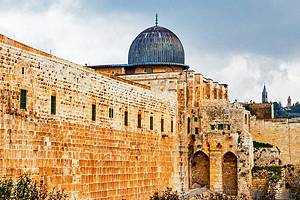
The 48-meter-long Western Wall (officially called Kotel HaMa'aravi) is the holiest Jewish site in Jerusalem's old city.
This massive stretch of wall was originally built as the retaining wall for the southwest side of the Temple Mount's Second Temple, destroyed by the Romans in AD 70.
Since 1967, the densely built-up area in front of the wall has been cleared to make a large open space known as the Western Wall Plaza.
The section of this area nearest the wall is railed off and ranks as an open-air synagogue, with separate entries for men and women. This is where Judaism's great religious ceremonies take place.
Western Wall Tunnels
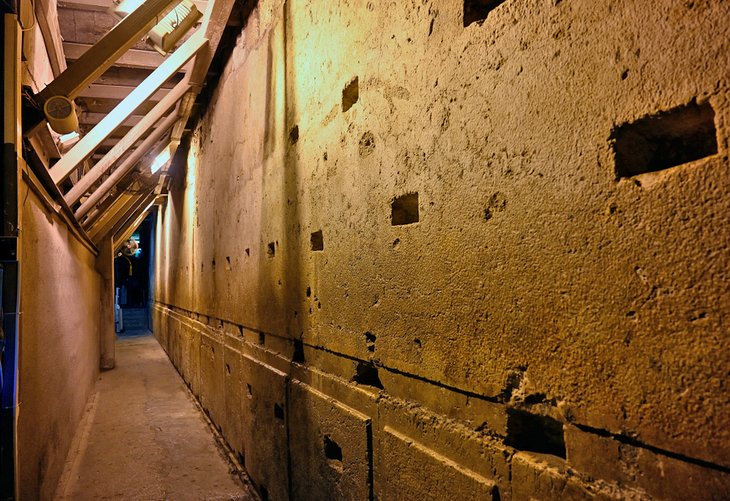
After you've finished visiting the above-ground portion of the Western Wall, you can walk a farther excavated 488 meters of the wall that runs underground, right down to the wall's original street level.
Access is by guided tour only. These tours are hugely worthwhile for travelers particularly interested in history, as the tour guides offer plenty of commentary on the construction of the wall.
Along the tunnel trail, you see the Western Stone, which was the largest stone used in the construction. The stone's estimated weight is 520 tons.
The tunnel also reveals sections of the Hasmonean water channel, which supplied water to the Temple Mount and architectural fragments and remnants from the Herodian era, when the wall was built, right up to the city's Mameluke era.
Hurva Synagogue
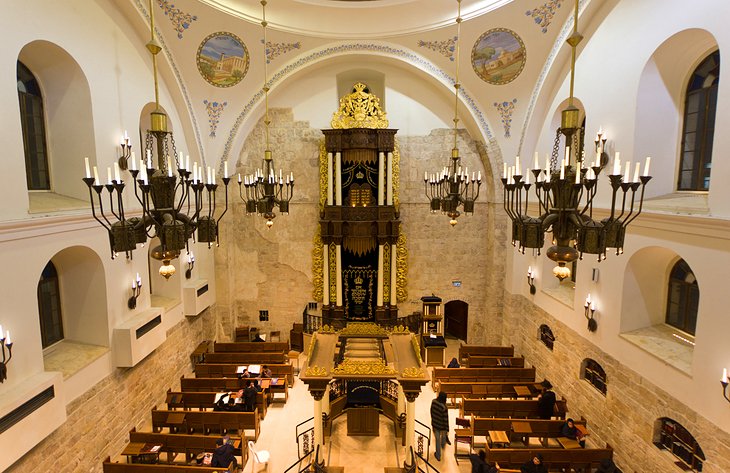
The beautifully restored Hurva Synagogue is a highlight of the old city's Jewish Quarter.
It was founded by Rabbi Yehuda HaNasi, who arrived from Poland in 1701 with 500 Ashkenazi Jews. It was burnt down by the Arab money lenders of the city in 1720, when the community could not afford to pay back the loan. The name of the synagogue stems from this act: hurva translates as "ruin."
It was rebuilt in 1856, but then destroyed again in the Arab-Israeli war of 1948. After 1967, various plans to rebuild the synagogue came and went until finally, in 2009, the Hurva Synagogue was resplendently restored once more.
Tourists are welcome to visit the synagogue but must take one of the synagogue's tour guides.
Nearby is the Ramban Synagogue, which was founded by Rabbi Moses ben Nahman (also known as Nachmanides) in 1267, making it the oldest synagogue in Jerusalem's Old City.
Cardo Maximus
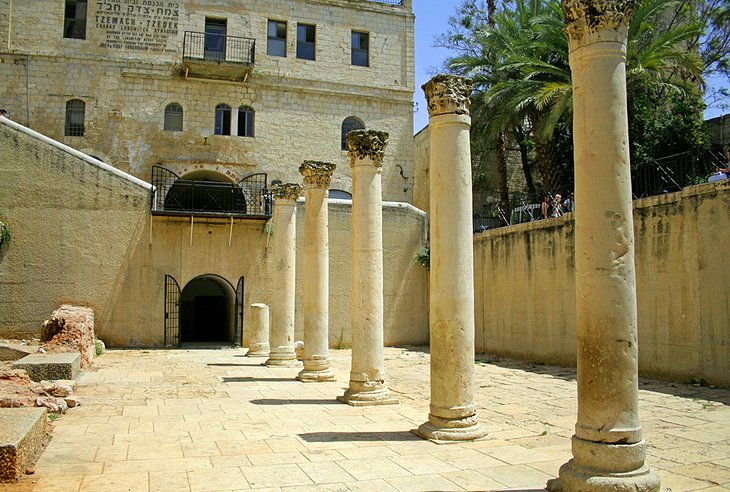
Just to the west of the Hurva Synagogue, steps lead down to the Cardo Maximus, one of Jerusalem's two principal streets in Roman and Byzantine times.
Excavated between 1976 and 1985, it runs for a length of just under 200 meters, six meters below the modern ground level.
As the reproduction of the 6th-century Madaba Map of the Holy Land (the original is in Madaba, Jordan) displayed here shows, it was a magnificent avenue, lined with shops and flanked by columns that supported a roof.
Back on modern ground level, but still following the path of the original Cardo below, the street is again lined with souvenir shops, so you can browse for wares just as the Romans once did along this road.
Address: Jewish Quarter Road, Jerusalem
Sephardic Synagogues
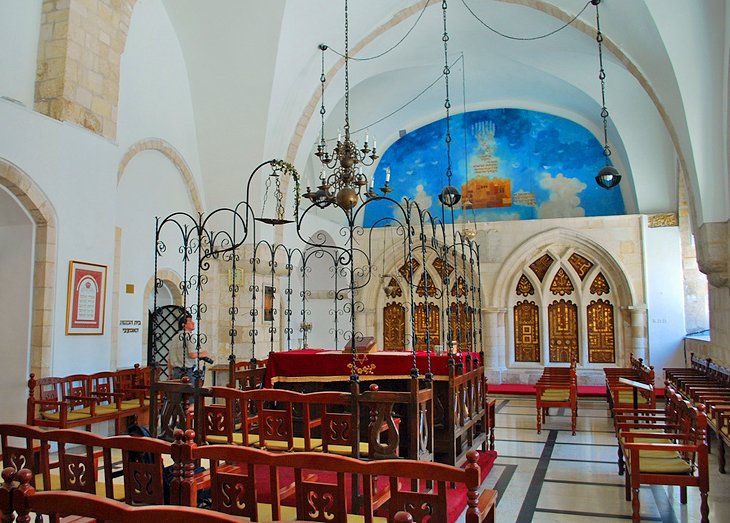
The four Sephardic Synagogues were built in Jerusalem's Ottoman era when many Jews from Europe arrived in the city.
The Ben Zakkai Synagogue is named after a rabbi of the Roman period.
The Istanbuli Synagogue was founded by Turkish Jews and dates to 1764.
The name of the Eliyahu Hanavi Synagogue commemorates the association of the site with the prophet Elijah, while the small Emtzai Synagogue, squeezed between the other three, was originally only the vestibule to the others.
All four suffered damage in 1948, but have been restored following their original 17th- and 18th-century form.
Address: Beit El St. 18, Jerusalem
Herodian Quarter (Wohl Archaeological Museum)
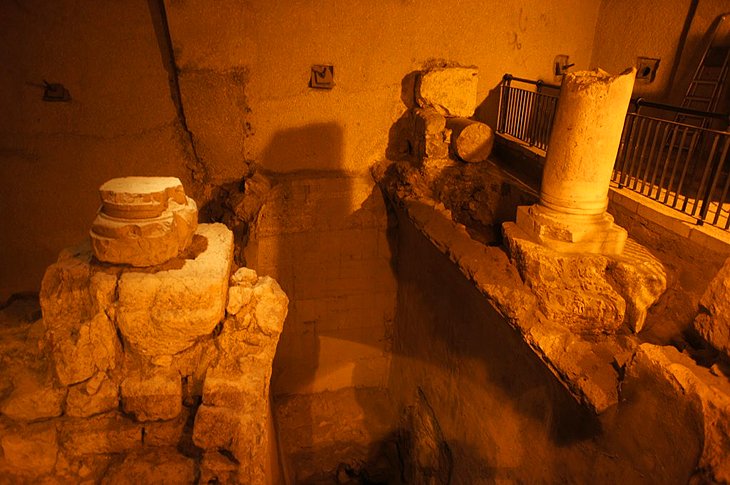
East of the Hurva Synagogue is the Wohl Archaeological Museum (more commonly known as the Herodian Quarter), where a number of houses built in the reign of Herod the Great (40-4 BC) and destroyed in AD 70 during the Jewish War have been brought to light.
The size and magnificence of the houses (in particular some of the mosaic flooring that has been excellently preserved) and the elaborate bathhouses bear witness to the wealth of their one-time owners.
The excellent information boards walk you through the ruins with exhibits of stucco and fresco decorations, as well as domestic equipment and other objects found during the excavation.
Address: HaKaraim Street, Jerusalem
Burnt House
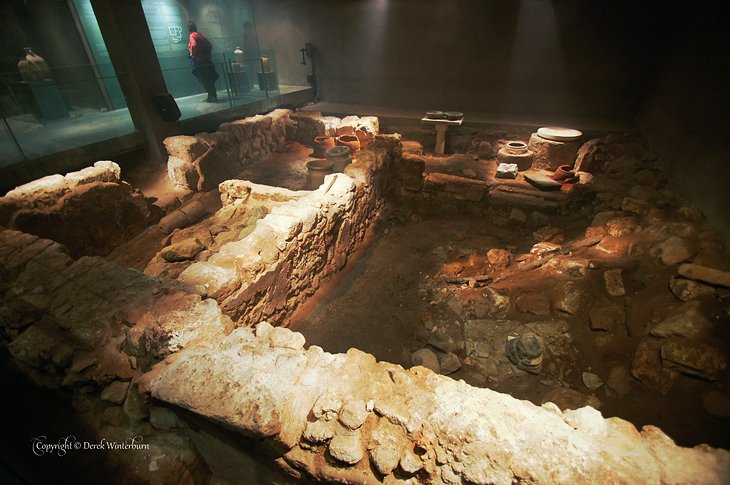
This fascinating, small museum is a ruined house from the Herodian period that lay undiscovered for centuries after its destruction by the Romans in AD 70.
A host of finds were discovered here during excavations of the area; including Roman coins and a female skeleton.
An audio-visual show is presented several times daily and is well worth a watch as it gives you a vivid picture of the history of the Jewish Quarter, in the time of Herod, and its destruction by the Romans.
Address: Tiferet Israel Street, Jerusalem
Tips & Tactics: How to Make the Most of Your Visit to the Wailing Wall & Jewish Quarter
- The most atmospheric time to visit the Wailing Wall is at sunset on Friday when the beginning of Shabbat brings crowds to the wall.
- Those of all faiths can visit the wall. Note the separate areas for men and women and dress modestly. Men are required to wear a kippa (Jewish male head-dressing). These are available on-site.
- Modest dress is also required to enter the synagogues of the Jewish Quarter.
Getting There
- From Central Jerusalem, take Egged Bus No. 38A, which runs from King George V Street through the Jewish Quarter and to the Western Wall Plaza and other attractions.
- The nearest Gate into the Old City's Jewish Quarter is the Dung Gate.
- If you're walking from Central Jerusalem, Jaffa Gate is the nearest approach.