

Normandy's 14 Best Attractions And Activities For Your First Visit
Vikings, William the Conqueror, Joan of Arc, Monet's water lilies, D-Day...the region of Normandy in France, the most exciting country in Europe, has played host to some of the country's most iconic moments and people. Beyond the truly epic history is a charming locality featuring some of France's most famous sights, like ancient abbeys and fancy chateaux, along with half-timbered houses and ancient tapestries, dramatic cliffs, war relics, enchanting seaside towns, amazing cheese, and delicious cider.
Normandy, in France's north along the coast of the English Channel, is the closest coastline to Paris, giving it the nickname of the "21st arrondissement." The location is prime for a getaway, and also, as the region's history suggests, invasions. Normandy manages to honor its sobering reminders of war without losing any of its charm, which we hope is reflected in this list of Normandy's 14 best attractions. To compile this list, we used a combination of personal experience, data from sites like Tripadvisor, information from local tourism sites, and opinions from travel experts. Whether you hit the well-traveled La Normandie Haut (Upper Normandy) or the off-beat La Basse Normandie (Lower Normandy), or both, this corner of France is bound to enchant.
Mont Saint-Michel

The phenomenal floating French castle of Mont Saint-Michel is the stuff of fairy tales. An abbey founded in 966, the UNESCO-listed Mont Saint-Michel sits dreamily on the horizon of the Normandy coast. The island is more of a small village (with a population of around 20) than just an abbey. Once you cross to the island, you'll be immediately ensconced in cozy streets that lead to the abbey, perched on the very top of the island.
Mont Saint-Michel can get very crowded, no matter the time of year. However, if you go early in the morning or late in the evening, the crowds will be smaller. While there is a free shuttle right onto the island, crossing the bridge on foot provides some stellar views. Walk along the city walls or through the streets, and leave plenty of time to explore the ancient abbey. One of the most unique ways to approach the abbey is at low tide, but this should only be attempted with a guide — the bay surrounding Mont Saint-Michel has the highest tides in Europe and can come in unpredictably.
D-Day beaches and war batteries

The plan to liberate France from the Nazis was carried out on the picturesque Normandy coast. Now, the beaches stormed on D-Day 1944 are returned to their peaceful beauty, but evidence of D-Day remains, scattered near (and on) the five main beaches. The town of Arromanches-les-Bains is the site of famous Gold Beach, where one of the artificial Mulberry harbours was built, part of which is still visible.
While here, pay a visit to the Arromanches 360, an immersive theater playing footage of the Battle of Normandy. Not far from Gold Beach is Omaha Beach, where American forces sustained the most losses, now home to a memorial and a museum. In between Gold Beach and Omaha Beach, the well-preserved Longues-sur-Mer German gun battery is also worth a visit.
Visit the cliffs of Pointe du Hoc, where Allied forces scaled a sheer face right into a nest of Germans; bunkers and bomb craters are still visible along the cliffs. (Remember: this is a gravesite and warrants respect.) On Utah Beach, discover the Utah Beach Landing Museum. Canadians will want to visit Juno Beach, where the Juno Beach Centre is dedicated to the Canadians who lost their lives, and Brits will want to see Sword Beach. While the D-Day sites are all fairly close together, they're scattered over a full 75 miles, so it's easiest to have a car or join a tour. The beautiful town of Bayeux is only 14 miles from Omaha Beach, and a good place to base yourself.
Military cemeteries

The D-Day beaches tell the story of the bloody battles during this pivotal moment in history, but the nearby military cemeteries are where you come to comprehend the true human sacrifice. Normandy's military cemeteries inter a large portion of the nearly 130,000 soldiers who died during the Normandy battles of 1944. Not far from Omaha Beach is the American Cemetery at Colleville-sur-Mer, where nearly 10,000 graves, marked by white crosses or stars, march across a green lawn nearly down to the ocean.
About 20 minutes away from the American Cemetery is the darker, somber German Cemetery at La Cambe, the final resting place of nearly 21,250 German soldiers. Dark stones inset in the ground list the names, while gray crosses are grouped periodically around the field, all surrounding a centerpiece statue atop a green mound, holding nearly 300 bodies of unknown soldiers.
Also worth a visit is the smaller yet still poignant British military cemetery in the town of Bayeux, with more than 4,600 graves of British or Commonwealth soldiers. Also in Bayeux is the War Reporters' Memorial Garden, one of the few places in the world that commemorates journalists who have lost their lives while covering wars; since 1944, more than 2,000 commemorative stones have been added in memory of these oft-overlooked casualties of war.
Rouen

Rouen is the capital of Normandy, known for its charming cobbled streets and half-timbered buildings, cathedral, and extensive history. You can experience all the charm of France without crowds in Rouen, set along the banks of the Seine, with history dating back to the Romans, a beautifully preserved medieval center, and an impressive cathedral. Rouen is also noted for its gastronomy and is an ideal place to sample Normandy's renowned four "Cs:" cream sauce, cider, calvados (apple brandy), and Camembert (make sure to try Rouen's specialty, duck à la rouennaise).
In this lesser-known cobblestoned town, the Gothic cathedral, dating to the 14th century, is considered one of the most impressive in France. A favorite of Monet and featured in many of his paintings, the gorgeous church also has a chapel dedicated to Joan of Arc, who was burned at the stake in Rouen in 1431, as well as a tomb holding the heart of Richard the Lionheart.
Other sites not to miss in Rouen include La Couronne, France's oldest inn and one of Rouen's best restaurants, and in the center, a beautifully intricate 14th-century astronomical clock. The clock decorates the facade of the historic Gros-Horloge, a Renaissance building with a picturesque arch.
Bayeux Cathedral and Tapestry

Many use the charming city of Bayeux as a base to explore the D-Day beaches, as its proximity to said beaches made this the first town liberated on June 7, 1944. However, Bayeux is also famous for two very different reasons: the famous 70-yard-long medieval tapestry depicting the Battle of Hastings and the grand Bayeux Cathedral. The Bayeux Tapestry, hand-embroidered in the 11th century, is fully on display in a large circle, in a dark museum dedicated to the piece. It's an astonishingly detailed piece of art, with various battle scenes, symbols, everyday life, and intricate embroidery throughout. (Note: the Bayeux Tapestry is set to undergo several years of restoration, likely through 2027, so double-check before you visit.)
The town of Bayeux is full of charming, cobblestoned streets all crowned by the dramatic cathedral, as large as the famous Notre-Dame in Paris, with grand spires and Gothic arches. A visit to the church is a must, and make sure to appreciate it at night, when it's beautifully illuminated. Bayeux's historic center is also lined with beautiful facades, charming shops, and even a little mill on the small river.
Honfleur

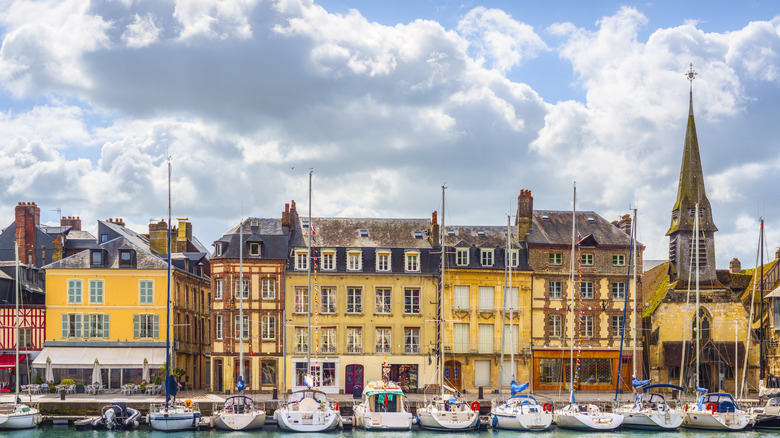
Normandy's Côte Fleurie (Flowered Coast) is one of France's prettiest stretches of coastline, and the star of the show is Honfleur. The harborside town of Honfleur is a delight, with colorful, half-timbered houses, lively markets, France's oldest wooden church, and maritime charm around every corner of the cobbled medieval streets. France's extraordinarily picturesque port town is beloved by visitors, locals, and artists alike for its well-preserved buildings, walkable streets, and boat-lined waterways. Honfleur's Vieux Bassin, or Old Port, is a key sight: here you'll see the town's most distinctive narrow rowhouses. Old city walls, dating to the 14th century, surround the Old Port, and can be climbed for incredible views (along with an overview of the town's history inside the walls).
Another notable destination within Honfleur is St. Catherine's Church, or the Church of Sainte-Catherine, France's largest (and oldest) church built entirely from timber. Peep the ceiling, which was reportedly built to resemble a ship's hull as a nod to Honfleur's portside status. For the best views of Honfleur, the Pont de Normandie, and the modern Normandy Bridge, make the trip up Mont-Joli (especially amazing at sunset).
Étretat & the Alabaster Coast

England has the White Cliffs of Dover, France has the white cliffs of Étretat. The formations carved in the cliff, best viewed from high cliffs, are breathtaking, and the charming town has plenty of its own incredible views. The cliffs make up a section of the famous Côte d'Albâtre, or the Alabaster Coast, part of one of the most stunning coasts in the whole world. The archways formed by the sea stretch out from the stunning, green-topped cliffs, which in turn shelter numerous sandy coves.
As the beautiful village of Étretat can see thousands of visitors a day during high season, consider basing yourself in the nearby Yport to experience the cliffs without the crowds. The famous GR21 walking path connects Yport and Étretat (expect about a three-hour walk), and is just one of the many hikes that provide stunning views of the white cliffs. For a shorter, paved path, follow the Porte d'Amont Loop, which takes about an hour, unless you stop and take a million photos (as you should). Étretat and its cliffs are about a 75-minute drive northwest of Rouen, and about 30 minutes from another well-known French port town, Le Havre.
Old Mill & Giverny Gardens (Vernon)

Giverny, in Normandy, is best known for its association with the famed French painter Claude Monet. You can visit his beautiful gardens and former home today as one of the best day trips from Paris, but the surrounding area of Vernon is lovely and worth a longer visit. Monet's Giverny Gardens are a tribute to the great artist and remain designed just as he wished, complete with his famous pond of lilies. The home in the gardens where Monet lived is also preserved exactly as it was upon his death there in 1947. Continue the Impressionism theme at Giverny's Musée des impressionnismes and Musée de Vernon, which both feature some of Monet's works.
Giverny is near the town of Vernon, known for its historic charm. One of the best sites in Vernon is its half-timbered Old Mill, standing over the river's edge by an ivy-covered stone bridge. Dating back to the 16th century, built onto a 12th-century bridge (now mostly in ruins), it's the last remaining mill of its kind along the Seine. Vernon is also notable for its long provincial traditions, including its bi-weekly Market Days, during which visitors can experience an authentic French market.
Château Gaillard

There are many beautiful castles throughout Normandy, but the white ruins of Château Gaillard, standing tall over the Seine, are particularly impressive, in part because they were built by Richard the Lionheart. High on a lush, terraced hill above the charming village, Les Andelys (one hour from Rouen), King Richard had his castle constructed in just one year, circa 1198.
Upon its completion, King Richard declared the castle "gaillard," thus naming it Château Gaillard, although the exact meaning of the king's use of the word is debated (most agree the king surely meant gallant, or strapping, or well-fortified, or...saucy?). King Richard would be dead by 1199, and his beloved castle would pass to his unfortunate brother, King John. King John the Landless, the French king, immediately seized his lands. Gaillard transferred between hands, at one point withstanding a 16-month siege, until the 16th century, when it was partially demolished. Nowadays, the grounds and castle ruins can be explored, and while there, take note of some unusual flowers, reportedly brought back from the Crusades and flourishing in this unlikely place ever since.
Fromagerie Durand in Camembert

Normandy is an adventure for your taste buds, and happens to be synonymous with its most famous cheese, the classic Camembert. Head to the town and tour a cheese farm to learn about the process, and of course, do some taste testing. One of the best places to sample the cheese is at an authentic Norman dairy, and one of the most traditional is the Fromagerie Durand. Here on this cozy farm, taste fresh cheese that has been expertly made for generations.
Tour the cheese dairy, watching videos on cheese production, visiting various rooms like the salting room, and finally tasting the special cheese, made exclusively from Durand's own herd of Norman cows. For an extra flavor boost, you can pair Camembert cheese with pears, jams, and apples, another Norman speciality. Camembert lies about an hour from the Norman hub, Caen.
Caen Castle & the Caen Memorial Museum

Next up is Caen, a major hub for Normandy, about 30 minutes from Bayeux (15 minutes by train) and 1.5 hours from Rouen. Here, explore the grand castle and the Caen Memorial Museum, one of the best World War II museums in France. Dating back to the Roman period, and fortified by William the Conqueror (who built the castle and the two prominent town abbeys: the Abbaye aux Hommes and the Abbaye aux Dames), Caen was nearly leveled during World War II, with about 80% of the city left in ruins.
Caen rebuilt or preserved much of its city, however, and its historic quarter with stone houses, the Vangeux neighborhood, is a must-visit. So is William's grand walled fortress, Caen Castle, where you can walk the walls and visit museums. Then there's the Memorial Museum, on top of a German bunker. This museum details the tipping points that led to the war, resistance movements, and the Holocaust, with a large focus on D-Day and the Battle of Normandy. Watch footage from the war and the Nuremberg Trials, explore the underground bunker, and see priceless artifacts.
Normandy Cider Route

Apple trees abound in Normandy, producing a bountiful harvest that becomes compotes, tarts, and, of course, cider. Head east of Caen for the Normandy Cider Route (Route du Cidre), where you can sample Normandy's specialty cider from more than a dozen makers. The 25-mile-long route meanders through the Pays d'Auge, a particularly fertile, hilly, and authentic Norman region. The route passes through charming villages, like Beuvron-en-Auge, and by traditional farms, home to half-timbered cottages. Immerse yourself in the world of apples by tasting bubbly cider along with a true regional speciality, calvados.
Calvados gets its name from the Calvados department (French region, of which Normandy is split into five). This delicious apple brandy, like champagne, can only use the official "calvados" label if it's made in Calvados. Several calvados distilleries are along the Cider Route, like family-run Calvados Roger Groult, where they've been producing calvados using traditional methods since the 19th century. Throughout the Cider Route, you'll also be able to sample another Normandy favorite: pommeau, which is a mix of apple juice and calvados, aged in oak casks.
Suiss Normande (Swiss Normandy)

Some of Normandy's best nature can be found in a section of the Orne Valley known as the Suiss Normande, or Swiss Normandy, characterized by dramatic cliffs, ancient viaducts, cute villages, river valleys, and recreation opportunities. The low mountain peaks of Suisse Normande hardly feel as if they're in Normandy, much less France, evoking the Swiss Alps — hence the nickname.
Base yourself in Clécy, the capital of Suisse Normande and its center for activity, eating, and sleeping (about 45 minutes south of Caen). Located on a slope near the Orne River, Clécy has the best of both worlds: hiking, climbing, and even an Alpine slide, versus swimming, kayaking, and canoeing in the river. Clécy's most recognizable sight is the Lande Viaduct, also known as the Clécy Viaduct, a stone train bridge dating back to 1866. The large, graceful arches tower over the Orne and are one of the best places for kayaking and canoeing. The village also has several spas, a large golf course, lovely riverside restaurants, camping opportunities, quaint nearby villages to explore, and plenty of lovely views.
Veules-les-Roses

Normandy is home to a varied selection of France's most beautiful villages, but one of its most charming is the town of Veules-les-Roses. Veules-les-Roses is famous as the home of France's shortest river, the Veules (the town's namesake), flowing for about 3/4 of a mile through town to the sea. The town itself, with half-timbered houses, old water mills, and nearby watercress beds, is located along one of northern France's most stunning stretches of coastline: the Alabaster Coast.
The best way to explore Veules-les-Roses is along the river loop, through the town, and out to the cliffs and beaches. The path, lined with helpful plaques, takes you through historic watercress beds, glassy fields used year-round to grow the coveted crop, past many a thatched or traditional cottage, past chapels and water mills, and even the ruins of an old castle, through forests and fields. The full walk is only about two miles and, as it's flat, can be done in less than an hour; however, plan to spend longer exploring the village. From Rouen, it's about an hour to Veules-les-Roses by car or just under two by train.
Methodology

For this article, we referenced the official (and very helpful) "Normandie Tourism" website. Using data from websites like Tripadvisor helped us identify the most popular attractions in Normandy, and then, paired with personal experience and advice from travel experts, we narrowed down the list to a manageable number. Historical websites, attraction websites, the UNESCO website, and more official sources were also consulted.