Visiting the Château de Versailles: 10 Top Attractions
Author Lisa Alexander spent two years living in Paris after college, enjoys returning to France as often as possible, and most recently visited Versailles in March 2023.
Step into the lavish world of France's ancien régime at the Château de Versailles. You will enter one of Europe's most dazzling castles, created for the most famous of French kings. Louis XIV resided here during his glorious reign, an epoch of absolute monarchy known as Le Grand Siècle.
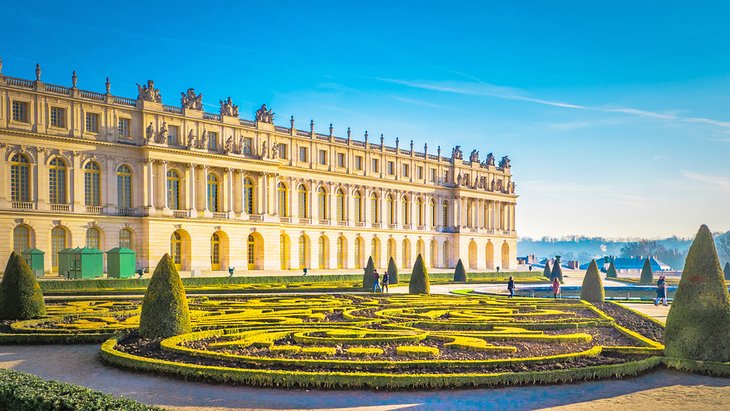
Louis XIV enlisted the renowned architect Jules Hardouin-Mansart to renovate the château of his father, Louis XIII. The Château de Versailles was transformed into a 2,300-room masterpiece of French Classicism, fitting of the new owner: "the Sun King" ("le Roi Soleil"), as Louis XIV was titled.
This incomparable château set a new standard for royal palaces, and today is designated as a UNESCO World Heritage Site.
During the reign of Louis XIV, any man with a sword and woman wearing a fine dress was allowed inside the Château de Versailles. People came to admire the magnificent interior decor and extravagant court ceremonies. Today, casually attired tourists continue to visit for a glimpse of the regal splendor.
Purchase your ticket (preferably ahead of time), wait in line, and voila, like magic, become immersed in the ambience of the 17th and 18th centuries. The ornately decorated reception halls and opulent apartments exude decadence. You start to understand the over-the-top lifestyle that went along with being the king and queen of France.
With your admission ticket to the Château de Versailles, you may visit a limited number of rooms. On a good day, your tour of Versailles might resemble an orderly parade of courtiers through the King's State Apartments. On a bad day (especially during high season), the mass of visitors may seem more like the mobs of the French Revolution. Whatever the crowds, Versailles is a must-see.
The domaine (estate) of the Château de Versailles covers over 800 hectares; this vast parkland is open to the public. Much of the palace may be visited by ticket holders.
It would take several days to cover everything at Versailles. With the Palace Ticket admission, you will see the famous Hall of Mirrors and other state reception rooms. You can also choose additional tickets that allow you to see different areas of the estate, such as the King's Private Apartment or the Domaine de Trianon (where Marie-Antoinette's hamlet is located).
Read our guide to learn more about the Château de Versailles and how to spend your time within this marvelous realm.
- 1. Hall of Mirrors (Galerie des Glaces)
- 2. King's State Apartment (Grand Appartement du Roi)
- 3. Queen's Apartment (Grand Appartement de la Reine)
- 4. King's Private Apartment (Appartement Intérieur du Roi)
- 5. The Gardens (Les Jardins)
- 6. Domaine de Trianon
- 7. Le Hameau de la Reine (The Queen's Hamlet)
- 8. Chapelle Royale
- 9. Opéra Royal
- 10. Galeries de l'Histoire du Château
- How to Make the Most of Your Visit to Château de Versailles
- Address
1. Hall of Mirrors (Galerie des Glaces)
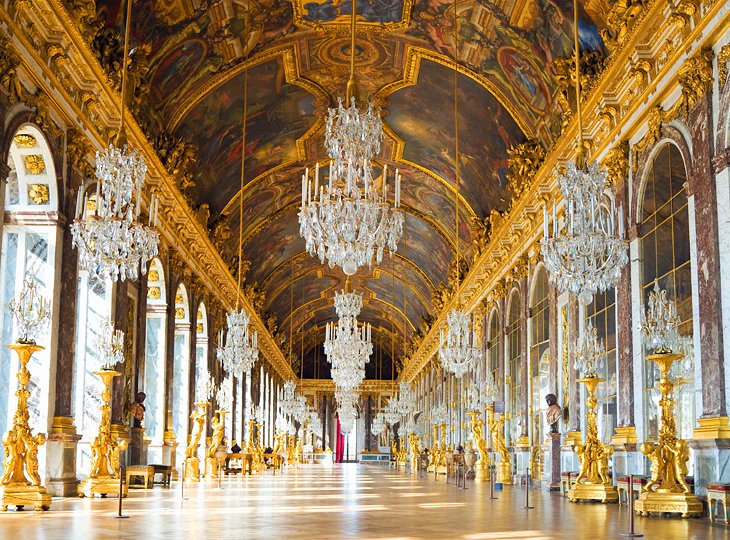
As you glide across the parquet floor of the Hall of Mirrors, try to imagine the glamour, intrigue, and opulence of court life at Versailles centuries ago. You are walking through the château's most dazzling room, where courtiers in the finest attire once waited to meet with the king and queen.
It's easy to imagine the magnificent celebrations, such as balls and wedding receptions, which took place in this room during the 17th and 18th centuries.
Look up to admire the glorious frescoed ceiling that is trimmed in gilded moldings and dripping with glittering crystal chandeliers. Peer out the windows to view the perfectly symmetrical landscaping of the formal French garden, and notice the reflection on the ornamental mirrors.
Three hundred mirror segments adorn the walls. At the time, mirrors were a luxury item. The visual effect is stunning.
Architect Jules Hardouin-Mansart created this Baroque gallery between 1678 and 1684. Mansart succeeded in achieving an ambience of grandeur that Louis XIV envisioned.
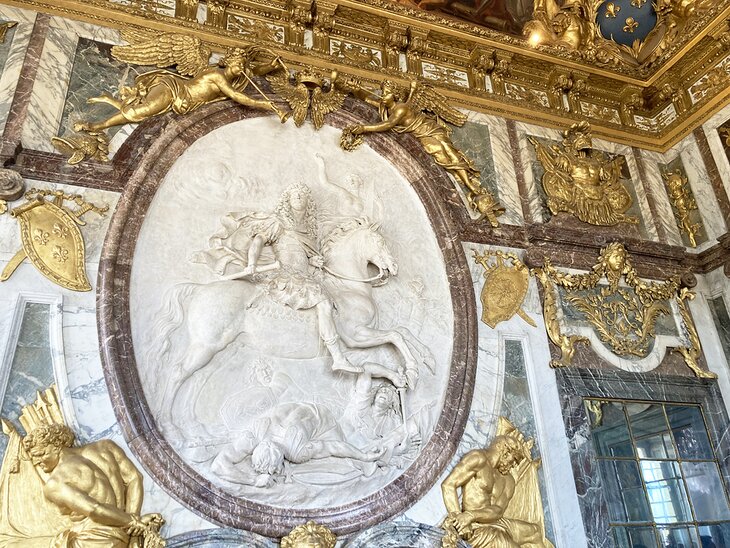
In the Hall of Mirrors, the German Empire was proclaimed in 1871 and the Treaty of Versailles was signed in 1919. At one end of the hall is the Salon de Guerre (War Salon) with paintings depicting military victories; at the other is the Salon de Paix (Peace Salon) with a ceiling painting by Charles Le Brun (Premier Peintre du Roi) and a portrait of Louis XVI by François Lemoyne.
For a truly memorable experience, attend the Royal Serenade held in the Galerie des Glaces every Saturday evening from mid-June through mid-September. The Royal Serenade recreates the scene of a royal court ball, complete with authentic 17th-century costumes and entertainment performed by Compagnie de Danse l'Éventail dancers and Les Folies Françoises musicians.
2. King's State Apartment (Grand Appartement du Roi)
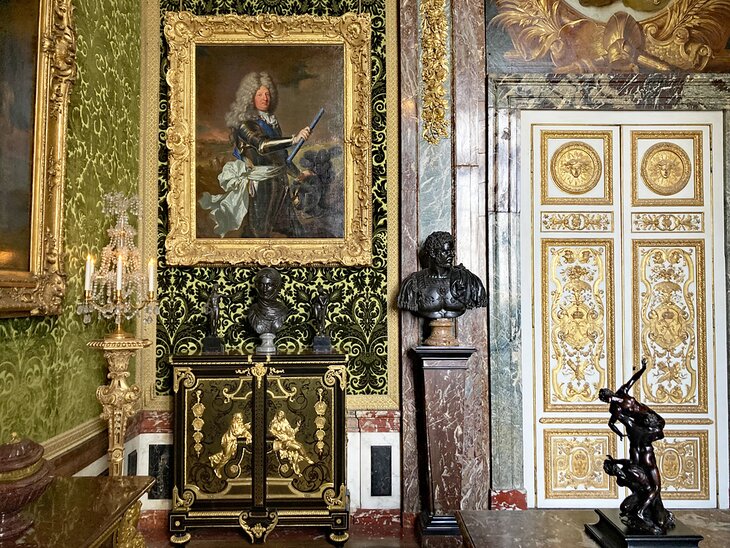
The King's State Apartment includes the royal bedchamber and other private rooms that were open to the public for daily ceremonies and official meetings.
The series of seven salons (reception rooms) was known as "L'appartement de parade" ("The parade apartment") because courtiers walked through the rooms every day before going to chapel services.
The salons are named after mythological deities, making a connection between Louis XIV's reign and the history of the Western world.
- Salon d'Hercule features one of the world's largest ceiling paintings, The Apotheosis of Hercules by François Lemoyne, as well as The Meal in the House of Simon, a masterpiece by Veronese given to Louis XIV by the Venetian Republic.
- Salon de l'Abondance is decorated with many precious objects and was where refreshments were served for evening soirees.
- Salon de Vénus shows the original marble and faux marble decor (marble walls, classical columns, and statues) that Louis XIV favored to reflect his power and glory.
- Salon de Diane displays the painting of Diana and Endymion by Gabriel Blanchard and several paintings on the theme of hunting.
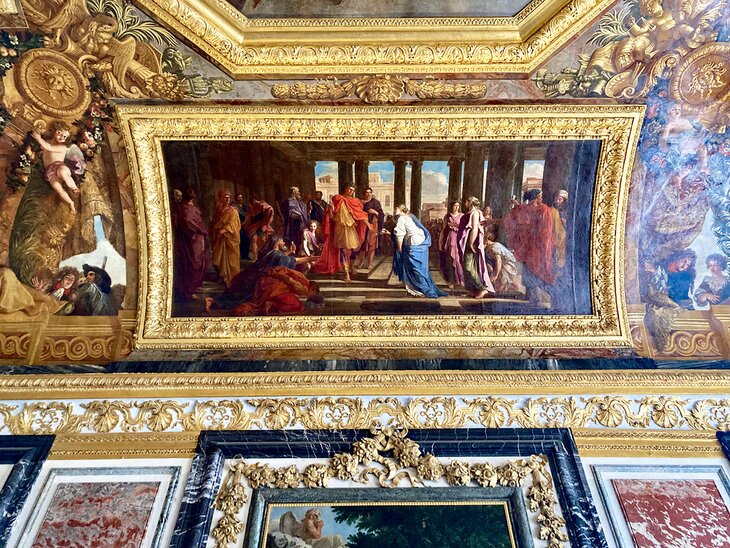
- Salon de Mars is celebrated for Charles Le Brun's painting, The Family of Darius before Alexander, created around 1665.
- Salon de Mercure features a renowned ceiling painting, Mercury on His Chariot Drawn by Two Roosters, by Jean-Baptiste de Champaigne.
- Salon d'Apollon boasts a fabulous ceiling painting of Apollo in the Chariot of the Sun by Charles de la Fosse. Over the fireplace is the well-known portrait by Hyacinthe Rigaud of Louis XIV in his coronation attire (a robe featuring fleur-de-lys and trimmed with ermine).
3. Queen's Apartment (Grand Appartement de la Reine)
Arranged in the same layout as the King's State Apartment, the Queen's Apartment has a more feminine sensibility. The rooms are flowery and delicate in style. The decor has been preserved since the time of Marie-Antoinette.
The Queen's Apartment has recently reopened after several years of refurbishment work. The decor has been refreshed and returned to its original splendor.
- Chambre de la Reine (Queen's Bedroom): The Queen's Bedroom was created for Queen Maria Theresa (wife of Louis XIV) and updated for Marie-Antoinette. Rococo-style ceiling paintings depict the four virtues of a queen: compassion, generosity, wisdom, and fidelity. The jewelry cabinet to the left of the bed was a gift to Marie-Antoinette from the city of Paris two years before the Revolution.
- Antichambre des Nobles: This salon was Queen Marie Thérèse's antechamber. Marie-Antoinette completely redecorated the room with damask wallpaper, mahogany furniture, and a Bleu Turquin marble fireplace.
- Antichambre du Grand Couvert: In this sumptuous room, the King was served his meals according to strict protocols. The ritual was a sort of public performance in which the Royal Family would take their places at the table and once they were seated, the high-ranking duchesses and princesses were allowed to sit on stools and observe the elaborate meal.
- Salle des Gardes de la Reine (Room of the Queen's Guards): The Queen's corps of 12 bodyguards stayed in this room all day and night, to perform their duty of protecting the Queen. On October 6th of 1789 as rioters were trying to push their way into the Queen's apartment, one of the Queen's guards alerted a lady-in-waiting to Marie-Antoinette. This allowed Marie-Antoinette the time to flee and saved her life.
4. King's Private Apartment (Appartement Intérieur du Roi)
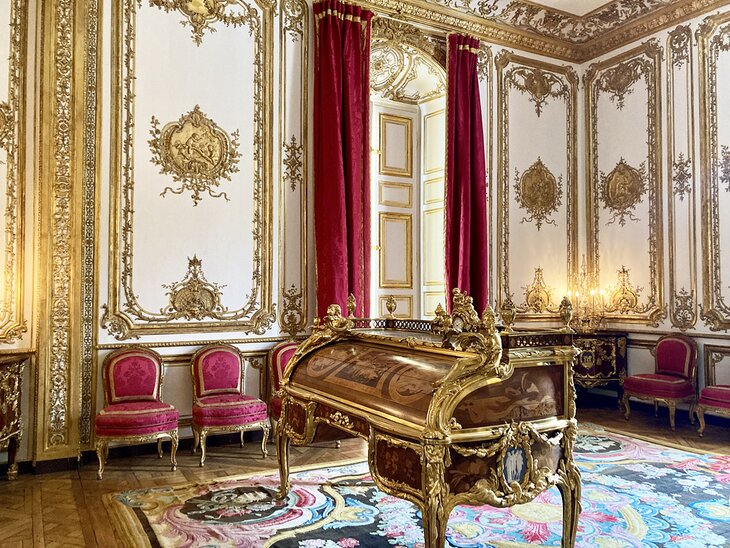
This suite of rooms provides a glimpse of the private life (including the social events) of the French Royal Family.
Note: This area of the château is accessible only by taking a guided tour. Access to the King's Private Apartment is NOT included in the standard Palace Ticket.
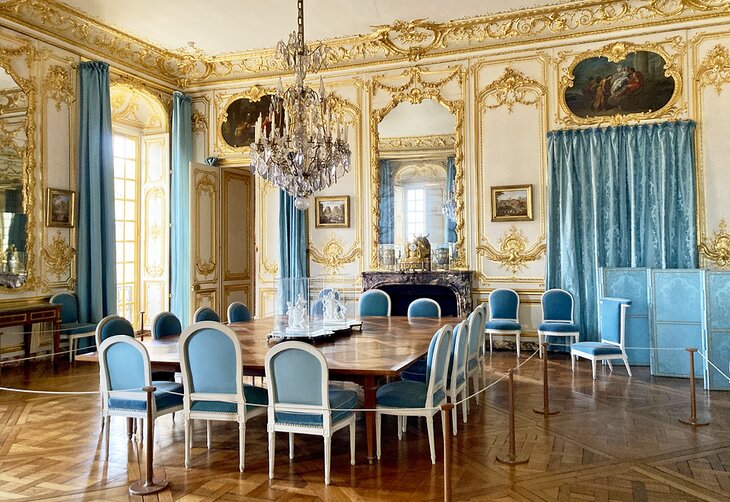
- Chambre de Louis XV (Bedroom of Louis XV): The bedchamber in the King's State Apartment was a place of formal ceremonies, from morning until night. In this smaller bedroom, Louis XV could relax and get away from the ceremonial etiquette of the court. (This room is currently undergoing renovations.)
- Cabinet du Conseil (Council Study): In this room, the king met with his ministers to discuss affairs of state. Décor includes a classical-style bust of Alexander the Great and a bronze statuette of Louis XIV supported by a mantelpiece clock.
- Cabinet d'Angle du Roi (King's Corner Room): This room contains a marquetry-paneled desk crafted for Louis XV by the renowned cabinet-maker Jean-Henri Riesener. The desk features bronze sculptural details and drawers with lock mechanisms to secure Louis XV's important papers. The desk is one of the most valuable pieces of furniture in the world.
- Cabinet de la Pendule (Clock Room): This room features a miniature version of the equestrian statue of Louis XV that stood on the Place de la Concorde before the Revolution and an astronomical clock that was created for Louis XV, who was very interested in astronomy.
- Bibliothèque de Louis XVI (Library of Louis XVI): Famous architect/interior designer Ange-Jacques Gabriel created this Rococo-style room adorned with gilded panels, a round mahogany table, and a rare piece of furniture created by Jean-Henri Riesener. Louis XVI was an extremely avid reader of literature and science books, which explains the impressive size of the library.
- Salle à Manger des Retours de Chasses (After-the-Hunt Dining Room): Louis XV hosted dinners once or twice a week in this gilded room, inviting the lords and ladies who accompanied him on hunts. Many nobles sought this prestigious invitation.
- Salle à Manger des Porcelaines (Porcelain Dining Room): Louis XVI and Marie-Antoinette had their meals here, including private dinners and official banquets. At Christmas time, Louis XVI presented gifts of Sèvres porcelain here (explaining the name of the room).
5. The Gardens (Les Jardins)
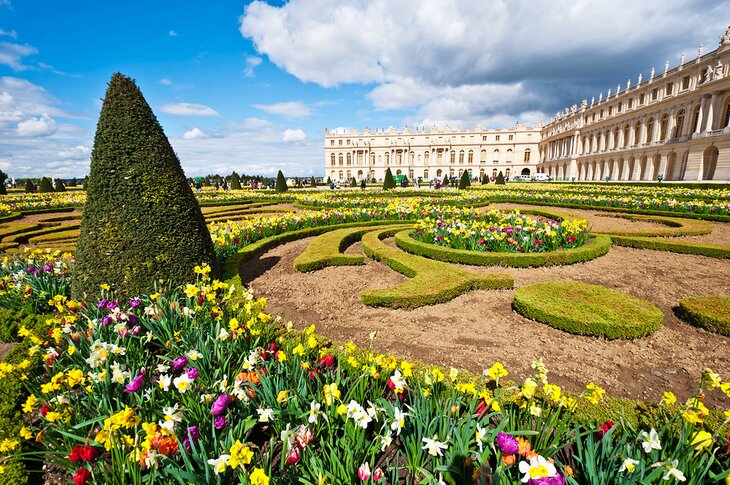
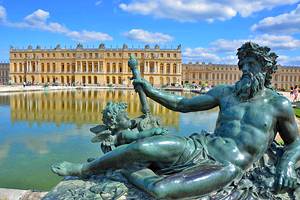
More like a piece of artwork than a scene of nature, these are no ordinary gardens. Perfectly trimmed shrubbery and tidy lawns form geometric patterns, characteristic of French formal gardens. Decorative pools and fountains balance the greenery, while bright flower beds and sculptures add further adornment.
Les Jardins are the masterwork of André Le Nôtre, the renowned landscape designer of the 17th century. Le Nôtre designed some of the most beautiful gardens in France.
Les Jardins makes its first impression with the Parterre d'Eau (Water Parterres), two ornamental pools decorated with fountains and statues. To enhance the garden's visual effect, Le Nôtre landscaped the space in a symmetrical fashion. This allowed for a sweeping view, the Grande Perspective, which stretches from the Parterre d'Eau to the Allée Royale along the garden's east-west axis.
Beyond the Parterres are Les Allées, expansive pathways that invite you to take a stroll. The Allée Royale (Royal Way) is also known as the "Tapis Vert" ("Great Lawn") and leads to the Bassin d'Apollon (Fountain of Apollo), the emblem of Louis XIV. At the center of this fountain is a celebrated statue: Apollon sur son Char (Apollo in his Chariot) sculpted by Jean-Baptiste Tuby, based on a design by Charles Le Brun.
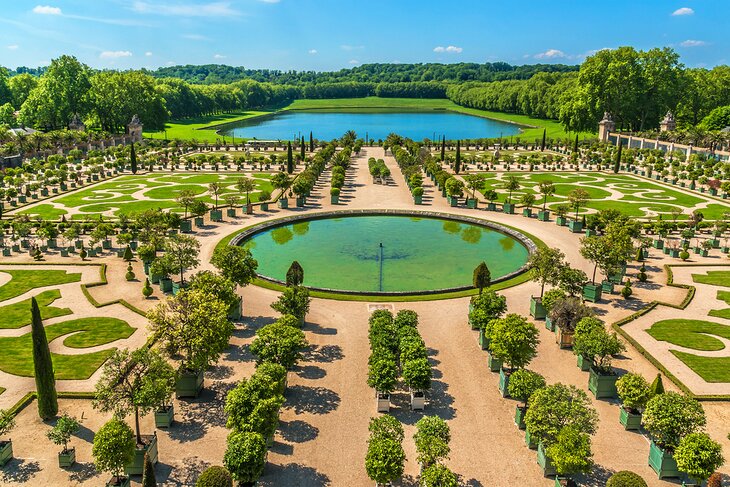
Be sure to check out L'Orangerie where Louis XIV kept orange, lemon, oleander, and pomegranate trees during the winter. Built in 1663 by Louis Le Vau, the Orangery still houses fruit trees, some of which are over two centuries old. During summertime, the trees are brought out to the Orangery parterre.
The classical Colonnade designed by Mansart is one of the most peaceful areas of the park. Farther into the park, Les Bosquets (Groves) are secluded woodland areas.
If you are visiting during spring or summer, try to attend one of the Musical Fountain shows.
6. Domaine de Trianon
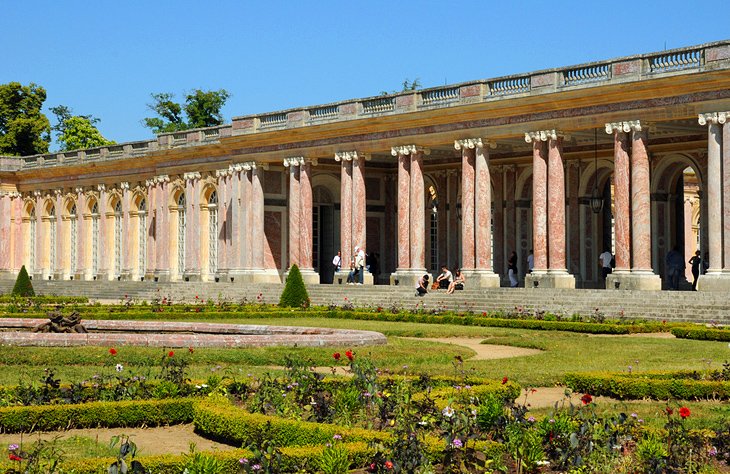
A half-hour stroll from the Chateau de Versailles leads to the Domaine de Trianon, the most refined area of Versailles. The lovely flowering gardens and delicate architectural ensemble appeal to feminine sensibilities.
Note: This area of Versailles is accessible with the Passport Ticket or the Estate of Trianon Ticket.
Le Grand Trianon is a pink marble confection created for the mistress of Louis XIV, Madame de Montespan. Louis XIV commissioned Jules Hardouin-Mansart to construct an Italian-influenced palace with exquisite features. The "Peristyle" takes your breath away, with its seemingly infinite marble columns and views over the gardens and the courtyard.
Refreshingly informal compared to the Château de Versailles, the interior decor of Le Grand Trianon is bright, cheerful, and elegant. Natural light floods the Galerie des Cotelle, with its floor-to-ceiling windows, while the walls display 17th-century paintings that depict the Versailles gardens.
The Grand Trianon palace is surrounded by delightful Jardins à la Française (French Gardens) filled with orange blossoms, roses, and tidy hedges. The gardens showcase a multitude of flower beds, planted with thousands of flowers, chosen for their vibrant colors and intoxicating fragrances.
Le Petit Trianon is a masterpiece of Neoclassical architecture, set in an expanse of greenery. Louis XV commissioned Ange-Jacques Gabriel to create this small palace for his mistress, the Comtesse du Barry. After the reign of Louis XV, the palace was gifted to Marie-Antoinette by Louis XVI in 1774. Marie-Antoinette redecorated Le Petit Trianon in her own distinctive feminine style.
Marie-Antoinette took a special interest in redesigning the landscape of the Petit Trianon estate. She commissioned Richard Mique to create a Jardin Anglais (English Garden) in the less-formal style that was fashionable at the time. This romantic garden imitates nature with meandering paths, a gently flowing stream, a waterfall, and a grotto.
A highlight of Petit Trianon garden is the Temple de l'Amour (Temple of Love), a decorative structure built in 1778 that resembles an ancient Greek temple. Marie-Antoinette's apartment looks out directly onto this monument.
7. Le Hameau de la Reine (The Queen's Hamlet)
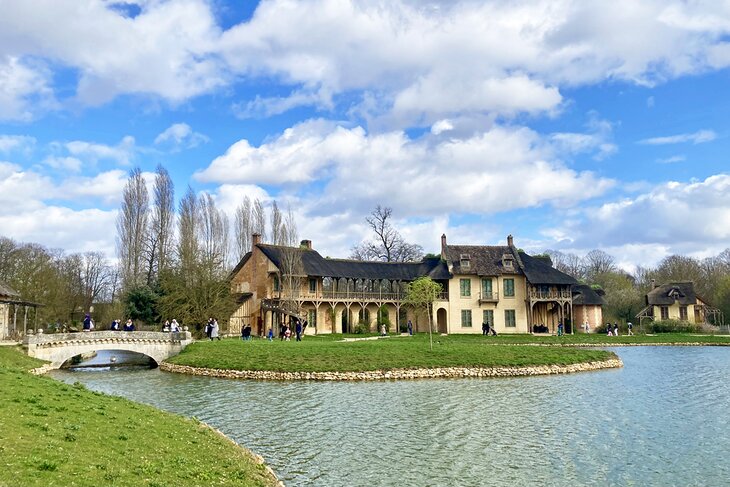
This little fantasy hamlet was where Marie-Antoinette came to escape the formalities and politics of court life. Ornamental "country" villages were a new feature of estates in the 18th century, revealing the influence of philosopher Jean-Jacques Rousseau's ideas about returning to nature.
Note: This area of Versailles is accessible with the Passport Ticket or the Estate of Trianon Ticket.
A group of half-timbered cottages (created in 1773) at the Domaine de Chantilly was the inspiration for Marie-Antoinette's fabricated pastoral village at Versailles. About a one-hour drive away, Chantilly is one of the top day trips from Paris and is worth a detour for those interested in exploring another historic estate.
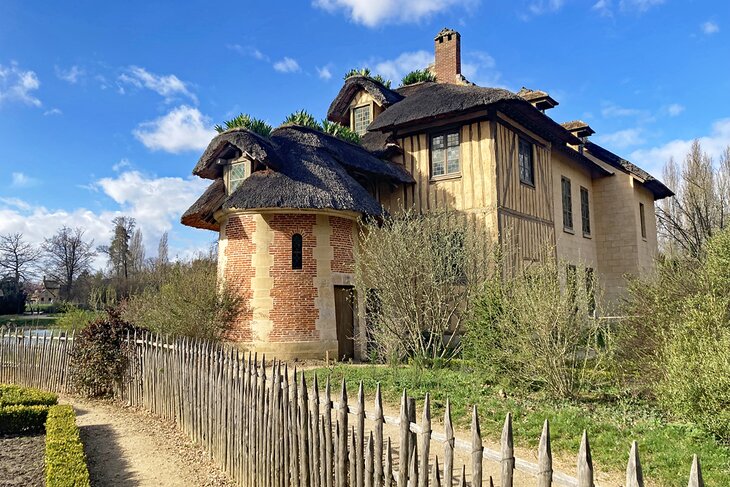
Constructed between 1783 and 1786, the Queen's Hamlet is nestled on the edge of the Château de Versailles parkland. This enchanting model village includes buildings resembling a Normandy farmhouse and thatched-roof cottages, all surrounding a tranquil lake. Behind the faux rustic facades are luxurious interiors.
A watermill, dovecote, vegetable gardens, and orchards complete the charming bucolic scene. The Queen's Hamlet maintained a working farm; a fishery with a jetty for boating on the lake; and a dairy, where Marie-Antoinette sampled products from the farm.
Marie-Antoinette hosted parties and informal social gatherings at the hamlet. A billiard room, game room, dining room, and an enormous kitchen attest to the entertaining that took place here. The Queen also used the farm for educational purposes, to teach her children about the natural world.
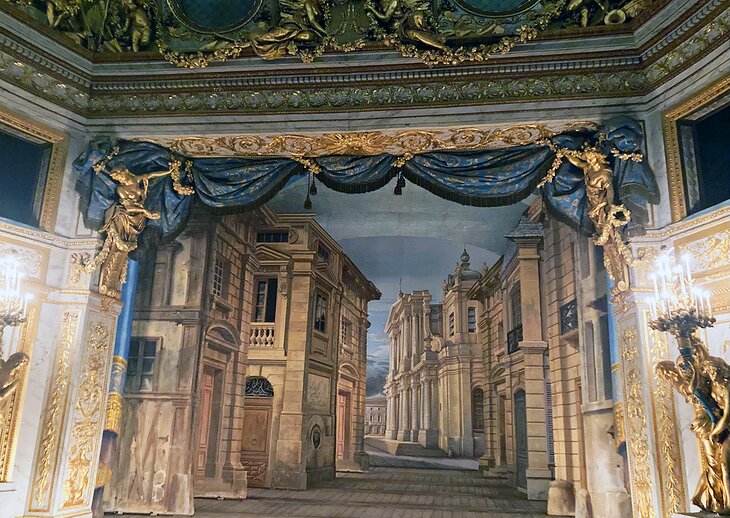
The Queen's Theatre (Le Théâtre de la Reine) is tucked away behind the garden of Le Petit Trianon. The architect of the Queen's Hamlet, Richard Mique, created this little gem of Louis Seize architecture between 1778 and 1780.
The theater is quite small and intimate. What it lacks in size is compensated for in magnificent décor. You will be surprised by the lavish interior, a contrast to the simple classical-style exterior.
Marie-Antoinette had a passion for theater, which she pursued at this one. She commissioned playwrights to create new works, and she even performed in comedy productions that were staged just for her friends. Most notably, in 1785 Marie-Antoinette played the part of Rosine in Barbier de Séville by Beaumarchais.
The theater has been recently renovated and its décor has been well-preserved, down to the most minute details. Stepping into this theater immerses you in the culture of the 18th century. You can almost imagine Marie-Antoinette appearing on stage.
Note: You may only visit the Queen's Theater on Les effets scéniques au théâtre de la Reine guided tour (currently offered as a French-language tour).
8. Chapelle Royale
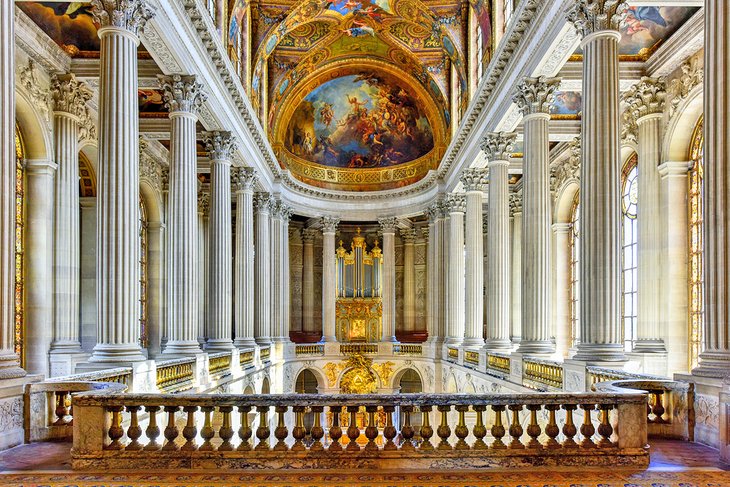
The Chapelle Royale at Versailles was begun by Jules Hardouin-Mansart in 1699 and completed by Robert de Cotte in 1710. This masterpiece of Baroque architecture blends a Gothic-inspired exterior and stained-glass windows with a serene Neoclassical nave. Supported by soaring columns, the nave's vaulted ceiling features paintings on the theme of the Holy Trinity.
Louis XIV used this chapel when it was opened in 1710. Previously, he worshiped in a chapel on the site of the Hercules salon. Every morning at 10am, the court would attend Mass. The gallery reserved for the King and royal family is the one with a tall Corinthian colonnade.
Note: The Royal Chapel is only open to the public on the Splendorous Versailles guided tour. However, you do have a chance to see the balcony of the Royal Chapel with Palace Ticket admission.
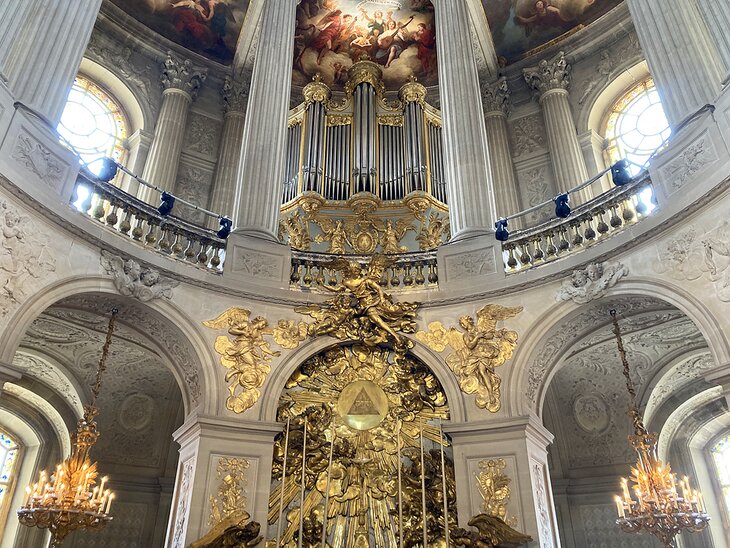
You may also see the interior if you attend one of the concerts that are held here. The Royal Chapel stages recitals of sacred music, such as Bach's Mass in E Minor, Handel's Messiah, and Mozart's Requiem. Many concerts make use of the chapel's Clicquot organ.
9. Opéra Royal
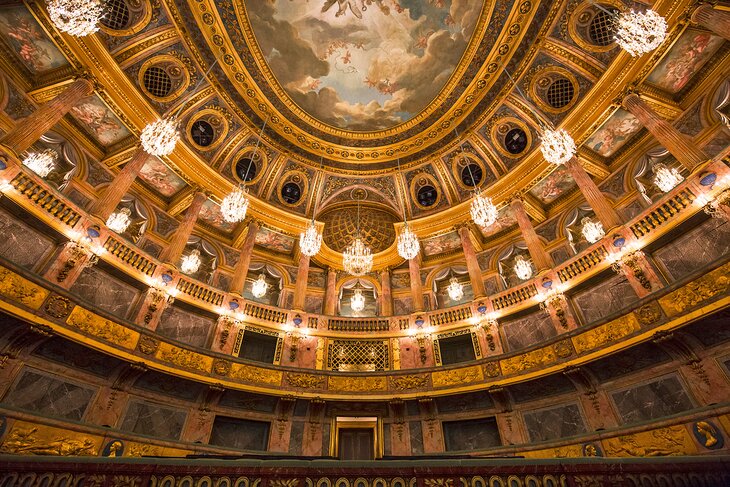
This glorious Opera House is one of the most beautiful of its kind. Designed by Ange-Jacques Gabriel for Louis XV, the auditorium was completed in 1770 just before the marriage of (the future King) Louis XVI to Marie-Antoinette, whose wedding reception was held here.
The Opera House features a harmonious Neoclassical colonnade of Ionic columns. The lavish interior is ornately decorated, with gilded bronze, marble, mirrors, and chandeliers.
Today, the Opera House hosts an impressive calendar of events throughout the year, including theater, opera, ballet, and music performances.
Note: You may visit the Opéra Royal by taking the Splendorous Versailles guided tour.
10. Galeries de l'Histoire du Château
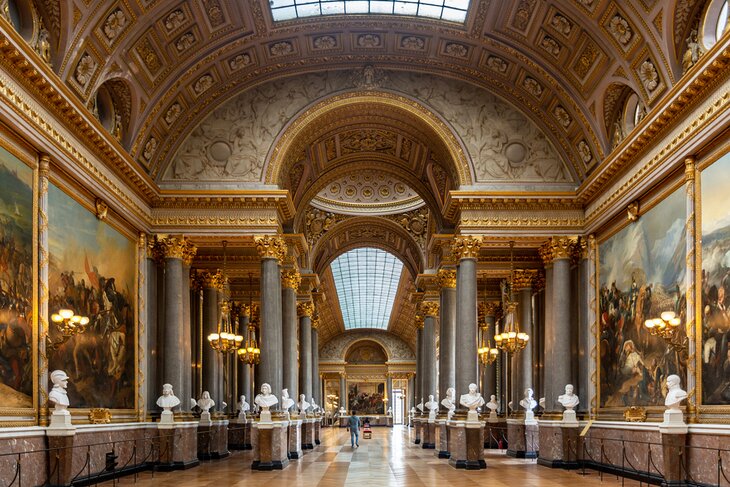
After the 1830 Revolution, the restored monarch Louis-Philippe ("King of the French") decided that the Château de Versailles should have a museum. Louis-Philippe commissioned the architect Frédéric Nepveu to create the galleries, which opened on June 10th, 1837. Victor Hugo, Alexandre Dumas, Eugène Delacroix, and other French luminaries attended the inauguration event.
Louis-Philippe had assembled a collection of paintings, sculptures, and drawings that illustrate French history dating back to the Crusades. Napoléon III later added new acquisitions to the collection related to 19th-century history.
The Galerie de l'Histoire du Château (Gallery of the History of the Palace) displays historical artifacts from specific time periods. Particularly interesting, the Salles des Croisades are devoted to the history of the Crusades from the 11th century through the 13th century.
Other noteworthy galleries include the Salle de 1792, which shows the history of the French Revolution through a series of paintings, and the Salles de l'Empire, which commemorates the achievements of Napoléon I.
How to Make the Most of Your Visit to Château de Versailles
- How to Get to Versailles: You can reach Versailles from Paris by public transportation. It's best to take the train to the Versailles Château Rive Gauche station (about a 10-minute walk to the entrance of the Château de Versailles) rather than the Versailles Chantiers station, which is farther away (about a 30-minute walk to the château entrance).
- Easy Day Trip from Paris: Enjoy the convenience of a guided tour with transportation from Paris to Versailles. This takes the hassle out of getting there, plus you benefit from interesting commentary.
- Take a Guided Bike Tour: Explore the domain of Versailles by bicycle on an organized bike tour that includes round-trip transport from Paris and suggestions for a picnic lunch.
- Avoid the Crowds: The only way to avoid crowds at Versailles is to visit during wintertime. Unfortunately, the gardens are not beautiful at this time, but you will be able to walk around the château at your own pace (rather than being pushed by the crowds).
- Timing: Plan to spend about two to three hours inside the château. If also visiting the King's Private Apartment, note that the guided tour takes an additional one hour and 30 minutes. Allow two hours in the gardens and at least another two hours to explore the Trianon palaces and the Hamlet (the walk to this area takes about 30 minutes from the château).
- Book Ahead to Skip the Lines: To skip ahead of the ticket line, buy tickets online in advance. Simply proceed to Entrance A by providing the printout of your prepaid ticket. Due to the high number of visitors, it is essential to book tickets in advance most of the year.
- Ticket Options: Château de Versailles offers various ticket options: The "Palace Ticket" includes entry to the Hall of Mirrors, Grand Appartement du Roi, and Grand Appartement de la Reine. The "Estate of Trianon Ticket" includes entry to the Grand Trianon, the Petit Trianon, and the Queen's Hamlet. The "Passport Ticket" option allows entrance to the sights included in both the "Palace Ticket" and "Estate of Trianon Ticket" options.
- Reserve an Audioguide: You may reserve an audioguide (available in 12 languages) in advance, by booking online.
- Guided Tours: To gain access to the King's Private Apartment, the Royal Opera House or the Royal Chapel, you must take a guided tour (available in English and French). Guided tours of the Petit Trianon and the Hamlet of Marie-Antoinette are available in French.
- To avoid waiting in a long line, you should book a free Palace Ticket and/or Estate of Trianon Ticket at a specific time.
- Public Gardens: The grounds of the château, including the gardens and the 800-hectare domaine of the estate, are open to the public; there is no admission fee, except when Garden Shows take place.
- Summertime Garden Shows: During summer, stroll through the Versailles estate while enjoying Garden Shows (tickets required). Garden Shows include Musical Fountains on weekends; Musical Gardens during the week (Tuesday through Friday); and Night Fountains (with fireworks) on Saturday evenings and on July 14th and 15th. Some of the Garden Shows are also held during springtime and autumn. Be sure to check the schedule.
- Restaurants & Cafés in the Château: Within the Château de Versailles, you will find the Grand Café d'Orléans cafeteria (accessible via Cour des Princes); Ore café (Dufour Pavillion, access via Cour d'Honneur) open for casual breakfast, lunch, pastries, and snacks; and Angelina tea salon (with snack counter), famous for pâtisserie and hot chocolate (accessible via Cour Royale or after the Grands Appartements).
- Lunch & Snacks in the Gardens: For casual outdoor dining and picnics, try Angelina's summertime food stand at the Petit Trianon; the Girandole Café (sandwiches, crepes, salads) in the Girandole Grove; Le Dauphin (crepes, ice cream, snacks) in the Dauphin's Grove; and La Flottille take-away stand (sandwiches, crepes, salads) and tearoom near the Grand Canal.
- Fine Dining at Versailles: If you have the time and would like to indulge in a gastronomic meal, there are several options at Versailles: Ore restaurant, created by renowned French chef Alain Ducasse, serves haute cuisine inspired by historic meals, using the porcelain dinnerware designed for Marie-Antoinette. In the gardens, La Petite Venise offers Italian cuisine in a romantic dining room. For the ultimate Versailles experience, dine at the Michelin-starred Le Grand Contrôle restaurant at the luxury hotel next to the château.
- Deluxe Lodging at Versailles: Treat yourself like royalty, by spending the night at the new five-star hotel on the estate of Versailles. At Airelles Château de Versailles - Le Grand Contrôle, you step into the footsteps of 17th- and 18th-century aristocrats and courtiers. The renovated building next to the Château de Versailles has been exquisitely refurbished with authentic period decor. Highlights include exclusive tours, a spa with indoor pool, and a Michelin-starred restaurant that channels the banquets of French kings.
Address
- Château de Versailles, Place d'Armes - 78000 Versailles
- Official site: http://en.chateauversailles.fr/homepage