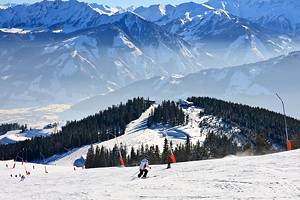
Things to Do in Salzburg
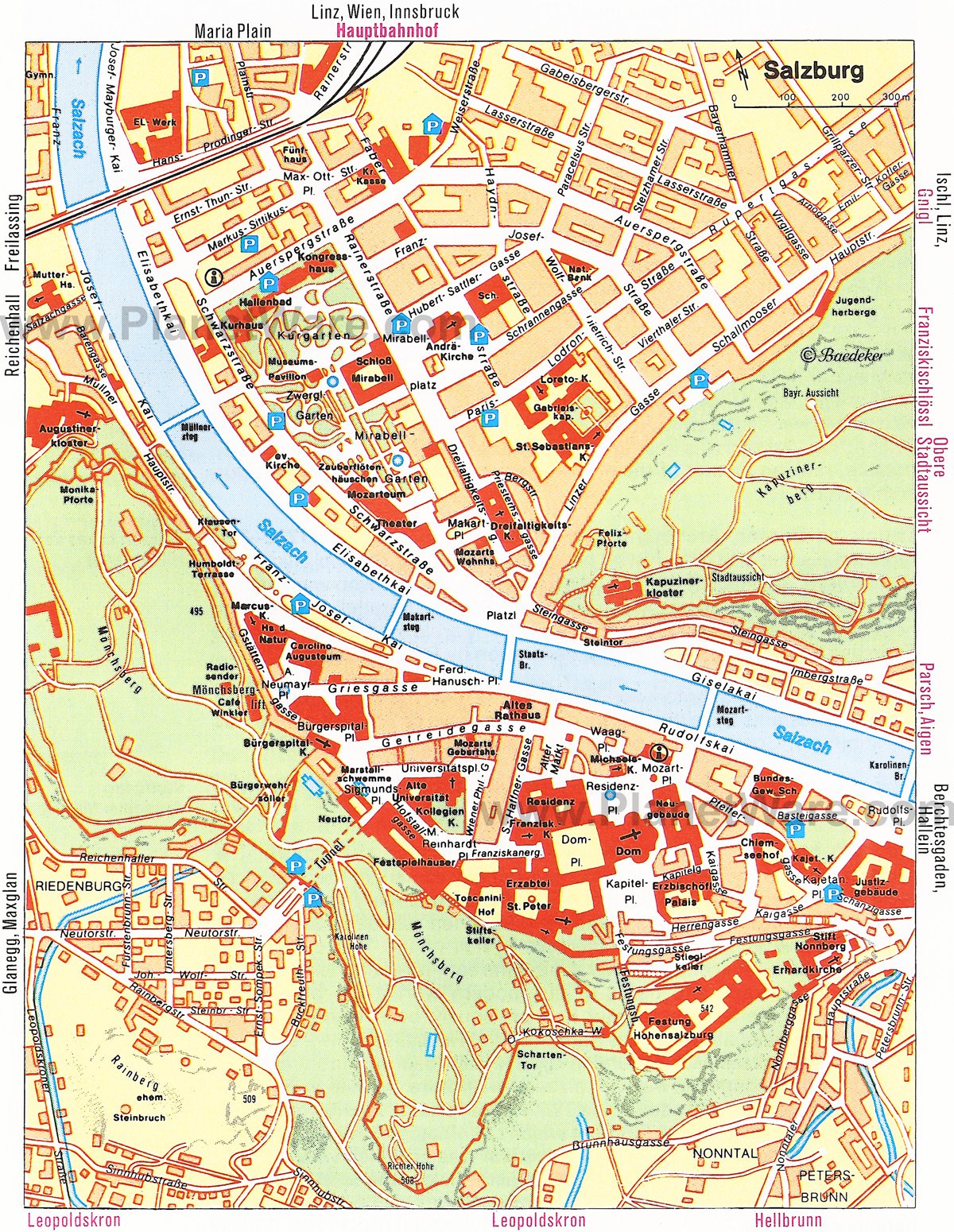
Salzburg is one of Europe's most beautiful cities. Located in northwest Austria, it's as popular among tourists for its well-preserved historical architecture as it is for its magnificent Alpine setting.
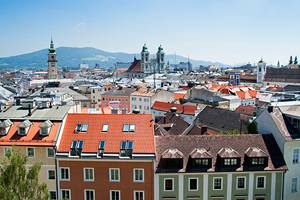
This picturesque city stretches along both banks of the River Salzach as it emerges from the Salzburg Alps into lower land dominated by the 1,853-meter Untersberg. Its romantic Old Town district is a must-visit attraction, a compact neighborhood of narrow medieval streets and arcaded courtyards that are fun to explore. So, too, are the spacious squares of the residential area between the Neutor and the Neugebäude districts.
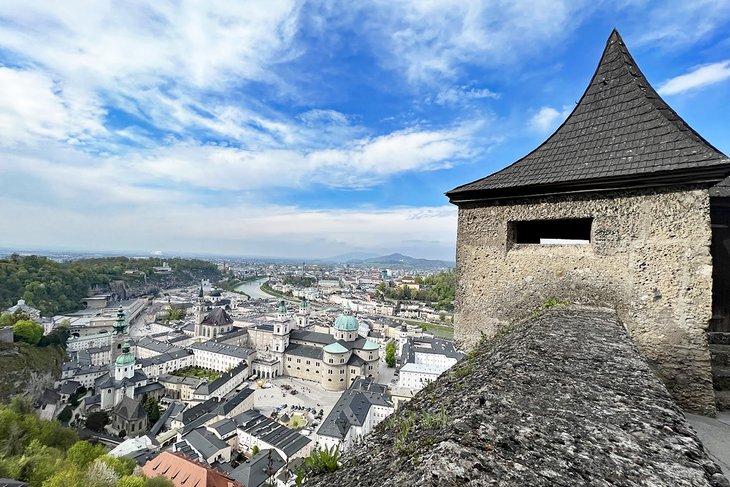
Salzburg also enjoys a special fame in the world of music as the birthplace of Wolfgang Amadeus Mozart. This rich musical heritage is reflected in tourist attractions such as the museum in his family home, various festivals showcasing his music, and even the melodies that ring out daily on the city's famous Glockenspiel. Several of Salzburg's attractions were also used as filming sites for The Sound of Music, and these are a particular draw for tourists.
Find out all the best places to visit while on vacation in this beautiful corner of Austria with our list of the best things to do in Salzburg.
Explore Salzburg's Old Town (Altstadt Salzburg)
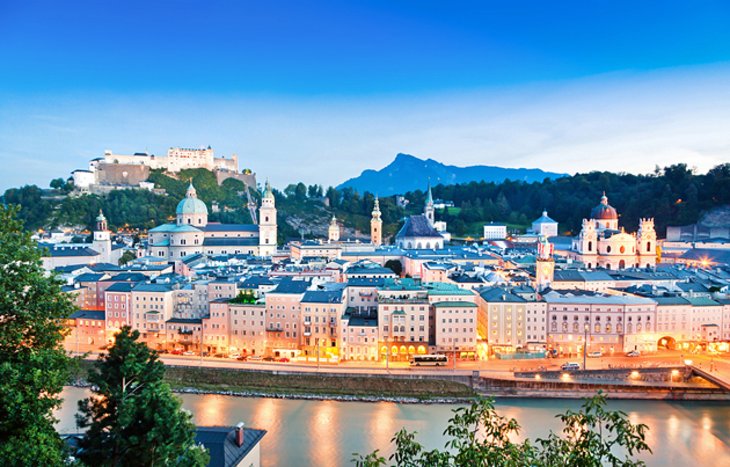
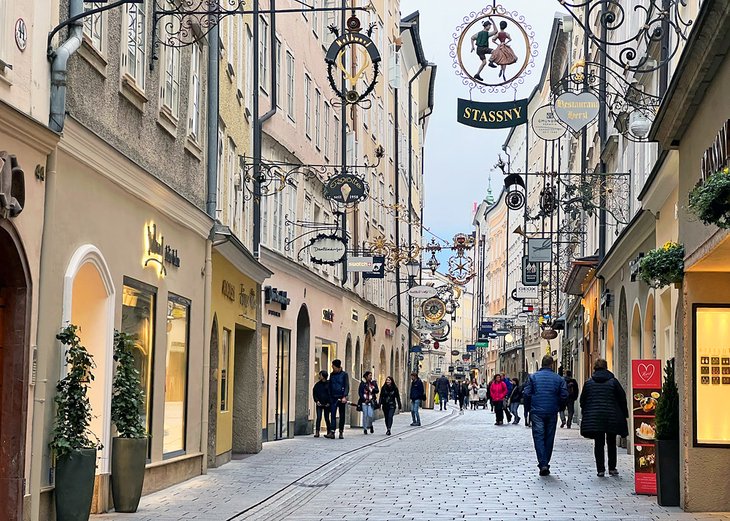
From University Square (Universitätsplatz), a number of wonderful passageways known as "Durchhäuser" weave northward to Getreidegasse. This busy pedestrian area has been recognized as a UNESCO World Heritage Site and is lined with quaint old merchant homes dating from the 15th to the 18th centuries.
Highlights of a walking tour of this Old Town area are its many original wrought-iron shop and inn signs, along with its many quiet old courtyards. And it's a big area to cover, encompassing some 580 acres in the heart of Salzburg, all of it just begging to be explored.
The area is also home to numerous art galleries, boutique shops, as well as jewelry and craft workshops. There are also plenty of cafés and restaurants, many with street-front patios that make for pleasant spots to kick back and do some people watching.
At the eastern end of Getreidegasse lies the Kranzlmarkt. Here, you'll find the old Town Hall (Rathaus) surrounded by even more old medieval houses, some as tall as five stories. In the Old Market (Alter Markt) stands the 13th-century Court Pharmacy (Hofapotheke), while in the middle of the square is the 17th-century St. Florian's Fountain. This latter attractive landmark is known for its unique octagonal basin and an even older spiral grille from 1583.
Other Old Town sightseeing opportunities include the Judengasse with its narrow, twisting lanes, and the Chiemseehof. Built in 1305, the latter was the residence of the Prince Bishops of Chiemsee until 1806. It's worth seeing for its arcaded courtyard decorated with coats of arms.
Climb to Fortress Hohensalzburg
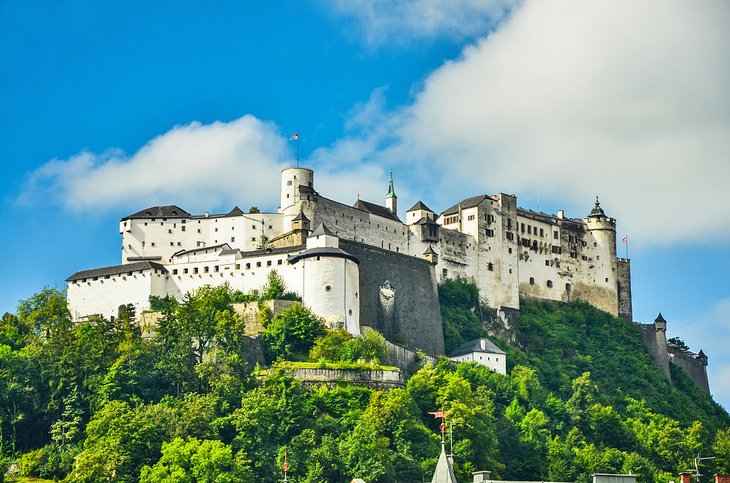
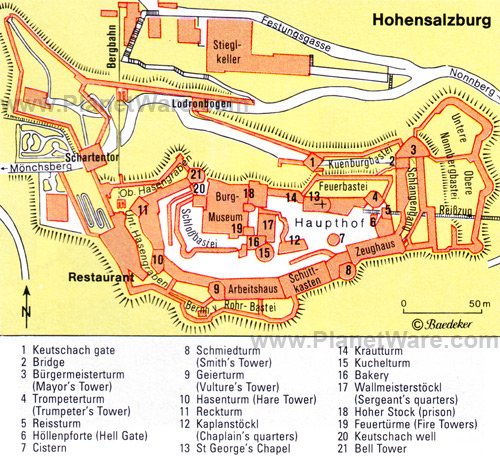
Salzburg is dominated by the picturesque Fortress Hohensalzburg (Festung Hohensalzburg), a stunning historic fortress that dominates the city skyline. Situated on the southeastern summit of the Mönchsberg, the original castle was built in 1077, and much of what's seen today dates from the early 1500s.
You can reach the castle by a pleasant 20-minute walk from the Old Town center or via a funicular railway from Festungsgasse. The approach to the fortress passes through a number of impressive arched defensive gateways under the 17th-century Fire Bastion to the Reisszug, a unique hoist dating from 1504 once used to haul supplies. It then continues through the Horse Gate into the Haupthof, or outer ward, with its ancient lime tree and a cistern from 1539.
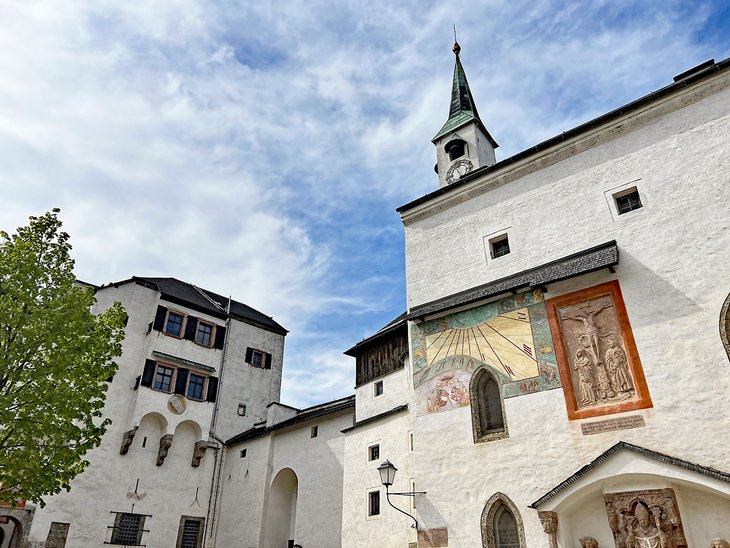
Other highlights include the courtyard, with its tiny Church of St. George (Georgskirche) from 1502, and the famous Salzburg Bull (Salzburger Stier). This historic organ dating from 1502 still plays daily and seems to echo the carillon in the Neugebäude.
Interior highlights include the sumptuous Princes' Apartments, with their Late Gothic décor and fine painted wainscoting; the Golden Room (Goldene Stube), with its marble doorways; and the Golden Hall, with gold bosses on the blue coffered ceiling and red marble columns.
Also worth seeing are the Fortress Museum, with weapons and torture devices, and the Rainer Regiment Museum containing artifacts from the old Salzburg household regiment. English language guided tours of the fortress are available and include options geared toward families and children.
Address: Mönchsberg 34, 5020 Salzburg, Austria
Official site: www.salzburg-burgen.at/en/hohensalzburg-castle/
See St. Peter's Abbey
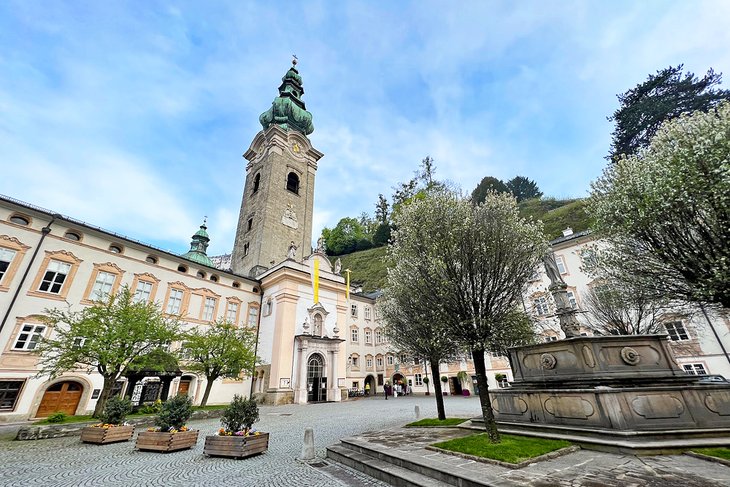
On the western side of Salzburg's Kapitelplatz stands the Benedictine Abbey of St. Peter (Erzabtei St. Peter). Founded by St. Rupert in 690 CE, this impressive building complex served as the residence of the Archbishops until 1110.
While the present buildings date mainly from the 17th and 18th centuries, they remain an impressive testament to the order's architectural skills. The best example of this can be seen in the building's tall onion-shaped tower, one of the first of its kind in Europe.
Highlights include St. Peter's Churchyard (Friedhof St. Peter), an impressive burial ground surrounded on three sides by arcades and family tombs from the 17th century. To the south, it backs onto the sheer rock face of the Mönchsberg, where you'll find Early Christian catacombs and St. Maximus' Chapel, hewn from the solid rock.
A passage leads from the churchyard into the outer courtyard graced by St. Peter's Fountain (Petrusbrunnen) built in 1673. Also of note here is the Haydn memorial depicting the life and work of Johann Michael Haydn, brother of famed composer Joseph Haydn.
Another important Salzburg landmark is Nonnberg Abbey, founded in 714 CE. The abbey is also the site of what is reputedly Europe's oldest restaurant, St. Peter Stiftskulinarium, which was founded prior to 803 CE.
Address: Sankt-Peter-Bezirk 1, 5020 Salzburg, Austria
Visit Historic St. Peter's Church
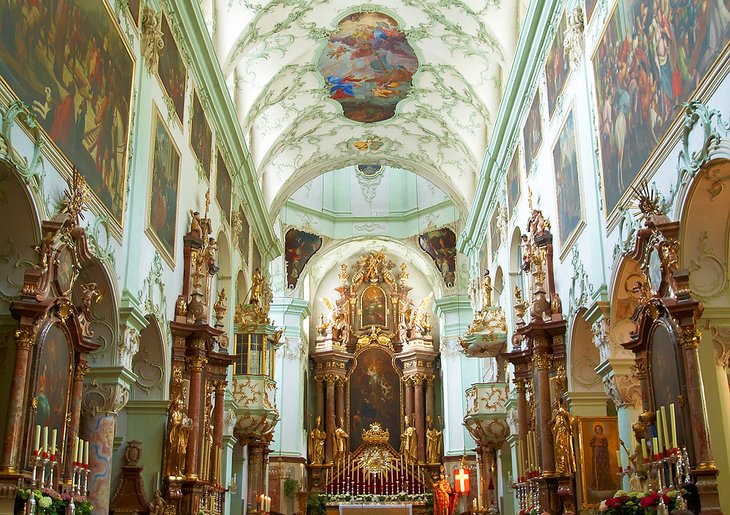
One of Salzburg's oldest and most attractive churches, St. Peter's Church (Stiftskirche St. Peter) has undergone many transformations over the years. Completed in 1143, it was added to and altered in 1625, and decorated in Rococo style between 1757 and 1783, when its distinctive helm tower was added. The church is also known as the "Abbey Church" for its location within the St. Peter's Abbey complex.
Inside the porch under the tower is the Romanesque west doorway dating from 1240. In the interior, the plan of the Romanesque basilica can still be detected, along with monuments including the rock-hewn tomb of St. Rupert with an epitaph from 1444.
Other notable monuments are those dedicated to Mozart's sister Marianne (Nannerl), who died in 1829, and to JM Haydn, brother of Joseph. Other highlights are the painted altarpieces on the 16 marble altars and the Lady Chapel (Marienkapelle) from 1319, which contains a stone figure of the Virgin, along with Early Gothic frescoes and later frescoes from 1755.
Address: Sankt-Peter-Bezirk 1, 5020 Salzburg, Austria
Tour Salzburg Cathedral
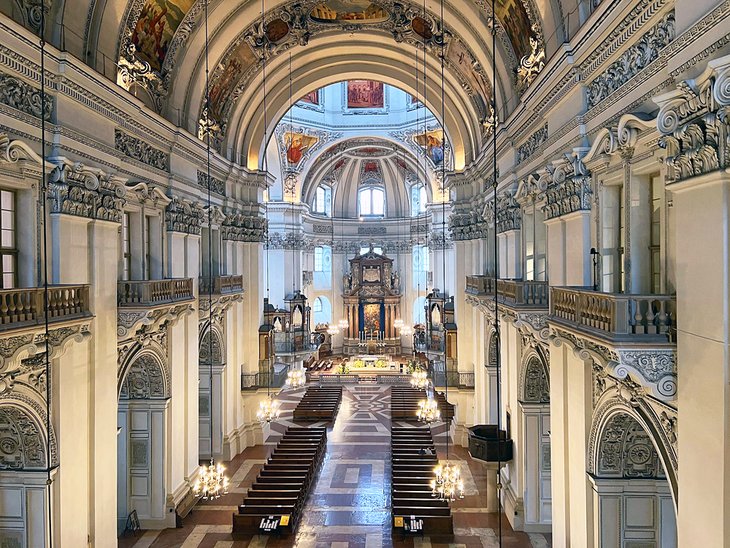
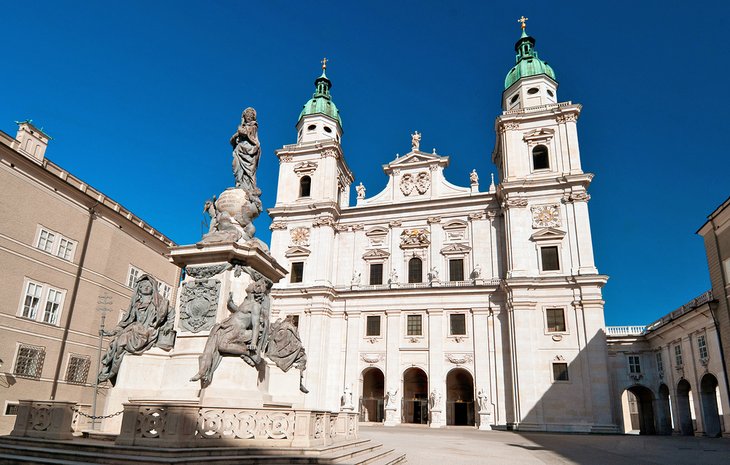
A prominent building thanks to its twin 79-meter tall towers, Salzburg Cathedral (Salzburger Dom) was completed in 1657 and is famous for its Italian style and its role as the location of Mozart's baptism. The building's west front, facing the Domplatz, has four colossal marble statues, the outer ones representing St. Rupert and Virgil, patron saints of the province. The inner ones depict Peter and Paul.
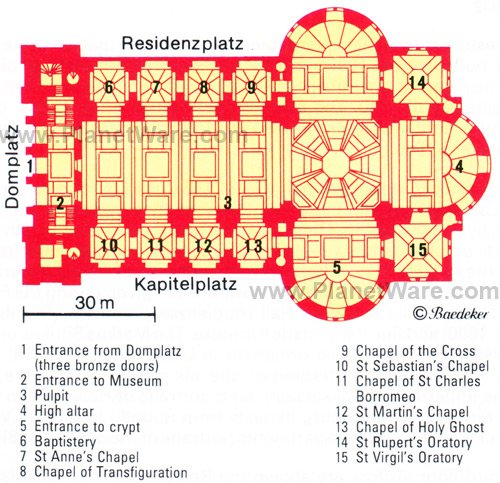
Notable features include its three massive bronze doors with their symbols of Faith, Love, and Hope; the high altar with its Resurrection painted in 1628; and the superb frescoes in the vaulting. The burial vaults and artifacts in the crypt are also worth seeing.
Be sure to visit the Cathedral Museum. This important cultural attraction features a variety of collections of liturgical objects and objets d'art from the Salzburg archdiocese. These include the 8th-century Carolingian Cross of St. Rupert, Gothic statues and paintings, and items from the Cathedral Treasury.
Also, check the cathedral's website in advance of your visit for details of upcoming concerts and recitals.
Address: Domplatz 1a, 5020 Salzburg, Austria
Explore the Residenzplatz
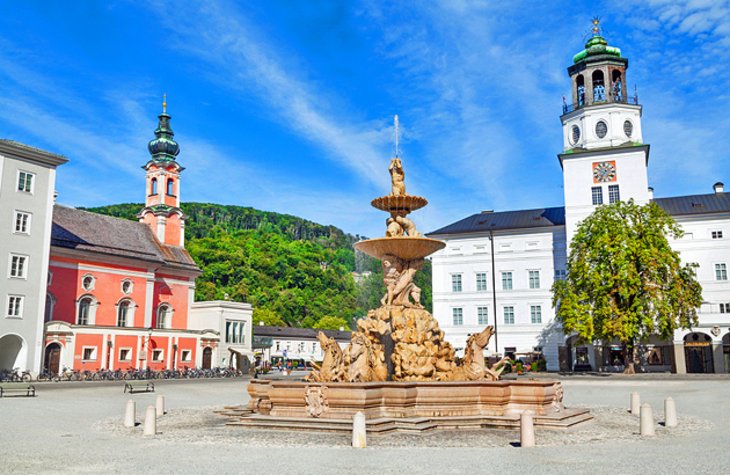
At the very heart of Salzburg's Old Town (Altstadt) on the left bank of the Salzach is the Residenzplatz. One of the city's largest squares, it's the best place from which to begin exploring the many tourist attractions and things to do that this beautiful city has to offer.
The focal point of the Residenzplatz is the stunning Residenzbrunnen. This masterpiece of marble was made by an Italian sculptor in 1661 and is the largest and finest Baroque fountain this side of the Alps. Standing 15 meters high with splendid figures of bold horses, along with the god Atlas bearing dishes, it also impresses with its dolphins. Crowning the whole display is a Triton with a conch shell.
From here, it's easy to spend time relaxing in the terraced cafés and boutique shops lining the adjoining streets. You can also jump right in and visit key attractions such as Salzburg Cathedral and the Residenz, the former palace of the city's Prince Bishops.
The square is also frequently used for concerts and celebrations such as public New Year's Eve parties and the excellent Salzburg Christmas Market.
Address: Residenzplatz, 5020 Salzburg, Austria
Explore the Salzburg Residenz and the Residenzgalerie
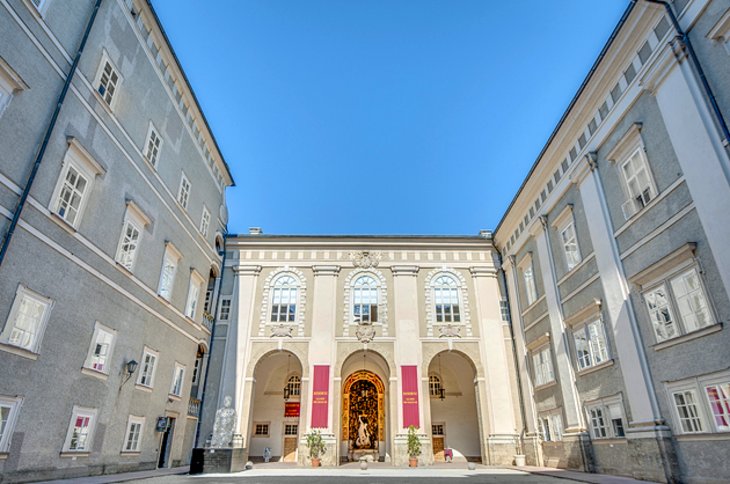
Dominating the western side of Salzburg's Residenzplatz is the Residenz, the former palace of the city's once powerful Prince Bishops. Built between 1596 and 1619, this huge palace is laid out around three courtyards, with a large marble gateway added in 1710.
Its spectacular State Apartments are lavishly decorated in Late Baroque and Early Neoclassical style and with exquisite wall and ceiling paintings, rich stucco ornaments, and handsome fireplaces. Of particular note are the Knights' Hall (Rittersaal), the Conference Hall (Konferenzsaal), and the splendid Audience Hall (Audienzsaal) containing Flemish tapestries from the 1600s and fine Parisian furniture.
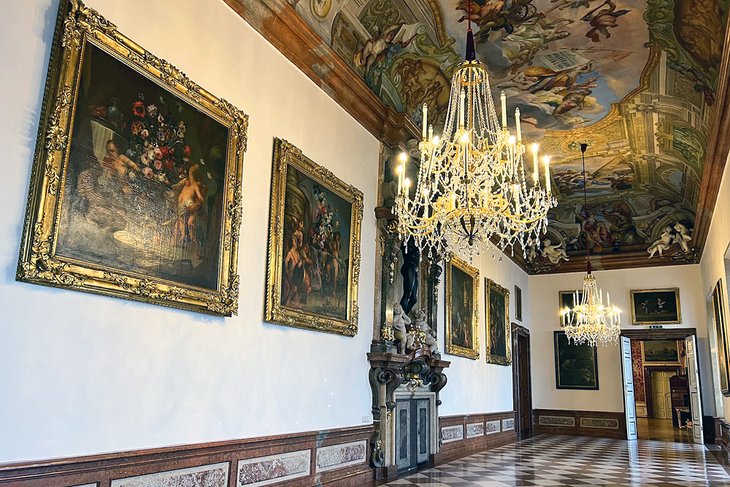
Other highlights include the White Hall (Weisse Saal), with its superb stucco ornaments in Louis XVI style from 1776; the Function Room (Gesellschaftszimmer), with 18th-century silk carpets; and the Imperial Hall (Kaisersaal), with its portraits of Holy Roman Emperors and Kings of the Habsburg dynasty.
The Residenzgalerie, an art gallery established in 1923, displays works of European painters from the 16th to 19th centuries. The collection includes paintings by Rembrandt, Rubens, and Brueghel.
Address: Residenzplatz 1, 5020 Salzburg, Austria
Official site: https://www.domquartier.at/en/residenz/
See How the Wealthy of Old Lived: Hellbrunn Palace and Fountains
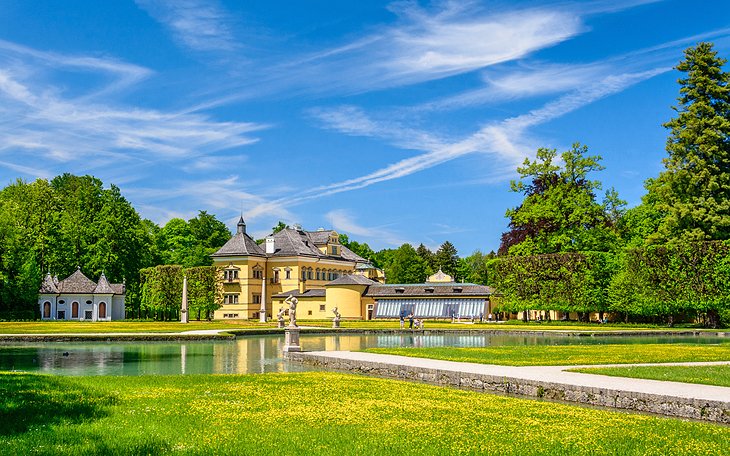
Markus Sittikus, Prince-Archbishop of Salzburg, commissioned this pleasure palace in 1613 as a place to relax and entertain. Never intended as a residence, Hellbrunn Palace (Schloss Hellbrunn) is nonetheless quite grand, and a tour gives you an inside look into the world of these immensely wealthy and powerful rulers of both church and state.
Sittikus conceived of unusual entertainments for his guests. These include a garden of trick water features and fountains, where an innocent looking statue of pavement may suddenly turn into a shower, or what appear to be benches around a table suddenly begin to spout water all over guests. The tour is lighthearted and fun, especially for children and those who don't mind getting a bit wet (it's a good idea to keep your camera and phone covered).
Apart from the trick fountains and beautiful flower gardens, the park is interesting as the site of the gazebo and grand alley of trees used in filming The Sound of Music. In December, the gardens are home to a lovely Christmas Market; entrance to a nearby folk museum is included in the admission ticket.
Address: Fürstenweg 37, Hellbrunn, Salzburg, Austria
Official site: www.hellbrunn.at/en/
Mirabell Palace and Gardens
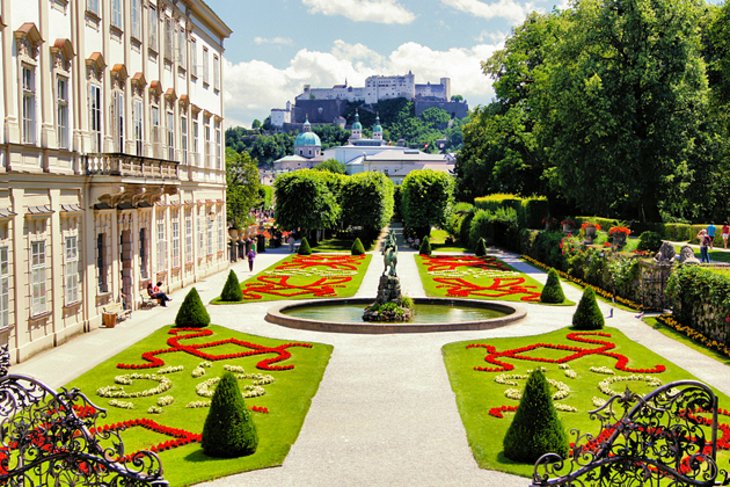
Another garden used in the filming of The Sound of Music is at Salzburg's lovely Mirabell Palace (Schloss Mirabell). This excellent example of Baroque landscape design was laid out in 1690 with numerous terraces, marble statues, and fountains.
The palace itself was remodeled in Baroque style between 1721-27 before being restored in the simpler Neoclassical style after a fire in 1818. Highlights of a visit include the spectacular Grand Staircase, built in the 18th-century, with a number of statues by Georg Raphael Donner and his pupils.
Other interesting features are the Marble Hall, which is still used for concerts and functions, and the Schloss Mirabell Baroque Museum. Housed in the Gardener's Building (the Gärtnergebäude), the museum is part of the estate's Orangery, and exhibits European art of the 17th and 18th centuries.
Also of note is the former 18th-century aviary, now used for exhibitions. Of interest, too, is the small open-air theater located at the southwestern corner of the gardens.
Address: Mirabellplatz 4, Salzburg, Austria
Visit the Franciscan Church
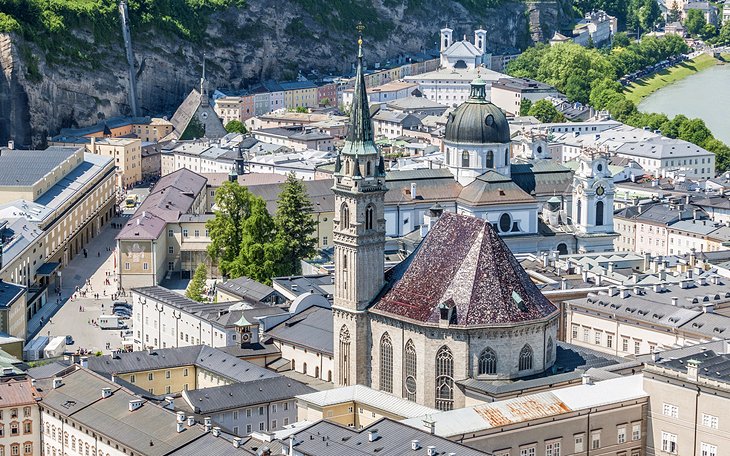
To the north of St. Peter's Church stands the Franciscan Church (Franziskanerkirche), the town's parish church until 1635. Notable features of the exterior are the high roof of the choir, and the tower on the south side from 1498.
Interior features of note include the dark 13th-century Romanesque nave, which contrasts with the high, bright 15th-century Gothic choir. In front of a ring of Baroque chapels dating from 1606 stands the high altar, added in 1709 and notable for its late 15th-century carved Madonna.
In the central chapel behind the altar is a winged marble altar from 1561 from the old cathedral. Opposite the church is the still-operating Franciscan Friary. Visitors are welcome to attend mass here.
Address: Franziskanergasse 5, 5020 Salzburg, Austria
Mozart's Birthplace
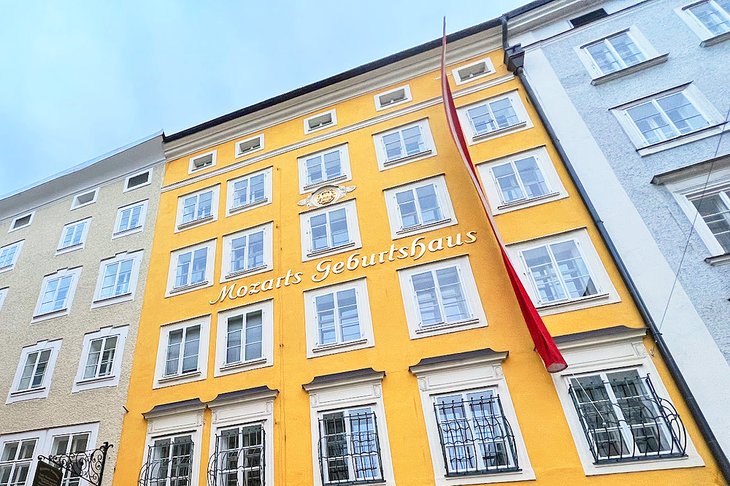
The house where Wolfgang Amadeus Mozart was born on January 27th, 1756, is one of the best places to visit in Salzburg if you're a fan of classical music. Highlights include the rooms once occupied by the Mozart family, and a museum displaying numerous interesting mementos, including the young Mozart's violin, portraits, and original scores of his compositions.
Engaging exhibits introduce his family members and their life and explore his operatic works, with costumes, set designs, and models and excerpts from his operas. One room is furnished as it would have been in his time. English language guided tours can be arranged.
Address: Getreidegasse 9, Salzburg, Austria
Official site: https://mozarteum.at/en/museums/mozarts-birthplace/
Salzburg's Festival Theaters
Salzburg has long been famous for its music festivals, as shown by the city's many historic theaters and concert halls. Collectively known as the Festival Theaters (Festspielhäuser), these buildings consist of the large Festspielhau; the smaller Haus für Mozart, between which is a foyer with fine frescoes; and the Karl-Böhm Hall, used for exhibitions and receptions.
It's in this building, decorated by superb 17th-century frescoes, that the famous Salzburg Festival has been held since 1925. This popular multi-week-long summer event showcases the best of European music and drama.
Other major Salzburg festivals include Mozart Week, a winter event focusing on the works of the great Austrian composer; and Salzburg Cultural Days, an annual two-week festival in October that includes symphonic and chamber concerts and opera performances.
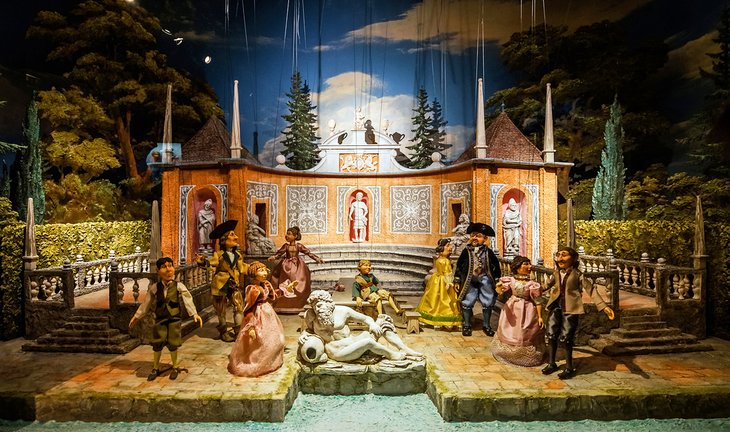
For a completely different theatrical experience, visit the Salzburg Marionette Theater. Eestablished in 1913, it's one of the oldest puppet theaters in the world.
Address: Hofstallgasse 1, A-5010 Salzburg, Austria
Official site: www.salzburgerfestspiele.at/summer
Neugebäude & The Salzburg Carillon
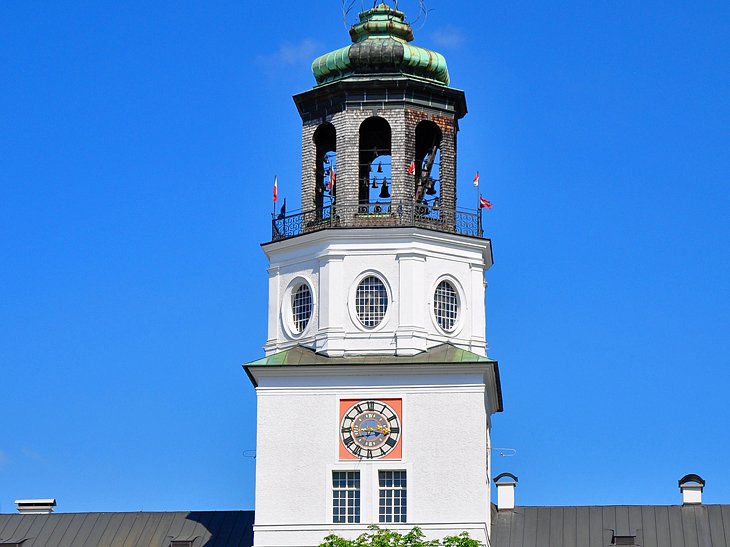
Opposite the Salzburg Residenz is the New Building (Neugebäude), erected in 1602 as the Archbishop's guesthouse and enlarged in 1670. Now home to provincial government offices and the Salzburg Museum, the building is famous for its carillon, the famous Glockenspiel.
Built in 1702, it contains 35 bells that play tunes from Mozart's vast repertoire three times per day (7am, 11am, and 6pm). Guided tours of the tower offering a unique view of the workings of this impressive mechanism are available.
A highlight of the experience is hearing the famous Salzburg Bull, the organ in neighboring Hohensalzburg palace, respond to the carillon with a chorale. Also, be sure to visit the lovely 18th-century St. Michael's Church (Michaelskirche) on the north side of the Residenzplatz at the corner of Mozartplatz with its Mozart Monument from 1842.
Address: Mozartpl. 1, 5020 Salzburg, Austria
St. Sebastian's Church and Cemetery
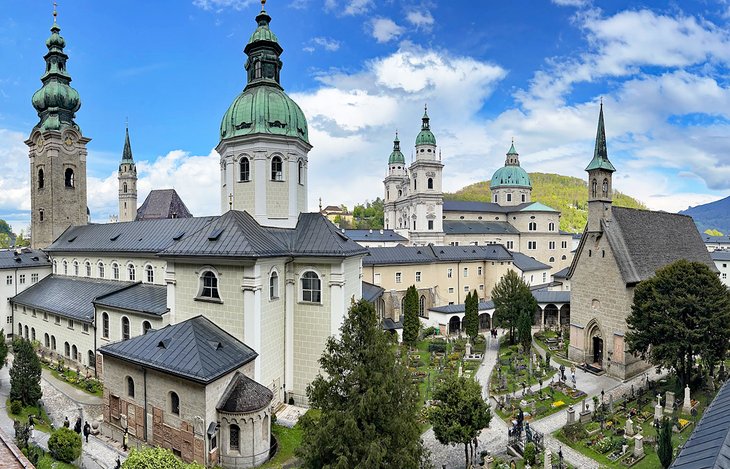
A highlight of Salzburg's more modern district on the right bank of the Salzach is St. Sebastian's Church (Sebastianskirche). Built in 1512 and completely remodeled in Rococo style in 1753, the church features a flight of steps leading to St. Sebastian Cemetery (Friedhof).
Established in 1595, in the middle of the cemetery, stands St. Gabriel's Chapel (Gabrielskapelle), with its ornate ceramic decoration, completed in 1603 as a mausoleum for Archbishop Wolf Dietrich.
On the path to the chapel lie the graves of Mozart's father, Leopold, and his widow, Konstanze. To the west of the church is a passage leading to the Loreto Convent (Loretokloster) and Paris-Lodron-Strasse.
Address: Linzer Gasse 41, 5020 Salzburg, Austria
See the Old Town Hall
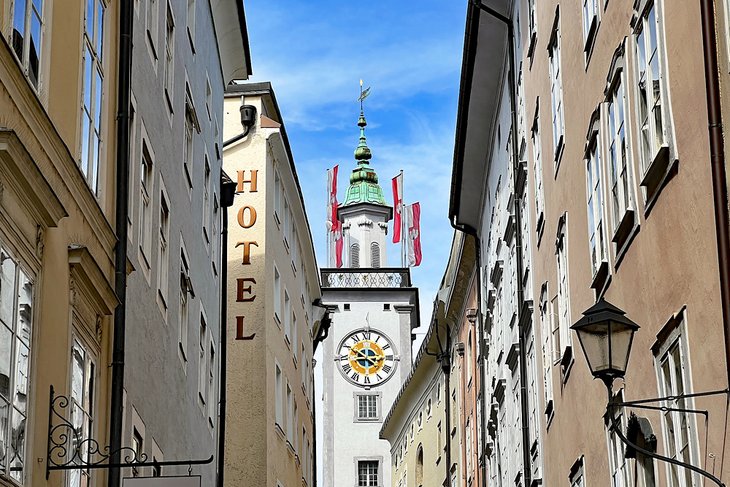
With its Rococo facade and iconic tower, the Old Town Hall makes for one of the most attractive sites in Salzburg. It served important roles throughout history: sounding the bell when curfew was near, keeping time for the public, and as a watchtower.
Today, its purpose is mainly to share local culture with tourists and provide a space for bureaucratic offices. Check out rotating exhibitions of works from Salzburg artists in the City Gallery, located on the first floor. While the second floor is primarily used for city council meetings, it also displays Franz Kulstrunk's famous painting The Town of Salzburg in 1916, on view for the public.
Address: Kranzlmarkt 1, 5020 Salzburg, Austria
Climb to the Salzburg Catacombs
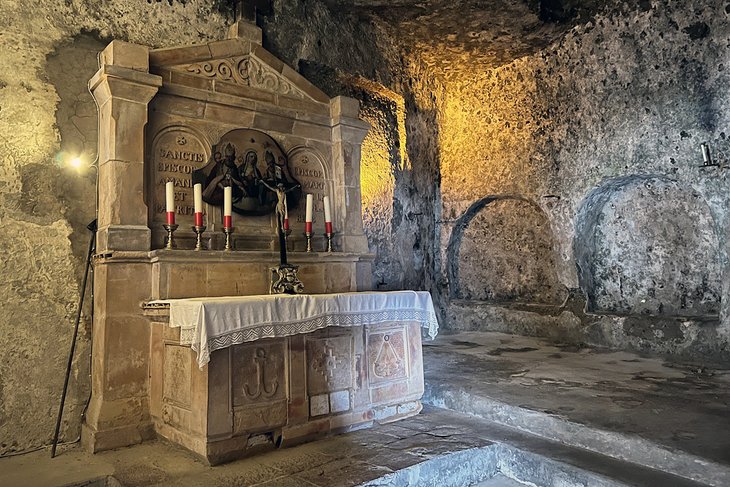
Just past St. Sebastian's Church and Cemetery are catacombs carved into the face of the Mönchsberg rock. The attraction, estimated to be about 1,000 years old, served dual purposes as both a hermitage and a burial site. You may recognize it from The Sound of Music as the place where the Trapp family sought refuge before fleeing to Switzerland.
To reach the two levels of the catacombs open to the public, you'll need to climb a set of old, steep stone steps (grippy shoes are a must!). The first level contains the "Gertrauden Chapel," while the upper part houses the "Maximus Chapel," which is thought to be even older. You can also see an incredible view of Salzburg from the windows and balcony.
Ride the Cable Car to the Top of the Untersberg
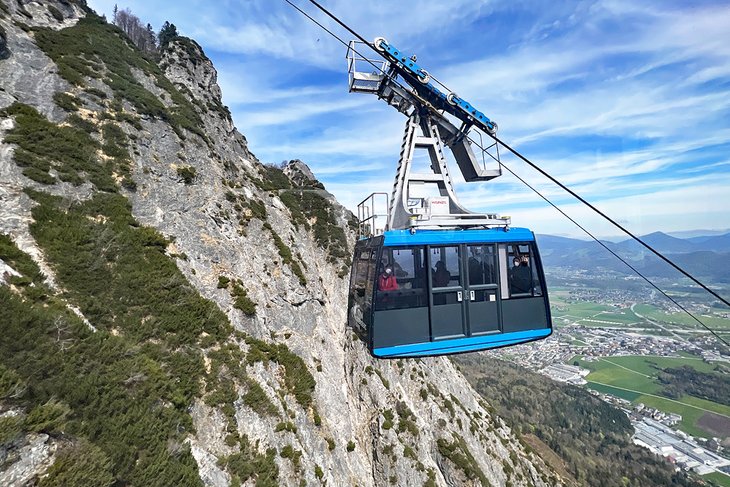
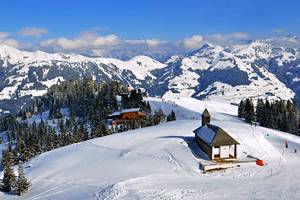
The Untersberg, a popular recreation area with a rugged peak, draws outdoors lovers from around the world. You can reach the top by taking a ride on the Untersbergbahn (cable car), located about 10 kilometers south of the city and easily reached by bus. The 8.5-minute ride in one of the two gondola-like cars is a delight, offering dazzling views of Salzburg, the Rositten Valley, and the entire Berchtesgaden region.
The best vistas, however, can be found when the cable car drops you off near the Geiereck 1,805-meter-tall Geiereck summit and you're looking down on the fluffy white clouds and the snowcapped Alps. It's no surprise that many couples get engaged in this beautiful spot.
Spend an hour or two exploring the stunning high Alpine terrain, and when you're ready to refuel, simply pull up a seat at the mountaintop café for coffee and strudel.
Address: Dr.-Friedrich-Oedl-Weg 2, 5083, Austria
Official site: https://www.untersbergbahn.at/
Take a Drive to Hallein and the Celtic Museum
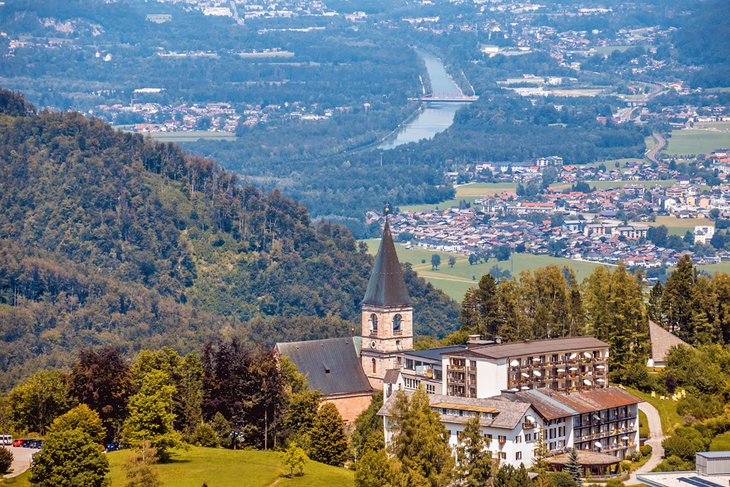
The old Celtic town of Hallein on the River Salzach, a 10-minute-drive from Salzburg city center, is one of the several interesting places to visit near Salzburg. The town is especially popular for its picturesque narrow streets, gateways, and statues, as well as the historic homes built in typical Salzach style.
Hallein is the birthplace of organist Franz Xaver Gruber, composer of Silent Night. It's also where you'll find the Celtic Museum (Keltenmuseum Hallein), one of the largest and most complete museums of Celtic art and history in all Europe. Set in a former 17th-century orphanage, this reconstructed Celtic farmstead includes buildings and tools used by Celt settlers, as well as an ancient burial chamber.
Other highlights include displays of finds from the Hallstatt and La Tène (Iron Age) periods from 800-15 BC. There are also exhibits portraying local customs and the history of town guilds.
Address: Pflegerplatz 5, Hallein, Austria
Salzburg, Austria - Climate Chart
| Average minimum and maximum temperatures for Salzburg, Austria in °C | |||||||||||
| J | F | M | A | M | J | J | A | S | O | N | D |
| 2 -4.4 | 3 -3.9 | 9 0 | 13 3.9 | 19 8.3 | 22 10.6 | 23 12.8 | 23 12.8 | 20 10 | 14 5 | 7 0.6 | 3 -3.3 |
| PlanetWare.com | |||||||||||
| Average minimum and maximum temperatures for Salzburg, Austria in °F | |||||||||||
| J | F | M | A | M | J | J | A | S | O | N | D |
| 36 24 | 38 25 | 48 32 | 56 39 | 66 47 | 71 51 | 74 55 | 73 55 | 68 50 | 57 41 | 45 33 | 37 26 |
| PlanetWare.com | |||||||||||
More Must-See Destinations near Salzburg
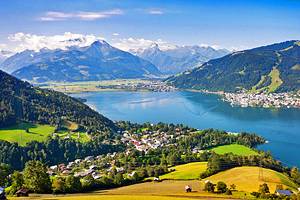
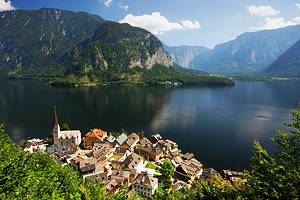
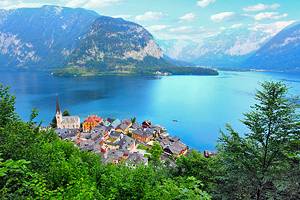
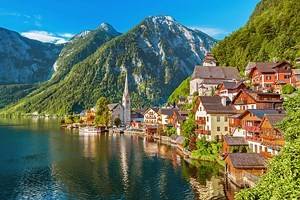
Salzburg sits close to the border between Austria and Germany, almost equidistant from Munich and Innsbruck. Passau, in northern Bavaria, is about the same distance to the north, and farther east on the Danube is Linz. Just across the border to the west, the German town of Berchtesgaden and the idyllic Königsee are easy day trips from Salzburg. To the southeast is the beautiful town of Hallstatt and the Hallstätter Sea, part of the Dachstein/Salzkammergut Alpine UNESCO World Heritage Site. About halfway between Salzburg and Innsbruck is the Austrian ski resort of Kitzbuhel.