

Vienna, Austria's Top 11 Tourist Attractions Worth Visiting
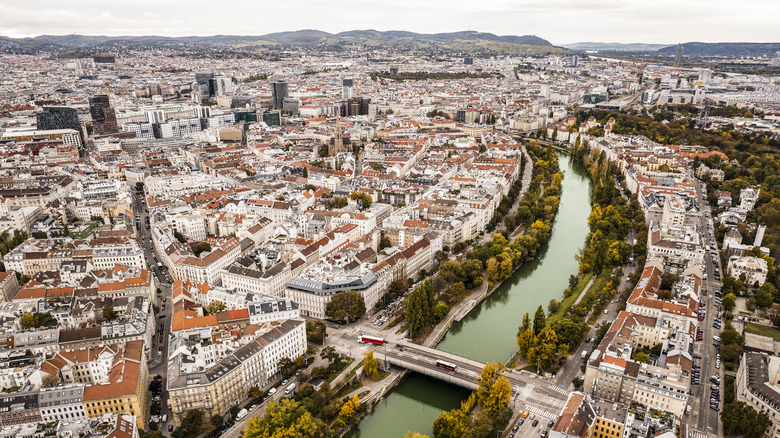
Vienna, Austria had never been on my bucket list, but on a jaunt through Central and Eastern Europe, it was an obvious stop. However, after seeing this bathed-in-white metropolis, I couldn't believe I almost ever missed it. As where the Habsburg dynasty — one of the main European dynasties for five centuries — formerly held their main home and ruled from, Vienna is regal through-and-through, with opulent, over-the-top architecture, world-class destinations, and palaces only suitable for a king. That rich culture translates into every nook and cranny in this city — the biggest in Austria — from the food, to the entertainment, and more. It also extends outwards, especially in these worthwhile day trips from Vienna.
I rounded up the best things to do as a tourist on your trip to this historic city, ranging from a museum with one of the biggest art collections in the world to one of the most beautiful Baroque palaces in Europe. To do so, I considered which Viennese attractions have the most and best reviews on Tripadvisor, which are the most famous, and which are the most likely to impress visitors of all ages and interests. To learn more about how I assembled this list, visit the last slide of this article.
Hofburg Palace
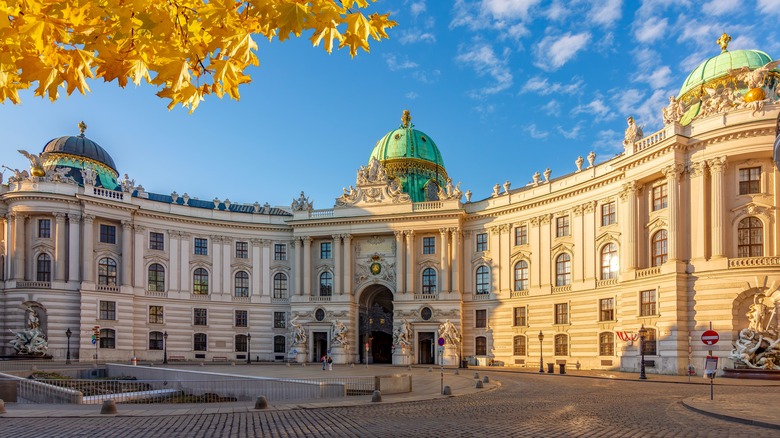
For six centuries through 1918, when the monarchy came to an end after Emperor Karl, Emperor Franz Joseph's successor, renounced the end of the throne, Hofburg Palace might as well have been the center of the universe for Austrians. It was where the Habsburg royal family lived. Among them were Maria Theresa, the 18th-century Holy Roman empress — the only woman to rule the empire in her own right — and the mother of the legendary Marie Antoinette; Emperor Franz Joseph, the longest-reigning Habsburg; and his wife, Empress Elisabeth, known as "Sisi" and remembered for her beauty and her tragic assassination. This palace is also where coronations, state banquets, and diplomatic summits were held throughout the times of the Holy Roman Empire and the Austro-Hungarian Empire. Today, it's where the federal president, the ministers of the chancellor's office, and the secretaries of state work.
The 2.6 million square-foot complex with neo-Gothic, Renaissance, and Baroque styles has 2,600 rooms spewing with rich history. It all dates back to the 13th century, when the complex was built as a medieval fortress. Two dozen of those rooms are encompassed in the Imperial Apartments, which are a must-see in the castle. People can also learn more about Empress Elisabeth at the palace's Sisi Museum
Another favorite here is the Austrian National Library, which, with over 12 million items, is the biggest library in the country and dates back to the 18th century. Don't miss its stunning Great Hall or the palace's Winter Riding School (built in 1735).
Schönbrunn Palace
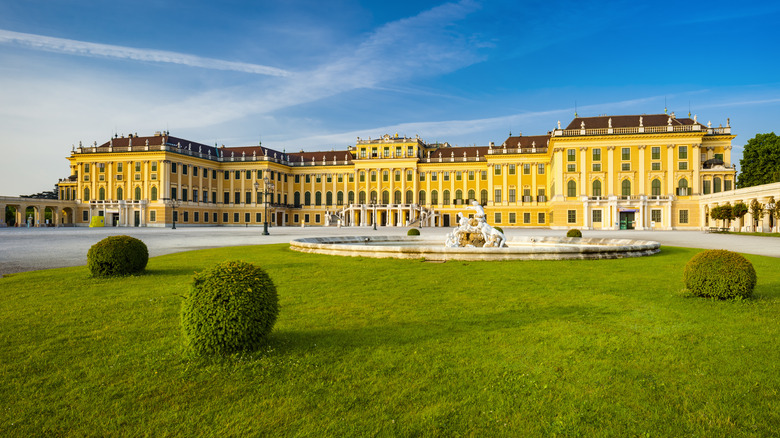
Hofburg Palace was just one of the Habsburg family's residences. During the summer, they stayed at Schönbrunn Palace. Schönbrunn Palace is known as one of the most stunning Baroque palaces on the continent, and as such, it's the most popular tourist attraction in the country. Within its 1,441 rooms, visitors can see where generations of Habsburgs, including Marie Antoinette, spent their summers.
The palace dates back to 1696 when the Habsburg family built it to replace a former derelict palace that had been destroyed in the Battle of Vienna during the Ottoman-Habsburg wars, which were fought between the Ottoman Empire and the Habsburgs over centuries. It only became more important in royal life in the coming decades, when the palace was the setting for balls and other events. Today, it's a UNESCO World Heritage Site.
Visitors can purchase a ticket and explore 40 of the palace's rooms, many of which feature gold tones, red French damask chairs, crystal chandeliers, Belgian tapestries, and family portraits for an over-the-top elegant feel. Some rooms utilize mirrors to make them look even bigger. The palace is so grand that Mozart played here when he was just a young prodigy, Napoleon held meetings here, and the Congress of Vienna gathered here.
The Albertina
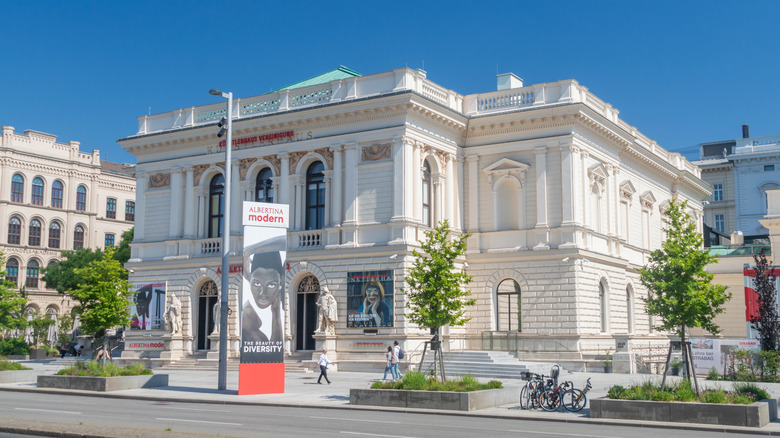
With its elegant buildings, Vienna looks like a work of art. One of the largest graphical art collections in the city — and on the planet — lives in one of those buildings. The Albertina, located inside Hofburg Palace, which is the biggest Habsburg residential palace, is an art museum with over one million prints and 60,000 drawings. It's named for its founder, Duke Albert of Saxony-Teschen, who privately started what later became the museum's collection in 1776. It's one of the most beloved museums in the country, as well as one of the best museums to visit in Vienna.
Among two floors and 20 rooms where Archduchess of Austria Marie-Christine (the favorite daughter of Maria Theresa) and Archduke Karl (Marie-Christine's husband) once lived are works like "Hare" by Durer, "Water Lily Pond" by Monet, and "Girl" by Renoir. You can expect to see Impressionist, Fauvist, German Expressionist, and Russian avant-garde pieces here. Plus, due to the museum's temporary exhibits, there's always something new to see here.
They're all displayed among original furniture that royals once used in the Neo-Renaissance-style palace dating back to 1891, as well as parquet floors and yellow, green, and turquoise tones. A few of the standout rooms that would be worth seeing, whether or not they were filled with priceless art, include the marble-lined Hall of Muses with its full-sized statues of Apollo and his muses, as well as the Spanish Apartments, which the Spanish royal family once called home.
Austrian Parliament
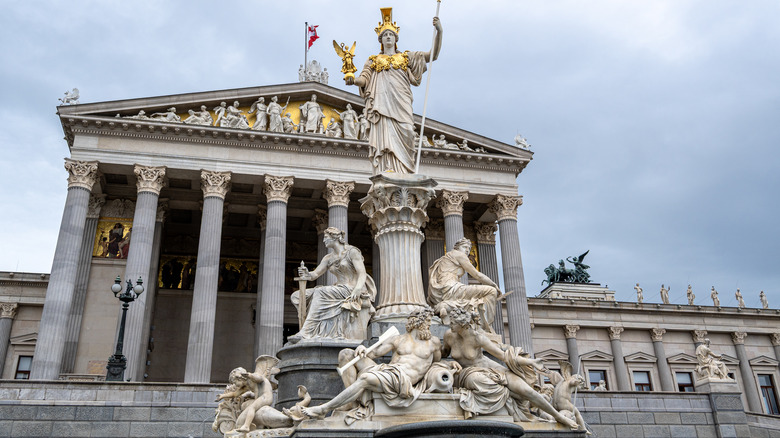
Since 1883, the Austrian Parliament building is where the country's legal and political history has been solidified. Danish Austrian architect Theophil began building it in 1874 after the stunning structure was commissioned in 1869. The building includes columns and statues of Greek goddesses like Pallas Athena and Nike.
It looks even better now, as the structure — one of the most important in Vienna — reopened in 2023 after a widespread renovation that cost 400 million euros. The four-year renovation included the creation of a new interactive visitor's center presenting the history of Austrian politics as well as the revamping of the National Council chamber. It also included more modern interior features like LED lights and a glass dome as well as more accessibility for people with disabilities.
It was the first renovation of its size on the historic building. The Austrian Parliament still has its original wood and stone floors as well as its original chandeliers. Two hundred and eighty sessions, including those held by the National and Federal Council, are held annually in the massive, more-than-150,000-square-foot building. Visitors can watch these sessions for free and also explore this mighty building on a guided tour for free.
Demel

Vienna is known for its delectable sweets, and nowhere are those sweets more delicious — or regal — than Demel. This coffee shop dates back to 1786 when it was founded by confectioner Ludwig Dehne. Itwas the official supplier of confectionery products to the royal court and the only confectionery that delivered to the Hofburg Theatre. Its candied violets were even favorites of Empress Elisabeth. Today, the confectionery still has plenty of noble touches, like ornate displays and equally detailed cakes, chocolates, and sweets.
The Regency-inspired seating includes plush red couches surrounded by chandeliers and white-tableclothed tables lined with fine china. It's one of the many cute cafes in Vienna. Fittingly, it's surrounded by chic shops like Gucci, Tiffany & Co., and Dior. However, not everything here needs to be over-the-top to be delicious. The shop claims that it's the creator of the iconic Viennese sachertorte, a humble chocolate cake with chocolate icing and a layer of apricot jam. Both Demel and Hotel Sacher have spent 200 years debating over which of them created the cake. At Demel, the cake is made from scratch onsite and is still made using its original recipe. Up to 500 pieces of the decadent cake are sold every day.
Spanish Riding School

Within Hofburg Palace's Winter Riding School is the Spanish Riding School, which is worth a visit all on its own. Within the school's Baroque-style walls are where the world-famous Lipizzaner stallions and their riders train and perform. Recognized by UNESCO, it's the only place on the planet where people can see these original performances synced to music. It dates back to the early 1700s, when architect Joseph Emanuel Fischer von Erlach designed the white-and-gold riding hall. That also makes it the oldest riding school in the world.
If you're interested in seeing these graceful white stallions up close, there are several ways to do so. The top option is to snag seated or standing tickets to the highly coveted, hour-and-a-half-long galas, where these four-legged performers showcase every move they've trained to do for years. You can also get tickets to their 45-minute or 70-minute shows. If the performances don't fall during your visit to Vienna, you can also purchase tickets to their hour-long morning training sessions.
Another option is to take a guided tour of the school's stables and riding hall. If you're really fortunate, you might just spot the horses — for free — being moved from the stables to the next-door riding hall, or in their outdoor paddocks in Burggarten Park. Regardless of how you choose to see them, just know you're lucky to do so, since at one time, seeing the horses' performances was only for nobles.
St. Charles' Church
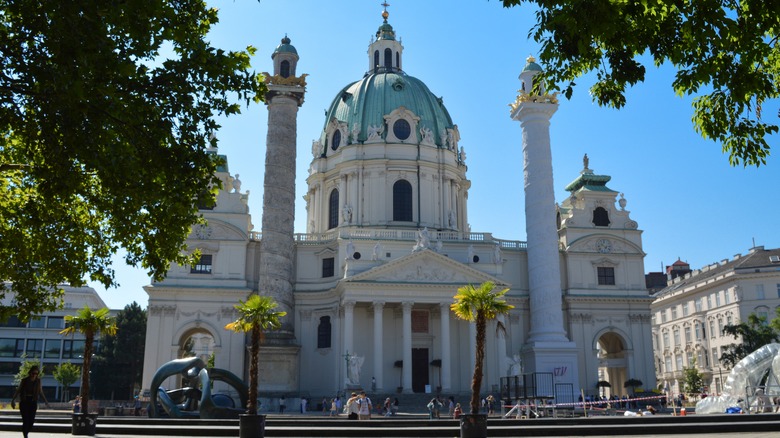
Architect Johann Bernhard Fischer von Erlach is behind many of Vienna's prized Baroque-style structures. But his greatest claim to fame — and his last — is St. Charles' Church, otherwise known as Karlskirche. He began it in 1716 at the request of Holy Roman Emperor Charles VI, who had the church built in honor of Charles Borromeo, the patron saint of plague victims. His son, Joseph, who also built the Spanish Riding School, completed the structure in 1737 after his father's 1723 death.
Today, the church — which towers over Vienna with its trademark, tarnished copper now-green dome — continues to be an emblem of the city. It's the setting for many Vienna events like Popfest and the Art Advent Market, as well as a destination for classical music concerts featuring works like Mozart's "Requiem" and Vivaldi's "Four Seasons." Vivaldi is even buried near the church.
From its outdoor terrace, they will be able to see many of the city's most important landmarks. Inside, don't miss the vibrant frescoes that line the dome, as well as the two columns that feature artwork exploring Charles Borromeo's life. Also inside are some of Borromeo's supposed possessions. No matter what your eye finds in this stunning church, it's sure to be in well-preserved condition.
St. Stephen's Cathedral
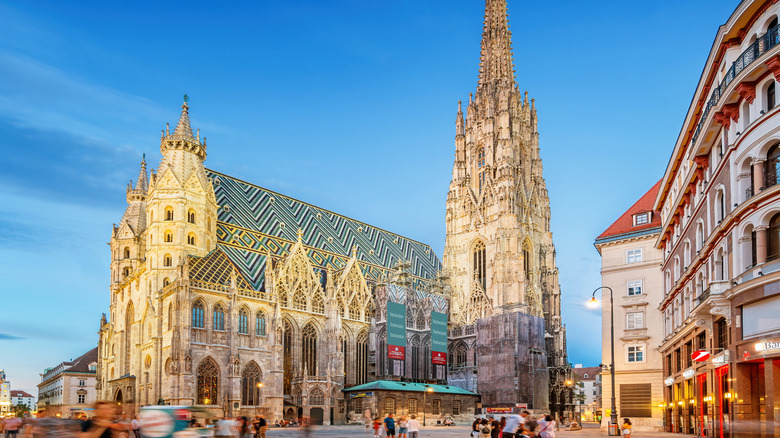
A Vienna church that rivals St. Charles' Church is also the tallest church in the country: St. Stephen's Cathedral. It's the seat of Vienna's archbishop and also the primary Roman Catholic church in the city. Also known as The Steffl, its history can be traced back to 1137, when it was built on the grounds of another church that had been demolished. Being so storied, it is a symbol of the city. To mark its dedication to Vienna, the church's roof features the coat of arms of the city as well as the royal and imperial double-headed eagle designed in 230,000 standout black, yellow, and white tiles. Visitors can climb to the top of St. Stephen's Cathedral for all-encompassing views of the city after trekking up the steps of one of the church's four towers. More than one million people visit the church annually.
Inside the church, which is the most significant Gothic building in the country, the features are even more standout. Emperor Friedrich III is buried here in a marble sarcophagus with an eight-ton cover. Habsburgs and Viennese cardinals and archbishops are just some of the other 11,000 people, including many plague victims, buried in the church's catacombs, which can only be visited on a guided tour. Funerals of many Habsburg family members have been held here, as well as the funeral of Wolfgang Amadeus Mozart.
Vienna State Opera

Vienna is a must-visit destination for classical music lovers and is home to one of the world's best opera houses. Since it opened in 1869 after being designed by architects August Sicard von Sicardsburg and Eduard van der Nüll, the Vienna State Opera has been a premiere place to enjoy music. The creation of the opera house was with the help of Emperor Franz Joseph, as he personally decided which opera scenes should be depicted in its décor. Just a few of the composers who have had works performed here include Richard Wagner, Wolfgang Amadeus Mozart, and Richard Strauss. It was even featured in "Mission Impossible," "Jack Ryan," "The Recruit," and "The Woman in Gold."
All of the theater, except for the exterior façade, staircase, and the Schwindfoyer, was destroyed during World War II. However, reopened ten years later after a 10-year rebuild with a new auditorium, then-modern technology, and a performance of Beethoven's "Fidelio." The Vienna State Opera presents rotates performances, so there's always something to see here, including Puccini's "Madame Butterfly," Britten's "A Midsummer Night's Dream," and performances by the Vienna State Ballet. Plus, some tickets — especially standing room tickets — can be fairly reasonably priced, making a night out here accessible even to tourists on a budget.
Naschmarkt
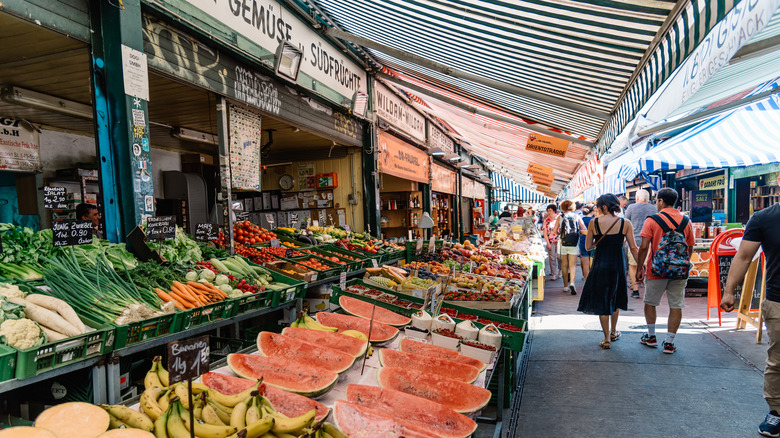
What Naschmarkt lacks in walls it makes up for in size and taste. The biggest and most famous outdoor food market in the city, as well as one of the best food markets in Europe according to travelers, Naschmarkt is home to 120 international food stands and restaurants. It's so well-known that it was even featured on Amazon Prime's "Sachertorte." The market has been a staple of the city for more than three centuries, at which time it was a simple milk market. It continued to grow when fruit and vegetable vendors were forced to move their work here.
The food stands run along one row, while the restaurants run along the other, all in the 4th district of the city along the Wienzeile. They're generally open from 6 a.m. through 7:30 p.m. on weekdays, 5 p.m. on Saturdays, and closed on Sundays. Just a few of the standout spots to check out include Neni for Israeli-Oriental fare, Orient & Occident for authentic Turkish eats, and Restaurant Iris for Greek cuisine. If you're planning on home cooking, you can also find ingredients like spices, sauces, fruits, vegetables, breads, meats, and seafood here.
It's all located over the River Wien at the Wienzeile, spanning nearly a mile. On Saturdays, the market gets even busier when the weekly flea market sets up shop, selling items like antique furniture, vintage clothing, books, and music records from 6:30 a.m. to 2 p.m. Each week, the flea market features completely different vendors, since each vendor is only allowed to sell their goods at the market three times annually.
Viennese Giant Ferris Wheel

On most Ferris wheels, you'll sit in a two-seat open-air chair as you watch the scenery whizz up and down. But the Viennese Giant Ferris Wheel isn't most Ferris wheels. This wheel that stretches more than 200 feet up in the air features 15 large, communal enclosed carts that visitors can walk around in. The carts move at just 1.67 miles per hour for a leisurely ride. From here in the Prater amusement park, people can see all of Vienna from the oldest Ferris wheel of its type on earth. It's so iconic that it's been featured in countless classic films like "The Living Daylights," "The Third Man," and "Before Sunrise." The European Film Academy has even named it a Treasure of European Film Culture.
The legendary wheel dates back to 1897, when it was built to celebrate Emperor Franz Joseph's 50th year of being emperor. It burned down during World War II, but it was rebuilt alongside other Vienna sites that were destroyed in the same way. Visitors can learn more about the wheel at the on-site Panorama Museum, which showcases replicas of the wheel's original carts.
Methodology
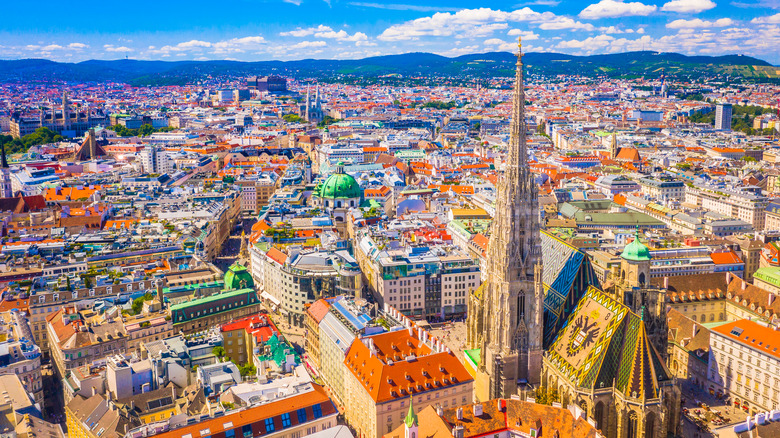
As one of the most-visited cities in Europe with more than eight million annual visitors, you can bet that this city that could win any beauty contest has much more to do than could fill even the most ambitious itinerary. So, PlanetWare rounded up the city's best tourist attractions, ranging from a world-famous opera house in the home of classical music to a one-of-a-kind, UNESCO-recognized riding school. But if Vienna's crowds have you feeling overwhelmed, then check out this underrated Austrian city full of stunning sights.
To decide which destinations made the cut, we first evaluated which Vienna spots had the most and best reviews on Tripadvisor, so you can be sure that travelers just like you felt the journey was well-worth it. Then, we considered which sites are the most famous, with some gaining recognition around the world, let alone the country. Finally, we determined which are the most likely to impress people of all interests, ranging from a sweet shop that once supplied royalty to the center of Austria's political sphere.