Exploring Gordion, Museum, & History
Gordion, once the great capital of the Phrygian dynasty, lies in the modern village of Yassihöyük, about 100 kilometers southwest of Ankara.
Although famously connected to the story of the Gordion Knot, which Alexander the Great sliced through instead of untying, Gordion's history stretches much further back.
Excavations in the surrounding area provide evidence that this region was already settled in the Early Bronze Age (2500 BCE), while a cemetery discovered beneath the Phrygian necropolis suggests a subsequent Hittite presence.
Myth & History
The Phrygians are thought by scholars to be one of the so-called "Sea Peoples," who overran Asia Minor in around 1200 BCE in a series of invasions.
Assyrian sources dating from roughly 1100 BCE refer to them as the Mushki or Mosher and state that they settled on both sides of the Kizilirmak River in Anatolia, from where they began to threaten their eastern neighbors.
Phrygian finds at Gordion date from the mid-9th century BCE. Greek sources have preserved the legend of the founding of the Phrygian dynasty and its capital, which begins when a farmer named Gordius, busy plowing his field, was startled by a flock of birds descending around his oxen. Keen to learn the meaning behind this omen, he set out to consult augurs in a nearby town.
Along the way, he met a beautiful woman, who told him the birds were a sign of his royal destiny and offered him her hand in marriage. Gordius then drove his ox-cart onward to the temple, where he was immediately hailed as king by the town's people after an oracle prophesied that the first person they saw driving to the temple would be their king.
Gordius then set up his ox-cart in the temple, attaching the yoke to the shaft with a long and elaborately-knotted strap, which would become known as the Gordian Knot. This elaborate knot had no visible end and was considered impossible to unravel. According to legend, whoever succeeded would become ruler of Asia Minor.
The most famous Phrygian ruler was King Midas, the son of Gordius who, in Greek mythology, turned all he touched into gold.
The Phrygian dynasty wasn't to last, though. Phrygia was overrun by both Cimmerians and Scythians between 700 and 670 BCE, and from the rubble of the Kingdom of Phrygia emerged the Lydian Empire, under the auspices of which Phrygian culture was, for a period, preserved.
In 546 BCE, the Persian Achaemenid dynasty defeated the Lydians and built a new settlement at Gordion.
An earthquake destroyed the town in about 400 BCE, and by the time Alexander the Great arrived here in 334 BC, Gordion was little more than a village.
The original ox-cart of Gordius was still tied up on Gordion's citadel hill beside the temple when the ambitious Alexander arrived. Resolving to fulfill the Gordian Knot prophesy, Alexander the Great is said to have sliced the knot in two with his sword (according to the Greek Historian Aristobulus of Cassandreia, Alexander instead removed the peg holding the shaft, thus freeing the end of the knot).
Whatever the case, Alexander the Great went on to conquer Asia Minor, and the legend of the Gordian Knot has survived into the present day, where a "Gordian Knot" is used to describe a complicated problem.
By the time archaeologists, led by Rodney S. Young of Pennsylvania University, began excavation work here in 1953, the Sakarya River had deposited a layer of sediment several meters thick over the ruins of Gordion's lower town.
By 1963, 169 bronze vessels and 175 bronze fibulae (ornamental brooches) had been unearthed. There was no trace, however, of the legendary Phrygian treasure, presumed to have been taken by the Cimmerians.
The Site
Citadel Complex
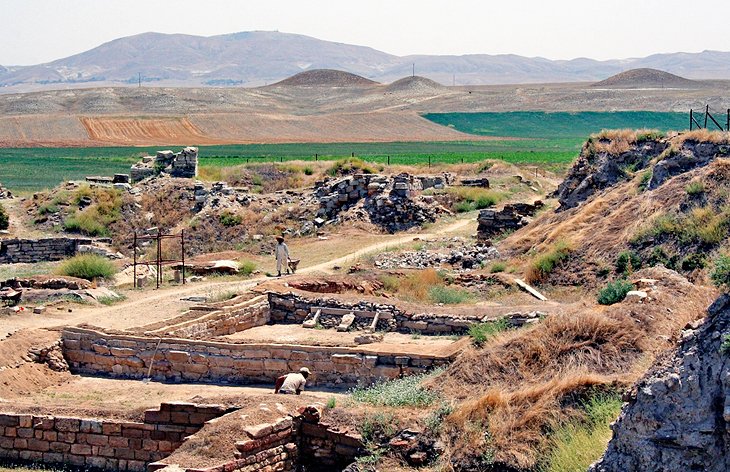
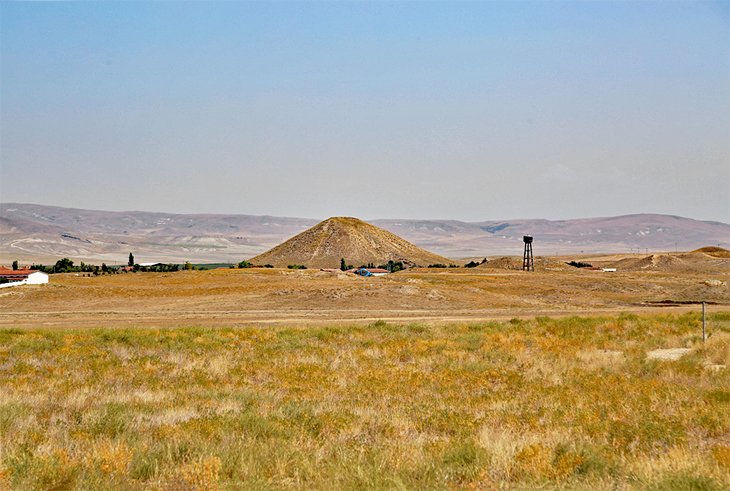
On the western edge of Yassihöyük village are the excavated ruins of Gordion's citadel complex. From the top of the settlement mound, there are excellent views across the surrounding fields, which are scattered with Gordion's cone-shaped tumulus burial mounds.
In the upper town section of the citadel complex, archaeologists have unearthed an imposing city gate from the eighth century BCE. Preserved to a height of over nine meters, it is a testament to the sophistication of Phrygian stone architecture.
Other finds from that era include the stone foundations of a palace complex, once supporting walls of mud brick on a timber framework.
In three of the four megaron-style buildings, with a hearth, ante-room, and principal hall, mosaics were found. A second gate excavated here dates from the Persian period.
Midas Tumulus
The Midas Tomb is located at the eastern edge of Yassihöyük village. For tourists, this is the number one attraction of a sightseeing trip to Gordion.
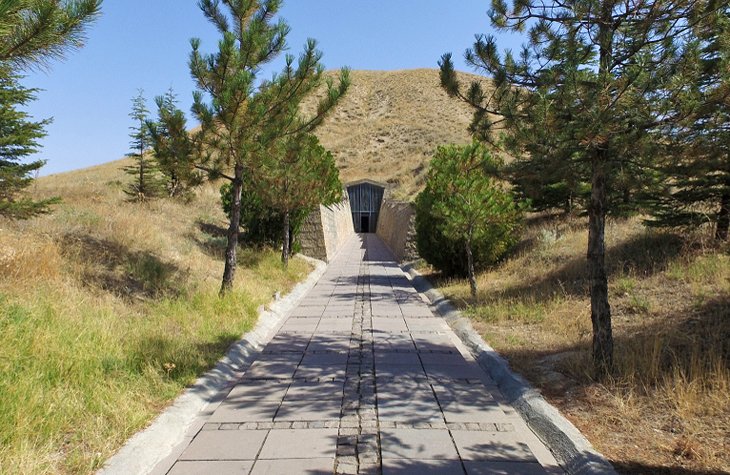
The so-called Midas Tomb was erected at the beginning of the 7th century BCE at the earliest. It was built from wood (mainly cedar) and buried in a tumulus (an earthen man-made burial mound), which measures 53 meters high and 250 meters in diameter, making it the largest of its kind in Anatolia. It towers over the flat surrounding farmland.
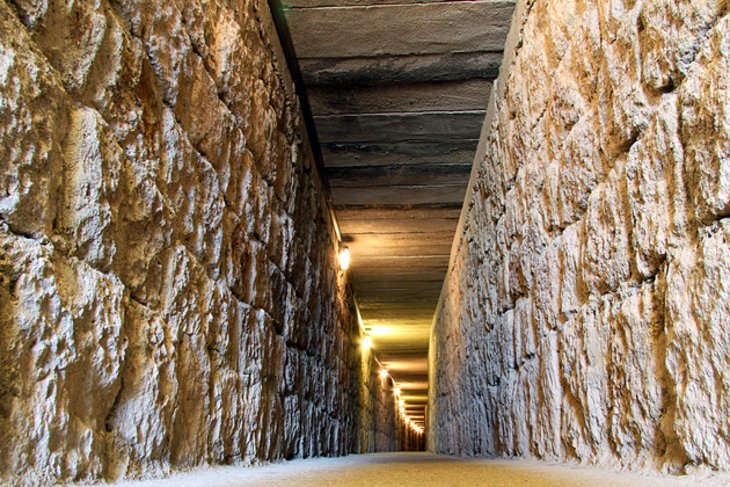
On the southwest side, a 70-meter-long passage leads down to the burial chamber, 39 meters below the top of the mound. This chamber, concealed beneath a mass of limestone blocks, was discovered in 1957 with its original wooden beam walls and gable roof still intact.
When archaeologists entered the tomb, they found the intact skeleton of a man, roughly 60 years of age, his clothes fastened with well-preserved bronze fibulae (a total of 175 of these bronze objects were discovered within the burial chamber). Around the body, tables were laden with rich grave gifts.
Other Tombs
Other smaller mounds nearby contain tombs from the period 725 to 550 BCE. The so-called Child's Tomb to the southeast of the museum yielded some rather special treasures, including wooden furniture, ivory reliefs, and boxwood carvings.
Gordion Museum
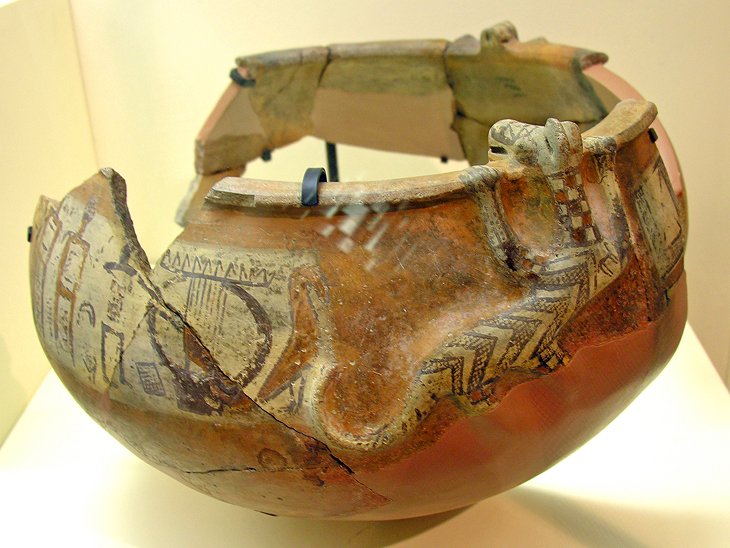
The small Gordion Museum, opposite the Midas Tomb, displays finds from the site, including bronze statuary, glass jewelry, and an extensive coin collection. The oldest pebble mosaic ever found is interred in the garden in the museum's grounds.
Of particular interest for history buffs are the displays of jewelry from Mesopotamia and the Babylonian coinage, both of which provide evidence of Gordion's importance as a vital link to the ancient trade routes of the region.
To see the vast collection of intricately decorated Phrygian grave goods that were excavated from Gordion's tombs, head to the Museum of Anatolian Civilizations in Ankara either before or after your Gordion trip.
Practicalities
Gordion is located in the village of Yassıhüyük, which is 17 kilometers northwest of the town of Polatlı and 109 kilometers southwest of Ankara.
The site is easily visited on a day trip from Ankara or as a stopover on a journey between Ankara and Eskişehir or Konya.
If you don't have your own wheels, you can visit Gordion with a train and taxi combination. Fast trains between Ankara and Konya, and some fast trains between Ankara and Eskişehir, stop in Polatlı from where taxi drivers at Polatlı train station can take you on a return trip to Yassıhüyük.
More Related Articles on PlanetWare.com
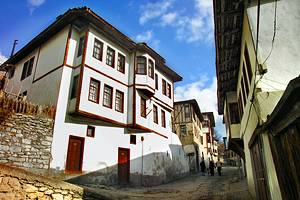
Historic Sites: Central Turkey has plenty of historic sites to discover. Head to Çatalhöyük to view one of the most important Neolithic sites in the world. While here, check out Konya, home of Turkey's famous whirling dervishes. To delve into more Neolithic era history, don't miss Sanliurfa from where you can visit Gobekletepe, which archaeologists call the world's first temple. Nearer to Gordion, head to Safranbolu for cobblestone alleys and beautifully preserved Ottoman mansions.