Shannon (River Shannon)
|
|
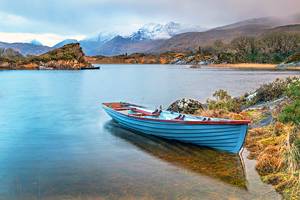
The Shannon, Ireland's longest river, rises in Cavan county, flows through the limestone plains of central Ireland and reaches the Atlantic just beyond Limerick. With its loughs, tributary streams and canals it forms a widely ramified system of waterways traversing a fifth of the area of Ireland. The banks of the Shannon, apart from the few places of some size through which it flows, are thinly populated and for much of their length bordered by pastureland. Since there is no industry along the river the light over the water is of unusual clarity. Apart from a short non-navigable stretch in its upper course the gradient down to Killaloe is so gentle that only six locks are required over this considerable distance.In recent years there has been an active development of facilities for recreation and the tourist trade on the Shannon between Battlebridge (at its outflow from Lough Allan) and Killaloe. There are marinas for cabin cruisers of all types and sizes at Carrick-on-Shannon, Athlone and Killaloe.A leisurely cruise along these peaceful waters is one of the great holiday pleasures that Ireland can offer. Care is, however, required on the two largest lakes in the Shannon area, Lough Ree at Athlone and Lough Derg at Killaloe, since a sudden wind can whip up heavy waves. Lough Ree, in particular, with its low lying shores and great expanse of open water, should be crossed only in good weather conditions.Most of the city of Limerick lies on the south bank of the Shannon, with docks and moorings for sea-going vessels of up to 10,000 tons.Beyond Limerick, on the right, is Shannon International Airport.Between here and the Atlantic, over a distance of some 60mi/100km the Shannon opens out into its funnel-shaped estuary. Near Kilkee there is a car ferry between Tarbert in Kerry county and Killimer in Clare county.
Related Attractions
Shannon River Cruising
A leisurely cruise along the peaceful waters of the Shannon is one of the great holiday pleasures that Ireland can offer.
Lough Key
Boats starting from Carrick-on-Shannon generally explore first the upper course of the Shannon, the River Boyle and its loughs, and above all beautiful Lough Key (near the town of Boyle), with its wooded islands and its Forest Park in the grounds of a former mansion (forest trails, bog garden, restaurant, shop).
Jamestown Canal
Sailing downstream from Carrick-on-Shannon, we pass through the Jamestown Canal with its lock (and possible visits to Drumsna and Jamestown).
Lough Boderg
Sailing downstream from Carrick-on-Shannon, we pass through the Jamestown Canal with its lock into beautiful Lough Boderg. From here a narrow passage through the reed beds gives access to the lonely Corronadoe loughs, a paradise for bird watchers and anglers.
Lough Bofin
Sailing downstream from Carrick-on-Shannon, we pass through the Jamestown Canal with its lock into beautiful Lough Boderg. From here a narrow passage through the reed beds gives access to the lonely Corronadoe loughs. At Dromod on Lough Bofin is a beautiful little harbor (which can accommodate only a small number of boats). Father south lies Roosky with its quay.
Lough Forbes
At Dromod on Lough Bofin is a beautiful little harbor, to the south of which lies Roosky with its quay. Beyond this extends a narrower tree-lined stretch of the Shannon, leading into Lough Forbes and, beyond the junction with the Royal Canal, to Termonbarry with its large lock. From Termonbarry or from Cloondara on the other side of the river, Strokestown and Longford can be visited.
Lanesborough
Downstream from Lough Forbes and, beyond the junction with the Royal Canal, to Termonbarry, is an extensive tract of bogland which is worked by the Irish peat development board, Bord na Móna. At Lanesborough the Shannon is spanned by a bridge of nine arches.
Lough Ree
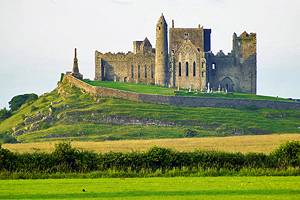
After passing Lanesborough, the Shannon river opens out into the great expanse of Lough Ree (the "Lake of Kings"). On several islands in the lough, including Inchbofin (National Monument), Inishturk and Inchmore, are remains of early monastic settlements. On Inchclearaun (also known as Quaker Island after a 19th century inhabitant) Clothra, sister of Queen Maeve, is said to have been killed by a slingstone hurled from the shores of the lough.South of Athlone and its lock the river pursues a quiet winding course through flat country until the towers of Clonmacnoise appear on the horizon. This is surely the finest way of approaching the ruins of the old monastic city (landing stage).
Shannonbridge
At Shannonbridge an old bridge of 16 arches spans the Shannon. Here can be seen remains of fortifications of the Napoleonic period.
Shannon Harbor
From Shannon Harbor boats once sailed to Dublin on the Grand Canal. The ruins of buildings dating from that period still convey some feeling of Regency elegance.
Lough Derg
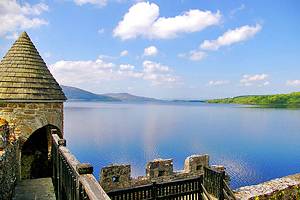
Below Shannon Harbor the river becomes wider, passing the old towns of Banagher and Portumna, and then flows into Lough Derg, the largest of the many Shannon lakes, studded with islands. The landscape now changes: the shores become more fertile, farms and villages appear more frequently and there is an air of greater prosperity. The south end of Lough Derg is surrounded by hills, and ranges of ancient red sandstone mountains mark out the horizon on both sides.The town of Killaloe is noted not only for its remains of the past but also for its large marina and its water skiing facilities.
Ardnacrusha
For visitors who have hired a boat the trip down the Shannon ends at Killaloe. Boat owners can go farther, though sailing lower down the Shannon is considered difficult and hazardous. For the next 18mi/29km the river, which, hitherto has been fairly sluggish, falls rapidly.At Ardnacrusha (Hill of the Cross) there is a huge hydroelectric power station built in 1925-29, with a dam at Parteen, a head race 8.5mi/14km long bringing the water to the power station, four turbines and two locks. This first and largest of Ireland's power station produces some 350,000,000kwh of electricity annually. It is an impressive experience to visit the power station; the approach by road from Limerick or Killaloe is along the north bank of the Shannon. In the huge locks boats are raised and lowered more than 100ft/30m. There is also a fish-lift in which fish - mainly salmon - are raised in three hours to the upper canal (the headrace). Below Ardnacrusha the waters streaming out of the turbines are led into the river at a point where it is already tidal.