Northwest Highlands, Scotland Attractions

The term Northwest Highlands usually refers to the northern third of Scotland that is separated from the rest of the country by the "Great Glen" or "Glen More". This fault line has been exploited by man to create the Caledonian Canal which extends from the west coast to the east, from Loch Linnhe to the Moray Firth and which serves as the boundary between the Northwest Highlands and the Grampian Mountains.

Royal Dornach Golf Course

The celebrated Royal Dornach is one of a number of challenging golf courses in the Highland region.

North West Highland Mountains

Experienced mountaineers and hill walkers will appreciate the wild beauty of the majestic mountain landscapes - the choice ranges from coastal footpaths and woodland walks to much more demanding climbing expeditions.

Kincraig - Alvie Stables

The Alvie Stables are located in the environs of Kincraig.

Northwest Highland Fishing

For many experienced fly fishermen, the Highlands is synonymous with salmon and brown trout.

Northwest Highland - Water activities

The sheltered harbors, inland lakes, estuaries and inlets of the North West Highlands offer amateur sailors plenty to explore. Yachts and motorboats are available for hire and there are a number of sailing schools for beginners. Other opportunities for watersport enthusiasts include skiing, windsurfing and canoeing. Sunken wrecks and a fascinating underwater world attract divers, while bathers are guaranteed crystal clear water.

Mallaig, Scotland

The A830 heads west out of Fort William towards Mallaig (42mi/67.2km) following a winding scenic route. Mallaig is a terminal for ferries to Skye, Rhum and Eigg.

Glenfinnan Monument

The Glenfinnan Monument at the north end of Loch Shiel (20mi/32km) was erected in 1815 to commemorate Bonnie Prince Charlie's proclamation of August 1745. It was here that he met the clan chiefs and they agreed to back his struggle against English domination.
The Visitor Centre has displays and commentary in four languages on the prince's campaign.

Loch Nan Uamh Cairn

A memorial stone by Loch Nan Uamh recalls the flight of the "Young Pretender" after the debacle at Culloden and his month-long trek through the Highlands. He boarded a French ship nearby and escaped from his English pursuers.

Road to the Isles (A87)

The scenic Road to the Isles runs past the Five Sister of Kintail. Some of the highlights in the surrounding area include the Eilean Donan Castle and the hike to the Falls of Glomach.

Loch Carron - Strome Castle

The road continues beyond Kyle of Lochalsh to Loch Carron, which is noted for its attractive lakeside scenery, and Castle Strome which was destroyed in 1602. For many years it belonged to the powerful Mackenzie barons of Kintail. The coat-of arms bears a stag's antlers (caberfeidh), symbolically the payment rendered in return for the granting of royal estates.

Applecross

A trip off the beaten track will reap a worthwhile reward. At Kishorn branch off the A896 to the west. Climb a steep mountain road with several hairpin bends over the Bealch nam Bo pass, beyond which the road suddenly drops from 2,000ft/600m down to a level plain and the fine, sandy beach of Applecross.

Torridon - Mountain Terrain

After Loch Carron, the A896 continues north to Loch Shieldaig, an inlet surrounded by fine woodland, and then on to the mountain region of Torridon dominated by the towering "Munros" (over 3,000ft/1,000m). The red sandstone (over 750 million years old) of Liathach (3,456ft/1,055m) and Beinn Alligin (2,232ft/679m) on the north bank of Upper Loch Torridon are much admired by geologists.

Visitor Centre

The National Trust for Scotland is responsible for the upkeep of this wild terrain and at the junction of the A896 and Diabaig Road it runs a visitor center which goes into considerable detail about the region's fauna and flora.

Auchnashellach Forest Walk

Walkers ought not to miss the remarkable Auchnashellach Forest Walk along Loch Clair and Loch Coulin southward to Auchnashellach railroad station.

Shieldaig Island

Shieldaig Island is a 32ac island off Shieldag. It is almost entirely covered in Scots pine, which once covered much of the Scottish Highlands.

Torridon Deer Museum

Located in the mountainous region of Torridon Mains you will find a Deer Park and Deer Museum.

Beinn Eighe Nature Reserve

Park rangers lead guided tours into the Beinn Eighe Nature Reserve near Kinlochewe. Opened in 1951, it was Britain's first nature reserve and in 1976 it was upgraded to a UNESCO biosphere reservation. Scotch pines and birch woods dominate the landscape on the lower slopes, but at higher altitudes alpine flora such as alpine azaleas can be found. Wildlife includes red deer, pine martens, wild cats, snow hares, red foxes and golden eagles.

Loch Maree

Loch Maree Nature Reserve lies along the south bank of Loch Maree, a deep Pleistocene valley with water low in nutrients but nevertheless a habitat favored by otters and black-throated divers. Access to the nature reserve is through a birch wood about 1mi/3km west of Kinlochewe. The nature trail through breathtaking mountain scenery stays below the tree line. The more demanding mountain trail, a 4mi/6.5km circular tour, begins at the parking lot. It rises to just under 1,800ft/550m and offers an unforgettable view over Loch Maree.

Victoria Falls

The waterfall near Shatterdale - accessible via a signposted footpath - was named after Queen Victoria who visited Loch Maree in 1877.

Gairloch, Scotland

The attractive village of Gairloch (pop. 1,100) is a scenic stop on the tourist route northwards. It lies in a sheltered, sandy bay and boasts a nine-hole golf course.
The road to Ullapool runs alongside sandy beaches, majestic mountain ranges and fjord-like inlets. Campers find it hard to resist some of the secluded bays.

Heritage Museum

The Heritage Museum details the cultural and economic development of the western Highlands from the Stone Age to the present day. A reconstructed crofter's house and models of fishing boats are among the exhibits.

Wester Ross - Inverewe Garden

Thanks to the extremely mild climate a lush, subtropical garden overlooks a sheltered bay by Loch Ewe near Poolewe (5mi/8km north of Gairloch). Rhododendrons, azaleas and magnolias, eucalyptus from New Zealand, Japanese ferns, Himalayan lilies, South American water lilies, giant forget-me-nots from the South Pacific, rock gardens, ponds, Scotch pines and rare varieties of palms are just some of the unusual plants and features to be admired in the delightful Inverewe Gardens. Osgood Mackenzie was only 20 years old when in 1862 he proved that plants from distant lands could survive on the poor Torridon sandstone and acid peaty soil, if it is enriched by loam from the coast and the wet peat is drained.

Braemore, Scotland

The scenic A832 winds round Gruinard Bay and then follows the south bank of Loch Broom to Braemore (38mi/60.8km). A suspension bridge over the Corrieshalloch Gorge offers the best view of the spectacular Measach waterfalls as they cascade over 150ft/46m into the valley.

Aberdeenshire - Mar Lodge Estate

Mar Lodge Estae is part of the Cairngorms, an internationally recognised nature conservation landscape in the British Isles. This estate contains: four of the five highest mountains in the UK; the upper watershed of the River Dee, and remnant Caledonian pine forest.

Corrieshalloch Gorge

Corrieshalloch Gorge in Braemore is one of Britain's finest examples of a box canyon. The canyon is 200 feet deep and the rive plunges 150 feet over the falls of Measach. Further downstream there is a suspension bridge, then further still there is a viewing platform pointing up, toward the falls.

Ullapool, Scotland

The A835 links Braemore with one of the Northwest Highland's most popular resorts. The fishing village of Ullapool (pop. 1,100) was founded in 1788 by the British Fisheries Association. Its pretty whitewashed houses in the village nestle on the north bank of Loch Broom. The art world is familiar with this remote spot thanks to some evocative watercolors by the Austrian-born Expressionist painter Oskar Kokoschka (1886-1980) who visited the area on more than one occasion during the 1940s.
Car ferries leave Ullapool for Stornaway.

Loch Broom Museum

Loch Broom Museum's collection of old photographs, paintings and traditional furniture tells the story of Wester Ross.

Dundonnell House

Numerous enclosures and box-edged paths make this household an interesting site.

Summer Isles

The Summer Isles lie to the northwest of Ullapool, just off the mainland. The largest island is called Tanara Mhor and like some of the smaller islands it can be visited by boat from Ullapool.

Inverpolly Nature Reserve

The remote 41sq.mi/109sq.km Inverpolly Nature Reserve which lies about 20mi/32km north of Ullapool was opened during the 1960s. It is characterized by open moorland, birch woods and lonely lochs.
The Knockan Cliff Visitor Centre with nature and geological trails is situated nearby.

Inverkirkaig Mountain Route

Evidence of glacial activity during the Ice Age are the rounded peaks and deep valleys. Instead of taking the direct route along the A835 to Ledmore, a more adventurous alternative winds its way below the constantly changing mountain backdrop and alongside the coast to Inverkirkaig where the Kirkaig waterfalls (2mi/3.2km south of Lochinver) cascade into the valley. To the west of the A835, Ben More Coigach (2,438ft/744m) and Cul Beag or Stac Polly (2,009ft/613m) are the first peaks to come into view followed by Cul More (2,787ft/850m) and Suilven (2,399ft/732m), an impressive "sugarloaf" mountain. All the mountains in this range are popular with mountaineers.

Knockan Cliff

Knockan Cliff is of interest to geologists because the sequence of rock strata has become reversed by tectonic movement and the older moine schist lies above the younger Torridon sandstone. A nature trail (about 1mi/2km from the parking lot) explains about the "moine thrust", a 125mi/200km fault line between the Isle of Skye and Loch Eriboll.

Loch Assynt

Almost 22mi/35.2km north of Ullapool the A835 crosses the unforgettable picture-book landscape to the north of Loch Assynt. Well-known among the angling fraternity for its salmon and trout, the loch is ringed by a majestic mountain panorama.

Ardvreck Castle

At the eastern end of Loch Assynt stand the ruins of Ardvreck Castle which was built ca. 1590 for the MacLeods. The Seaforth MacKenzies took over the estate in 1691 but were obliged to sell it to the Earl of Sutherland in 1757 to meet their tax debts.

Inchnadamph Nature Reserve

Geologists are fascinated by the rock formations visible at the Inchnadamph Nature Reserve. The route along the north bank of Loch Assynt ranks very highly on the list of Scotland's finest panoramic routes.

Lochinver, Scotland

No fewer than 280 lochs surround the rural community of Lochinver (pop. 700) and although some of them do not even have a name, they do provide a wealth of opportunities for anglers. Lochinver was an important port for the herring industry during the 17th and 18th centuries but now the catch is primarily white fish and crustaceans. Locally-produced ceramics are available from the Highland Stoneware Pottery.

Eas a Chual Aluinn Falls

It is possible to take a boat trip from Kylesku, northeast of Loch Assynt, along Loch a'Chairn Bhain to see the seal colony. The Eas a Chual Aluinn Falls are Britain's highest waterfalls (658ft/200m) and are visible on the return journey.

Handa Island

The bird reserve on Handa Island is run by the Scottish Wildlife Trust and lies almost 3mi/4.8km northwest of the crofting community of Scourie. As one of the biggest seabird colonies in northern Europe, it gives bird watchers a rare opportunity to see puffins, guillemots, razorbills, great skuas, fulmars, shags and kittiwakes at close quarters. Seals often bask on the rocks in the sun.

Kinlochbervie, Scotland

The tiny settlement of Kinlochbervie is an important port for whitefish. Catches are auctioned every day in the new fish market (1988).

Sandwood Bay

To the north of Blairmore a 5mi/8km long footpath leads to Sandwood Bay. It is not only one of the remotest but also one of the most beautiful beaches in Scotland. The spirit of a bearded sailor from a ship wrecked off the coast is said to haunt the beach and mermaids are also supposed to sit on the shore.

Loch Eriboll

The north coast road, in many places just single-track, passes through delightful scenery as it winds its way to Thurso. Loch Eriboll, a salmon farming center, is a good place for a break. A walk to Whiten Head offers further splendid views.

Sutherland Clearances

On a lonely hill by Ben a'Bhragaidh northwest of Golspie stands a huge statue of the first Duke of Sutherland. The statue was erected in 1833 initially to acknowledge his contribution to the kelp industry, fisheries, house and road building, but it quickly came to symbolize one of the bitterest episodes in Scottish history: the Highland Clearances.
The origins of these traumatic events can be traced back to the defeat of the Scottish clans. With the exception of Caithness, the traditional structure of Highland society rested for centuries on a system of almost 180 clans that lived independently of each other, cultivated the valleys to fulfillll their own requirements and bred "Black Cattle". The land belonged to the clans, which were represented by a clan chief, and every individual had rights and duties arising from his or her membership of the clan. After the convincing defeat at Culloden in 1746, the clan system was banned and the clansmen's property became the property of the English administrators who showed little concern for the welfare of the crofters whose livelihood depended on that land.
After 1780 the estates were returned to clan chiefs who vowed allegiance to the crown. These landowners were known as "lairds" and were able to grant feudal rights to the small-scale farmers.
Spurred on by the success of the southern Scottish estates where the "laird" system was well tried and also the burgeoning demands of the expanding English textile industry, these new Highland landlords saw opportunities for profitable exploitation of the vast expanses of land. Large-scale sheep farming was seen as an escape from low yields, poverty and famine that accompanied traditional, labor-intensive cultivation of the land. The numerous sheep breeders of the Lowlands were offering to pay three times as much to graze their Cheviot and Linton flocks but this meant that a large proportion of the farmers would have to be resettled in the coastal regions. The forced eviction of two thirds of the farming families, the "Highland Clearances" as they became known, started at the beginning of the 18th century and continued until the 1870s. After a vain attempt by the crofters to stop the advance of sheep farming at Easter Ross in 1792, there was little organized resistance to the power of the lairds. The result was the almost entire removal of settlements from the Highland region and overcrowding in the coastal regions.
Fishing and collecting seaweed as a fertilizer was an inadequate second source of income for the crofters who were given only small plots of land, so many of them, faced with little chance of a decent livelihood at home, were forced to emigrate south to the industrial regions of Scotland and England or else to go abroad. After the famines of 1836 and 1846 and incentives offered by overseas governments, the Highlands, before 1745 home to three fifths of the total Scottish population, were by 1870 almost deserted. One Canadian province, Nova Scotia, owes its existence to the disastrous Highland Clearances.
The county of Sutherland earned notoriety from the Highland Clearances as some 15,000 Highlanders were forced to leave their native soil. Those who did not leave voluntarily faced the bailiff and anyone who stood up to him had to endure brutal violence. Homes were razed to the ground, families torn asunder and agitators were rounded up and sent to penal colonies in Australia. The initiator of the Sutherland Clearances was George Granville, at the time one of Europe's wealthiest businessmen. This Englishman, the Marquess of Stafford, had married the daughter of the Earl of Sutherland in 1785. When Queen Victoria visited the seat of the Sutherlands in 1832, she is said to have been aware that the simplicity of her own home, Balmoral Castle, contrasted with the splendor of Dunrobin Castle, which is even today one of Scotland's largest ancestral homes. Immediately after his wedding, the 27-year-old marquis set about resettling his crofters near the coast and handing over the agricultural land to sheep farmers from the Lowlands. He built new homes, schools, roads and even a railroad line as part of the "land reform" and in 1833 was rewarded with a dukedom. Twenty years later, however, Karl Marx wrote in the New York Herald Tribune that he had committed an act of brutal despotism on a par with that of Genghis Khan.
Memories of the Clearances run deep in the psyche of the unfortunate victims and an objective assessment of the policy is impossible. Scottish emigrants in all parts of the former British empire, some four or five generations on, are said to be able to put a name to the soldier - almost certainly a Highlander - who ejected their ancestors from their homes. Further information on the background to the mass evictions is available in the Timespan Heritage Centre (1987) in Helmsdale and the Strathnaver Museum where finds from the abandoned village of Rosail (7mi/11.2km to the south) are also exhibited. A painting by the contemporary artist Thomas Faed (1826-1900) entitled "The Last of the Clan" (1865) shows the misery and desperation of the victims. It is now on display in the municipal art gallery in Glasgow.

Bharraich Castle

Bharraich Castle near Tongue was once the seat of the MacKays. It is thought that the fortress dates from Viking times.

Bettyhill, Scotland

Like many other coastal settlements in Sutherland, Bettyhill owes its existence to the Highland Clearances.

Strathnaver Museum

Strathnaver Museum in the old village church in Bettyhill describes the devastating consequences of the land clearances. Also on display is a traditional Highland cottage, which gives some insight into the everyday life of the crofters before they were evicted, and clan memorabilia belonging to the MacKay family.

Torrisdale Bay

The nature reserve at Torrisdale Bay near Bettyhill is noted for its boreal vegetation.

Dounreay, Scotland

The fast breeder reactor at Dounreay was in operation from 1959 to 1977. An exhibition explains how the nuclear reactor generated electricity.

Crosskirk - St Mary's Chapel

The remains of St Mary's Chapel are situated near Crosskirk, about 6mi/9.6km outside Thurso. The holy site dates from the 12th century.

Thurso, Scotland

Thurso (pop. 8,000; "Thors-a" = "by the river") has the northernmost railroad station on the mainland. The medieval St Peter's Church (12/13th century) is the oldest building in the small town. It is thought that the foundation stone was laid by Bishop Gilbert of Moravia.

Heritage Museum

The Heritage Museum documents the traditions and customs of the local people. It also displays a collection of minerals belonging to Robert Dick (1811-1866), a well-known geologist, and a reconstruction of a typical Caithness cottage.

Reay Golf Club

Golf enthusiasts will appreciate the 18-hole Reay Golf Club.

Scrabster

Car ferries to Stromness leave from the fishing port of Scrabster just to the west of Thurso.

Loch Shin

Situated in central Sutherland, Loch Shin (15mi/24km long and 2mi/3.2km wide) is a popular watersports and fishing center and also a source of hydroelectric power.

Lairg

Lairg (pop. 1,000) at the south end of Loch Shin is the venue for the largest lamb market in the country.

Shin Falls

From mid-July until the end of summer it is possible to watch salmon jumping at the Shin Falls.

Altnaharra, Scotland

Loch Naver and the tiny village of Altnaharra (pop. 60) north of Loch Shin nestle in the center of a splendid mountain region.

Rosail Clearance Village

A short distance south of Altnaharra of Syre lies the abandoned Rosail Clearance Village which bears witness to the dramatic changes wrought by the Highland Clearances.

Flow Country

The wild peat moor to the northeast of Altnaharra is impressive for its size alone. The "flows" are sometimes 16ft/5m wide and flanked by small lakes are a favorite breeding ground for curlews, black and red-throated divers, golden plovers and greenshanks.
For birdwatchers the only time to visit is in spring and summer.

Strathpeffer, Scotland

As illustrated by an exhibition in the old well house, the elegant spa town of Strathpeffer with its smart villas, delightful gardens and 18-hole golf courses (4mi/6.4km to the west) was one of Scotland's most fashionable resorts in Victorian times. In the village square it is still possible to sample the mineral-rich water and the woods around the village are ideal for relaxing walks. Craftsmen and women from around the region display their skills and products in the restored railroad station. As well as craft shops, the old station contains the delightful Highland Museum of Childhood, which is open from April to October and is well worth a visit.

Pavilion

The Strathpeffer Spa Pavilion has been restored and is now a venue for the Arts as well as for functions, weddings, conferences and other events. The original lantern on the Pavilion roof was a feature that was removed in the early 1900's. A replica of the original lantern was put in place to provide light in the main hall.
The Pavilion's main hall is one of the largest performing arts spaces in the Highlands with a modular stage and flexible seating.

Alness, Scotland

The A9 passes through Alness, the home of Cnoc Fyrish and at its summit is Fyrish Monument. This was the brainchild of Sir Hector Munro of Novar who had it built in 1792 to provide work for unemployed workers.

Invergordon, Scotland

The A9 follows the north bank of the Cromarty to Invergordon (pop. 4,200). Its harbor was once an important military base but is now dominated by the oil industry. The town is one of the main repair and maintenance centers for the British sector of the oil drilling industry. In 1749, scarcely 10 years after the last Jacobite uprising, Sir John Gordon devised a scheme to convert the town into a holiday resort with bathing machines and pleasure boats but the project was only partially completed.

Fearn Abbey

As the "Brahan Seer" a famous 17th century Highland prophet predicted, the roof of the medieval Fearn Abbey (9mi/14.4km north of Invergordon) collapsed during a service in 1742 and 42 people were buried beneath the rubble. The north and south chapels of the restored Premonstratensian abbey remain roofless.

Tain, Scotland

Locally-quarried red and yellow sandstone gives the houses in Tain (pop. 4,100) an attractive appearance. This small royal market town by the Dornoch Firth has several sights of interest including the town hall in Scottish baronial style.

St Duthus Chapel & Collegiate Church

Collegiate Church of St Duthus (14th century). The ruined St Duthus Chapel (1246), a popular place of pilgrimage during the Middle Ages, is situated in the cemetery of Tain by the seashore.

Ardjachie Point Tunnel

Beyond Tain, a tunnel near Ardjachie Point passes under the Dornoch Firth to the southern tip of Sutherland.

Dornoch, Scotland

The coastal town of Dornoch (pop. 1,100) is noted for its cathedral. Little remains of the old castle - once an episcopal palace - apart from the tower which has since been incorporated into a hotel.
Today Dornoch is best known for its 18-hole golf course and its long sandy beach.

Cathedral

Dornoch's cathedral was established in 1224 by Gilbert of Moravia. Fine arcades, original stonemasonry (13th century) in the chancel and a splendid west window are among the cathedral's most interesting features.

Whitch's Stone

The Whitch's Stone serves as a reminder of a cruel chapter in Scottish history. Janet Horne, a woman thought to be a witch, was burnt to death at the stone. She was the last of more than 4,500 women who, following the Reformation, were accused of involvement in witchcraft, tortured and then executed.

Skibo Castle

Skibo Castle (5mi/8km to the west of Dornoch on the A949) was built in 1898 for the philanthropist and steel magnate Andrew Carnegie. He frequently visited Scotland and wanted to spend his twilight years in the country of his birth. This handsome little castle is now used as an exclusive private club.

Golspie, Scotland

The main road north runs from Dornpoch alongside the coast to Golspie (pop. 1,300; 10mi/16km to the north). It is the administrative center for Sutherland and can boast a long sandy beach, a go-kart track and an 18-hole golf course overlooking the sea.

Dunrobin Castle

The magnificent Dunrobin Castle dates back to 1275. Exuding fairy-tale charm, the Castle is often likened in style to the popular French Loire Valley Chateaux.

Great Glen Way Walking Trail

The trail is being considered by Scottish Natural Heritage as an official long distance route. The 71-mile / 114 kilometer route goes from Fort William on the west coast to Inverness on the east, following a canal towpath, forest tracks and minor roads. The trails can be used for both cycling and hiking.

Brora, Scotland

Brora (pop. 1,100; 6mi/9.6km to the north of Durobin Castle) lies at the mouth of the Brora, a river much acclaimed by anglers for its salmon. Other attractions include an 18-hole golf course and a long sandy beach. The village is home to Hunters Woolen Mill which produces fine tweeds.

Helmsdale, Scotland

The tiny port of Helmsdale (pop. 900; 11mi/17.6km) owes its origins in the 19th century to the herring industry.

Timespan Heritage Centre

The award-winning "Timespan" center in Dunrobin Street uses an audio-visual presentation and life-sized models to explain the history of the Highlands from the Picts and Vikings, to the dramatic Highland Clearances and the arrival of the oil rigs in the North Sea.

Strath of Kildonan

A short detour inland up the Strath of Kildonan is worthwhile. In 1869 gold prospectors moved into the region after particles of the precious metal were found in the river bed. It is still possible to find the occasional gold speck.

Dunbeath, Scotland

The fishing village of Dunbeath (pop. 490; 10mi/16km to the north of Berriedale) was the birthplace of the writer Neil M. Gunn.

Heritage Centre

The Heritage Centre here is devoted to the cultural history of Caithness.

Lhaidhay Croft Museum

In the Lhaidhay Croft Museum life in a traditional Caithness longhouse is recreated.

Clan Gunn Heritage Centre

The former parish church in Latheron documents the family history of the Gunns.

Northwest Highland Prehistoric Standing Stones

The road between Latheron and Wick (17mi/27km) passes several prehistoric standing stones such as the oval-shaped Hill o'Many Stones by the A9 near Mid Clyth and the Cairn of Get near Ulbster.

Grey Cairns of Camster

The two well-preserved burial chambers known as the Gray Cairns of Camster (6mi/9.6km north of Lybster) date from the fourth millennium B.C.

Wick, Scotland

The lively town of Wick (pop. 8,000) whose name is derived from the Nordic word "vik" meaning "bay" earns its living from fishing and the oil industry.

Caithness Glass (closed)

The Caithness glass factory by Harrow Hill is worth a visit as its handmade glass products combine traditional manual skills and innovative design.
ATTRACTION IS CLOSED.

Heritage Centre

Wick's Heritage Centre is situated in Bank Row and its displays focus on the tough life endured by the herring fishermen.

Old Wick Castle

The striking ruins of Old Wick Castle perch on coastal rocks to the south of the town.

Girnigoe Sinclair Castle

Brig o'Tram rock arch near Wick is an interesting sight, while at the commanding viewpoint of Noss Head to the north of Wick the remains of Girnigoe Sinclair Castle are visible.
This location is the site of a pilgrimage of those who believe that Henry Sinclair, Earl of Orkney, discovered the new world before Columbus' famous journey.

Berriedale, Scotland

The A9 winds its way through magnificent mountain scenery and deep gorges. Berriedale (10mi/16km), where Langwell Water and Berriedale River flow into the sea, is the site of an abandoned castle, while Morven (2,313ft/705m) and the lower peaks of the Scaraben can be seen to the west.

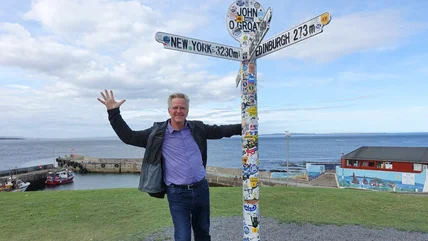
John o'Groats

John o'Groats lies at the northeastern tip of mainland Scotland. Of note in the area are Duncansby Head, and Dunnet Head, with views to the Orkney Islands.
More Scotland Resources