Le Bardo - Bardo National Museum
Four km/2.5mi west of Tunis is the suburb of Le Bardo, famed for the Bardo National Museum (Musée National du Bardo), which has the world's largest collection of Roman mosaics and ranks with the Egyptian Museum in Cairo as one of the two great museums of North Africa. (Other Tunisian museums with fine mosaics are those of Sousse, El Djem and Sfax)
Access
The museum is easily reached from the city center by public transport (bus No. 3 from the corner of Avenue Habib Bourguiba and Rue de Rome or No. 4 from Jardin Habib Thameur), by taxi or by car.
Access
The museum is easily reached from the city center by public transport (bus No. 3 from the corner of Avenue Habib Bourguiba and Rue de Rome or No. 4 from Jardin Habib Thameur), by taxi or by car.
|
Must-see attractions nearby:
|
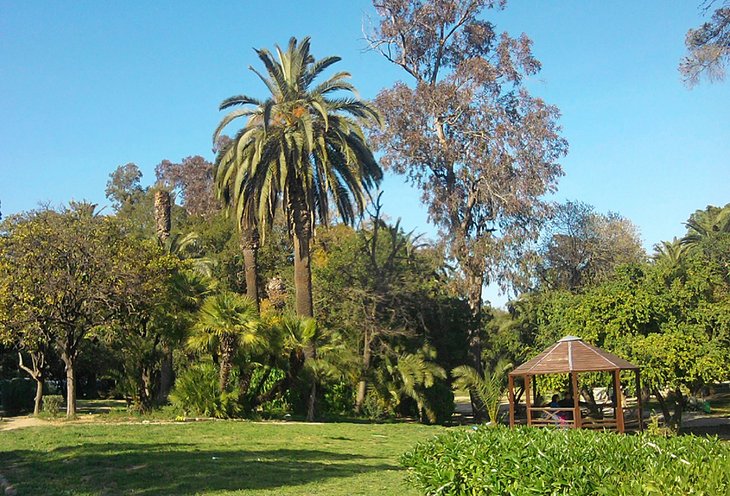
For those traveling by car the route is as follows: From Place Bab Souika, at the north end of the Medina, take Rue Bab Saadoun, which runs northwest to the roundabout at Bab Saadoun, one of the old town gates (restored), and from there follow Boulevard du 20 Mars 1956, passing the remains of a 13th century aqueduct (restored in the 17th century) which supplied Carthage with water. The Museum, set in a park, lies outside the town on the right of the road, concealed at first by the imposing 17th century palace occupied by the Tunisian National Assembly, its entrance flanked by two marble lions and guarded by men of the National Guard. Immediately beyond this is the National Museum (entrance by a gate in Rue Mongi Slim which leads to a large parking lot in front of a mosque). Much of the walled park around the museum is occupied by the army and closed to the public. Admission tickets are issued at a kiosk in front of the entrance. A special ticket must be obtained for taking photographs; the use of flash and/or a tripod is banned.
Things to See
Acholla Room
Mosaics from Acholla (present-day Ras Bou Tria, 40km/25mi north of Sfax, near Djebeniana). Dating from the second century, they are among the earliest mosaics found in Tunisia. Particularly fine is the "Triumph of Dionysus". In the center of the room is a semicircular fountain.
Althiburos Room
Room 13 takes its name from the large third century mosaic from Althiburos (Medeina, near Le Kef). This depicts over 20 different types of ancient ships sailing in a sea teeming with fish, each type being labeled with its name in Greek and Latin. Other mosaics are from Carthage, El Djem, Radès, Bizerte and Béja. This was originally the music room of the palace. It has an ornate painted ceiling in Italian style and two galleries. One of them, linked by a staircase with the harem of the palace, enabled the princesses of the Bey's family to attend concerts and other performances; the other, to the left of the entrance, was for the orchestra. From the balcony opening off this room there is a view of the 15th century mosque in front of the Museum. On the opposite side of the Great Hall is Room 14.
Bronze armor
Rooms 3 and 4
Bronze armor with a head of Minerva, originally from Campania, which was found in a cedarwood coffin at Ksour Essaf. Punic grave goods (in cases). Of particular interest are the little heads (usually bearded) in colored glass paste (fifth and fourth century B.C.) - amulets designed to ward off evil. Corinthian (seventh-sixth century B.C.), Etruscan (sixth century) and Campanian (sixth-second century B.C.). Egyptian influence can be seen in the clay masks intended either to ward off evil (grimacing heads) or to bring good fortune (smiling women).
Bulla Regia Room
Room 6
(Bulla Regia Room)
The mosaics in this room date from the heyday of Bulla Regia in the A.D. second and third centuries. Opposite the entrance hangs the famous mosaic of Perseus and Andromeda from the dining room of a Roman villa (third or fourth century). In niches along the opposite wall are statues of Apollo, Ceres and Aesculapius from the temple dedicated to this divine triad.
(Bulla Regia Room)
The mosaics in this room date from the heyday of Bulla Regia in the A.D. second and third centuries. Opposite the entrance hangs the famous mosaic of Perseus and Andromeda from the dining room of a Roman villa (third or fourth century). In niches along the opposite wall are statues of Apollo, Ceres and Aesculapius from the temple dedicated to this divine triad.
Carthage Room
Room 9 (Carthage Room)
In this colonnaded room with a ceiling decorated in Italian style, originally the Great Hall of the palace, are displayed finds from Roman Carthage. The best general view of the room is to be had from the gallery on the second floor. In the center of the room is an altar of the Gens Augusta, dating from around the beginning of the Christian era, which was found on the Byrsa Hill. It has fine relief decoration; on one side Aeneas is depicted fleeing from Troy with his father Anchises and his son Ascanius. The two large mosaics on the floor come from the country house of a wealthy family of the second century at Oudna (ancient Uthina). One of them depicts scenes of country life; the other shows King Ikarios of Attica being taught by Dionysus. The statues and fragments of statues in the room (Hercules, Hermes, Venus, etc.) came from the Odeon and Theater of Carthage (A.D. second and third centuries).
Collection
The Museum gives a comprehensive view of the prehistoric, Phoenician, Roman, Christian and Arab past of Tunisia. The collection is arranged chronologically and, within particular periods, by provenance. On the history of mosaics in particular see Art and Culture in the introduction to this guide. Continuing work on the renovation and alteration of the building, the closing of some rooms at certain times and rearrangement of exhibits - to say nothing of the labyrinthine ground-plan - make it impossible to give a detailed plan or description of the Museum. The following account seeks only, therefore, to direct attention to the main features of interest. In any event almost all the exhibits are labeled.
Dougga Room
Room 11 (Dougga Room)
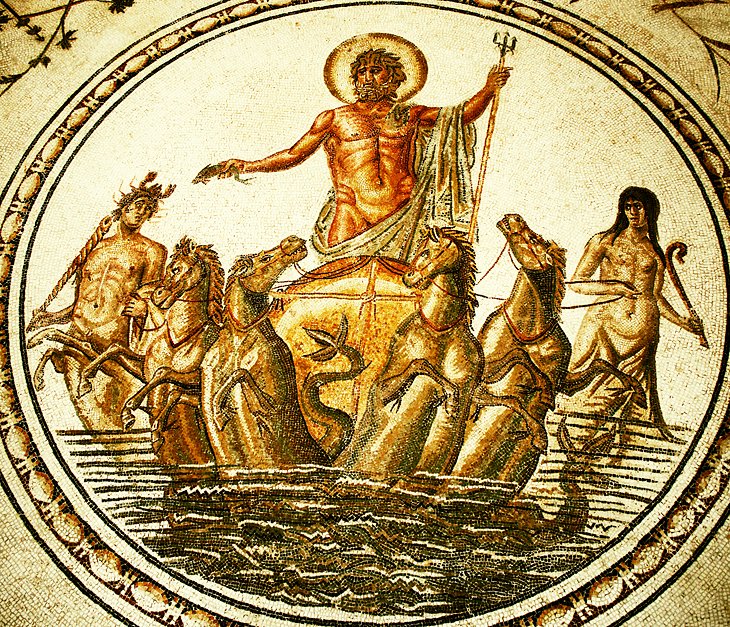
Most of the exhibits in this room come from Dougga (third and fourth century). The mosaic of the Cyclopes (Brontes, Steropes and Pyracmon) forging thunderbolts comes from the frigidarium of the baths. There is also a fine representation of the victorious Eros in the Circus. The fishing scene came from the baths in Carthage (second century). The second century mosaic of the "Triumph of Neptune" is from La Chebba, near Sfax (second century). There are also statues of Saturn, Bacchus, Aesculapius, Jupiter and Venus and fine silver and goldsmiths' work, including a silver dish inlaid with gold from Bizerte (first century). On the left of the doorway into Room 12 is part of a mosaic of Eros driving a chariot which gives the names of two horses, Amandus and Frunitus. To right and left of the doorway are plaster models of the Capitol and theater of Dougga.
Early Christian Rooms
The centerpiece of the Early Christian Rooms (Salles Paléo-Chrétiennes) is a mosaic-decorated immersion font in the shape of a Greek cross (sixth century) found in a church north of Kelibia (Cap Bon). Around it are displayed funerary mosaics from the same church, together with lamps, pottery and coins of the fourth-seventh centuries.
Room 5
Early Christian material of the fourth-seventh centuries from Carthage, Tabarka, Thuburbo Majus and Cap Bon. The mosaic grave-slabs depict the dead person, accompanied by Christian symbols (crosses, pigeons, fishes). Other mosaics depict Old Testament figures like Daniel and Jonah. They come from Early Christian and Byzantine churches and graves. In the center of the room is a cruciform marble immersion font (sixth century) from El Kantara (see Djerba). The mosaics come from Carthage, mostly from tombs. Some sarcophagi have inscriptions giving the name of the dead person.
The centerpiece of the Early Christian Rooms (Salles Paléo-Chrétiennes) is a mosaic-decorated immersion font in the shape of a Greek cross (sixth century) found in a church north of Kelibia (Cap Bon). Around it are displayed funerary mosaics from the same church, together with lamps, pottery and coins of the fourth-seventh centuries.
Room 5
Early Christian material of the fourth-seventh centuries from Carthage, Tabarka, Thuburbo Majus and Cap Bon. The mosaic grave-slabs depict the dead person, accompanied by Christian symbols (crosses, pigeons, fishes). Other mosaics depict Old Testament figures like Daniel and Jonah. They come from Early Christian and Byzantine churches and graves. In the center of the room is a cruciform marble immersion font (sixth century) from El Kantara (see Djerba). The mosaics come from Carthage, mostly from tombs. Some sarcophagi have inscriptions giving the name of the dead person.
El Djem Room
Room 12 (El Djem Room)
This room is mainly devoted to material from El Djem (ancient Thysdrus). The mosaics mostly date from the third century. Note particularly the "Triumph of Bacchus", a hunting scene depicted in three registers and a mosaic of the nine Muses.
First Floor
From Room 5 a staircase (with Early Christian mosaics from Tabarka on the walls) leads to the upper floor.
Room 16
Punic jewelry and ornaments (finely restored) of the seventh-third centuries B.C. Some of the items came from overseas.
Room 16
Punic jewelry and ornaments (finely restored) of the seventh-third centuries B.C. Some of the items came from overseas.
First Floor
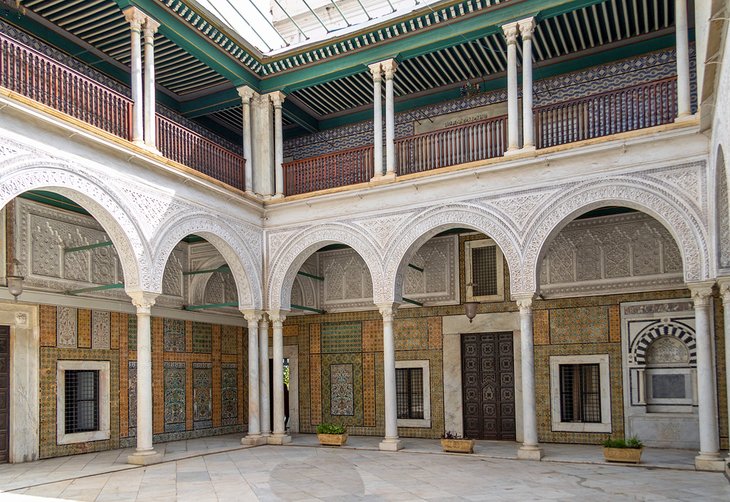
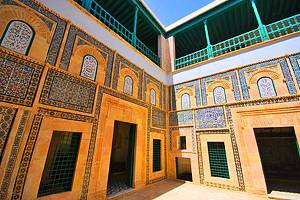
A pretty little inner courtyard gives access to other rooms. In a recess at the entrance are two thrones presented to the Bey by Napoleon III. In a series of small rooms opening off the courtyard are 16th and 17th century prints with views of the town and a variety of other prints; a reception room furnished in traditional style (late 19th century); a collection of Jewish cult objects; and a small kitchen in which the Bey's morning coffee was made, with domestic equipment, including copper plates and jugs. In other rooms are finely carved chests, traditional musical instruments with mother-of-pearl intarsia decoration, a collection of richly decorated weapons, beautiful jewelry and garments in traditional style.
Fresco Room
Rooms 34 and 35
In spite of its name the Fresco Room mainly displays mosaics, including scenes in the circus (Dougga) and hunting scenes (El Djem), as well as remains of frescoes from Gightis.
Ground Floor
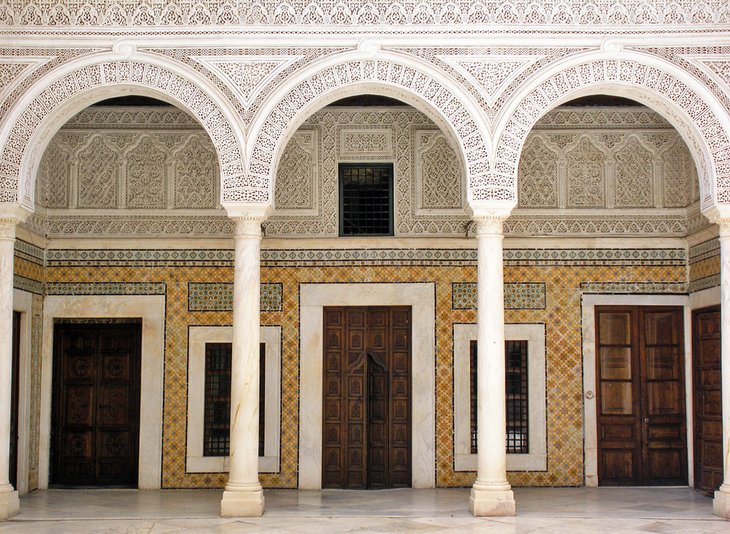
The Museum of Islamic Art, which is entered from Corridor D in the main Bardo National Museum, is housed in the Hussein Palace (1824-35), which is linked with the main building. In a room in the former harem, paved with beautiful glazed tiles, are a model of the Ribat of Sousse and a collection of rare ancient fabrics, some of them imported from Egypt. The early Islamic gravestones have inscriptions in both Kufic and cursive script. One room is devoted to Islamic Tunisia of the early medieval period, with examples - all exactly dated - of pottery, jewelry, coins of various ruling dynasties and beautifully illuminated pages from the Koran and Koran bindings. Also of interest is a small astrolabe of the 13th or 14th century.
Ground floor
Room 1
Entrance; information; sale of guides and casts of statues and masks. Plaster model of Roman Gightis.
Corridor A
Finds from a tophet at Sousse (third-second century B.C.). Two of the stelae show scenes of sacrifice.
Corridor C
On the walls are terracotta panels from Christian basilicas with relief decoration, mostly of Old Testament scenes.
Room 7
This room originally contained material from the Punic necropolis at Thinissut (near Bir Bou Rekba, Cap Bon), now in the museum of Nabeul. The busts of Roman emperors now displayed here (including Hadrian, Caracalla, Lucius Verus, Marcus Aurelius, Vespasian, Gordian I, Trajan and Augustus) are from various Tunisian sites (first-third century).
Corridor E
Tablets with inscriptions and votive stelae.
Entrance; information; sale of guides and casts of statues and masks. Plaster model of Roman Gightis.
Corridor A
Finds from a tophet at Sousse (third-second century B.C.). Two of the stelae show scenes of sacrifice.
Corridor C
On the walls are terracotta panels from Christian basilicas with relief decoration, mostly of Old Testament scenes.
Room 7
This room originally contained material from the Punic necropolis at Thinissut (near Bir Bou Rekba, Cap Bon), now in the museum of Nabeul. The busts of Roman emperors now displayed here (including Hadrian, Caracalla, Lucius Verus, Marcus Aurelius, Vespasian, Gordian I, Trajan and Augustus) are from various Tunisian sites (first-third century).
Corridor E
Tablets with inscriptions and votive stelae.
History
The site, lying in fertile country immediately outside the gates of the capital, was occupied in the 13th century by a Hafsid palace. The origin of the name Bardo is disputed. Some hold that it is derived from the Spanish "Prado", others that it comes from the Moorish berd ("cold" - the suggestion being that it was not sufficiently insulated against the winter cold). The successors of the Hafsids appreciated the advantages of the situation, and each generation altered or added to the palace, creating over the centuries an extensive complex of buildings.
The National Museum itself is housed in the Little Palace, built in 1831-32, and the state apartments of the Great Palace. The mosque opposite the Museum dates from the 15th century (restored). The decision to establish a museum was taken in 1882, and six years later it was opened under the name of the Alaoui Museum (after the reigning Bey, Ali). After Tunisia became independent it was renamed the Bardo National Museum (Musée National du Bardo).
Islamic Museum
The Museum of Islamic Art at Reqqada is still in course of development. Part of the Bardo collection has been and is being transferred there, and it is not therefore possible to say precisely what is still to be seen in the Bardo. In general, however, the exhibits are labeled, with an indication of provenance and date.
Kourba
Room 29
The mosaics on the walls of the staircase are from Kourba (second century). The upper gallery of the Great Hall is lined with cases displaying small items from Roman tombs (terracotta statuettes, bronzes), vases, glass and pottery. From the gallery there is a good view of the Carthage Room below.
Mausoleum room
Room 24, the Room of the Mausoleum, contains a reconstruction of a second century mausoleum from Carthage, all four sides of which are covered with fine bas-reliefs. Also in this room are mosaics from Carthage and Thuburbo Majus, including a representation of a stag-hunt and a large semicircular still life.
Mosaics
Room 23
The Room of the Marine Mosaics, are a variety of mosaics, mainly from Carthage, Gightis, El Djem and Oudna.
Corridor F
Mosaics from Carthage, Thuburbo Majus and El Djem.
Room 25
Mosaics, including a "Venus Pudica" (Carthage, late third century), "Bacchus and Ariadne" (Thuburbo Majus, fourth century), a peacock displaying its tail (Bir Chana, third century) and "Diana the Huntress" (Oudna, second/third century).
Room 26
Floor mosaic from the baths in Thuburbo Majus (fourth century).
Room 28
Mosaics from Ellès, Carthage and El Djem depicting mythological themes, hunting scenes and scenes in the circus. Second floor (no plan)
Rooms 30-32
Rooms 30-32 contain more mosaics, including representations of Theseus killing the Minotaur (Thuburbo Majus, third/fourth century), Bacchus with a gecko on a leash, surrounded by wild animals (Room 30; El Djem, fourth century), Diana the huntress (Utica, second century) and one from Thuburbo Majus (Room 31; third/fourth century).
The Room of the Marine Mosaics, are a variety of mosaics, mainly from Carthage, Gightis, El Djem and Oudna.
Corridor F
Mosaics from Carthage, Thuburbo Majus and El Djem.
Room 25
Mosaics, including a "Venus Pudica" (Carthage, late third century), "Bacchus and Ariadne" (Thuburbo Majus, fourth century), a peacock displaying its tail (Bir Chana, third century) and "Diana the Huntress" (Oudna, second/third century).
Room 26
Floor mosaic from the baths in Thuburbo Majus (fourth century).
Room 28
Mosaics from Ellès, Carthage and El Djem depicting mythological themes, hunting scenes and scenes in the circus. Second floor (no plan)
Rooms 30-32
Rooms 30-32 contain more mosaics, including representations of Theseus killing the Minotaur (Thuburbo Majus, third/fourth century), Bacchus with a gecko on a leash, surrounded by wild animals (Room 30; El Djem, fourth century), Diana the huntress (Utica, second century) and one from Thuburbo Majus (Room 31; third/fourth century).
Neo-Punic collection
Corridor B
Neo-Punic funerary stelae and clay statuettes of divinities (first century B.C.). The stelae, in the form of obelisks, have Punic inscriptions, like Clay mask nesses of deities (Tanit or Baal-Ammon), figures of fishes and birds, crescents and fruit. They show that after the fall of Carthage in 146 B.C. Punic influence continued for a time (worship of Caelestis, identified with Tanit) but that Greco-Roman influence steadily increased (worship of Dionysus, Aphrodite, Zeus and Hermes). The material comes from Korba, Dougga, Maktar and Thuburbo Majus. Hellenistic influence can be seen to have reached the Numidians. Also of interest are the cedarwood coffins from Punic tombs of the third century B.C. at Gightis and Ksour Essaf. Just before the entrance to Corridor D is a fine Roman sarcophagus (third century) with relief figures of the nine Muses, with a later (fifth century) sarcophagus above it.
Neo-Punic sarcophagi
Corridor D
Neo-Punic funerary stelae and richly decorated sarcophagi of the second and third centuries. Note particularly a sarcophagus at the near end of the corridor with symbols representing the wisdom of the dead man (from Carthage, early fourth century). Also notable (in a niche on the left) is an over-life-size statue of an elderly man with an expressive face holding a sheaf of corn and poppies, indicating that he was a devotee of Ceres (late third century). On the floor are mosaics from Thuburbo Majus.
Odysseus Room
Room 27 is called the Odysseus Room, after a mosaic from Dougga of which four fragments have been preserved; one of them shows Odysseus tied to the mast as he listens to the Sirens (third century). A mosaic from El Djem depicts the musical contest between Apollo and the satyr Marsyas (second century), another the "Triumph of Venus" (Kasserine, third century).
Oudna Room
Room 14, the former dining room of the palace, which also has a painted ceiling in Italian style, contains mosaics of the second and third centuries from Oudna (ancient Uthina), 25km/15mi southwest of Tunis. They include representations of Venus at her toilet and Orpheus surrounded by wild beasts. One mosaic is signed with the name of the artist, Masurus.
Roman ship discovery
Rooms 17-22 display material recovered from the Roman ship which sank off the coast at Mahdia in 81 B.C. and was discovered by sponge-divers in 1906 lying at a depth of 39m/128ft. It was carrying a rich cargo from Greece, including statues, vases, bronzes and much else besides (third-second century B.C.). Also on display are fragments of the wrecked vessel, which was around 40m/130ft long by 10m/35ft wide, and items of equipment. Also in Room 19 are mosaics from Utica, El Djem and Thuburbo Majus.
Sousse Room
Room 10 (Sousse Room)
Material from Sousse (ancient Hadrumetum) is displayed in the former banqueting hall of the palace, which has a domed ceiling with delicate ornament by Tunisian craftsmen. On the floor is a large mosaic (10.25m/34ft by 13.50m/44ft) depicting the "Triumph of Neptune" (late second century). In the center is the sea god in his war chariot, surrounded by sirens, nereids, tritons and nymphs in circular and hexagonal medallions. On the walls are other mosaics giving glimpses of everyday Roman life (fourth-fifth century). Mosaics from Carthage and Tabarka depict various country houses; from Carthage and Gafsa come representations of chariot races and gladiatorial contests. On the rear wall are the head and sandal-clad feet of a statue of Jupiter, originally 7m/23ft high, from the Capitol of Thuburbo Majus (third century). In cases around the room are small finds, including pottery with relief decoration, vases, coins and oil lamps of the A.D. second-fifth centuries. The doorway to the right of the head of Jupiter leads into Room 11.
Thuburbo Majus Room
Room 8 (Thuburbo Majus Room)
The mosaics and sculpture in this room come from private houses, public buildings and a temple (later converted into a church) in Thuburbo Majus (third and fourth century). The marble statue of Hercules has an inscription indicating that it was presented to the town by the guild of cloak-manufacturers (Sagarii, from sagum, "cloak", a garment originally introduced from Gaul).
Tophet of Carthage
Room 2
Finds from the Tophet of Carthage, where children were sacrificed to Baal-Ammon. Urns, cippi and votive stelae of the sixth-second centuries B.C., showing the development of forms over the centuries. The oldest stelae have pyramidal roofs (sixth century), the later ones resemble Greek temples (third century), while in the second century they take the form of obelisks. Many stelae bear the symbol of the goddess Tanit (a triangle with a cross bar topped by a disc) or of Baal-Ammon (a solar disc) and inscriptions in Punic script. Behind protective glass is a stele with the incised figure of a priest holding a child ready for sacrifice (fourth or early third century B.C.). A votive tablet dedicated to Baal-Ammon bears the earliest known Punic inscription (sixth century B.C.).
Virgil Room
Room 15 (Virgil Room)
A short flight of steps at the lower end of the Great Hall leads into the Virgil Room. This was originally the center of the harem, the Bey's private apartments, with the various rooms opening off it. Notable features are its cruciform plan and its decoration (19th century). The central dome has rich stucco ornament, and the walls are clad with typical 19th century faience tiles. The room contains a variety of statues (Demeter and Kore/Persephone, first century) and portraits of Emperors. On the wall is a mosaic from Hadrumetum (Sousse) depicting Virgil with the Muses Clio (History) and Melpomene (Tragedy), who are inspiring him to write the "Aeneid". On the papyrus scroll in his lap can be read the words "Musa mihi causas memora, quo numine laeso, quidve ..." ("Muse, tell me the reasons for which the offended divinity. . ."; "Aeneid", Book I, lines 8 and 9). In the center of the room is a hexagonal mosaic (third century) from the Zaghouan area depicting the seven deities of the planets and the days of the week.
Hours
May 1 to October 31
| Mon | Tue | Wed | Thu | Fri | Sat | Sun | |
|---|---|---|---|---|---|---|---|
| Open | 9:00 | 9:00 | 9:00 | 9:00 | 9:00 | 9:00 | 9:00 |
| Close | 17:00 | 17:00 | 17:00 | 17:00 | 17:00 | 17:00 | 17:00 |
November 1 to April 30
| Mon | Tue | Wed | Thu | Fri | Sat | Sun | |
|---|---|---|---|---|---|---|---|
| Open | 9:30 | 9:30 | 9:30 | 9:30 | 9:30 | 9:30 | 9:30 |
| Close | 16:30 | 16:30 | 16:30 | 16:30 | 16:30 | 16:30 | 16:30 |