Tourist Attractions in Tabarka, Tunisia
While foreign tourists flock to Djerba, Hammamet, and Sousse for their sand-and-sea vacations, Tabarka is many local Tunisian's beach resort of choice.
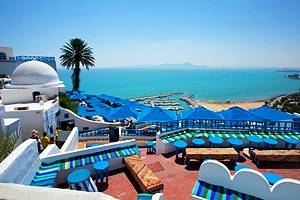
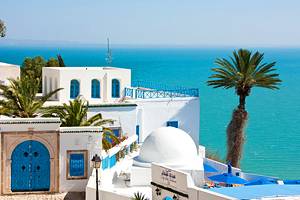
The rocky coast, with its sandy beaches and crystal-clear water (a paradise for anglers), and the densely-forested, hilly hinterland make this a popular tourist center. Visitors will also find a selection of hotels and other accommodation options.
As well as the many sandy attractions in the area, Tabarka is a well-placed base to delve into North Tunisia's many star attractions and things to do, with the Roman sites of Dougga and Bulla Regia both within easy day-trip distance if you feel the need to drag yourself off the beach for some historic sightseeing.
Learn about more places to visit with our list of the top tourist attractions in Tabarka, Tunisia.
Tabarka's Beaches
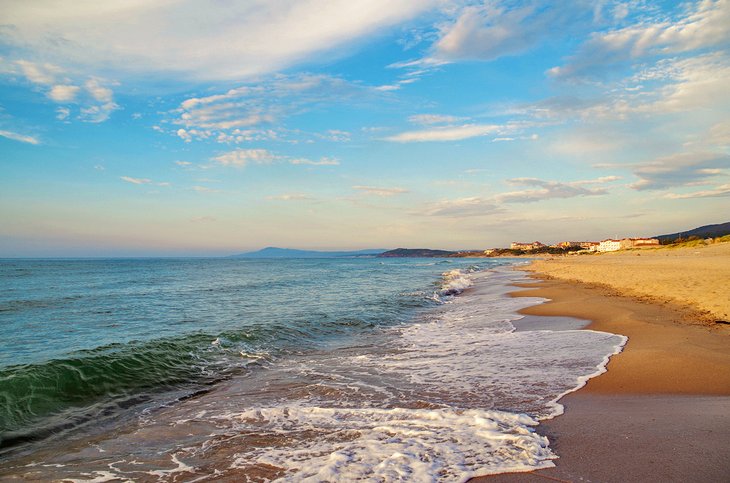
Tunisian families flock to the shores surrounding Tabarka for sun-and-sand vacations, but the beaches along this stretch of coastline remain well under the radar of most foreign visitors.
During the summer months, the sandy strip fronting Tabarka town itself fills up with locals enjoying a day at the beach.
Heading east from central Tabarka is the main resort area, where a long strip of yellow-sand beach, as good as anything other Tunisian beach towns can offer, is backed by resorts.
Farther east (12 kilometers from central Tabarka) is the wide, long yellow-sand stretch of Barkoukech Beach, which is so large, it never feels busy.
The very eastern end of this stretch of shoreline, where the Oued El Zouara (El Zouara River) empties into the sea, is called Zwaraa Beach. In summer, this is a popular spot with local campers and outdoor enthusiasts, who come here to kayak on the river, as well as to soak up the sand, sun, and sea.
In season, Zwaraa Beach has decent facilities, with sun loungers and shades for rent, as well as a restaurant and campground.
For more secluded beach days, check out the shorefront west of town – heading towards the Algerian border. Along this stretch of coast, you'll find many shingle beaches, where visitors are few even during high season weekends.
Tabarka Genoese Fort
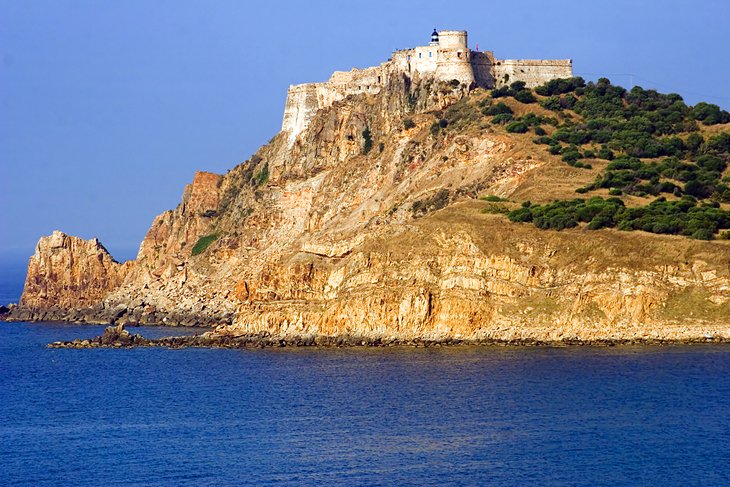
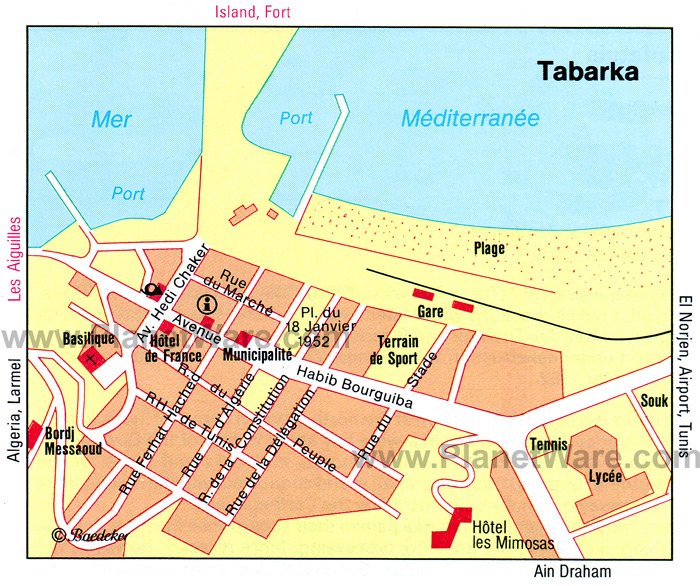
Within Tabarka town itself, there are few tourist attractions. The major landmark and point of interest is the Genoese Fort, which sits on an island just offshore from the center.
The remains of the fort are scanty, but a trip here - across the 400-meter causeway that links it to the mainland - is worthwhile for the excellent coastal views.
The fort dates back to the mid-16th century, when Tabarka came under the rule of the Genoese, but also incorporates some later fortifications built by the Ottomans.
For more things to do in town after viewing the fort, stroll into the center to see the historic Hotel de France on Avenue Habib Bourguiba, where Habib Bourguiba (the founder of modern Tunisia), Mongi Slim, and Habib Achour were interned in 1952. Mementos of these three important figures in Tunisian history are now displayed in the rooms they occupied.
Then walk another 100 meters to the basilica, which is actually the remains of a 3rd- or 4th-century Roman cistern that the Pères Blancs (White Fathers) converted into a three-aisled church.
Dougga
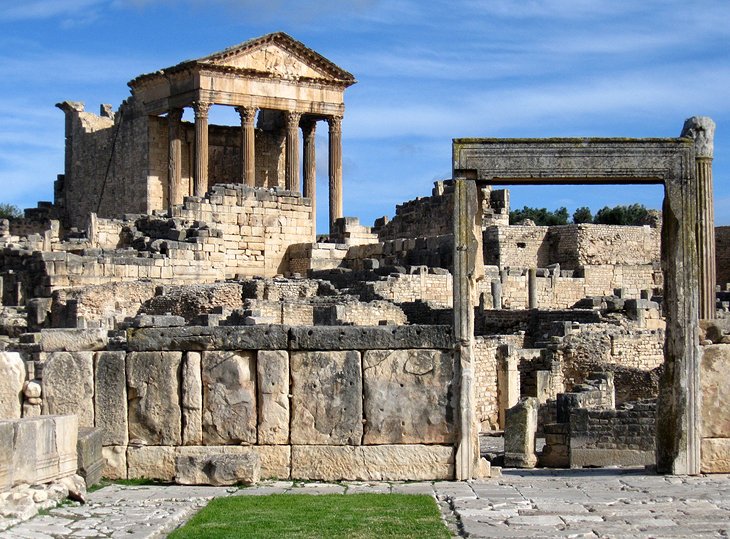
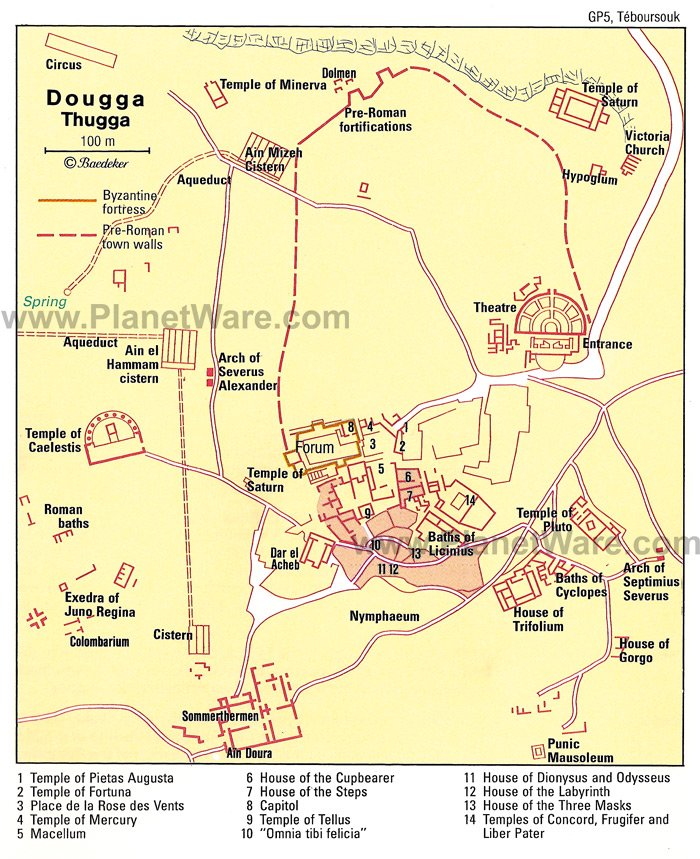
Dougga is one of Tunisia's eight UNESCO World Heritage Sites and northern Tunisia's most important Roman ruins.
It's commonly regarded as one of the best-preserved Roman cities in Africa.
Covering approximately 25 hectares, the vast site sits amid a rural landscape of olive groves and green fields that stretches out to the dusky hills beyond.
In contrast to most Roman cities, Dougga was not laid out on a regular grid pattern. Instead, the streets here formed a winding labyrinth.
The site's major highlight is the well-preserved Roman Theater, built into the hillside and dating to CE 161. Puff your way up the seating levels for views across the site and out across the surrounding countryside.
To the north of the theater, you'll find the Temple of Saturn, built during Septimius Severus' reign.
To the south, in the main area of ruins, is the impressively well-preserved Capitol Temple, dedicated to a triad of gods: Jupiter, Juno, and Minerva.
Dougga is 128 kilometers south of Tabarka and is easiest visited with either your own vehicle or by hiring a driver.
Bulla Regia
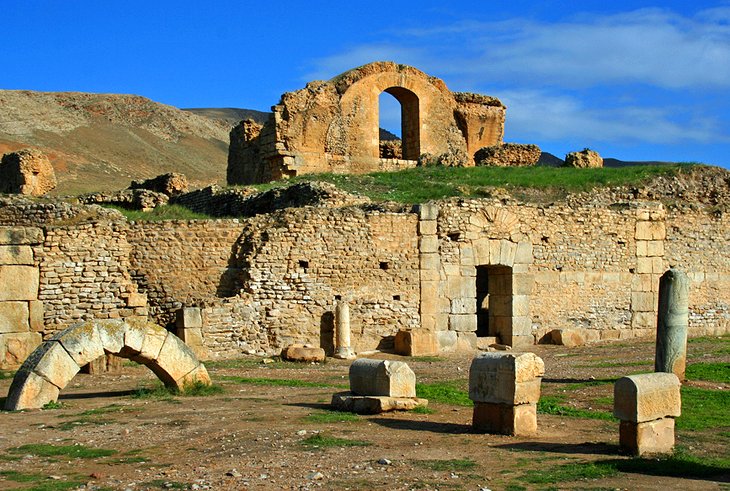
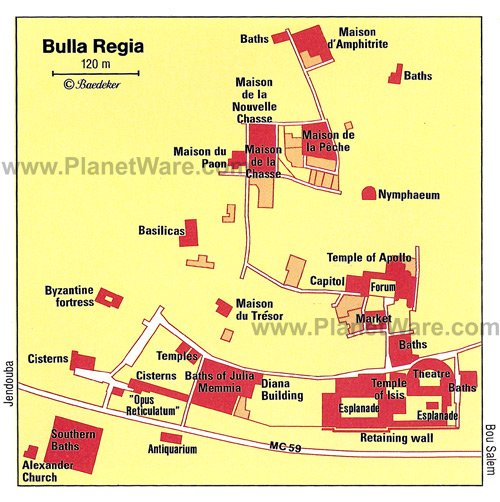
Bulla Regia is one of Tunisia's most important Roman sites and is the nearest Roman archaeological site to Tabarka, 65 kilometers south from the center.
The site contains the remains of baths, cisterns, temples, a theater, a forum, and the site's major highlight: a series of 3rd- and 4th-century handsome villas.
Most of the ancient villa rooms are buried underground, a unique method of construction that provided the inhabitants with protection from the summer heat.
Due to this underground architecture, the villa structure's have been remarkably well preserved, making Bulla Regia one of the best places to visit to imagine domestic life in the Roman era.
Within the villas, archaeologists uncovered a series of exceptional floor mosaics, which again, thanks to the underground architecture, have survived in an exceptional state of preservation.
Although many of the best mosaics were removed and are now on display at the Bardo Museum in Tunis, some are still in situ.
Bulla Regia and Dougga can be easily combined as a day trip from Tabarka if you have your own vehicle or have hired a driver for the day.
Chemtou
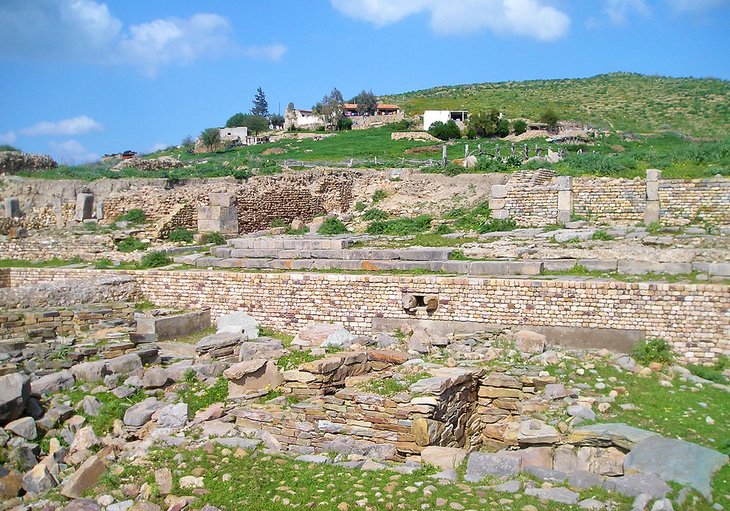
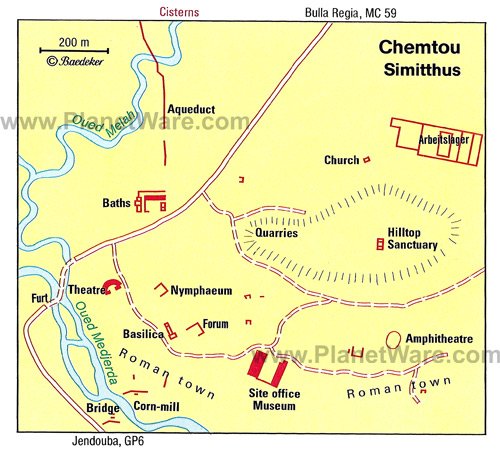
The ancient city of Simitthus (modern Chemtou) lay at the intersection of two important roads between Carthage and Hippo Regius (in Algeria) and between Sicca Veneria (Le Kef) and Thabraca (Tabarka).
The most important tourist attraction here is the hilltop Sanctuary on the summit of Djebel Chemtou, dedicated to the Punic god Baal-Ammon.
Although only remnants of the monumental marble altar remain, many richly decorated architectural elements from the Sanctuary were unearthed during excavations and can now be seen in the site museum.
The archaeology area covers the actual town site (at the base of the hill), where only partial excavations have been carried out; a work camp dating from CE 154, where large numbers of slaves and unfortunate workers were condemned to forced labor in the nearby marble quarries, and the quarries themselves.
To the south of the site are the mammoth remnants of a Roman Bridge lying along the banks of the Medjerda River. It collapsed during a flood in the 4th century.
Chemtou is 91 kilometers south of Tabarka
La Galite Islands
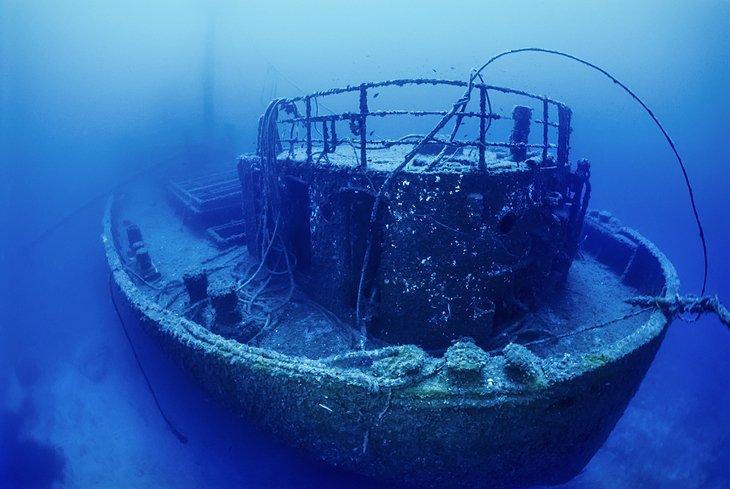
About 60 kilometers off the coast northeast of Tabarka, the rocky La Galite Islands are uninhabited except for the principal island of the group, where local people make a living by catching crayfish.
In antiquity, the main island was known as Galathea, and the Phoenicians had an anchorage here.
Scattered about the island plains are Punic tombs, Roman remains, abandoned quarries, and caves, which are an adventure to explore.
But for many visitors to these islands, the main sightseeing attractions are underwater - excellent wreck diving awaits just off the islands' coasts.
There is no regular boat service to the island group, but passage can usually be arranged upon a fishing boat from Tabarka or Bizerte.
Tabarka's Les Aiguilles
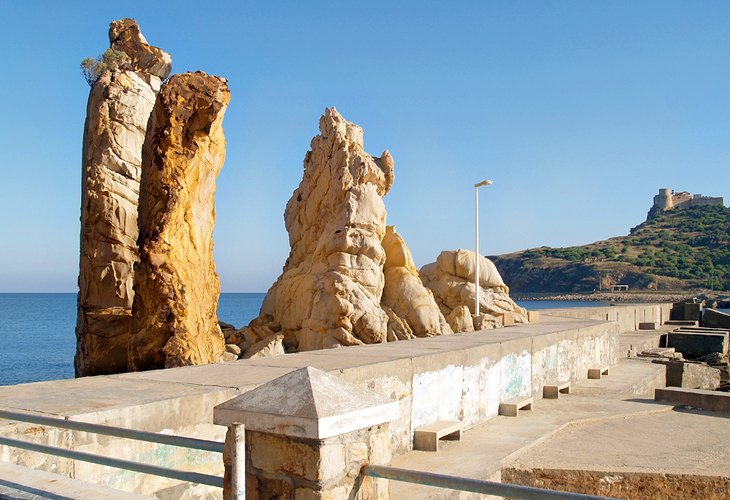
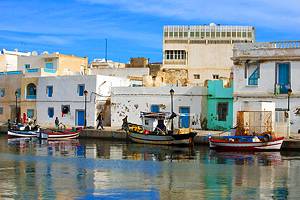
To the west of Tabarka's bustling fishing harbor are Les Aiguilles rock pinnacles sitting right on the coast.
These needles of ochre-colored sandstone soar out of the sea up to 25 meters high.
They have been worn into these bizarre shapes by the weathering effects of erosion; the stone whittled away by wind and water action across the millennia.
It's an easy 10 minute stroll from the harbor to the rocks along the coastal road, and this is a great place for sunset photos.
Bordj Messaoud
Merchants from Marseilles and Padua converted this ancient cistern complex in Tabarka into a fortress during the 12th century.
In the 18th century, it was again enlarged and strengthened by the ruling Ottomans.
Farther southwest is the Ottoman fortress and cistern complex of Bordj el Djedid which French engineers put back into work in the late 1880s.
Both are now in ruinous states, and although the cisterns are an impressive feat of engineering, only the most enthusiastic history lover or archaeologist would probably enjoy a visit.
Tabarka, Tunisia - Climate Chart
| Average minimum and maximum temperatures for Tabarka, Tunisia in °C | |||||||||||
| J | F | M | A | M | J | J | A | S | O | N | D |
| 15 5 | 16 5 | 18 6 | 22 8 | 27 11 | 32 15 | 36 18 | 36 19 | 32 17 | 26 13 | 20 9 | 16 6 |
| PlanetWare.com | |||||||||||
| Average monthly precipitation totals for Tabarka, Tunisia in mm. | |||||||||||
| 58 | 51 | 53 | 43 | 31 | 18 | 5 | 15 | 31 | 48 | 43 | 56 |
| Average minimum and maximum temperatures for Tabarka, Tunisia in °F | |||||||||||
| J | F | M | A | M | J | J | A | S | O | N | D |
| 59 41 | 61 41 | 64 42 | 70 45 | 80 52 | 89 59 | 97 64 | 96 65 | 89 62 | 79 54 | 68 47 | 61 42 |
| PlanetWare.com | |||||||||||
| Average monthly precipitation totals for Tabarka, Tunisia in inches. | |||||||||||
| 2.3 | 2.0 | 2.1 | 1.7 | 1.2 | 0.7 | 0.2 | 0.6 | 1.2 | 1.9 | 1.7 | 2.2 |