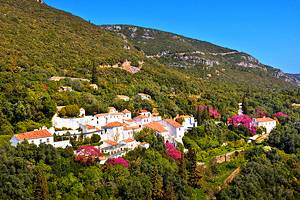
Tourist Attractions in Mérida, Spain
Mérida's UNESCO-listed archaeological sites bring to life the fascinating world of classical antiquity. Mérida is home to some of the best-preserved Roman ruins in Spain. The town of Emérita Augusta was founded in 25 BCE under the rule of Emperor Augustus, when Rome was expanding its empire, and soon became the largest Roman outpost in Iberia and the capital of the Lusitania province.
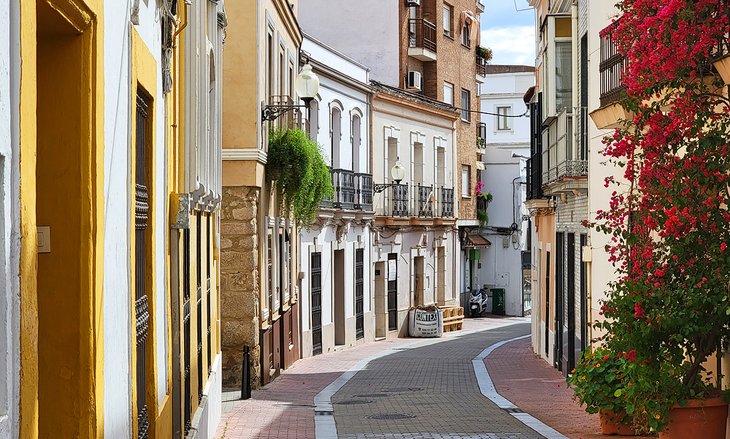
Today, you can wander the city and see the legacy of this rich past in Mérida's abundance of attractions and ancient monuments. Some of the most important things to see here including the Roman Theater, the Portico del Foro, the Temple of Diana, Casa del Mitreo, and an impressively well-preserved 2,000-year-old aqueduct.
Most of the Roman archaeological remains are at the eastern end of the town, and an entry ticket includes combined admission to multiple sites. Merida also has many free attractions that are well worth visiting.
Discover the best places to visit in this captivating historic city with our list of the top attractions and things to do in and around Mérida.
Teatro Romano (Roman Theatre)
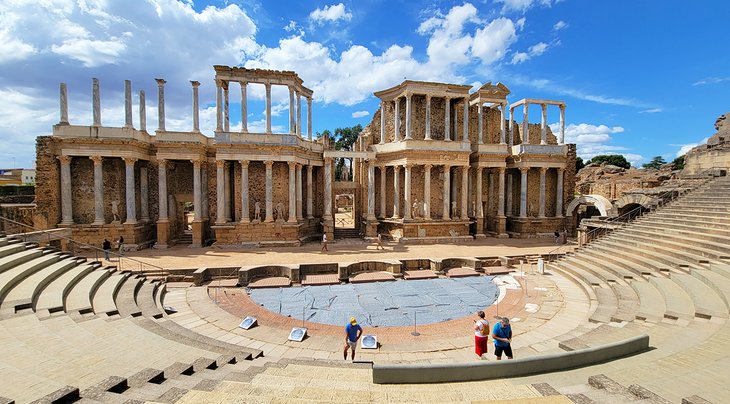
A magnificent ancient monument, the Teatro Romano is the most impressive archaeological site in Mérida and the best conserved Roman theater in Europe. The theater was built by the Roman general Agrippa in 16 BC and rebuilt in the 1st century AD after a fire during the reign of Hadrian. In its sloped semicircular seating, the theater could accommodate 6,000 spectators.
The rear wall of the stage buildings has magnificent sculptural decorations and once had a garden that served as a foyer. Because the theater is so well preserved and has been beautifully restored, tourists can easily visualize being at an event more than two millennia ago. The theater is still used today for performances of plays, ballets, and concerts.
During July and August, the theater becomes a stunning venue for the prestigious Classical Theatre Festival. The festival is dedicated to classical theater of the Greco-Latin tradition, but also includes other dramatic arts and music performances as well as film screenings. Sitting on the old stone benches, attendees experience firsthand the cultural legacy of ancient Greece and Rome.
In addition to hosting cultural events, the Teatro Romano is open to the public for visits (with an admission fee) every day year-round.
Address: José Ramón Melida, E-06800 Mérida
National Museum of Roman Art
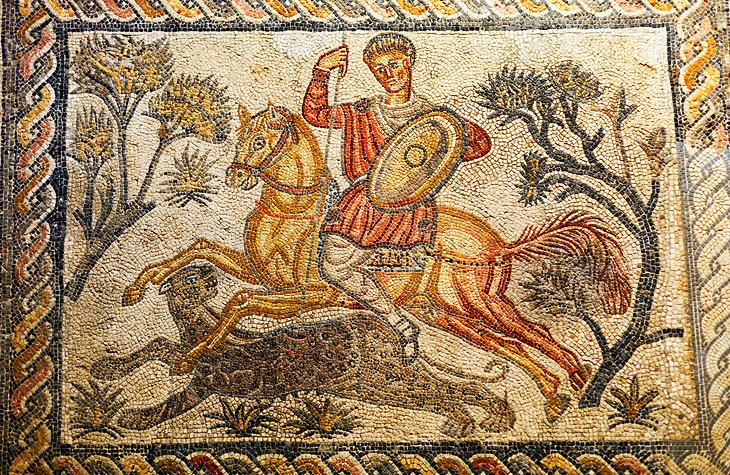
This superb collection of ancient Roman art is opposite the Teatro Romano. Opened in 1986, the National Museum of Roman Art displays Roman antiquities found at the archaeological sites in Mérida. From ancient coins, sculptures, glassware, ceramics, and wall paintings to tombstones, the items on display offer a palpable insight into everyday life during the Roman era.
Highlights of the collection include a bust of Emperor Augustus carved from Carrara marble, wall paintings from the Roman theater, and an assortment of exquisite floor mosaics. The museum was built on top of archaeological remains, and the basement of the museum features archaeological excavations in progress.
Address: Calle José Ramón Mélida, Mérida
Anfiteatro Romano (Roman Amphitheatre)
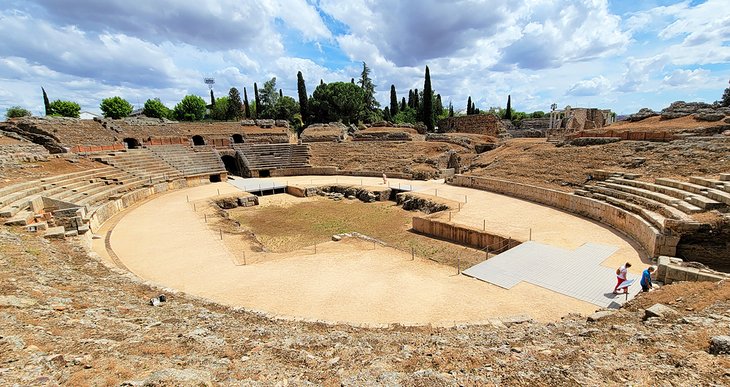
Next to the Roman Theater are the excavated remains of the ancient Roman Amphitheater. Built in 8 BC, this massive stadium packed in 15,000 spectators to watch gladiatorial contests. The amphitheater also staged mock naval battles; the stage area could be flooded with water allowing ships to sail in.
Eventually gladiatorial contests were banned, and the amphitheater was dismantled. The ruins reveal the foundations of the structure and give visitors a sense of the original monument's grandeur. You can even enter the amphitheater floor from the same small rooms as those used by the gladiators themselves in ancient times.
Near the Roman Amphitheater is the Amphitheater House, an ancient Roman villa. This site has several well-preserved rooms decorated with frescoes, paved hallways featuring mosaics, and an outdoor space with a vine-covered peristyle. The floor mosaic in the dining room is especially impressive. The remains of thermal baths, the original kitchens, and drains can also be seen.
This site can be visited with the same ticket that allows admission to the Teatro Romano.
Templo Diana (Temple of Diana)
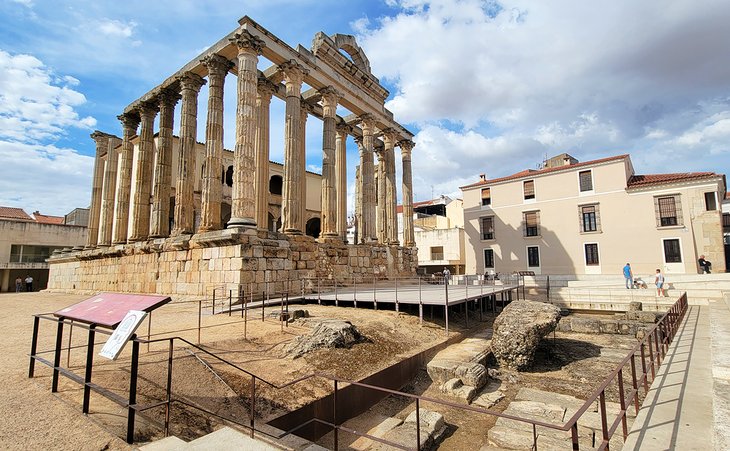
This majestic building is the most beautiful of the ancient Roman sites in Mérida. The enormous temple was an important religious building during the Classical period. Standing on an elevated rectangular base, the structure is surrounded by peripteros (columns) with six columns on the facade. The granite columns feature Corinthian capitals typical of the era.
Scholars believe that a garden with a pond once sat beside the temple. In the 16th century, the temple was converted into a palace for the Duke of Corbos, however the ancient structure is still prominent. The Temple of Diana is at the corner of Calle Romero Leal Sagasta west of the Plaza de España.
Entrance to this attraction is included in the combination ticket, but the structure can be viewed from the street without entering.
The Temple of Diana is open to the public, free of charge.
Casa del Mitreo: An Exceptional Roman Villa
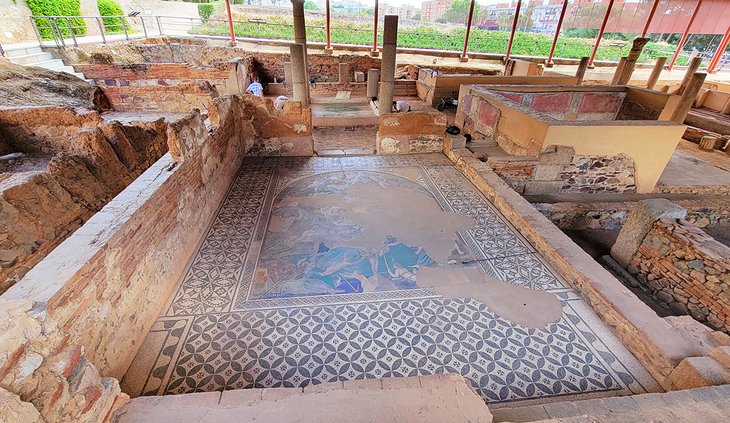
The Casa del Mitreo was a large Roman villa that belonged to a noble family. Also discovered on the site was a mithraeum (an underground cave used for mystic rites) that was related to the cult of Mithra, explaining the house's name.
The Mithraeum House was designed around three lovely peristyles (patio-courtyards with colonnades) that gave the living space a pleasant quality.
The house included private living quarters and reception areas, gardens, and thermal baths. Splendid mosaics and frescoes decorate the rooms. The most exquisite mosaic depicts the origin of the world with representations of heaven, earth, and the sea. The Casa del Mitreo is near the Plaza de Toros (Bullring) via the Calle de Oviedo.
The Casa del Mitreo is open to the public for visits (with an admission fee) every day year-round.
Circo Romano (Ancient Hippodrome)
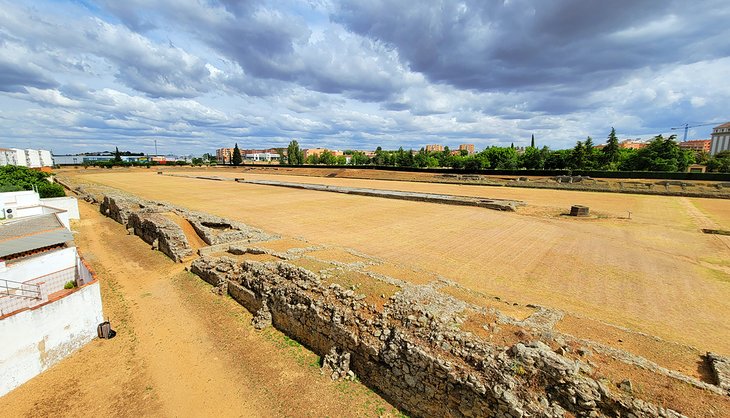
Northwest of the amphitheater beyond the railroad, the remains of the Circo Romano are unique in Spain. This ancient Roman hippodrome was used as a venue for chariot races and later for naval games. The circus has a rectangular shape and is divided lengthwise by a raised platform in the middle, originally covered in marble.
The arena where the races took place and the seating areas are still easily visible. Upon closer observation, visitors can see the area known as carceres where competitors entered the circus. This is one of the best conserved ancient circuses in existence.
The Circo Romano is open to the public for visits (with an admission fee) every day year-round.
The Pórtico del Foro
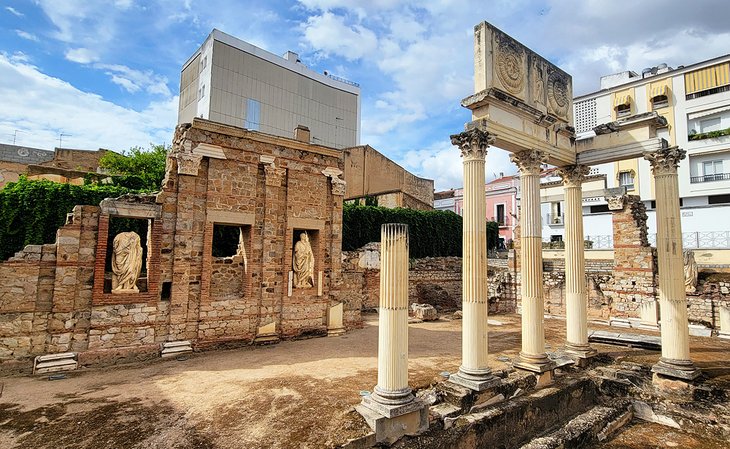
The Pórtico del Foro was built during the 1st century as part of the Augusta Emerita Municipal Forum, modeled after Rome's Forum of Augustus. The ruins that remain today are impressive given their age and include several Corinthian columns that still support a massive piece of marble, and a large section of wall that still contains statues of Roman gods and rulers.
This is one of many free attractions in Merida, which can be seen from the street. You can even dine at an outdoor table overlooking the site.
Puente Romano (Puente sobre el rio Guardiano)
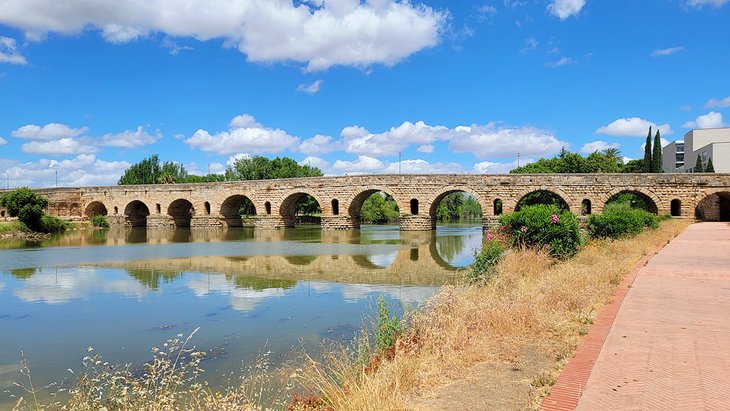
One of Mérida's most iconic sights, the Roman Bridge provided a strategic link between the ancient city of Emérita Augusta and Tarragona. This ancient Roman bridge was originally built during the reign of Emperor Augustus and was restored over later periods.
You can see the bridge from water level by walking along the riverside trail, or, to see the full length of the bridge, view it from the wall of the Alcazaba.
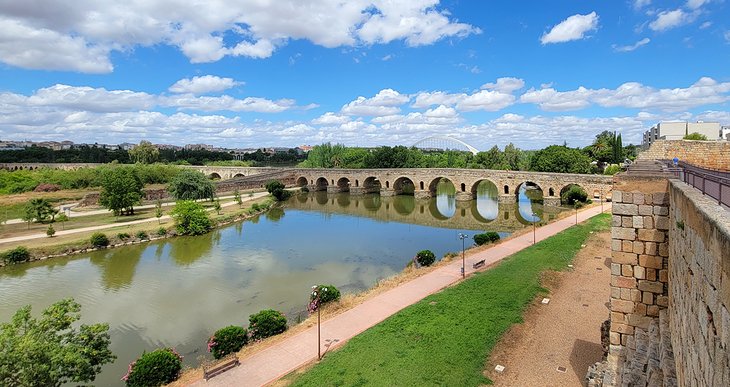
At 792 meters long, it is one of the largest Roman bridges in Spain. Built from bolstered granite, the bridge spans the Guadiana River with its 60 semicircular arches. The pillars are rounded and were well designed for spill flows when the river's water level is high.
Acueducto de los Milagros
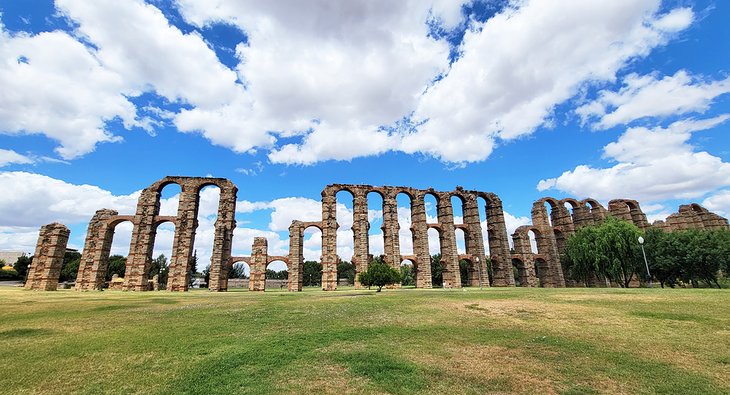
Constructed during the 1st century AD, this ancient Roman aqueduct is a feat of engineering designed to deliver fresh water to the city of Emérita Augusta, or present-day Mérida. It once stretched 10 kilometers from the Prosérpina Reservoir.
Its name translates to the Aqueduct of Miracles, which was given because the structure has endured the millennia in an amazing state of preservation. Today, over 800 meters of the original structure still stand, with entire sections almost entirely intact, including portions that are 27 meters in height.
Built from granite and brick, the aqueduct was a massive monument featuring three stories of semicircular arches, with distribution towers and a tank for water. The northern end of the aqueduct incorporated a pool that purified the water.
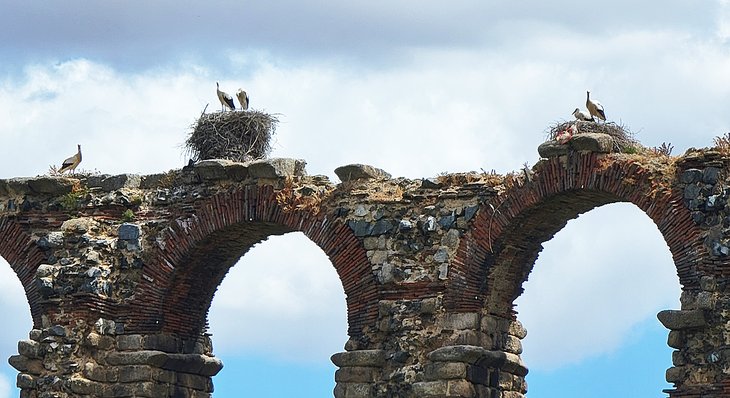
Storks nest all along the top of the structure. In the spring, you can see them feeding their young in the nests (May and June).
The Acueducto de los Milagros is open to the public, free of charge. The area in front of the structure is a grass field with benches along one side where you can rest in the shade.
Address: Avenida Vía de la Plata, Mérida
Alcazaba (Moorish Castle)
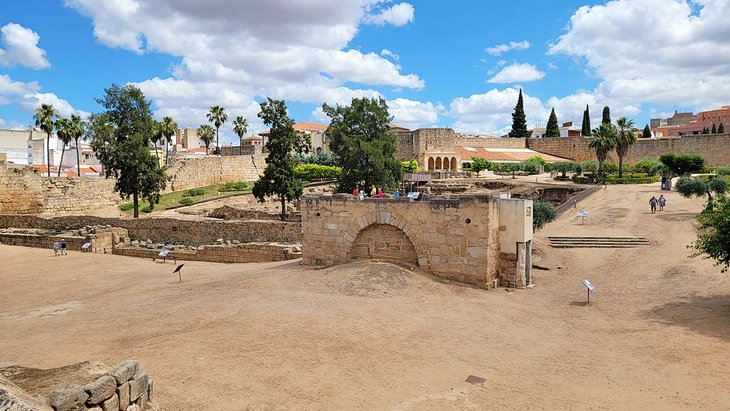
The Alcazaba is south of the Plaza de España on the banks of the Guadiana River. This ancient Moorish citadel, the first of its kind in Spain, was built in 855 by Abd ar-Rahman II. It was constructed in part by using the remains of the former buildings, which included a Roman building and a subsequent monastery of the Order of Santiago.
Some of the original structure was retained, most notably the Roman cistern, which stored water collected from the Guadiana River. From the wall closest to the river are fantastic views over the Puente Romano.
This monument is open to the public for visits (with an admission fee) every day year-round.
Address: Paseo Roma, Mérida
Zona Arqueologica de Moreria
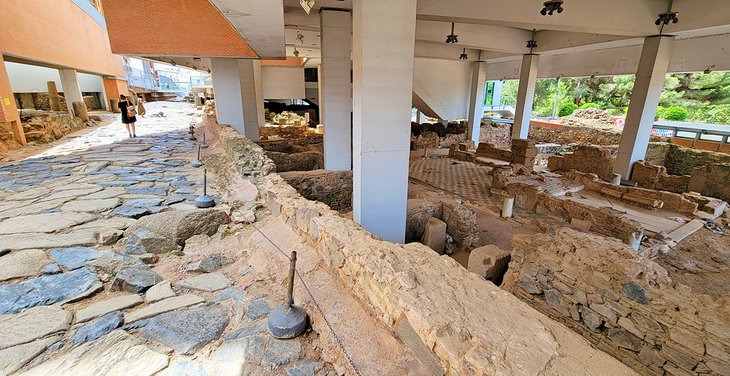
One of the lesser visited but still impressive Roman excavations in Merida is the Zona Arqueologica de Moreria. You could be forgiven for missing it – the city of Merida has built a modern building above one third of the site.
Be sure to spend a bit of time in the visitors center, where you'll find a massive map showing the ancient Roman roads (the English explanation is on the far left side of the map). Reading the description makes walking along the actual ancient Roman road in the site a bit more meaningful. In addition to the road, a large home has also been unearthed complete with interesting floor tile work still visible.
Admission to the Zona Arqueologica de Moreria is included with the combination ticket to the monuments.
Basilica de Santa Eulalia & Cripta de Santa Eulalia
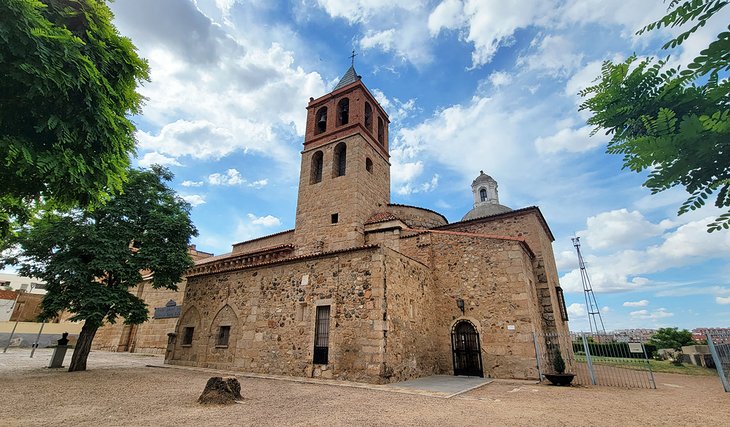
The Basilica of Santa Eulalia was built in the 13th century during the Christian Reconquest of Spain. This venerated historic monument stands on the site of a fourth-century Visigothic basilica (where a Roman temple previously stood).
Exemplifying Romanesque architecture, the Basilica has three naves and a semicircular apse. Around the apse are chapels featuring Visigothic and Gothic architectural details.
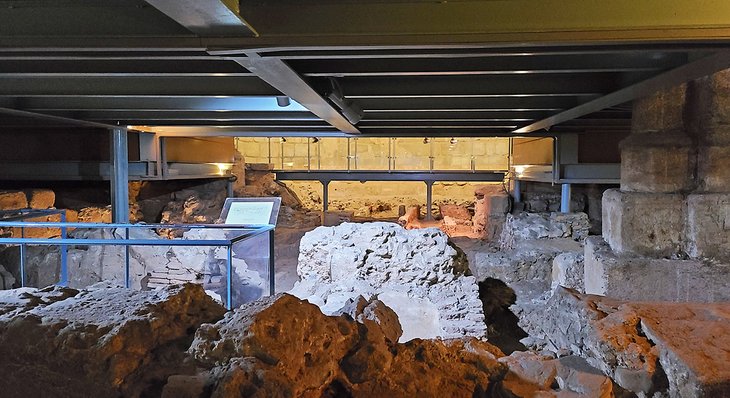
Beneath the basilica are the remains of ancient Roman houses and an early Christian necropolis, the Cripta de Santa Eulalia. The crypt is one of the key attractions in Merida and included in the combination ticket that encompasses the major sites in the city. Admission to the basilica is extra.
Address: 11 Avenida Extremadura, Mérida
Relax on the Plaza de Espana
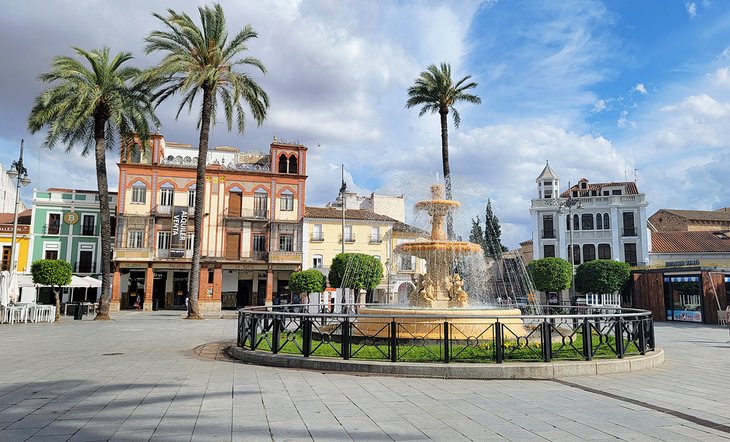
The delightful Plaza de España is a wonderful place to relax after a morning or afternoon of sightseeing. Restaurants can be found on every corner of the square and on the streets in behind looking out to the plaza. The central fountain and surrounding palm trees are a refreshing sight after touring the monuments.
The buildings encompassing the plaza are a mix of architectural styles. One of the standout structures is the ILUNION Merida Palace hotel, a former 16th-century palace that has been turned into a luxury accommodation.
Concatedral de Santa María de la Asunción
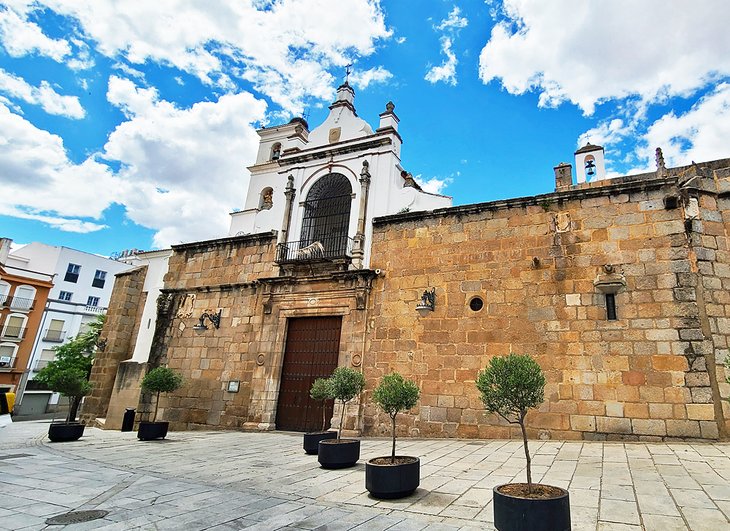
Built between the 13th and 15th centuries, the Co-cathedral of Santa María la Mayor was founded by Alonso de Cárdenas, Grand Master of the Order of Santiago. The church stands on the site of an earlier Visigoth temple and has preserved some elements from the 13th century. During the 17th and 18th centuries, the church was renovated in Neoclassical style.
On the relatively unadorned facade, visitors can find a vaulted niche with an image of the Virgin Mary (known as "Our Lady of Guidance"). The interior has three naves divided by square pillars and contains the tombs of Don Alonso de Cárdenas and the Duke and Duchess de la Roca.
Tourists can only visit the Concatedral de Santa María de la Asunción during the hours of worship.
Address: Plaza de España, Mérida
Arco de Trajano (Arch of Trajan)
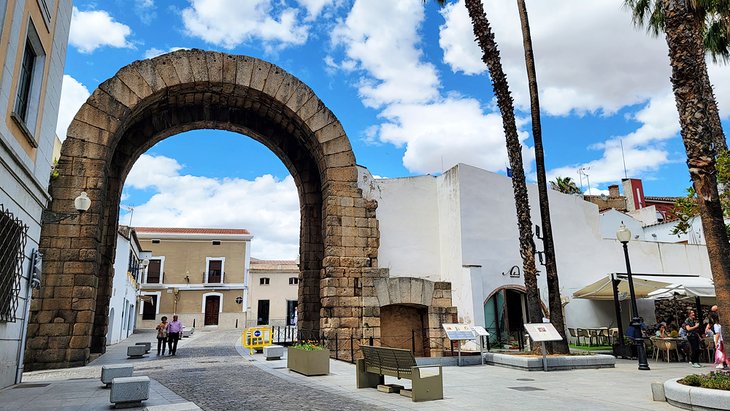
The Arco de Trajano is a 2nd-century Roman arch found in the heart of Mérida. Straddling a street and surrounded by residences and businesses, it has a striking appearance and seems pleasantly out of place as you approach. This is another of Mérida's free things to see as you wander around the city.
Several restaurants with patios line the street immediately in front of the arch. If you're looking for things to do that don't require a lot of walking, enjoy a relaxing afternoon over an atmospheric lunch. Adjoining the arch on one side is the popular and well-regarded A de Arco restaurant.
Attractions Included in the Combination Ticket
If you want to see the majority of the top sites, it's best to buy a combination ticket. This ticket can be used over several days and allows a single entry to each of the following monuments: Teatro Romano and the Anfiteatro, Casa del Anfiteatro, Templo Diana, Alcazaba, Area Arqueologica de Moreria, Cripta de Santa Eulalia, Crico Romano, and the Casa del Mitreo y Columbarios.
The Best Free Attractions in Merida
The number of free things to see and do in Merida is extensive. The city offers a tourist map listing all of the attractions, including a list of all those that are free. Many of the Roman monuments can be seen without an admission fee.
- The Templo Diana can be seen from the street; you only need to pay an admission fee if you want to go into the museum behind.
- Wander along the scenic path by the river to see the Puente Romano (Puente sobre el rio Guadiana).
- The Acueducto de los Milagros is an impressive free site that you can walk right up to. Across the street from the Circo Romano is another interesting aqueduct, the Acueducto de cornalva.
- Other free highlights are the Portico del Foro and the Arco de Trajano, both of which can be seen as you walk around town.
Day Trips from Mérida
Discover the Charming Town of Badajoz
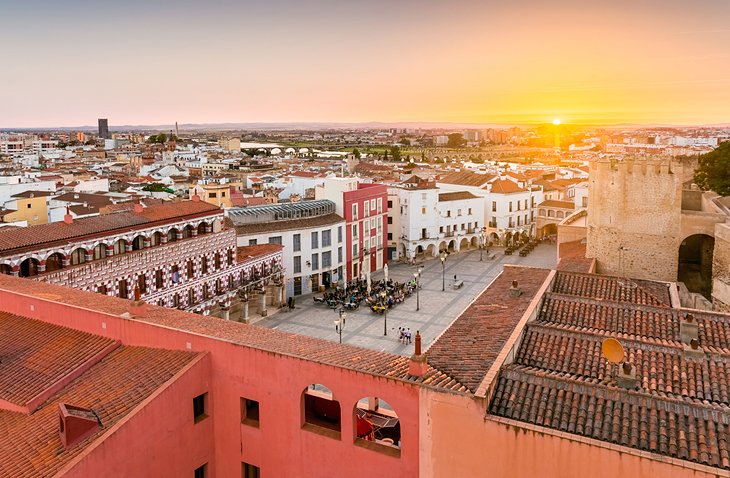
Badajoz is a charming town on the banks of the Guadiana River, near the Portuguese frontier (six kilometers from Portugal and 43 kilometers from Mérida). Full of Old World ambience, Badajoz offers many delightful surprises such as old ramparts, picturesque cobblestone streets, and interesting historical monuments.
In the center of the town is the Plaza de España, where the Catedral de San Juan stands. Built between 1232 and 1284, the cathedral is a fortress-like structure with an imposing tower and a Renaissance facade.
While Badajoz is now Catholic, the city's Islamic legacy of Badajoz is seen in the Alcazaba. This Moorish castle was converted to a Mudéjar-style palace for the Dukes of Fería, now in a public park.
Visitors can take in exceptional views from the Alcazaba's 12th-century Torre de Espantaperros, a massive tower built by the Islamic Almohad rulers. Panoramas from the tower extend from the Guadiana River to the rolling hills of the Extremadura region.
The Alcazaba also houses an excellent Archaeological Museum with more than 15,000 items found at architectural sites in the area.
Day Trip to the Anient Town of Cáceres
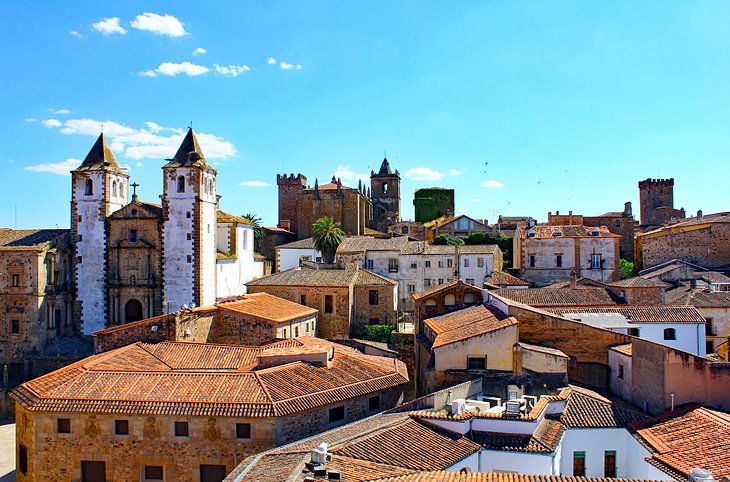
About 78 kilometers from Merida, the ancient town of Caceres was founded in the first century AD by the Romans. During the early Middle Ages, Caceres was under Moorish rule like much of the Iberian Peninsula.
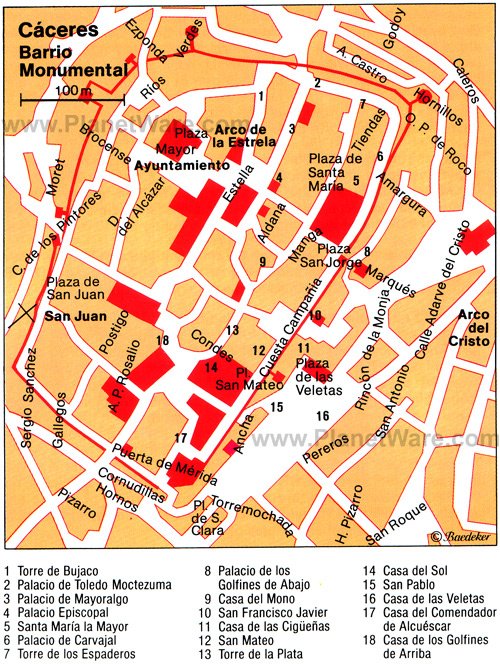
The Ciudad Monumental (Old Town) of Cáceres stands on a hilltop surrounded by the medieval walls with 12 towers and five gates.
Enclosed within these historic ramparts are many old aristocratic mansions such as the 15th-century Palacio de los Golfines Abajo near the cathedral. This palace has a magnificent facade with Gothic, Mudéjar, and Plateresque elements as well as the family's coat of arms.
The Plaza de Santa María is worth visiting to see the 16th-century Bishop's Palace (Palacio Episcopal) and the Palacio de Mayoralgo.
See the UNESCO-listed Monastery in Guadalupe
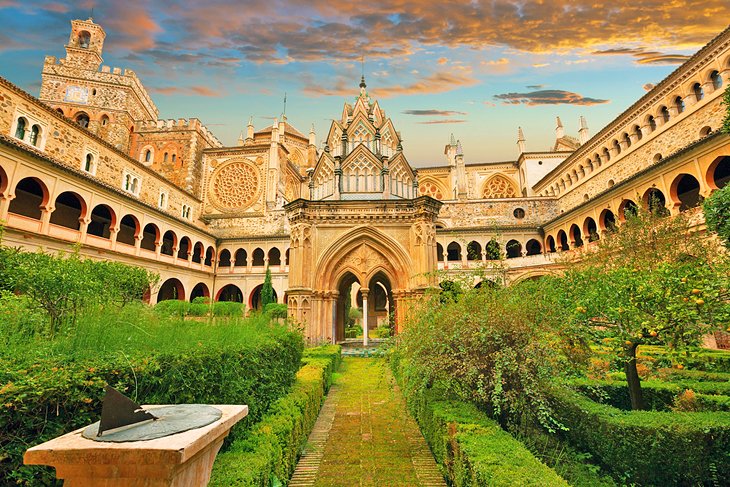
Filled with cobblestone streets and important monuments, Guadalupe is a quaint little village about 131 kilometers from Merida.
The most famous sight is the Royal Monastery of Santa María de Guadalupe, a UNESCO World Heritage Site in the Plaza Juan Carlos. The monastery buildings date from the 14th and 18th centuries, and as a result show great diversity of architectural style.
The monastery is open to the public for visits daily. A highlight is the monastery's 14th-century church featuring a Baroque retablo by Giraldo de Merló and richly carved choir stalls. Not to be missed is the sacristy, sumptuously decorated in Baroque style with ceiling paintings by Francisco de Zurbarán.
Guadalupe is an excellent place to begin a journey through the mountain towns of Las Villuercas. Other noteworthy stopping points are Cañamero, Logrosán, and Berzocana.
Map of Attractions & Things to Do in Mérida, Spain
More Related Articles on PlanetWare.com
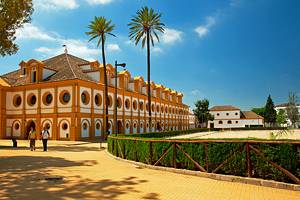
Stunning Seville: Nestled in the heart of Adalusia, Seville is one of Spain's most enchanting cities, with its medieval Barrio Santa Cruz, imposing Moorish Alcázar, and the world's largest Gothic cathedral. Just two hours away, Mérida is one of the top day trips from Seville.
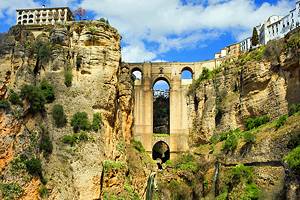
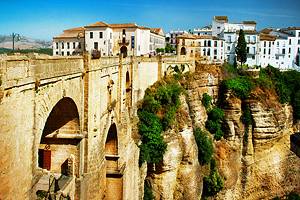
Historic Ronda: Located in southern Spain, Ronda is a smaller city home to a wide variety of historic sites, including the old Moorish town and the Baños Árabes. Ronda also hosts several annual cultural events, including the Andalusian May Fair, which has been celebrated here for over 500 years.
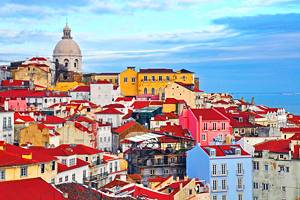
Lovely Lisbon: The coastal city of Lisbon is about a three-hour car ride from Mérida and a top destination for anyone who wants to explore neighboring Portugal. Lisbon is full of world-class museums, historic churches, grand monuments, and historic landmark buildings that await exploration.