Baja California Norte
Mexican State
Population: 2,300,000
How to get there
By air from Mexico City and other Mexican airports to Tijuana and La Paz; by ferry; by rail from Mexico City in about 60 hours to Mexicali; by coach from Mexico City in about 44 hours; from the USA by air, by Greyhound coach and by car.
Location and description
The 1,250km/775mi long and, on an average, 90km/56mi wide peninsula of Baja California (Lower California), which consists of two federal states, borders the USA (California) in the north. Its shores are lapped by the Pacific in the west and the Golfo de California in the east. The border between Baja California Norte and Baja California Sur runs along the 28th degree of latitude. The peninsula is a hot, dry area with mountain ranges and richly contoured coasts. The most important chain of mountains is the Sierra de Pedro Mártir, running roughly from north to south, its highest peak being the Cerro de la Encantada (10,100ft/3,080m above sea level). The border with the state of Sonora is formed by the Rio Colorado, which runs into the northernmost point of the Gulf of California.
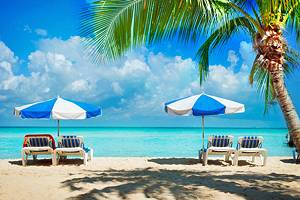
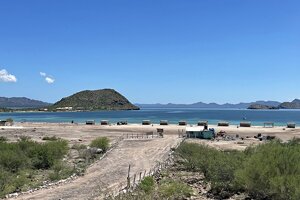
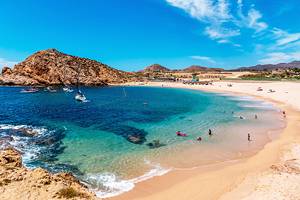
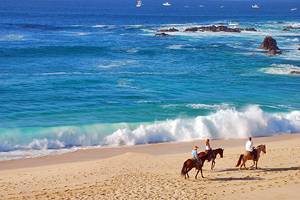
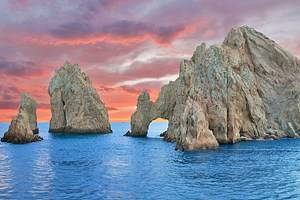
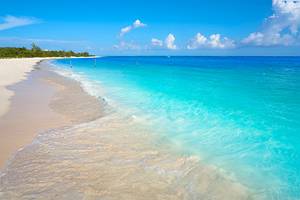
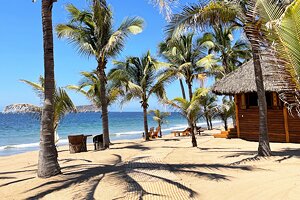
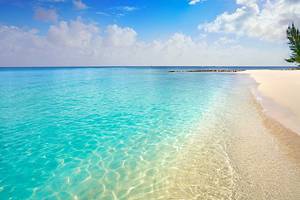
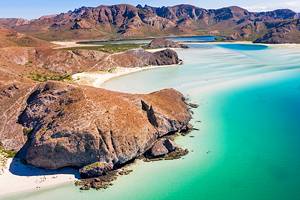
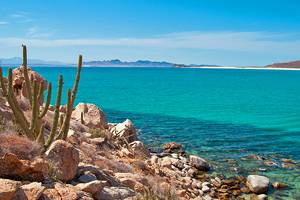
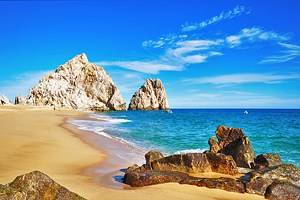
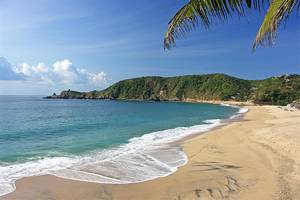
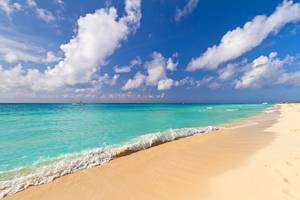
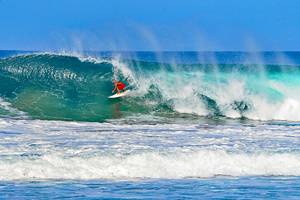
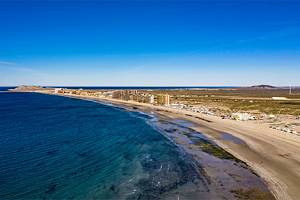
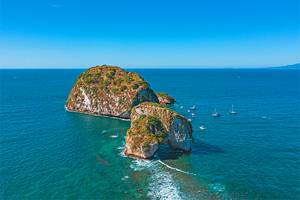
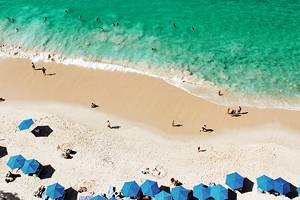
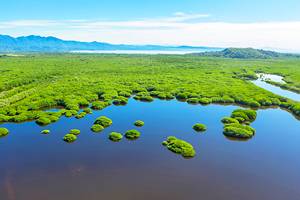
The peninsula, which obtained a north to south road connection with the building of the Carretera Transpeninsular in 1974, offers little that is typically Mexican, apart from some mission stations. As a result of its proximity to the USA and the great stream of tourists from the north, its towns and villages have largely assumed an American character. The tourist charm lies in the desert flora (cacti), the impressive silhouettes of the bare mountain regions and the endless coasts, with their mixture of sandy beaches, cliffs and lagoons. Apart from a few places overrun with tourists, in Baja California you can find barren, isolated countryside.
The original Indian population, made up of the Cucapá, Kiliwa, Pai-pai, Cochimí and Ki-nai tribes, numbers scarcely 1,000 today.
Fauna
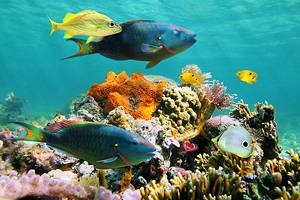
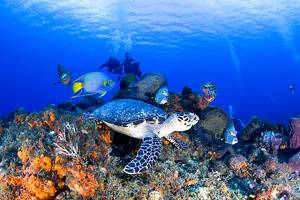
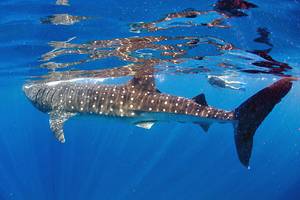
Baja California is rich in varieties of animal life. On the peninsula still live the puma, coyote, fox, red deer, hare, wild goose, wild duck and sea-birds of all kinds; gray whales frolic in the sea and can be watched in the Bay of San Ignacio from December to February; sea-lions, seals, swordfish, dolphins, barracudas and tuna-fish also can be seen.
Archaeological sites
Apart from some rock-paintings, such as those at San Boritja, San Ignacio and Calimalí, Baja California holds little of archaeological interest. Caves have been found in Caguama, Metate Comondú and on the Isla de Cedros.
History
Traces of settlements from pre-Columbian times, going back as far as 7500 BC., have been found. Almost nothing is known of the little developed culture of the early Indian tribes of the peninsula.
In search of a legendary Amazonian paradise ruled over by a black queen named Calafia, Hernán Cortés landed in the La Paz region in 1535. The Spaniards who followed later met with strong resistance from the Indios, and were unable to gain a foothold there. Embittered by their lack of success, they named the area "California", after the queen who had never been found. Not until after 1697, when the Jesuit missionaries Francisco Eusebio Kino, Juan Maria de Salvatierra and Juan de Ugarte arrived, were they successful in colonizing parts of the country. After the expulsion of the Jesuits in 1767, the Franciscans took over this task, until the Dominicans superseded them in 1772. In 1804 Lower California was separated from California, and during the war with the USA the peninsula was occupied by American troops in 1847/1848. In 1931 the division into northern and southern territories took place. Finally in 1952 Baja California Norte, and in 1974 Baja California Sur, were declared independent federal states.
Economy
As well as a considerable tourist industry, the cultivation of cotton, maize, wheat, alfalfa, vegetables and fruit is carried on with the aid of artificial irrigation. The processing of agricultural and fishing products, and the mining of gold, copper, iron, silver and salt are worthy of mention. Fishing could be a good source of income but it lacks a strong fleet and processing facilities.
Destinations
In addition to Tijuana, the most important destinations to aim for in Baja California Norte, which do not lie on the Carretera Transpeninsular, are Tecate, Mexicali and San Felipe.
Population: 2,300,000
How to get there
By air from Mexico City and other Mexican airports to Tijuana and La Paz; by ferry; by rail from Mexico City in about 60 hours to Mexicali; by coach from Mexico City in about 44 hours; from the USA by air, by Greyhound coach and by car.
Location and description
The 1,250km/775mi long and, on an average, 90km/56mi wide peninsula of Baja California (Lower California), which consists of two federal states, borders the USA (California) in the north. Its shores are lapped by the Pacific in the west and the Golfo de California in the east. The border between Baja California Norte and Baja California Sur runs along the 28th degree of latitude. The peninsula is a hot, dry area with mountain ranges and richly contoured coasts. The most important chain of mountains is the Sierra de Pedro Mártir, running roughly from north to south, its highest peak being the Cerro de la Encantada (10,100ft/3,080m above sea level). The border with the state of Sonora is formed by the Rio Colorado, which runs into the northernmost point of the Gulf of California.
The peninsula, which obtained a north to south road connection with the building of the Carretera Transpeninsular in 1974, offers little that is typically Mexican, apart from some mission stations. As a result of its proximity to the USA and the great stream of tourists from the north, its towns and villages have largely assumed an American character. The tourist charm lies in the desert flora (cacti), the impressive silhouettes of the bare mountain regions and the endless coasts, with their mixture of sandy beaches, cliffs and lagoons. Apart from a few places overrun with tourists, in Baja California you can find barren, isolated countryside.
The original Indian population, made up of the Cucapá, Kiliwa, Pai-pai, Cochimí and Ki-nai tribes, numbers scarcely 1,000 today.
Fauna
Baja California is rich in varieties of animal life. On the peninsula still live the puma, coyote, fox, red deer, hare, wild goose, wild duck and sea-birds of all kinds; gray whales frolic in the sea and can be watched in the Bay of San Ignacio from December to February; sea-lions, seals, swordfish, dolphins, barracudas and tuna-fish also can be seen.
Archaeological sites
Apart from some rock-paintings, such as those at San Boritja, San Ignacio and Calimalí, Baja California holds little of archaeological interest. Caves have been found in Caguama, Metate Comondú and on the Isla de Cedros.
History
Traces of settlements from pre-Columbian times, going back as far as 7500 BC., have been found. Almost nothing is known of the little developed culture of the early Indian tribes of the peninsula.
In search of a legendary Amazonian paradise ruled over by a black queen named Calafia, Hernán Cortés landed in the La Paz region in 1535. The Spaniards who followed later met with strong resistance from the Indios, and were unable to gain a foothold there. Embittered by their lack of success, they named the area "California", after the queen who had never been found. Not until after 1697, when the Jesuit missionaries Francisco Eusebio Kino, Juan Maria de Salvatierra and Juan de Ugarte arrived, were they successful in colonizing parts of the country. After the expulsion of the Jesuits in 1767, the Franciscans took over this task, until the Dominicans superseded them in 1772. In 1804 Lower California was separated from California, and during the war with the USA the peninsula was occupied by American troops in 1847/1848. In 1931 the division into northern and southern territories took place. Finally in 1952 Baja California Norte, and in 1974 Baja California Sur, were declared independent federal states.
Economy
As well as a considerable tourist industry, the cultivation of cotton, maize, wheat, alfalfa, vegetables and fruit is carried on with the aid of artificial irrigation. The processing of agricultural and fishing products, and the mining of gold, copper, iron, silver and salt are worthy of mention. Fishing could be a good source of income but it lacks a strong fleet and processing facilities.
Destinations
In addition to Tijuana, the most important destinations to aim for in Baja California Norte, which do not lie on the Carretera Transpeninsular, are Tecate, Mexicali and San Felipe.
Hobbies & Activities category: Region with significant interests
Baja California Tourism Office
Blvd. Diaz Ordaz s/n
Edif. Plaza Patria Nivel 3
Tijuana, Baja California Norte 22400
Mexico
Blvd. Diaz Ordaz s/n
Edif. Plaza Patria Nivel 3
Tijuana, Baja California Norte 22400
Mexico
Attractions Near Baja California Norte, Mexico
Hotels in Popular Mexico Destinations