Exploring Haram al-Sharif (Temple Mount): A Visitor's Guide
The Haram al-Sharif is one of the most contentious pieces of land in the world, as well as being Jerusalem's most recognizable landmark.
For the Jewish faith, this marks the spot where the world was first created, and where it will end.
Muslims believe that the Prophet Muhammad ascended to heaven from here on his M'raj journey.
For all three major monotheistic faiths (Jews, Christians, and Muslims), the Haram al-Sherif is the place where the Prophet Abraham stood ready to sacrifice his son to prove his faith to God.
First the site of the Israelites' First and Second Temples, and now home to the Dome of the Rock, this small plot of land has been fought over across the centuries and remains a place of deep religous significance and faith.
The Enclosure Walls
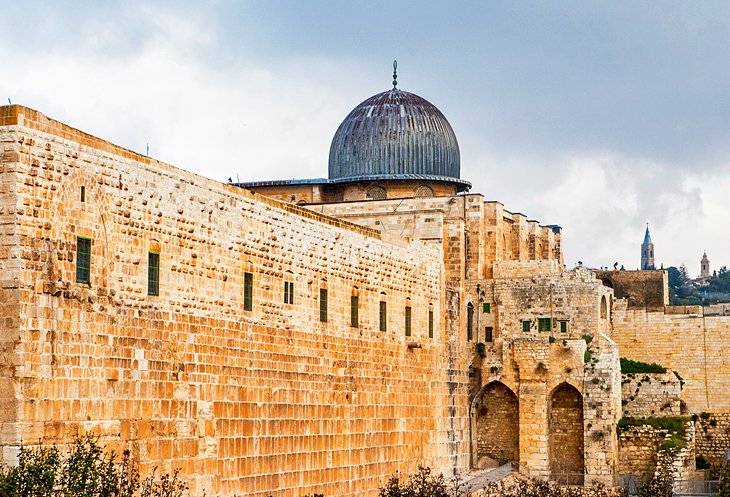
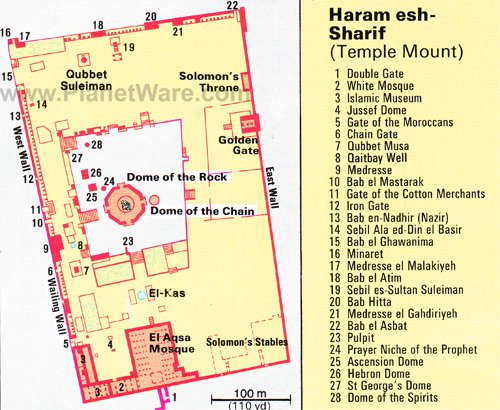
The walls enclosing the Haram al-Sharif reach their highest point (65 meters) at the southeast corner, where there is a clear view of the massive blocks of dressed stone of the Herodian walls and the overlying courses of smaller stones of later restorations.
There are seven gates leading up to the plaza but non-Muslims can only enter through Bab al-Magharibeh.
If you decide to take a tour around the walls, the four other major gate entrances are the Chain Gate (Bab es-Silsileh); the Cotton Merchants' Gate (Bab al-Qattanin), which displays an excellent example of stalactitic corbelling; the Iron Gate (Bab el-Hadid); and the Watchman's Gate (Bab en-Nazir).
On the western and northern walls are four minarets with a range of construction dates: at the southwest corner (1278, altered 1622), above Bab es-Silsileh (1329), at the northwest corner (1297), and — the youngest of the four — on the north wall (1937).
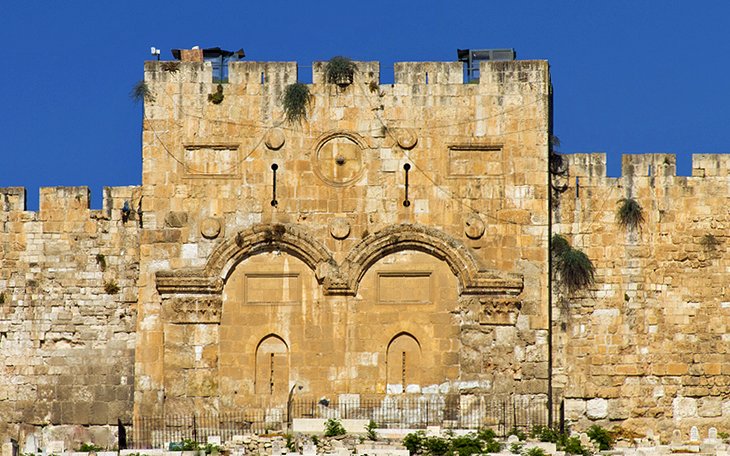
One of the most interesting tourist attractions of the walls is the bricked-up Golden Gate, a double gateway through which Jewish tradition states the Messiah will enter the city on the day of the last judgement.
Accordingly — and undoubtedly also with strategic considerations in mind — the Arabs walled up both gateways and for good measure laid out a cemetery outside the walls here.
Temple Platform
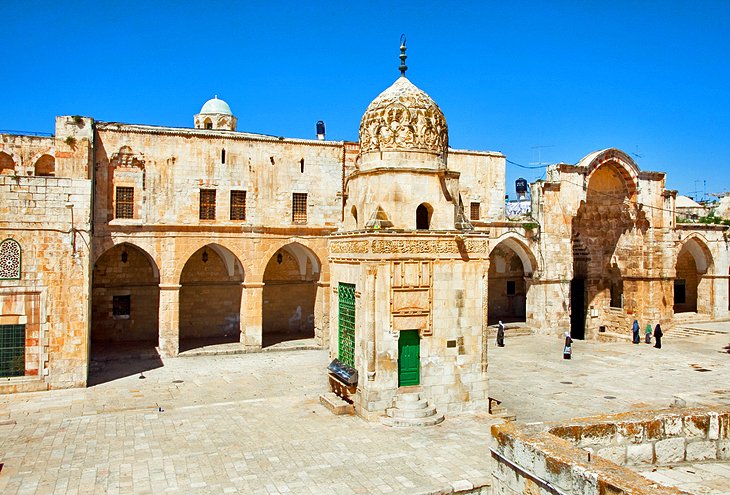
The site of Solomon's First Temple is now a spacious plaza.
The western side features some arcaded Mameluke-era buildings. Between the gates of Bab al-Qattanin and Bab el-Hadid are a number of tombs, including that of Sharif Hussein I Ibn Ali (1851-1931), leader of World War I's Arab Revolt.
At the southeast corner, a flight of steps leads down to the so-called Solomon's Stables (usually closed), a series of chambers built by Herod the Great, where the later Crusaders tethered their animals.
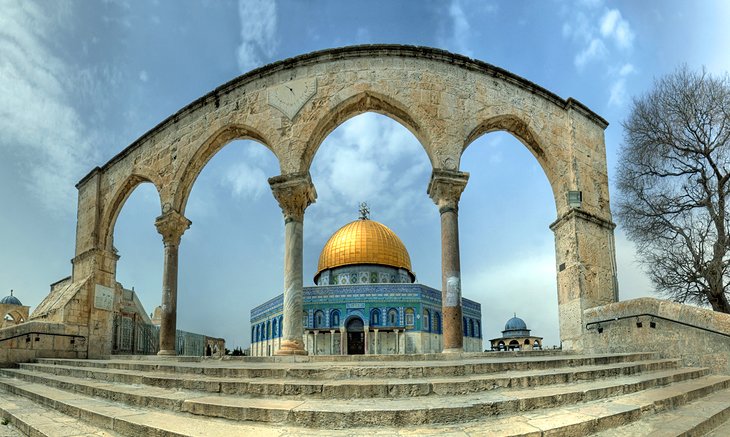
The steps that lead up to the central platform, where the Dome of the Rock sits, are spanned by handsome arched columns dating from the Mameluke period.
Muslims call these the "Scales" as they believe that the scales used to weigh the souls of men will be hung from here on the Day of Judgement.
Al-Aqsa Mosque
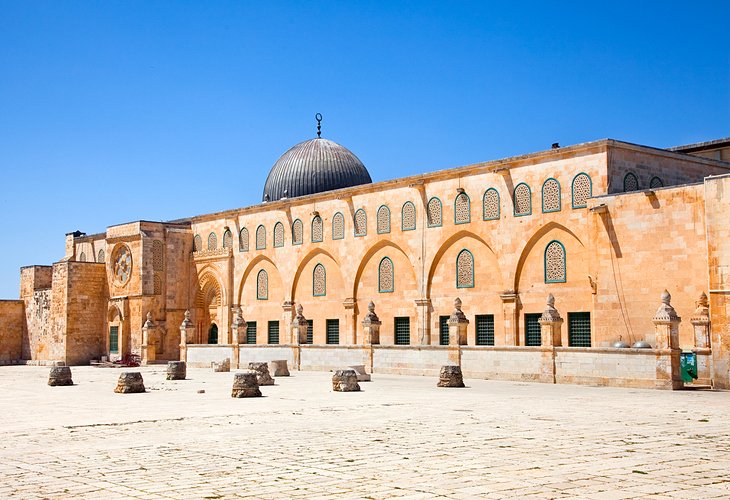
Al-Aqsa Mosque ("The Farthest Mosque") takes its name from the Prophet Muhammad's journey to heaven (known as al-Isra wal Mi'raj or "the night journey" by Muslims) in which he traveled from Mecca to the farthest mosque before ascending to heaven.
Archaeologists believe that the mosque stands on the marketplace site of the Jewish Temple Mount.
The original mosque was built during the reign of the Umayyad Caliph Al-Walid I (AD 705-715), and some archaeologists believe that the builders overlaid a Byzantine-era basilica in the construction, though there is dispute about this.
When the Crusaders arrived in Jerusalem, they decided the mosque was the true site for Solomon's Temple.
Across the centuries, Al-Aqsa has been extensively restored and renovated, most recently between 1938 and 1943, when columns of white Carrara marble, supplied by Mussolini, were installed and a new ceiling was built at the expense of King Farouk of Egypt.
In 1967, it was damaged by gunfire and in 1969, a fire deliberately started by an Australian Christian, destroyed some of the priceless 12th-century interior detail.
Despite this, the seven-aisled interior is impressive and is home to a striking and intricately-carved mihrab (prayer niche). Outside the front of Al-Aqsa is the El-Kas ablution fountain, erected by the Mamluk Sultan Qaitbay in 1455.
Dome of the Rock Platform Buildings
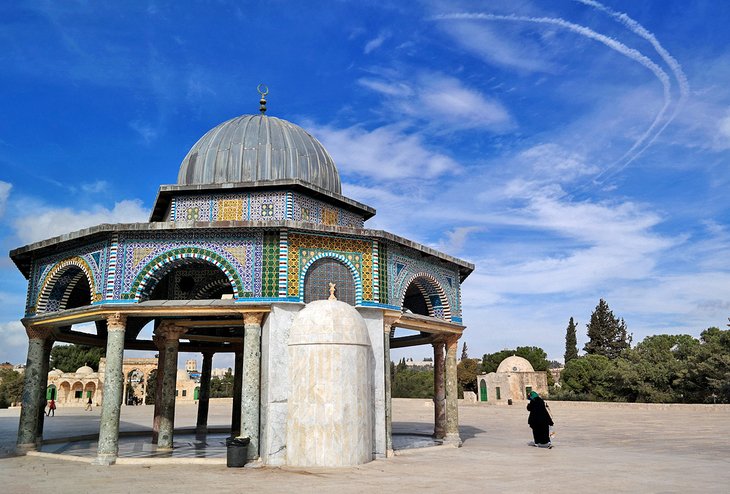
On the Dome of the Rock's eastern side is a small circular domed building known as the Dome of the Chain, so called because Solomon is said to have hung a chain over his father's place of judgement from which a link would fall if any man appearing for judgement swore a false oath.
The large mihrab (prayer niche), marking the direction of Mecca, dates from the 13th century.
At the northwest corner of the raised platform is the Dome of the Ascension, built on the spot where, in Muslim belief, the Prophet Muhammad prayed before his ascent to heaven.
In the northwest corner, in front of the staircase are the Dome of St. George and the Dome of the Spirits, which date from the 15th century.
Dome of the Rock
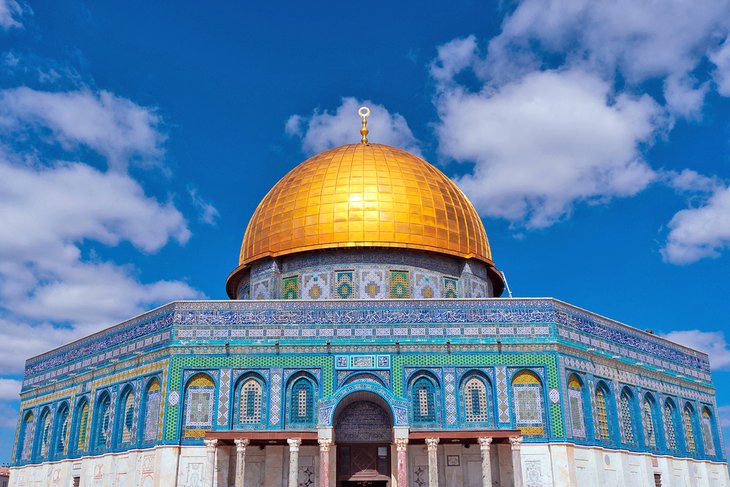
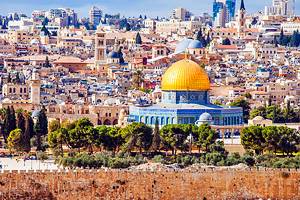
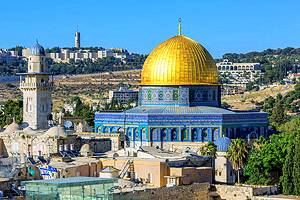
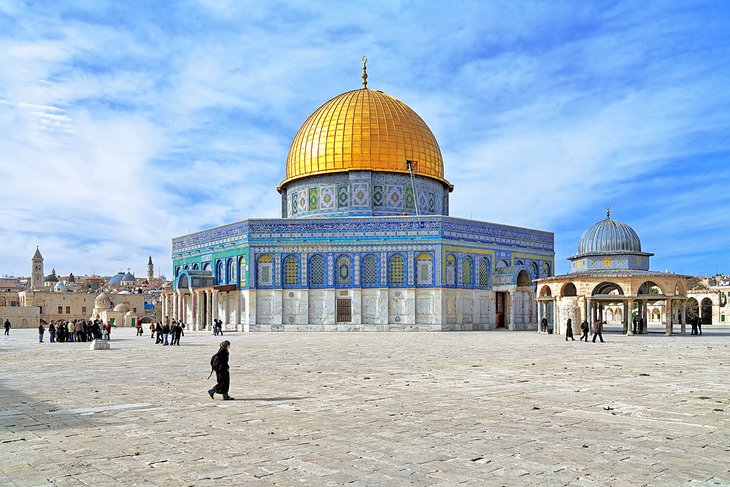
The main sightseeing attraction upon the platform is of course the Dome of the Rock itself.
Non-Muslims cannot enter, but the façade is beautiful. Built over the site where Jews believe Abraham prepared to sacrifice Isaac, and Muslims believe the Prophet Muhammad began his ascent to heaven, the Dome of the Rock (Qubbet el-Sakhra) is one of the greatest of Muslim monuments.
It was built by Abd al-Malik (685-705), the fifth Umayyad Caliph. The octagonal structure, with a high dome, enshrines the sacred rock of Moriah.
The impressive effect of the Dome of the Rock results from the combination of fine proportions and sumptuous decoration with an apparently simple ground-plan consisting of three concentric elements.
Around the rock is a ring of piers and columns supporting the dome; a broad ambulatory separates this ring from an octagon, also formed by piers and columns, and this in turn is separated from the octagonal outer walls by a narrow ambulatory.
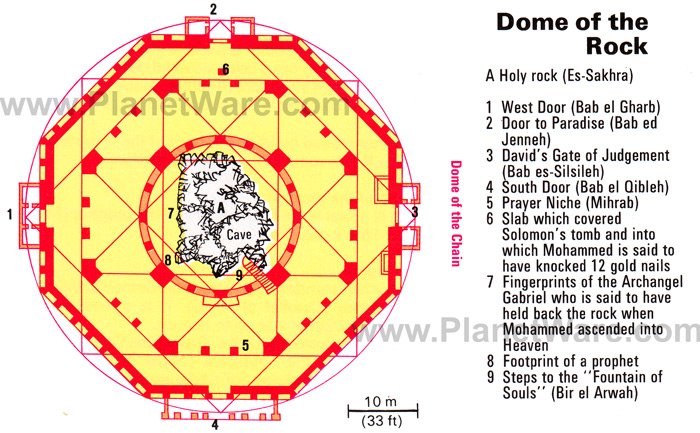
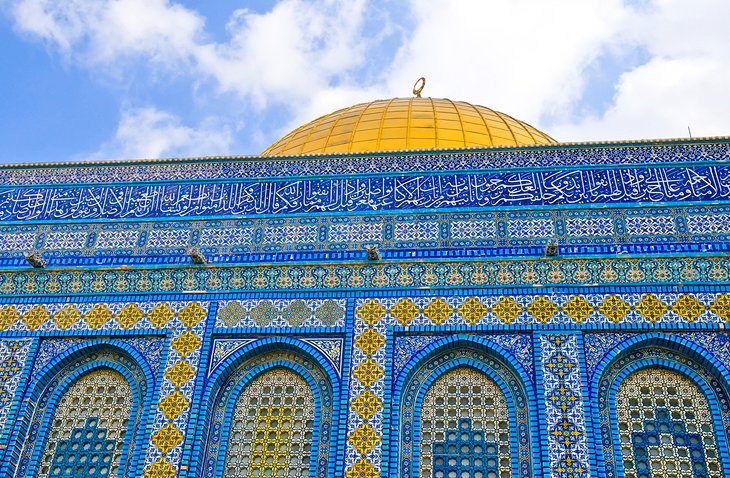
Four doors, clad with copper by Qaitbay (1468-96), lead into the interior, which is unfortunately off-limits to non-Muslims.
In the center of the inner rotunda is Es-Sakhra, the Holy Rock, over which the Jews' altar for burnt offerings may have stood. Just under 18 meters long by 13.25 meters across, it is surrounded by a grille installed by the Crusaders in the 12th century to prevent relic collectors from breaking off pieces of the stone.
Under the rock is a cave, known to Muslims as Bir al-Arwah ("Well of Souls"), where it is believed that the souls of the dead gather to pray.
Tips and Tactics: How to Make the Most of Your Visit to Haram al-Sharif
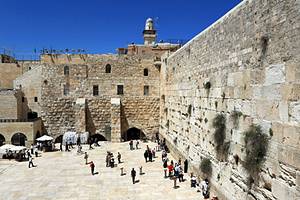
- Non-Muslims can only enter from the Bab al-Magharibeh, next to the Western Wall in the Western Wall Plaza.
- Get here as early as possible. Security checks mean lines at the entry can be long and tiresome.
- You can exit from any of the other gates. Exit from the Bab al-Qattanin to admire its grand stalactite architecture.
- You are entering one of the holiest sites in the world - dress modestly.
Getting There
- From Central Jerusalem, Egged Bus No. 38A runs from King George V Street through the Jewish Quarter and to the Western Wall Plaza and related tourist attractions.
- If you're walking from Central Jerusalem, Jaffa Gate is the nearest approach into the Old City.
History of Haram al-Sharif
For those of the Jewish faith, the Temple Mount is where the world began, with God bringing forth the earth, Adam, and Eve from the foundation stone of Mt Moriah.
It was on this same stone that the Prophet Abraham signaled his devotion to God by agreeing to sacrifice his son.
The First Temple built on this spot was constructed by King Solomon with the Ark of the Covenant stored inside. The First Temple was completely destroyed by Nebuchadnezzar in 586 BC.
Later, a Second Temple was built here, which was obliterated by the Romans in AD 70.
Before the Muslims captured Jerusalem, the city was held by the Byzantine Empire, and Emperor Justinian dedicated a church to the Mother of God on the Temple Mount site.
After the Muslim armies conquered Jerusalem in AD 638, Caliph Omar visited the city. Simply dressed, and accompanied by Archbishop Sophronius, he entered the Temple precinct and said a prayer on Abraham's rock, which those of the Muslim faith believe to have been the site from where Prophet Muhammad ascended to heaven.
The brilliant period of the Umayyad Caliphs, whose capital was in Damascus, saw the erection on the Temple platform of the two buildings that have become the landmarks and emblems of Jerusalem - the Dome of the Rock, built over the rock of Moriah by Abd el-Malik in 687-691, and the Al-Aqsa Mosque by his son El-Walid I (705-715).
The period of Muslim rule on the Temple Mount was interrupted by the coming of the Crusaders, who held Jerusalem from 1099 to 1187 and plundered the Dome of the Rock and the El-Aqsa Mosque (less generous than Caliph Omar, who had spared the church of the Holy Sepulchre).
The first kings of Jerusalem resided in the Al-Aqsa Mosque but later made it over to the Order of the Temple (founded 1149), which took its name from the Templum Salomonis (Al-Aqsa) and Templum Domini (Dome of the Rock).
After Jerusalem was recaptured for Islam by Saladin in 1187, there was much further building on the Temple platform, particularly by the Mamelukes.