Tourist Attractions in Bethlehem
By far the most visited town in the Palestinian Territories, Bethlehem is famous for being the place of Jesus Christ's birth and has been celebrated in Christmas carols and hymns through the centuries. But the bustle of the modern city can be a surprise for some visitors.
The major tourist attraction here is the Church of the Nativity, and for anyone – religious or otherwise – who has ever celebrated Christmas, it really is top of the things to do list.
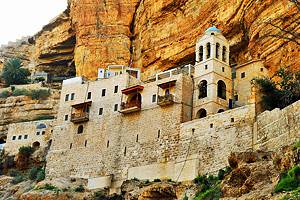
Afterwards, two of the best places to visit in the surrounding countryside are Shepherd's Field, for the panoramas swooping across the hills, and Mar Saba Monastery, with its domes that seem to have sprung organically from the sheer cliff face.
Plan your visit with our list of the top tourist attractions in Bethlehem.
Church of the Nativity
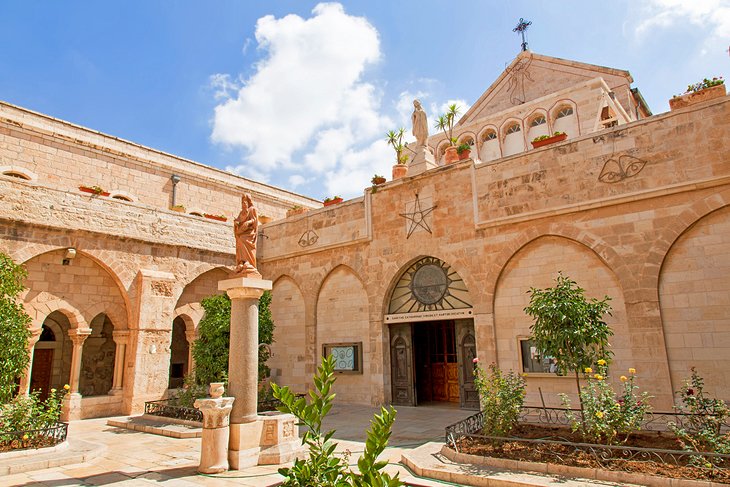
Bethlehem's Church of the Nativity is top of the town's sightseeing list and is said to be the birthplace of Jesus Christ.
A church has sat here continuously since Byzantine Emperor Constantine built a chapel on this spot in the 4th century CE.
This was superseded by a 6th century basilica, commissioned by Emperor Justinian, which was again built over by the Crusaders in the 12th century.
The central doorway shows this overlap work of many centuries, with the original door surround and the relief-decorated architrave of Justinian's church still in place.
The Crusaders reduced the size of the entrance, inserting a doorway with a pointed arch and walling in the upper part of the original one. Later, the doorway was further reduced in order to prevent the Mamluks from riding into the church on horseback. It is now only 1.2 meters high so that visitors must bend down on entering.
Inside, the interior has essentially preserved the tranquil monumental trappings of the 6th century.
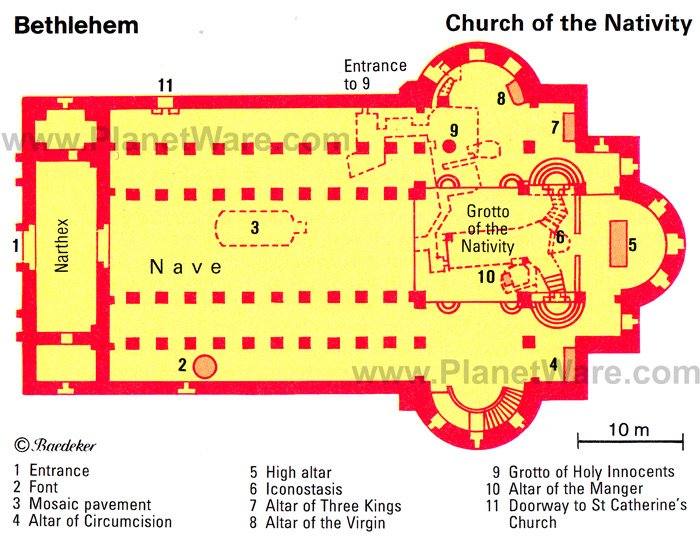
In the north transept, are the Armenian Altars of the Virgin and the Three Kings; in the south transept is the Altar of Circumcision which belongs to the Greeks.
From the south transept, a finely carved doorway gives access to the stairs leading down to the Grotto of the Nativity; the actual place where Jesus is said to have been born is marked by a silver star. For Christian pilgrims, this tiny grotto is a place of deep religious significance and the major highlight of a visit here.
The clerestory of the church's nave is borne on four rows of eleven monolithic columns with Corinthian capitals. Two openings in the floor allow visitors to see mosaics on the floor of Emperor Constantine's church of CE 325, which is 60 centimeters below the present floor level.
Paintings from the Crusader period have been preserved on the columns and on the clerestory walls. On the south side are depicted the ancestors of Christ, while on the columns are pictures of figures of saints and Baldwin I's (first King of Jerusalem in the Crusader era) helmet.
Address: Manger Square, Bethlehem
St. Catherine's Church
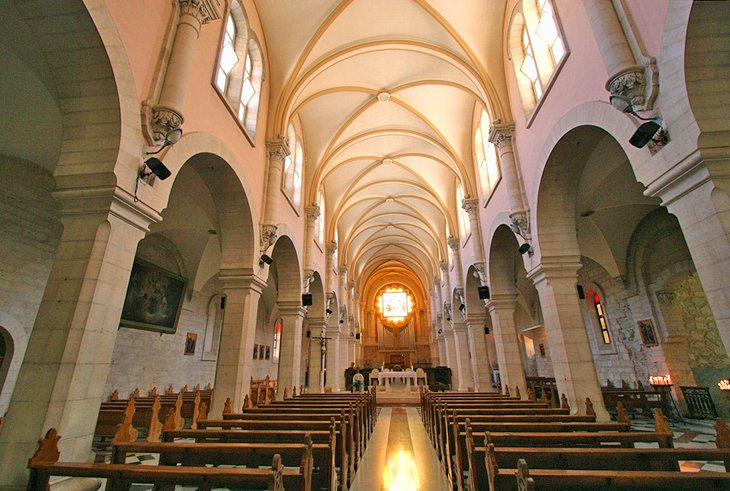
Next door to the Church of the Nativity is St. Catherine's Church, built by the Franciscans over an earlier church in 1881.
A flight of steps in the south aisle leads down to the northern part of the cave system underneath.
To the left is the Chapel of the Holy Innocents commemorating Herod's massacre of the children of Bethlehem, while straight ahead is St. Joseph's Chapel.
To the right are the Chapel of St. Eusebius, the tombs of St. Paula and her daughter Eustochium, and the tomb of St. Jerome who is heavily connected to the church and said to have written the Vulgate (Latin translation of the bible) while living in a cave here.
On the rear wall is the stone bench on which the remains of St. Jerome rested until they were taken to Rome for burial in the Church of Santa Maria Maggiore.
Address: Manger Square, Bethlehem
Milk Grotto
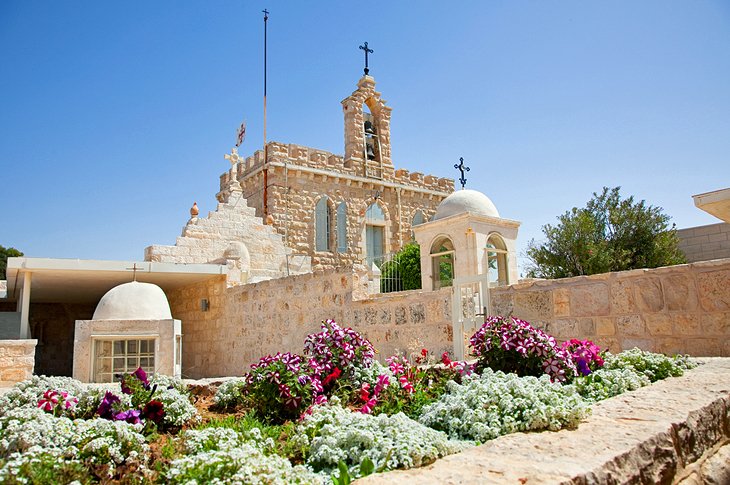
This cave-chapel is said to be the site where the Holy Family hid before their flight into Egypt, after Herod ordered the murder of all infant boys.
The proper name of the church is the Chapel of the Milk Grotto of Our Lady and it has been a place of worship since the Byzantine era.
The current church was built by the Catholics in the 19th century.
According to tradition, while the Holy Family were sheltering here, a drop of Mary's milk fell on the floor of the cave and whitened the stone.
Many people believe that a visit here aids fertility, and so the tiny five-meter-by-10-meter grotto is a favored pilgrimage destination for women who have trouble conceiving. The internal walls are covered with letters from past pilgrims.
Address: Milk Grotto Street, Bethlehem
Manger Square
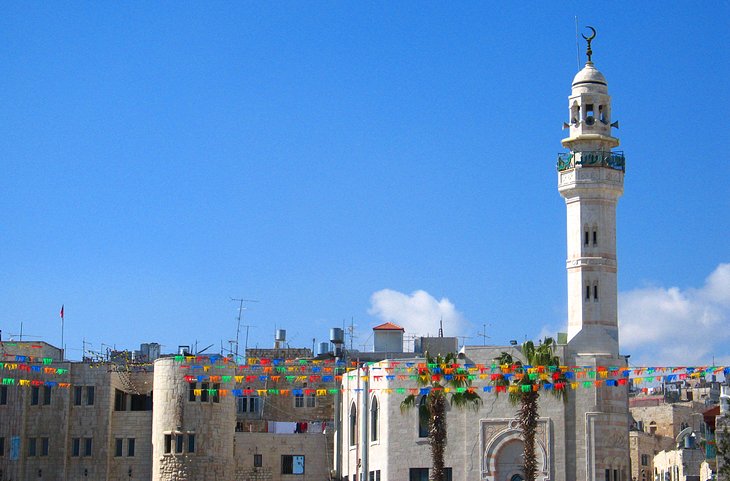
Manger Square is the hub of modern Bethlehem, with cafés, restaurants, and souvenir stores all surrounding this central plaza.
The Church of the Nativity dominates the eastern side of the square, while the Mosque of Omar is on the western side.
Although the mosque is modern (built in 1860), it has a lovely story attached to its name. It's named after the Caliph Omar whose Arab armies conquered Byzantine Jerusalem. After taking the city, he traveled here to Bethlehem and prayed inside the Church of the Nativity, declaring that Christians would be free to practice their faith and pray at this important Christian shrine.
Palestinian Heritage Center
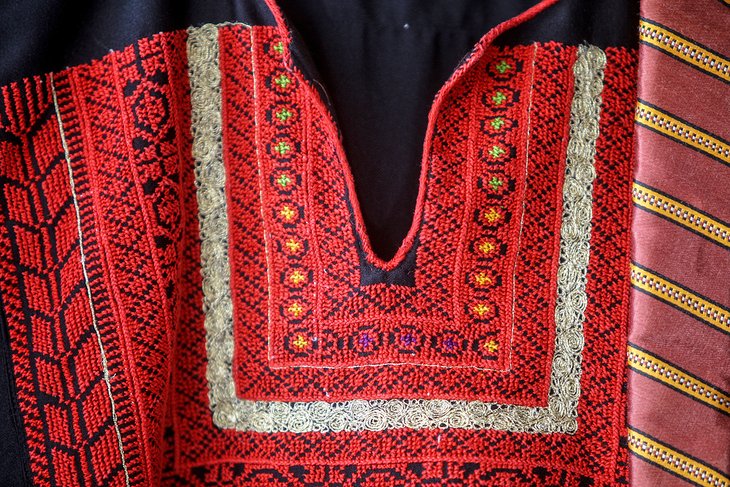
This is a must-stop while in Bethlehem for anyone interested in Palestinian craft traditions.
This shop-museum is a great place to buy locally made craftwork and support local artisans, as well as explore the rich heritage of textile crafts in Palestine.
The museum displays exhibits of the huge variety of different embroidery patterns used in Palestinian textile work.
For interested visitors, the staff here are enthusiastic about discussing the history behind local textile traditions, the meanings of individual patterns, and the struggle to keep this textile heritage alive today.
For shoppers, there is a large number of textiles, decorated in intricate embroidery, that can be bought, from small cushion covers to traditional Palestinian dresses.
Address: Manger Street, Bethlehem
Shepherd's Field (Beit Sahour)
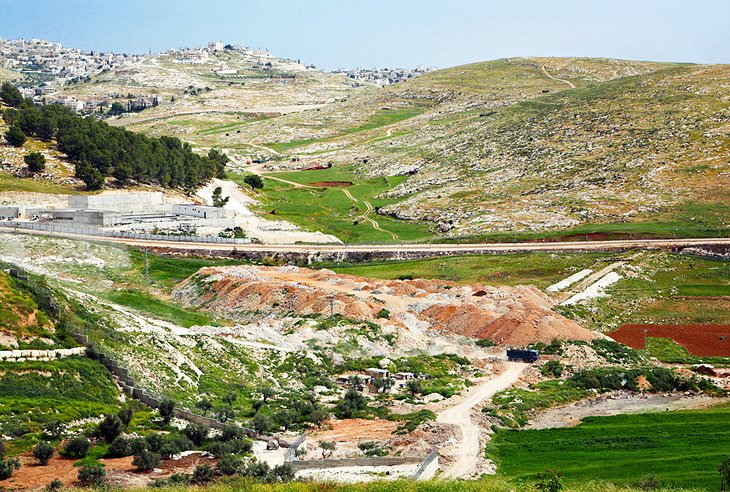
Wondering where those shepherds watched their flocks by night? The fields around the village of Beit Sahour are widely recognized by Christian believers as the site of the Shepherd's Field in which the birth of Jesus was announced by the angels.
The field claimed to be the actual site is home to a Greek Orthodox Church where, in 1972, archaeologists excavated a 4th century church with a beautiful mosaic pavement. There are fine views across the rolling hills from here.
Beit Sahour is three kilometers east of central Bethlehem and easily added on your sightseeing in town, or used as a stop off on your way to Mar Saba Monastery.
Address: Ash Salon Street, Beit Sahour
Mar Saba Monastery
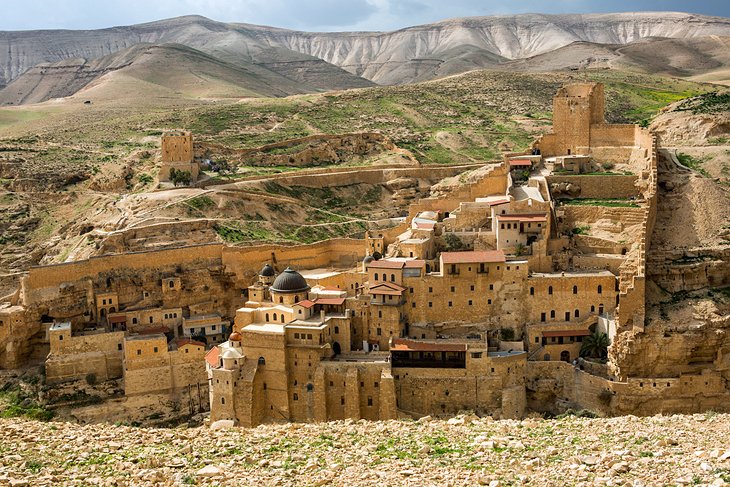
This historic old Greek Orthodox monastery, in the desert east of Bethlehem, is a magnificent sight squeezed between the almost vertical rock walls of the Kidron Gorge.
Saint Sabas (born in 439 CE) was a native of Cappadocia (in modern-day Turkey). In 457 CE, he entered a Jerusalem monastery, but left in 437 CE to seek solitude in the Kidron Valley.
Mar Saba Monastery was founded by him in 492 CE on the slopes of the gorge opposite the cave where he used to dwell.
Sabas gained a great reputation, not only in Palestine, but also in the capital of the Empire, Constantinople (modern Istanbul). At the great age of 90, he traveled to that city and persuaded the Emperor Justinian to rebuild the Church of the Nativity in Bethlehem.
After his death in 532 CE, at the age of 93, his tomb became a place of pilgrimage. During the 8th century, the monastery found further fame by becoming home to John of Damascus, considered the greatest theologian of his day.
Only men may enter the actual monastery, but women can climb a hill to the right of the monastery up to the tower in which female visitors used to be accommodated. There are excellent views over the domes of the monastery complex from here.
Male visitors who enter the monastery can see the tomb of St. Sabas in the domed cruciform church, which also has rich icons and wall paintings. They can also see the gruesome skulls of the monks slaughtered by the Persians in 614 CE.
St. Theodosius Monastery
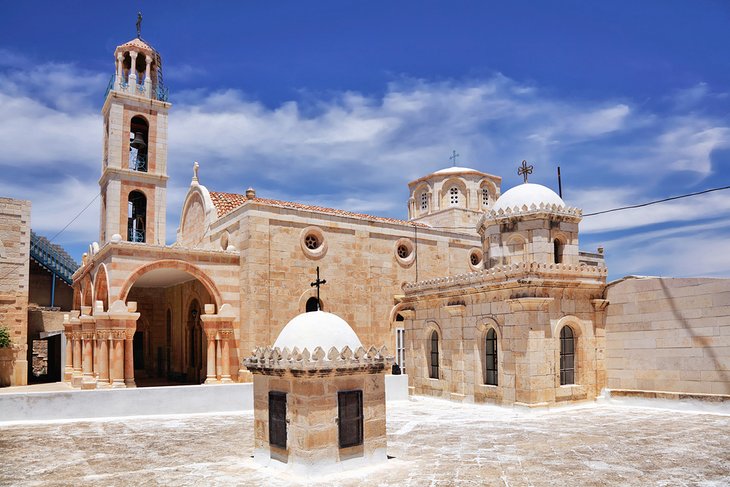
St. Theodosius, eight kilometers east from Bethlehem, is another Cappadocia priest who ended up in the Holy Land.
He began this monastery in 476 CE, and during its heyday, the cloisters here were home to a population of 400 monks.
The most important part of the complex is the cave where Christians believe the three magi (holy men from Persia) spent the night on the way to see the baby Jesus. The monastery also contains the St. Theodosius' tomb.
St. Theodosius Monastery was destroyed by the Persians in 614 CE and only reoccupied and rebuilt by Greek Orthodox monks in 1900.
Herodium
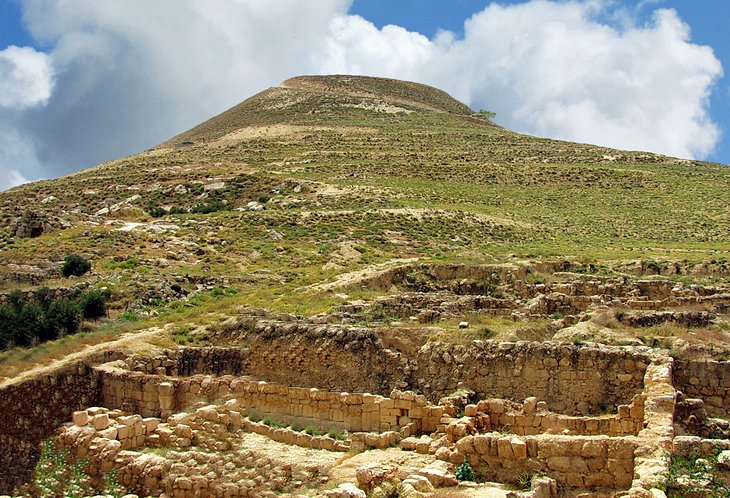
The conspicuous landmark of Herodium Hill (like a volcano with its summit leveled off) was given its characteristic form when Herod built a fortified palace here.
Herod had the summit cut away and dug out, creating a circular plateau surrounded by a double ring of massive walls and towers. Excavations here have brought to light a garden laid out in a peristyle court, residential apartments, baths, and a synagogue.
From the top of the hill are wonderful panoramas extending eastward to the Dead Sea and northward to the Mount of Olives.
The double ring of fortifications can still be easily seen, while the circular area within the walls is divided into two equal halves: the eastern side, a column-filled garden area, and the western side, occupied by residential buildings.
At the foot of the hill are the excavated remains of the lower town built by Herod to house his courtiers and servants, which covers an area of 15 hectares.
The site is 11 kilometers southeast of Bethlehem.
Al Bad Museum
Bethlehem's Al Bad Museum is dedicated to the heritage and long history of olive oil production in Palestine.
It holds an ethnographical collection that covers all facets of the process, from harvesting the olives through to the processing of the oil, and olive oil's many uses. Exhibits include ancient grinding stones and other implements that were once used by olive farmers, as well as a range of the products olive oil is a fundamental ingredient for.
The museum is just as interesting for the stone-cut Ottoman building it is set in. The cream-stone 19th-century mansion has been fully restored and is a beautiful example of Bethlehem's traditional architectural style.
From the roof, there are great views over central Bethlehem.
Address: Al Najajreh Street
Solomon's Pools
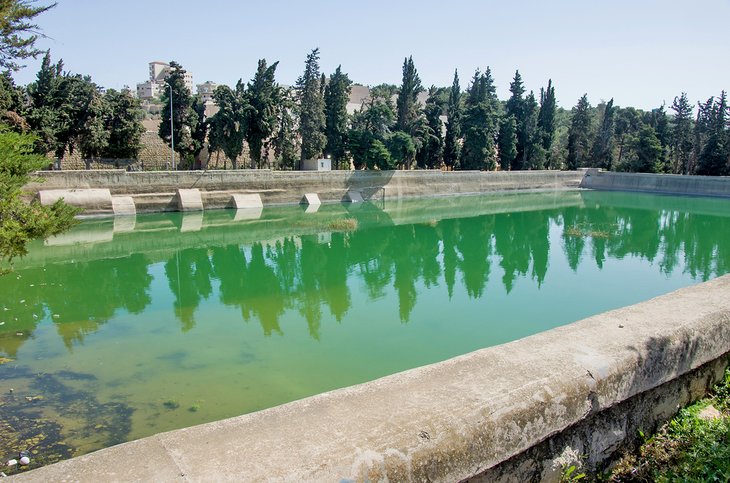
The road that runs to Hebron from Bethlehem passes by the small village of Al-Khadr and its three large open cisterns on the left, known as Solomon's Pools.
Built in ancient times, they were used to provide water for the city of Jerusalem as well as Herodium. The pools are mammoth, and could hold over a quarter million cubic meters of water when in use.
A reliable tradition dates them to the reign of Solomon in the 10th century BCE.
The village of Al-Khadr itself is home to a Greek Orthodox Church dedicated to St. George (Al-Khadar in Arabic).
The site is five kilometers west from central Bethlehem's Manger Square.
Hebron's Tomb of the Patriarchs
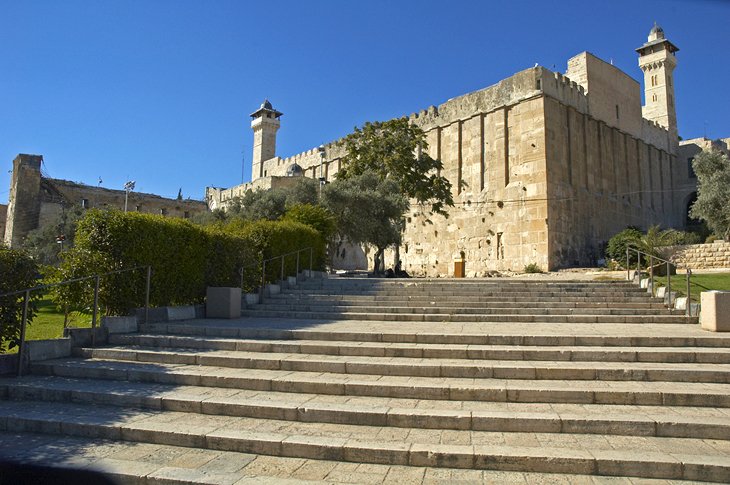
Historic Hebron, south of Bethlehem, plays an important role in religious history for Jews, Muslims, and Christians alike.
Inside the bulky stone-cut walls of Hebron's Tomb of the Patriarchs (also known as the Al Ibrahimi Mosque to Muslims, and the Cave of Machpelah to those of the Jewish faith) are some of the most sacred shrines of the world's three monotheistic faiths, as the caves below the building are said to be home to the burial grounds of the Prophets Abraham, Isaac, and Jacob and their wives.
The skyline of town is dominated by this massive structure, with its ancient walls, using stones nearly one meter high and two meters thick, first built by Herod the Great.
The enclosure was converted into a mosque in the 7th century and then became a church during the Crusader era, until Saladin reconverted it back into a mosque in the 12th century, adding the minarets.
To enter, you must dress modestly and be prepared to go through heavy security. Jewish visitors and Muslim visitors enter the enclosure from separate areas. Tourists of other faiths, or no faith, may enter from either.
Inside are the memorial cenotaphs of Abraham and his wife Sarah, Jacob and his wife Leah, and Isaac and his wife Rebecca, all of which were constructed during the Mameluke era.
The mosque prayer hall itself has a richly carved minbar set up by Saladin in 1191.
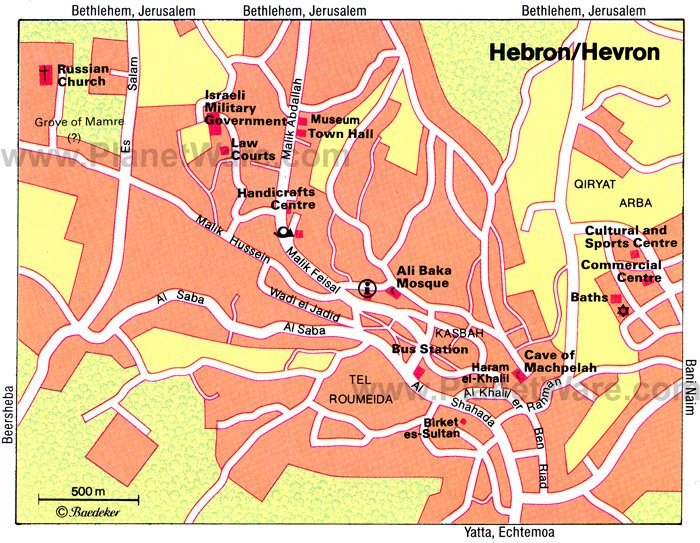
Map of Tourist Attractions in Bethlehem
Bethlehem, West Bank - Climate Chart
| Average minimum and maximum temperatures for Bethlehem, West Bank in °C | |||||||||||
| J | F | M | A | M | J | J | A | S | O | N | D |
| 12 4 | 13 4 | 16 6 | 21 9 | 25 12 | 28 15 | 29 17 | 29 17 | 28 16 | 25 14 | 19 9 | 14 6 |
| PlanetWare.com | |||||||||||
| Average monthly precipitation totals for Bethlehem, West Bank in mm. | |||||||||||
| 142 | 114 | 99 | 31 | 3 | 0 | 0 | 0 | 0 | 23 | 69 | 109 |
| Average minimum and maximum temperatures for Bethlehem, West Bank in °F | |||||||||||
| J | F | M | A | M | J | J | A | S | O | N | D |
| 53 39 | 56 40 | 61 43 | 70 49 | 77 54 | 82 59 | 84 63 | 84 63 | 82 61 | 77 57 | 66 49 | 57 42 |
| PlanetWare.com | |||||||||||
| Average monthly precipitation totals for Bethlehem, West Bank in inches. | |||||||||||
| 5.6 | 4.5 | 3.9 | 1.2 | 0.1 | 0 | 0 | 0 | 0 | 0.9 | 2.7 | 4.3 |
History of Bethlehem
Religious Accounts
In the Old Testament, Bethlehem is first mentioned in the account of the death of Rachel. On her way from Bethel to the south, she died giving birth to her second son Benjamin and "was buried in the way to Ephrath, which is Bethlehem" (Genesis 35,19).
Centuries later, the widowed Ruth returned from Moab with her mother-in-law, Naomi, to her home town of Bethlehem. She was gleaning in a field belonging to Boaz when he encountered her. He then married her and she bore his son Obed, "the father of Jesse, the father of David" (Ruth 4,17).
It later appears again as the birthplace of Jesus Christ in the New Testament gospels: "Jesus, of the lineage of David, was born in Bethlehem, to which his parents had traveled from their home in Nazareth for a census in the reign of the Emperor Augustus" (Luke 2,1-7).
By around 200 CE, the Grotto of the Nativity had become an established place of pilgrimage, and in 325 CE, the Emperor Constantine built a church over the grotto (where a Roman temple built by Emperor Hadrian had stood since 100 CE).
The plan of this first church was reconstructed by R. W. Hamilton on the basis of contemporary descriptions and an excavation in 1934.
A colonnaded atrium (under the present forecourt of the church) led into a five-aisled basilica, with mosaic pavements and marble facing on the walls, from which three steps at the east end led into an octagon at a higher level. This stood immediately above the grotto, into which pilgrims could look down through an opening in the floor.
A few decades after the building of the church, in 386 CE, St. Jerome, a native of Dalmatia, came to Bethlehem; settled in a cave adjoining the Grotto of the Nativity; and composed his Latin translation of the Bible, the Vulgate. Thereafter, hosts of pilgrims traveled to Bethlehem from many lands, and Jerome recorded that "men sang God's praises in many different tongues."
Constantine's church was destroyed in 529 CE by rebellious Samaritans. St. Sabas, who lived in his nearby monastery, traveled to Constantinople and sought the Emperor Justinian's support for the building of a new church. The emperor's architect retained the original plan of a five-aisled nave but replaced the octagon by a trefoil sanctuary and omitted the atrium.
Miraculously, this church has survived to the present day.
The Persians, advancing in 614 CE against Byzantium, spared it because they took the figures of the three kings from the East clad in Oriental garb in a relief over the entrance for fellow-countrymen.
In the time of the Crusaders, who captured Bethlehem before taking Jerusalem, the Byzantine Emperor Manuel had the church thoroughly restored (1161-69). Previously, at Christmas 1100, Baldwin I had been crowned here as the first king of Jerusalem.
In the 13th century, the Mamelukes also left the church unscathed, but thereafter it fell increasingly into disrepair.
In 1479, the roof had to be shored up, and from 1516 onwards, the Turks used the marble facing in their buildings on the temple platform in Jerusalem. In 1670, however, the Greek Orthodox Church, with the permission of the Ottoman authorities, began work on the restoration of the church.
During the 18th and 19th centuries, there were frequently bitter and sometimes violent conflicts between Greek Orthodox, Catholic, and Armenian believers, which were further aggravated by the intervention of the protecting powers, Russia and France. The Sublime Porte sought to settle these conflicts by means of the law on property rights originally introduced in 1757 and renewed in 1852 - a law which has outlived the Ottoman Empire and remains in force to this day.