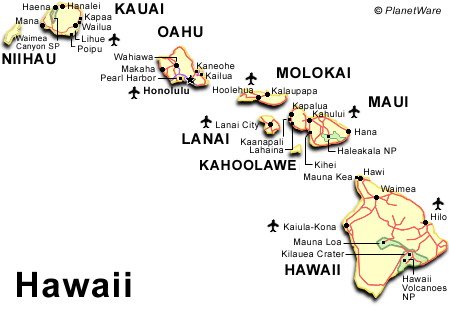
Description
Area: 70sq.miles/181sq.km

County: Kauai

Main village: Puuwai

Niihau Island has belonged for more than 100 years to the Robinson family. Since then the island has been isolated from the rest of the world and is a prohibited area. The inhabitants of Niihau are at liberty to leave the island but still only certain people are allowed to visit (representatives of the health, tax and school authorities, occasionally a doctor and personal guests). Today the island's inhabitants regard their chosen isolation as the only means of leading a natural Hawaiian lifestyle.

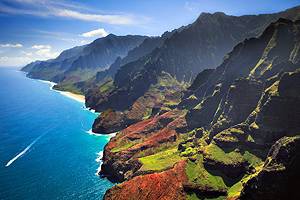
Niihau is the most westerly of the main eight Hawaiian islands. The 70sq.miles/181sq.km-large, 17 miles/28km-long and about 6 miles/10km-wide island is separated from Kauai only by the narrow, approximately 17 miles/28km-wide Kalakahi Channel. Niihau is the oldest of the inhabited Hawaiian islands. The large volcano which originally formed the island was thought to have been between 14769ft/4500m and 19692ft/6000m high. Through millions of years progressive erosion has reduced it to its current size.

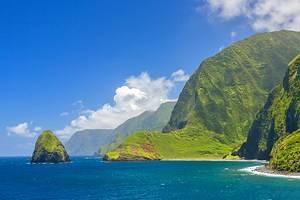
The mountainous part of the island occupies about one third of its surface. The highest point is Paniau at 1280ft/390m. The remaining surface is flat and relatively bare. Niihau is noted for its two freshwater lakes. Despite the low rainfall Halulu Lake is the largest lake in the Hawaiian islands. Although Halalii Lake is much larger it does not contain water the whole year.

The meaning of the word Niihau is not known. The nickname "Forbidden Island" is clear - visitors are not welcome.

Although Niihau is only 44 miles/70km as the crow flies from the rainiest place in the world, Waialeale, Niihau is one of the driest islands in the entire Pacific, with an annual rainfall measurement of only between 41/4in./110mm and 11in./280mm. The reason for the lack of rain is the location of the island. It lies exactly in the rain shadow of the much larger and higher island, Kauai.

Wide expanses of the island are covered by dry grassland - only the most hardy kiawe trees thrive here.

Niihau still has 210 inhabitants. They are pure Hawaiians and lead their lives according to the customs and rituals of the old Hawaiians. Many young inhabitants leave the island, however, which causes the population to decline constantly. It is reported that, in addition to the Hawaiians, about ten Japanese and a German carpenter with a Hawaiian wife live on Niihau.

The traditional features of modern life are not to be found on Niihau. There is no restaurant, neither alcohol nor cigarettes and tobacco can be bought, policemen and a prison are not needed. There is an elementary school in Puuwai which, together with the main house, are the only two buildings supplied with electricity. There are no telephones, no radios or televisions and only a few cars. Until several years ago, carrier pigeons were the only means of communication with the outside world. The children, who are taught in English and Hawaiian, have to continue their education in Kauai, where the nearest high school is located. Then they only spend the holidays at home on Niihau.

Since 1987 it has been possible to fly over the island in a helicopter from Kauai. In addition to this, since 1989, the island can be visited for a short time although contact is not allowed to be made with the inhabitants. In any case, most of the islanders live for the most part on the side of the island (in Puuwai, Kiekie and Nonopapa) opposite the landing point used by visitors. Flights over the island and short visits can be arranged through Niihau Helicopters.
Hobbies & Activities category: Region with significant interests
Attractions Near Niihau Island, Hawaii