

Rick Steves Thinks This Old-School Money Tip Is A Waste Of Time In Europe

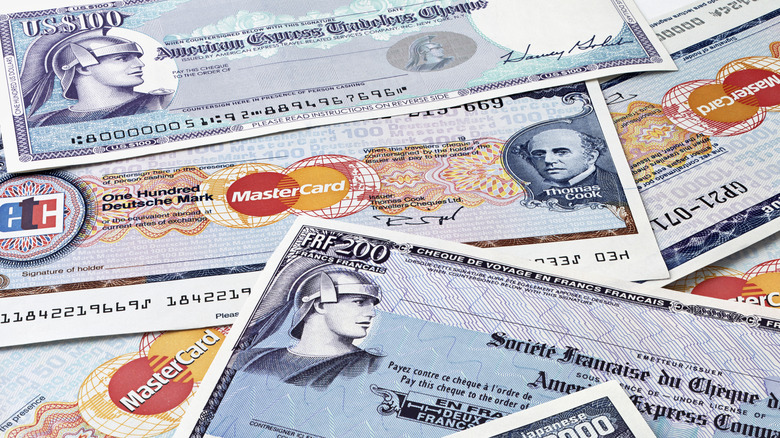
Dealing with foreign currency during a European vacation can be a little stressful. You have to figure out exchange rates where you're going, which can be complicated if you're visiting more than one country. You may wonder if it's worth exchanging actual cash at the airport, or if you should pay in dollars rather than the country's currency if you have the option. You may even wonder about whether or not to use traveler's checks. Luckily, travel expert Rick Steves has some advice on the latter. Steves has doled out practical money advice to tourists for years, and he advises that traveler's checks should remain a thing of the past. On his website, the guidebook author says, "Use ATMs rather than travelers checks. You'll get your cash cheaper and faster."
If you're not familiar with traveler's checks, they're paper documents that you pre-pay for, and you can use them as cash or at a bank in exchange for local money. They're given out in set amounts (such as $20 or $100), and if you use them when shopping, you get change back in currency. You usually have to purchase them from banks or credit unions, sign them there, and then sign them again when you use them for a purchase. You may also have to pay a fee to buy and use traveler's checks. However, some institutions and lenders don't give them out anymore, including American Express (though any you still have will be honored by the company). Additionally, many stores and hotels no longer accept them, meaning you're paying a fee for something you may not be able to use. Some banks in Europe won't accept them, either.
What to use instead of traveler's checks, per Rick Steves
If you've always used traveler's checks and you're not sure what to do without them, Rick Steves recommends using a card and going to the ATM to get cash instead. While he cautions that there are transaction fees, meaning that you should take out more at a time and do fewer transactions, ATMs do, he says, "give the best possible rates." Plus, with ATMs, debit cards, and credit cards, you don't have to visit a bank beforehand to sign things in person.
However, in another post, Steves has a few pointers to know before relying on cards. First, check if your credit cards allow for "tap-to-pay," which is the norm at many European stores. Ask your bank about fees for withdrawals and purchases in Europe, and if there are any foreign transaction or currency conversion fees. It's also a good idea to carry a backup credit card when traveling, just in case. Make sure you have a PIN on your credit card in addition to your debit card, and check daily withdrawal limits for your ATM card so you can plan ahead.
What you should try to avoid, according to Steves, is exchanging money, particularly at the airport. It can be very expensive with high fees. The travel expert has tips on the right way to exchange currency if you don't want to waste money, but in the end, taking cash out of an ATM is much smarter than exchanging currency or using traveler's checks. If you have cash left over before you leave, you may be better off picking up a few fun gifts at the duty-free shop or spending it on your last meal in the country. On that note, Steves reminds you to stay vigilant when shopping in Europe so you don't get ripped off.