Minneapolis Tourist Attractions
|
|
Minneapolis and St Paul, the Twin Cities on the upper course of the Mississippi, together form the largest city in Minnesota, but yet are very different from one another.
Nicollet Mall
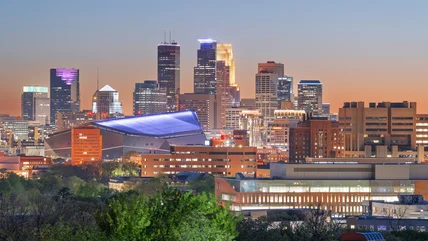
The main shopping center in downtown Minneapolis is Nicollet Mall, a beautifully laid out precinct with a large concentration of shops, restaurants, galleries and other attractions like the Minneapolis Planetarium. The central feature of the complex, over which looms the 775 ft tower of the IDS Center, is the Crystal Court, from which a network of glazed skyways lead to other buildings. Further skyscrapers tower all around: the 57-storey Norwest Center by I.M. Pei, and next to it the new Gaviidae Common shopping mall, the 42-storey Piper Jaffray Tower (222 S 9th St.) and the Foshay Tower (821 Marquette Ave.), the oldest tower block in the city.
Guthrie Theater
The Guthrie Theater in Minneapolis opened on May 7,1963 with a production of Hamlet directed by Sir Tyrone Guthrie, the theater's founder. Today the theater presents classic and contemporary productions with backstage tours available.
American Swedish Institute
The American Swedish Institute on the east side of I 35 West has many different exhibits that demonstrate the importance of the surrounding region's Swedish heritage.The American Swedish Institute in Minneapolis was founded in 1929 by Swan J Turnblad and is housed within the Turnblad mansion. Carved oak, walnut and mahogany are featured throughout the interior and painted plaster sculpturing decorates the ceilings. Swedish glass, textiles, decorative and fine arts are displayed.
City Hall
Minneapolis Society of Fine Arts Complex
The Minneapolis Society of Fine Arts Complex is home to three buildings that surround the courtyard - The Minneapolis College of Art and Design, The Children's Theatre Company and the Minneapolis Institute of Arts.
Minneapolis Institute of Arts
The Institute of Arts has a large collection of works from many countries and in many styles, including pictures by European masters (Rubens, Rembrandt).More than 100,000 objects from diverse cultural traditions spanning 5,000 years of world history are on display. Sculpture, photographs, paintings, drawings, textiles and prints are included.
Children's Theatre Company
The Children's Theatre Company in Minneapolis presents plays for all ages.
Mississippi River
There is an excellent view of the Mississippi and the 49 ft high St Anthony Falls from the walkway of the Stone Arch Bridge, a 19th C railway bridge. Beyond the waterfalls begins the navigable stretch of the Mississippi to the Gulf of Mexico. There are also good views from the locks at Portland Avenue and Westriver Parkway.
University of Minnesota
The campus of the University of Minnesota lies on both banks of the Mississippi. On the east bank are the Bell Museum of Natural History and the Frederick R. Weisman Art Museum, designed by Frank Gehry, which is worth a visit for its eccentric architecture alone.
Frederick R Weisman Art Museum
The Frederick R Weisman Art Museum at the University of Minnesota features American art from the early 20th C to the present. The building is a four-story structure made of stainless steel.
Bell Museum of Natural History
The Bell Museum at the University of Minnesota in Minneapolis features exhibits that include dioramas of the state's habitats from big woods to Great Lakes to prairies. The Touch and See room allows visitors to pet a turtle, stare down a grizzly, and try on a pair of antlers. Oil paintings, sketches and watercolors of wildlife are on display.
Minnehaha Park
To the south-east of the city, extending along the banks of the Mississippi at the 55 ft high Minnehaha ("Laughing Water") Falls, is Minnehaha Park, with statues of Hiawatha and Minnehaha, the chief characters in Longfellow's "Song of Hiawatha".The 193-acre park is one of the oldest and most popular in Minnesota.
Walker Art Center
The Walker Art Center is devoted to 20th C art. Opposite it is the Sculpture Garden, the finest work in which is Claes Oldenburg's "Spoonbridge and Cherry".Paintings, sculpture and prints of American and European art are featured.
Minneapolis Sculpture Garden
The Minneapolis Sculpture Garden features numerous sculptures in an 11-acre urban garden. The Cowles Conservatory features palm and orange trees and a sculpture pond.
Museum of Questionable Medical Devices
Over 325 quack medical devices, dating from 1790, are on display at the Museum of Questionable Medical Devices at the Science Museum of Minnesota. Exhibits include a phrenology machine that measures the size of bumps on the head; a machine that claimed to increase virility and cure prostate problems with a few volts of electricity; a foot powered breast enlarger; and weight reduction glasses.
Mill City Museum
The Mill City Museum in Minneapolis was built within the Washburn A Mill and chronicles the flour milling industry. Hands-on exhibits and the eight-story Flour Tower recount Minneapolis' status from 1880 to 1903 as it dominated world flour production.
Hennepin History Museum
Exhibits at the Hennepin History Museum in Minneapolis include bicycles, fashions, the history of Hennepin County, Dakotah and Ojibway objects, vintage signs from area businesses, and a hands-on gallery for children.
Eloise Butler Wildflower and Bird Sanctuary
The Eloise Butler Wildflower and Bird Sanctuary is a public wildflower garden that presents woodland, swamp and prairie areas with seasonal displays of native wildflowers.
Gateway Center
The Gateway Center District in Minneapolis was the great staging area from which pioneers left to settle the Northwest in the late 1800s. The fountain has colored light patterns from dawn to midnight.
Upper Lock
The Upper Lock in Minneapolis has a lift of nearly 50ft/15m which permits river traffic to reach the railheads, industrial and commercial parts of the city. An observation deck allows visitors to view lock operations.
More Minneapolis Pictures
More Minnesota Resources
- Minneapolis tours and day trips by Viator
Map of Minneapolis Attractions