

The World's Most Turbulent Flight Route Is A Short Trip Nervous Fliers May Want To Avoid
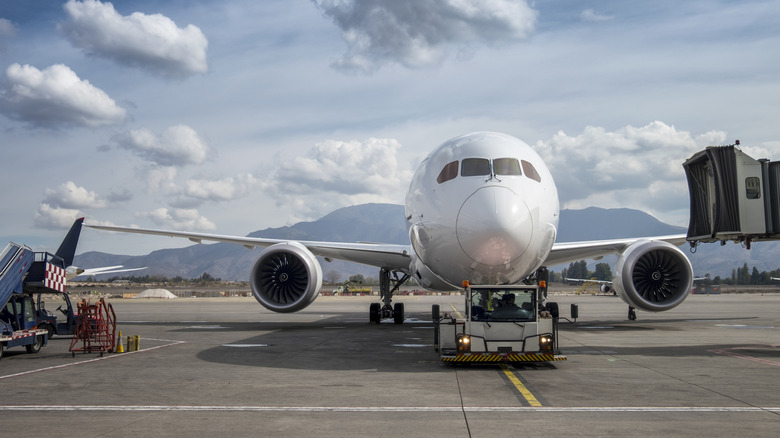
Turbulence during a flight can be anything from a few bumps that splash your drink to a pretty scary drop that makes everyone on the plane gasp. While pilots do what they can to mitigate it, you may want to avoid certain routes that are known for having particularly bad turbulence. Luckily, the world's worst route is a short one. According to a 2025 report from Turbli, the most turbulent flight route in the world is from Mendoza, Argentina's Governor Francisco Gabrielli International Airport (MDZ) to Santiago, Chile's Arturo Merino Benítez International Airport (SCL).
To find out which route is the worst, Turbli looked at around 10,000 flights between 550 airports. It ranked turbulence by eddy dissipation rate (EDR), which is, according to Skybrary, "the rate at which energy dissipates in the atmosphere." Turbli then divided turbulence into levels: light turbulence (zero to 20 EDR), moderate (20 to 40), moderate-severe (40 to 60), severe (60 to 80), and extreme (80 to 100). The route from Mendoza to Santiago has an average EDR of 22.983, and the distance is just under 122 miles. That's around an hour long, which sounds short, but if you're a nervous flier, it can feel like forever. If you're wondering about flights closer to home, the most turbulent flight route in North America is between Denver, Colorado, and Jackson Hole, Wyoming, which is also a relatively short flight. That one has an average EDR of 18.18 and is just under 406 miles. In case you weren't aware, climate change is the reason turbulence has been getting worse over the years.
How to deal with turbulence when you're on a flight
It's smart to be prepared for turbulence when you're flying, just in case. You may notice that flight attendants sit on their hands during takeoff and landing. While it's protocol for them to prevent injuries, you don't actually have to do that yourself, but you should obey the seat belt sign and any other directions given by the cabin crew. The Federal Aviation Administration (FAA) explains on its website that turbulence comes from conditions like jet streams, weather changes, and how air moves around mountains, and it can happen unexpectedly. This is why it recommends that you keep your seat belt fastened when you're sitting in your seat, particularly when the plane starts moving and during taxiing, takeoff, and landing.
You should also make sure your personal items are secured under your seat, and pack what you'll need for your flight there so you don't have to stand up and open the overhead bins. If you know you'll be on a turbulent route, take a travel mug or water bottle with a lid and put any drinks from the flight attendants inside so they don't spill. Nervous fliers can also do breathing techniques, such as the 4-7-8 technique: breathe in for a count of four, hold for a count of seven, and breathe out for a count of eight. You may also want to look at your in-flight entertainment choices, as many airlines have programs to help you stay as relaxed as possible.