
The Old-School Travel Essential You're Better Off Leaving At Home
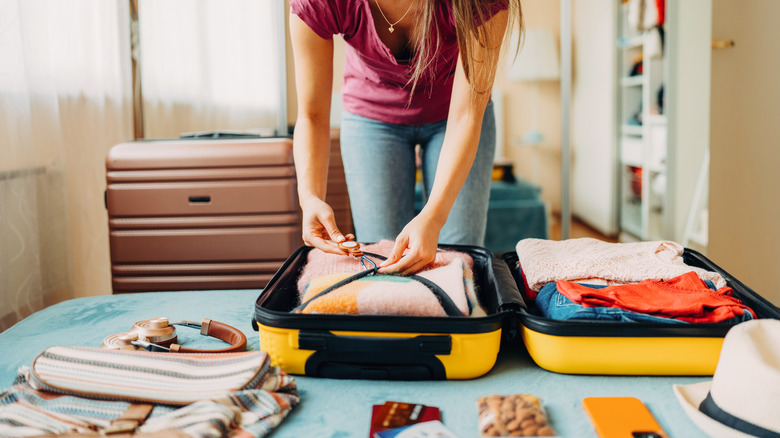
When you're heading out for a trip to another country, there are time-honored essentials you probably pack. You have to have your passport, a visa if it's required, and your favorite neck pillow for the plane. However, there is one old-school travel essential that you no longer need to pack, and that's your phrase book or travel dictionary. It's sad, in a way, as it was often fun to crack these things open and begin learning another language. It could be comforting to have a small book in your bag, just in case you got into trouble understanding someone or making yourself understood.
However, these days, you can use your smartphone to instantly translate conversations in real time with apps, such as the lifesaver Translate app preinstalled on newer iPhones, Google Translate, or the live translation feature available on some AirPods models. That means you don't have to add weight to your bag with an actual book, or thumb through the pages to look for what you want to say.
It isn't just conversations where modern tech comes in handy. You can use the Google Translate app in camera mode to live-translate menus, signs, and labels. It's incredibly handy and may feel less intimidating than trying to use the limited language skills you learned in high school. However, that doesn't mean you shouldn't try to pick up some of the language before you go. Even memorizing just a few phrases can make communication feel a lot smoother.
Getting by without a travel dictionary

Knowing a few key phrases, from greetings to pleasantries like "thank you" and "you're welcome," can make you feel less dependent on a device. It can also be helpful if you lose your phone or if you're in an emergency. Additionally, it's a sign of respect in another country where you're a guest. Knowing how to be polite if your phone battery dies can go a long way.
All of that said, technology can be a real gift if you have to take a last-minute trip for work, if you have issues learning a language, and for accessibility. Prices for international phone plans generally aren't that expensive these days. Plus, you can get relatively inexpensive eSIM cards to use in your phone in another country so you don't have to worry about roaming charges or overages on your international plans. However, keep in mind that you may need an unlocked phone or an eSIM that is compatible with your phone. (Check on this before you leave for your trip.)
All of this doesn't mean you should get rid of phrase books or travel dictionaries you have at home. If you're better at learning a language (or at least a bit of it) visually, and you don't want to have your eyes on a screen in a language-learning app, you can use these books to help you prep for a trip before you leave. Finally, if you're going to try to learn at least a few phrases in another language before your trip, make sure this important phrase is one you commit to memory.