

5 Code Words Flight Attendants And Pilots Use In Emergency Situations
"Cross-check," "tray tables up," and "secure your own mask before assisting others" are just a few common phrases frequent fliers have heard from flight crews countless times. If you've interacted with flight attendants enough, you may have even picked up some of the specific lingo they use during a flight. Interestingly, some of these terms are a kind of flight attendant shorthand, referring to everything from irritating passenger behavior to onboard meal offerings to more irritating passenger behavior. But while plenty of crew lingo covers low-stakes situations, a few terms are associated with far more serious ones.
When emergencies happen aboard commercial aircraft, flight crews have the dual task of handling the situation and minimizing passenger panic. Crews may use codes, phrases, and other signals to communicate with one another without necessarily tipping off passengers that something is wrong. However, emergency code words are not universally standardized in global air travel; instead, they can vary among crews, airlines, and regions. Still, some are common enough among air crews based in North America and Europe. From onboard medical emergencies to mechanical issues to even more serious situations, these five code words may be used by flight crews during emergencies.
Code Yellow
Many terms flight crews use are meant to sound somewhat cryptic to passengers. For example, the seemingly complimentary term "VIP" isn't as good as it sounds. "Code Yellow," on the other hand, is probably closer to what most passengers would expect when they hear it. Among some flight crews, "Code Yellow" may refer to a potential medical issue with a passenger, generally one less severe than a life-or-death health emergency.
If you hear "Code Yellow" spoken by a flight attendant on your next flight, it may mean that another passenger is experiencing a medical concern that requires extra caution but has not yet risen to the level of a serious emergency. The exact meaning and severity may vary between flight crews. In some cases, the term may refer to a passenger dealing with airsickness, lightheadedness, or something else fairly minor. "Code Yellow," therefore, can let flight crews discreetly monitor a potentially significant medical situation and prepare any assistance that may be needed.
Pan-Pan
Observation skills are essential for any good flight attendant. As soon as passengers begin boarding an aircraft, flight attendants watch for everything from potential medical issues to awkward passenger traits like body odor, along with anything that could cause major problems for the flight. When an urgent situation does arise, however, pilots have their own terminology for communicating with air traffic control. One such term is "Pan-Pan," which is used for urgent situations that do not yet rise to the level of an all-out emergency.
Pilots use "Pan-Pan" when a situation arises that requires prompt attention but does not, at the moment, require immediate assistance. What that situation is can vary considerably depending on the circumstances, but "Pan-Pan" may be used for things like airplane fuel concerns, potential mechanical issues, or medical problems. Unlike informal cabin code words, it is an internationally recognized urgency signal. If "Pan-Pan" sounds too whimsical for a potentially serious situation, it helps to know it comes from the French word "panne," which translates to "breakdown." In essence, "Pan-Pan" is a way for pilots to convey that they have an urgent problem but aren't yet at full "Mayday" levels of danger.
Angel
While terms like "Code Yellow" and "Pan-Pan" may be concerning, they ultimately refer to situations that can sometimes resolve themselves without incident. However, there are other flight attendant code words you definitely do not want to hear on a flight. The word "Angel" can sound positive or negative, depending on your perspective. Among some flight crews, though, "Angel" can refer to a serious or tragic medical situation, including an onboard death.
The prospect of a dead passenger on board can easily disturb or distress the remaining passengers, especially if passengers find themselves having to sit next to an actual dead body. In situations where a passenger does experience a life-threatening emergency or death, code words like "Angel" help flight attendants discreetly and respectfully handle the situation without alarming the rest of the cabin. Other flight crews may use different terms to describe serious medical situations or potential deaths among a flight's passengers. In some cases, the term "Code 300" has also been reported for situations involving a passenger who is unresponsive, in serious distress, or deceased. Neither term is standardized across airlines.
Squawk 7500
The death of a passenger on board is certainly tragic, but frequent fliers would probably hope that life-threatening medical emergencies are the worst thing that could happen during a flight. Sadly, as recent history has shown, other potential emergencies can be even more catastrophic. "Squawk 7500" is a funny-sounding aviation code that refers to a far from funny situation. Officially, transponder code 7500 signals that an aircraft is being hijacked or subjected to unlawful interference.
Plane hijackings and hijacking attempts are not actually new. The earliest documented incidents date back decades, with hijackings becoming especially frequent between 1968 and 1972. Motives varied, with some hijackers seeking to reroute a plane to a new destination for political reasons and others making ransom demands. In the infamous D.B. Cooper case, the perpetrator hijacked a plane to acquire a ransom.
Because the prospect of a hijacked flight can cause so much alarm among passengers, pilots can set the transponder code "Squawk 7500" to discreetly alert air traffic control to a hijacking or unlawful-interference situation. This allows the crew to communicate that something is wrong without necessarily having to explain the situation over the radio.
Easy Victor
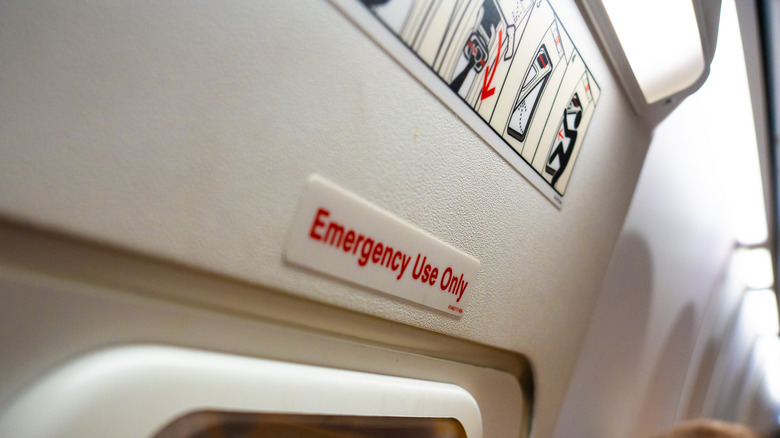
"Easy Victor" is another flight attendant code term that is much more serious than its constituent words would imply. If the initials EV weren't a giveaway, "Easy Victor" is used when an aircraft may need to be evacuated. Pilots may give the code to flight attendants to alert them to prepare for a possible evacuation and assess their exits. The exact situation when this term becomes relevant can vary, but it may include cases where a plane is about to make an emergency landing or a flight still on the ground may need to be evacuated due to fire, security threats, or other dangers.
As with many emergency code words, "Easy Victor" may be used instead of immediately announcing an evacuation to reduce unnecessary alarm among passengers while crews prepare. Air travel can be anxiety-inducing, after all, even in ideal conditions. If passengers hear the word "evacuation" before the crew is ready to give instructions, panic could make safe evacuation more difficult. Ultimately, passengers should follow the flight crew's direct instructions rather than trying to interpret an overheard code themselves.