

The 'Grand Canyon Of Colorado' Is An Awesome National Park With Unique Views
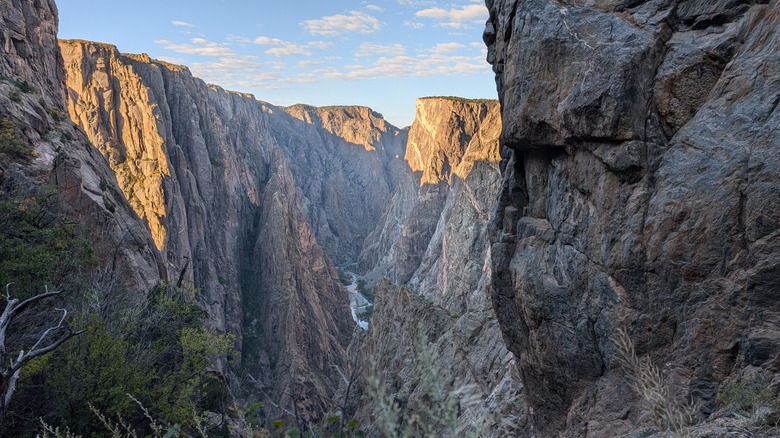
Colorado needs little introduction among outdoor lovers, largely thanks to its monumental Rocky Mountains and their unforgettable activity offerings. Colorado's topographic magic, however, does not exclusively reach skyward. One of the state's most awe-inspiring natural features is not a towering mountain peak at all, but rather a breathtaking (and perhaps dread-inducing, given its steep drops) canyon. Nearly five hours by car west of Denver lies the extraordinary Black Canyon of the Gunnison National Park and its titular canyon.
As the unofficial "Grand Canyon of Colorado," the Black Canyon of the Gunnison offers incredible views of geology in action, while Colorado's Rocky Mountains provide a backdrop that is quite different from the more famous canyons of Arizona and Utah. The United States does have many canyons that are (arguably) more beautiful than the Grand Canyon, some of which even exceed the Black Canyon of the Gunnison in terms of raw dimensions. Few, however, have the Black Canyon's sheer heart-stopping vistas and scenery that straddles the border between awe and terror. For sightseeing alone, Black Canyon of the Gunnison National Park offers some of the most unique views of any natural wonder in the United States. Beyond its photo-worthy shots, the Black Canyon of the Gunnison offers hikes that are unsurpassed for dramatic, Instagrammable views and some of the most daring rock-climbing challenges in the U.S. national park system.
Steep cliffs, ancient rocks, and breathtaking views in the Colorado Rockies
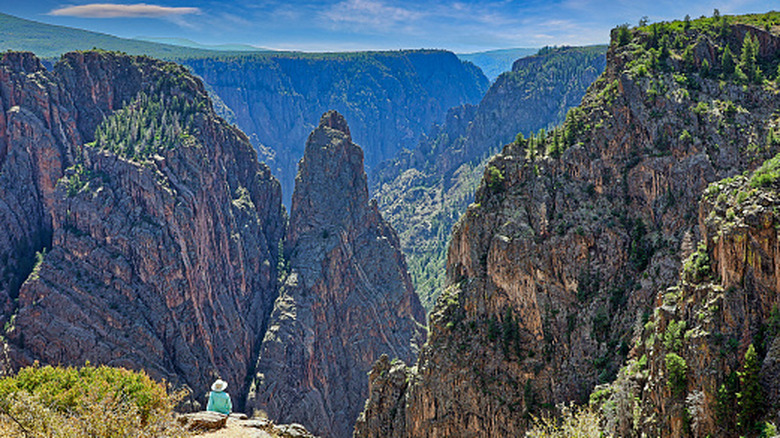
Black Canyon of the Gunnison's dimensions are impressive on paper alone. The canyon drops 2,722 feet at its deepest point and extends 48 miles long. While not as deep as canyon heavyweights like the Grand Canyon or the record-holding Hells Canyon, the Black Canyon of the Gunnison outranks many other prominent American canyons like the Grand Canyon of the Yellowstone, New River Gorge, and its Colorado neighbor Royal Gorge. Taken alone, these dimensions are enough to rank the Black Canyon of the Gunnison as one of the most iconic landmarks to visit in Colorado.
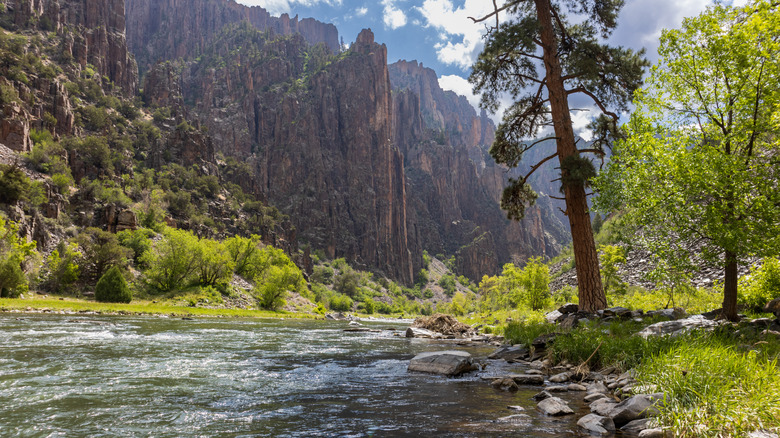
However, the Black Canyon's magnificence is just as much about quality as quantity. The canyon's dramatic multi-colored walls are among the steepest cliffs in North America, with the 2,250-foot Painted Wall being Colorado's highest. The canyon's lofty rocky spires add a cathedral-like atmosphere along the canyon rims. Roughly 2,000 feet below, the powerful Gunnison River descends an average of 43 feet per mile through the canyon, with a maximum descent of a precarious 240 feet in 1 mile at the park's Chasm View. At points, the canyon narrows to a mere 40 feet from rim to rim, shrouding the raging river below in a mysterious shadowy darkness that adds to its haunting, gothic quality.
Though not as immediately apparent, the Black Canyon of the Gunnison's geology is just as impressive. The canyon's rock layers provide a grand snapshot of eons of the Earth's geological processes. Parts of the canyon's walls feature some of the oldest exposed rock in the world — dating back around 2 billion years! Black Canyon of the Gunnison National Park also contains 15,599 acres of designated wilderness.
How to experience the Black Canyon of the Gunnison in person
Despite its arresting appearance, Black Canyon of the Gunnison is the least-visited of Colorado's four national parks, receiving only around 250,000 visitors in 2025. Though undeserved, this lack of popularity does mean the park often avoids the crowds that can afflict more popular Colorado darlings like Rocky Mountain National Park. Visitors who make the trip can usually enjoy the park's outstanding recreation options and unique views in peace and solitude. The national park space divides into two sections on either side of the canyon. The South Rim is busier, more developed, and (relatively) more reachable, while the North Rim is less developed, less crowded, and more rugged.
The South Rim has 12 different canyon overlooks, including the amazing Painted Wall Overlook highlighting the canyon's colorful Painted Wall cliff. Other South Rim overlooks exhibit geological formations like the eye-catching Pulpit Rock and panoramic canyon viewpoints like Warner Point. The South Rim also provides access to the park's East Portal, bordering the adjacent Curecanti National Recreation Area. On the North Rim, visitors can find more unique rock formations, with evocative names like Kneeling Camel and Balanced Rock.
Both the South Rim and North Rim have expansive networks of trails ranging from short and easy to long and strenuous. More daring (and experienced) visitors can attempt the park's expert-level rock climbing routes, which count among the country's most technically demanding. Alternatively, Black Canyon of the Gunnison's scenic drives offer much less dangerous canyon-viewing experiences. The national park has one developed campground on each rim, though the park is also just 12 miles from the city of Montrose and 23 miles from the underrated Colorado outdoor adventure town of Paonia.