

These Huge US Airlines May Soon Merge Into One. Here's What It Could Mean For Travelers
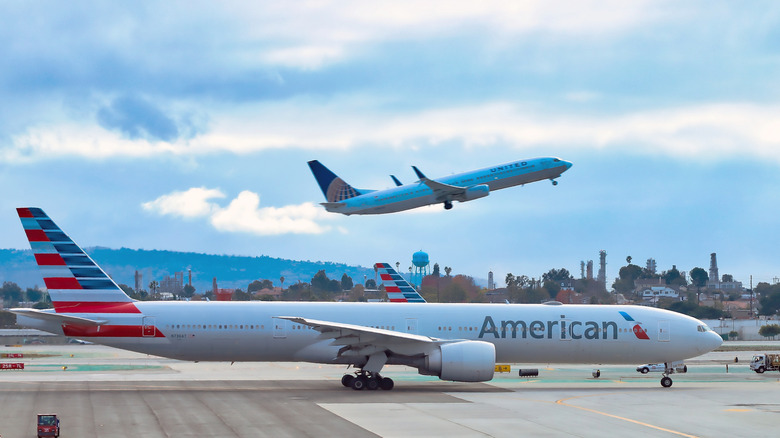
Change is in the air — or, at least, it might be. American Airlines, the world's largest airline by passenger count, and United Airlines, the world's largest by revenue passenger miles, may join forces. If this merger were to happen, the new airline would become the largest in the world. Experts say that it would reshape the commercial airline industry, but that the deal is unlikely to go through. Analysts also believe that travelers will not benefit from the changes.
On April 13, 2026, Reuters and Bloomberg reported that United Airlines CEO Scott Kirby raised the idea of the merger between United Airlines and American Airlines while meeting President Trump in February. Kirby pitched the merger as making U.S. commercial aviation more competitive internationally. Per Reuters, Kirby said that foreign airlines dominate about two-thirds of long-haul flights in and out of the U.S. But according to legal experts in a related Reuters article, Kirby's proposal to create the world's largest airline would face tremendous regulatory challenges before it comes to fruition. It would "almost certainly draw heavy scrutiny from both the Department of Justice and the Department of Transportation," said aviation attorney Mark Dombroff to Newsweek. George Hay, law professor at Cornell University, echoed this statement. "I can't even see the slightest chance that a court would allow it," said Hay to CNBC. Other opposing forces could include states, unions, airports, lawmakers, and consumer rights groups.
Currently, the four biggest airlines in the United States — United, Delta, Southwest, and American — make up 75% of the national market, per aviation guide OAG. It's estimated that the mega-airline would have about 40% of the share. Matt Woodruff, head of aerospace, defense, and transportation at CreditSights, said in the Newsweek report that certain hubs would be especially impacted. At Chicago O'Hare International Airport — the U.S. airport with the most non-stop flights — the new airline would reportedly operate 88% of departures, which would likely lead to antitrust enforcement.
How the United-American Airlines merger would affect passengers
A merger between United Airlines and American Airlines might be in a better position to compete internationally, but consumers would likely be worse off. Several legal experts have said that the move would make flying more expensive for travelers. Antitrust lawyer with DBM Law Group, Andre Barlow, said in the Reuters report, "This deal would reduce choices and give the airlines more pricing power, which means higher fees for consumers." Historically, this has also been the case. According to research published in the Economics of Transportation back in 2017, the United Airlines merger with Continental Airlines led to higher airfare prices on certain routes.
The mega-airline could also affect flights at certain airports. Jim Speta, antitrust expert and law professor at Northwestern University, said to Chicago Tribune that it would likely have to surrender gate space to other airlines and make cutbacks to its schedule. Paul Hudson, president of non-profit Flyers Rights, noted to KTVU that a merger would mean "fewer flights, less convenience, and more delays." Travelers are already being told to prepare for flight disruptions to European destinations, so more setbacks would be a tough pill to swallow. With so many frustrating aspects of flying to contend with these days, the last thing we need is another hurdle.
In 2024, the Justice Department blocked JetBlue's proposed $3.8 billion purchase of Spirit Airlines because the transaction violated antitrust laws and was unfriendly to passengers. However, U.S. Transportation Secretary Sean Duffy recently said in an interview with CNBC that President Trump "loves to see big deals happen." Duffy said that he believes there is room for mergers in the aviation industry. Only time will tell if this merger does move forward, but if it does, it will change air travel as we know it.