Granna Attractions
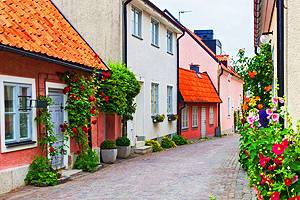
40km/25mi northeast of Jönköping is Gränna (pop. 2,200), one of the few towns with old wooden houses which have not been devastated by fire. With its charming old-world architecture and its beautiful situation on Lake Vättern, at the foot of the Grännaberg, this idyllic little town has become a popular holiday resort. It also serves as a connection point for the ferry service to the island Visingsö.
The town was founded in 1652 by Count Per Brahe, who laid out the main street (Brahegatan), which then consisted of only 10 houses, in such a way that he could see it from his castle of Brahehus (now a ruin). He also built the Town Hall, with its belfry, and enlarged the medieval church. The church, now a handsome Baroque edifice, stands above the village at the foot of the hill. In the cobbled market square is the Medborgargård (Community House). In Museigården can be found the Andrée Museum, commemorating the engineer and Arctic explorer Salomon Andrée, a native of the town (b. 1854) who was lost in 1897 during an attempt to fly to the North Pole from Spitzbergen in a balloon.
Gränna is noted also for its polkagrisar (polka-dotted piglets") - sticks of red-and-white striped peppermint rock.
The sweets were first created in 1859 by a widow, Amalia Eriksson - her statue stands in the park at the foor of Gränna mountain.
The town was founded in 1652 by Count Per Brahe, who laid out the main street (Brahegatan), which then consisted of only 10 houses, in such a way that he could see it from his castle of Brahehus (now a ruin). He also built the Town Hall, with its belfry, and enlarged the medieval church. The church, now a handsome Baroque edifice, stands above the village at the foot of the hill. In the cobbled market square is the Medborgargård (Community House). In Museigården can be found the Andrée Museum, commemorating the engineer and Arctic explorer Salomon Andrée, a native of the town (b. 1854) who was lost in 1897 during an attempt to fly to the North Pole from Spitzbergen in a balloon.
Gränna is noted also for its polkagrisar (polka-dotted piglets") - sticks of red-and-white striped peppermint rock.
The sweets were first created in 1859 by a widow, Amalia Eriksson - her statue stands in the park at the foor of Gränna mountain.
Read More