Ängelholm, lying north of Helsingborg at the head of the inlet of Skäldervik in the Skagerrak, was founded in 1516 by King Christian II of Denmark, but its origins go farther back to the medieval town of Luntertun, near Rönne Bro, on Skäldervik, of which there now remains only a ruined church. Christian moved the site of the town farther inland for defensive reasons. Strategically situated near the mouth of the Rönneå, it was until the beginning of the 18th century a bone of contention between Denmark and Sweden.
Since the 16th century Ängelholm has been a favorite haunt of salmon fishermen. Now an industrial town, it has a military airfield, the base of a squadron of the Swedish air force, as well as a civil airfield.
The Town
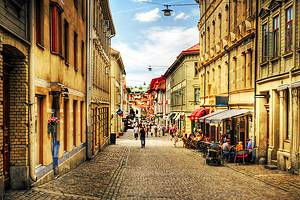
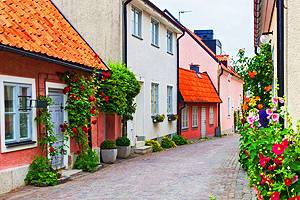
Ängelholm has preserved its small-town aspect, with narrow little streets and low houses. In the market square (Stortorget) are the old Town Hall (1775; renovated) and the church (originally 1516; altered in the 19th century). To the southeast, on the Rönneå, are the new Town Hall (1975) and the landing-stage used by the tourist boat "Laxen" ("Salmon"). In Tingstorget, housed in Sweden's oldest state prison (1780), is the Craft Museum, with a potter's workshop.
Tourists flock to Ängelholm for the popular sandy beaches located just outside the town. Wind surfers and sailors also enjoy the winds in Skälderviken bay.
From Torekov, Road 115 runs east to Hov. A rewarding side trip from this road is to the Hovs Hallar nature reserve, where the Hallandsåsen range of hills ends abruptly on the coast, with striking rock formations. From here the "Italian Road" winds its way eastward to a beautiful park, Norrvikens Trädgårdar.
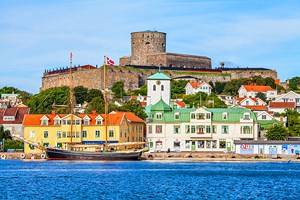
A road goes north from Vegeholm along the coast to Barkåkra (12th C. church) and Torekov, at the tip of the Bjäre peninsula. This little fishing village is now a popular seaside resort. Features of interest are the Maritime Museum, housed in an old sailing ship, and the Rosa Ljung ceramic factory (ornaments).
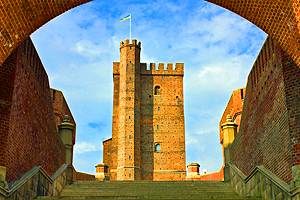
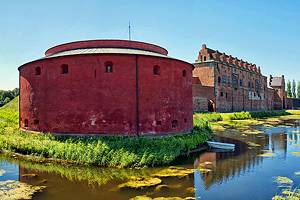
6km/4mi south of Ängelholm, set in a large park on an island in the Vegeå, is Vegeholm Castle (16th C.), with two square towers. From here Road 112 runs west to Höganäs and Mölle.
From Torekov there are boat services to the island of Väderö (area 3sq.km/1sq.mi). The whole island is a nature reserve, the haunt of large numbers of birds.