Description
States: Arizona, New Mexico, Utah

Area: 24,980sq.mi/64,700sq.km

Situation and characteristics

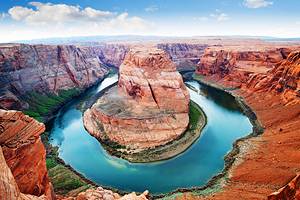
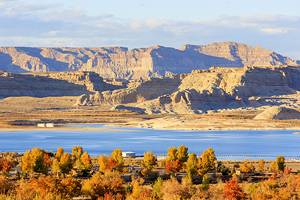
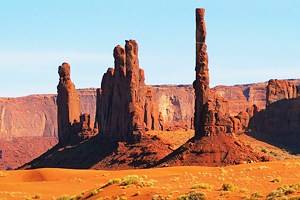
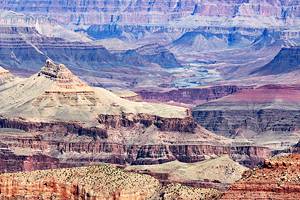
The Navajo Indian Reservation (Navajo Country), established in 1868, is the largest Indian reservation in the United States. Lying for the most part in Arizona, it is bounded on the west by the Colorado River and on the north by Lake Powell, a long artificial lake formed in a canyon, and the San Juan River; the boundaries on the east and south are ruler straight. Much of the central part of the territory, roughly half of which is barren and infertile, is a desertic tableland slashed by canyons. To the east, striking north-south, are the Chuska Mountains, with Pastora Peak (9,413ft/2,869m); to the northeast is the Ute Mountain Indian Reservation in Colorado; and to the southwest is the Hopi Indian Reservation, which has an area of some 560sq.mi/1,450sq.km. The most interesting parts of Navajo Country, both scenically and culturally, are organized and protected as Tribal Parks or National Monuments. The largest settlements in the reservation are Window Rock (Navajo), the Indian-run administrative center of the reservation, and Hotevilla (Hopi). The Navajo

The Navajo or Navaho (pronounced n vaho), who call themselves the Diné ("people of the earth"), are the largest of the Indian tribes of the United States, with some 200,000 members. Around the middle of the 16th century the Navajo, then semi-nomadic, ranged over North America from northwestern Canada to the southwestern United States, where they came in contact with the local Pueblo Indians. From them the Navajo learned weaving and, on a modest scale, farming (maize, pulses). The Spaniards introduced them to the use of tools and firearms and to horses, cattle, sheep and goats, and they then took to stock-rearing (mostly sheep). They put up a fierce resistance to the advance of the whites into their territory, but in 1864, under their chief Manuelito, were compelled to acknowledge defeat after Kit Carson and his forces, avoiding open battle, burned their pastureland, crops and dwellings. The survivors were then forced to undertake a 300mi/500km trek to Bosque Redondo, by Fort Sumner in New Mexico, on which many died. There the Navajo, now reduced to only 8,000, were held prisoner for four years in appalling conditions, after which they were allowed to return to the area of the present reservation on condition that they gave up all resistance to the presence of the whites.

The Navajo now live mainly by cattle-rearing and the sale of craft objects. The mineral resources of the reservation (coal, uranium, etc.) are still mainly worked by whites, the Indians having been bought off with derisory sums. There is little in the way of industry, and the unemployment rate is high. Many of the Navajo, who are reserved but not unfriendly, live in "hogans" - windowless huts of wood, brushwood and clay - and stick to their traditional social structure and beliefs. The reservation is run by a 74 member tribal council based in Window Rock. It has some schools, and in Many Farms is the Navajo Community College, established in 1969.

Art

Navajo art of the early period is represented mainly by pottery vessels and pipe bowls. The Navajo learned their craft skills from the Spaniards and the Pueblo Indians, achieving a great cultural flowering in the 19th century. The weaving techniques of the Pueblo Indians, which were practiced by men, were imitated by Navajo women. Their favorite products were the patterned blankets which were used for clothing, bed covers, hogan doors or wall decoration. The abstract geometric patterns, rarely repeated, which gave expression in allegorical form to themes from tribal history or the conflict with the whites, consisted originally of plain horizontal stripes (the "chief" pattern), later supplemented by squares, lozenges and zigzag-lines (the "eye-dazzler" pattern). The colors (predominantly shades of brown) were obtained by dyes made from plants. When European yarns and synthetic dyes were introduced in the later 19th century the traditional artistic elements were increasingly abandoned, the weave became looser, the colors brighter, the patterns more standardized, abstract patterns being replaced by representational designs. Textiles imitating the Indian blankets were now manufactured commercially by whites and sold widely throughout the United States. In addition to weaving the Navajo produce attractive silver jewelry inlaid with precious and semi-precious stones (mainly turquoise). Like the Hopi, they practice the ritual art of sand painting.

Customs

Apart from rock drawings no written material survives from the early days of the Navajo, but over a thousand Indian legends and hundreds of prescriptions for ceremonies have been handed down orally and in more recent times recorded in writing or on tape. Among traditional rituals is the sacred sun dance, which was prohibited for many years by the United States authorities.
Attractions Near Navajo Indian Reservation (Navajoland), Navajo Indian Reservation, Arizona - Indian Country