

What Do The Giant Numbers On Airport Runways Actually Mean?
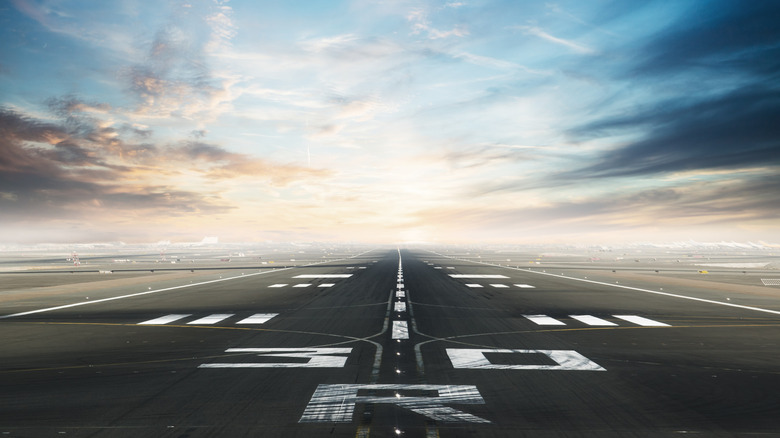
When you're sitting on a plane, waiting to take off for your business trip or vacation, you may spend a bit of time thinking about the flight. Maybe you're debating the lack of legroom on planes these days or wondering about the etiquette around who is entitled to use an empty middle seat. Perhaps you've also wondered what the giant numbers (and sometimes letters) on airport runways mean while looking out the plane's windows. They may seem like simple identifiers, but they actually have a very specific meaning: The numbers indicate the degrees away from magnetic north that the runway is facing, and the letters help tell parallel runways apart.
Consider a compass, which uses zero for magnetic north. As you go around the dial, you are degrees away from magnetic north. To find the number for a runway, you use the number of degrees away from magnetic north, round it up or down to the nearest 10, and then remove the last zero. If you're looking at a runway with "30" painted on it, it may be, say, 303 degrees from magnetic north. You'd round that down to 300 and remove the final zero. From that, you get 30. However, there is one exception: If the runway is pointing directly at magnetic north, which would be zero degrees, it isn't indicated that way. Instead, it's called "36." (If you add a zero to 36, it's 360, the number of degrees in a circle.) Note that runways always use Arabic numbers, no matter where they are in the world, and they're always painted white.
Understanding and identifying plane runways
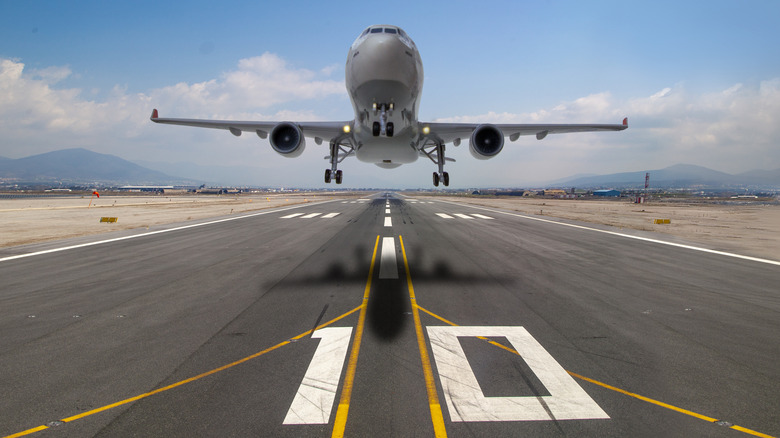
You may also see the letters "L," "C," or "R" along with the runway number. These help differentiate parallel runways. If you have two with the same number, you would mark the left one "L" and the right one "R." So, "30R" is runway 30 on the right, meaning there is also a 30L runway to the left of that runway. If you have three parallel runways, the middle one is marked "C" for center. If you have a fourth, it goes up a number. So, you might have a "30L," a "30C," a "30R," and then a "31," even though the last runway is pointing in the same direction. Additionally, since magnetic north tends to move around, sometimes runway numbers have to change. There are also some airports that use true north instead of magnetic north if they're in an area where magnetic north tends to vary significantly. If you hear a flight being cleared to land, the numbers are said individually, like "three, zero, right," rather than "30R."
Runways point in the directions they do because of a few factors. First, the most dominant wind direction helps determine where the runway goes, so the plane isn't buffeted by wind from the side, and places with different wind directions may have several runway directions. However, that can shift a bit due to barriers, like a coastline, mountains, or other types of terrain. Additionally, manmade structures may require that runways move, as can cities and towns that would be affected by the sound of constant flights taking off overhead.
Now that you understand a bit more about airport runways, you may want to learn why airplane turbulence has been getting worse over the years.