

The South's Sprawling National Park Spans Three States And Rivals The Smokies With Fewer Crowds

The Appalachian Mountains, a roughly 2,000-mile mountain range, are one of the East Coast's most remarkable natural wonders. Great Smoky Mountains National Park is indeed a glorious destination for nature lovers seeking to immerse themselves in the region's beauty. However, it also happens to be the most visited national park in the United States, with roughly 13 million visitors per year. If you want to experience Appalachia's natural beauty without the crowds, head about 100 miles north to Cumberland Gap National Historical Park, which receives just under 800,000 visitors per year. For another less-crowded alternative to the Smokies, consider nearby Roan Mountain State Park.
A geological anomaly, Cumberland Gap is one of the few naturally formed transportation corridors that cut right across the mountains from east to west. Archaeological evidence indicates that Native Americans traveled through Cumberland Gap as early as 8,000 years ago, and their descendants are today the Cherokee, Shawnee, and Creek peoples. For centuries, this land was used as a hunting route by Shawnee and Cherokee Native Americans who lived in the region. It was a passage used by migratory wildlife, notably bison and elk.
Today, Cumberland Gap National Historical Park protects approximately 24,000 acres across Kentucky, Virginia, and Tennessee and offers 85 miles of trails along abundant natural beauty. Visitors may spot cottontail rabbits, bobcats, gray foxes, black bears, wild turkeys, snakes, and other wildlife. The park offers frontcountry and backcountry camping, with enough to see and do to fill several days of exploration. Cumberland Gap is about a 1.5-hour drive from Knoxville, Tennessee, and nearly a three-hour drive from Lexington, Kentucky. No entrance pass is required.
Witnessing Cumberland Gap's natural beauty
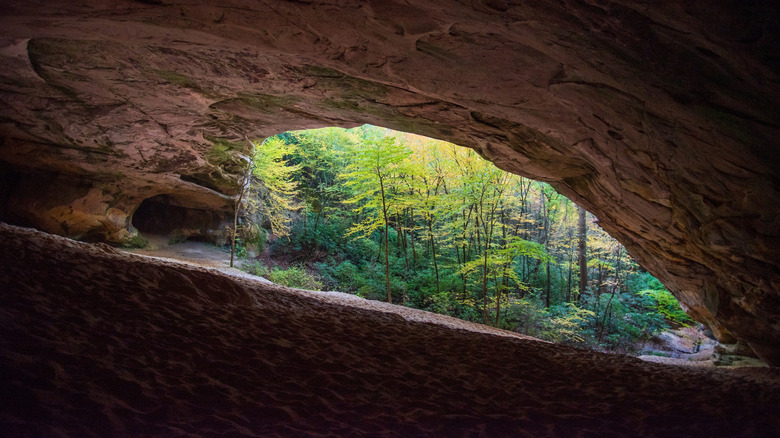
This park is rich in rugged mountain trails and geological wonders, due in part to its location on a stretch of limestone that has eroded over millions of years. As a result of that erosion, the park has at least 30 known caves, as well as pits, sinkholes, and springs. Gap Cave, for example, is the longest known cave in the park and is open to visitors through ranger-led cave tours. Along its 18 miles of passages are incredible formations such as stalactites, stalagmites, pillars, and flowstone formations. Tours are two hours long and offered between May and August at $8 per adult and cover a good deal of the history of the cave and its significance in Native American life, the Civil War, and mining. Some lucky visitors might spot some cave dwellers such as bats, cave salamanders, cave crickets, and pack rats.
Another one of the most beloved and visually stunning sites in Cumberland Gap is the Sand Cave, accessible via Ewing and Ridge Trails. This massive domed cave sits on the Kentucky side of the park, was formed by wind and water erosion, and covers an area of 1.25 acres. Long ago, it was used as a shelter by Native Americans and early settlers. A short hike from Sand Cave are the massive 500-foot cliffs known as White Rocks. Both Sand Cave and White Rocks are accessible via the Ewing and Ridge Trails, which make for a challenging hike especially due to the ascent of more than 2,000 feet up rugged mountain terrain. If you're looking for a similarly spectacular view without the strenuous hike, head over to Pinnacle Overlook, which is just a short drive from the main visitor's center and offers stunning views of the famed Gap itself.
Exploring Cumberland Gap's expansive history
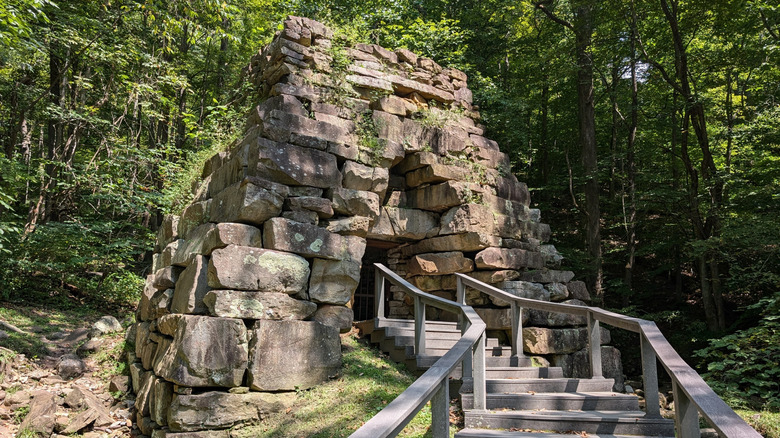
Cumberland Gap is a site of major historical significance in the lives and cultures of Native Americans, early settlers, Civil War soldiers, miners, and others. Much of the park's programming is dedicated to educating visitors about that history. The programs run primarily between June and September and cover a wide range of topics. For example, the Furnace Friday program is centered on sharing the significance of a large 19th-century furnace that sits just below Gap Cave. The Iron Furnace was used throughout the 1800s to smelt iron and was a major part of local technological and economic innovation. If you'd like to see more than just one historic site, you might want to take a guided Historic Cumberland Gap Tour. On a moderate 1.2-mile hike, you'll hear stories about the different kinds of people who have passed through Cumberland Gap and left their mark over many, many years. You can get up-to-date information about scheduled programming at The Cumberland Gap National Historical Visitor Center, located in Middlesboro, Kentucky.
Comparable to the way Pigeon Forge is a gateway town to the Smoky Mountains, the towns surrounding Cumberland Gap National Historic Park are also well worth a visit. Middlesboro, for instance, is a historic boom town built entirely within the circumference of an ancient meteor crater. It's also home to one of the oldest golf courses in the U.S., and its charming downtown is on the National Register of Historic Places. Slightly further east, on the Tennessee side, the town of Cumberland Gap is just as quaint. The town is home to a handful of historical museums that preserve the area's rich Appalachian heritage, as well as an artist's co-op dedicated to showcasing the work of those sustaining local traditions of painting, quilting, tatting, woodworking, and pottery. If camping isn't quite your style, try the charming Old Mill Inn Bed & Breakfast, built in the 1800s.