

The Real Reason Airplane Turbulence Has Been Getting Worse Over The Years
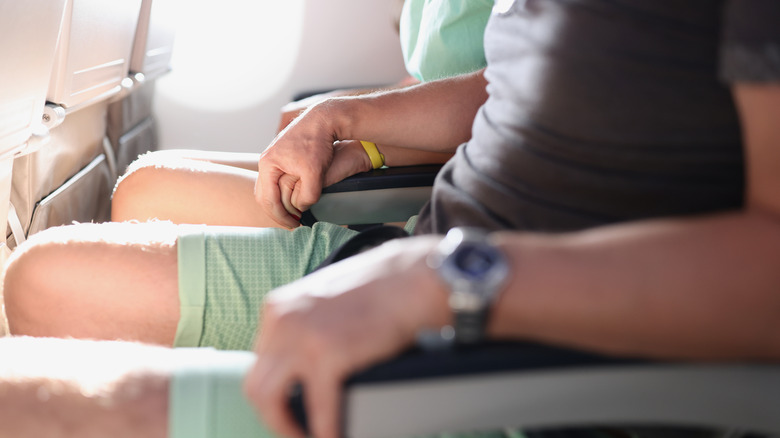
There are few things more upsetting during a flight than when the plane starts bouncing around. While turbulence is a normal part of flying and generally nothing to worry about, that doesn't make it a comfortable experience. Gentle turbulence might make your drink splash out of your cup. Something stronger might have everyone clutching their seats. In the worst cases, turbulence can cause injury and even death. And unfortunately, you may have noticed that turbulent flights are getting more frequent due to climate change, an observation that's backed up by a 2023 study published in Geophysical Research Letters.
The study looked at global trends for clear-air turbulence (CAT) between 1979 and 2020 and found "clear evidence of large increases around the midlatitudes at aircraft cruising altitudes." Moderate or greater CAT in the North Atlantic, for example, went up 37% during this period, and severe-or-greater CAT went up 55%, with similar increases around the continental United States. Additionally, it appears to be getting worse, with findings consistent with "the expected effects of climate change." That includes carbon dioxide emissions that are making the air warmer, affecting the jet stream and wind speeds. Doctoral researcher at the University of Reading and co-author of the study Mark Prosser told NBC News, "Planes like to fly with the jet stream, but where planes like to fly is also ironically where all the turbulence is."
Recent turbulence incidents where people have been injured include a June 2025 incident where nine people were hurt on a Ryanair flight, and the plane was forced to make an emergency landing, while another June 2025 flight on American Airlines experienced turbulence that sent five people to the hospital. In May 2024, a passenger died aboard a Singapore Airlines flight that encountered severe turbulence.
What airlines are doing and how you can stay safe during turbulence
Airlines have begun to take precautions to help deal with turbulence. According to The Times, the International Air Transport Association (IATA) has a platform that gives real-time turbulence data to pilots. Some airlines are covering hot drinks and changing the food they serve, and when they serve it, according to turbulence levels. Some airlines have also turned to AI predictions to help avoid spots of turbulence.
If you're on a flight, there are some things you can do to keep yourself safe during turbulence. The Federal Aviation Administration (FAA) suggests keeping your seat belt fastened at all times. In fact, it's required during takeoff and landing and when the seat belt sign is illuminated. (There is a good reason that flight attendants end up on "crotch watch," aka checking to make sure everyone's seat belt is fastened. If you're sleeping or have a blanket on, make sure your belt is fastened over the top of it.) Look at the safety briefing card and pay attention to flight attendant instructions, even if you fly all the time. Make sure children have seat belts on and that kids under 2 years old are in a "government-approved child seat or device," says the FAA.
If there is a situation that requires an emergency landing and evacuation, able-bodied passengers (who have likely been noticed by flight attendants during boarding) may be asked to help. The FAA also says that it's taking steps to help deal with turbulence, including improving data collection and sharing, as well as working on automation so pilots and air traffic controllers can share information on turbulence digitally. Finally, speaking of turbulence, here is why flight attendants sit on their hands during takeoff and landing.