

What Do Europe's Blue Road Signs Really Mean?
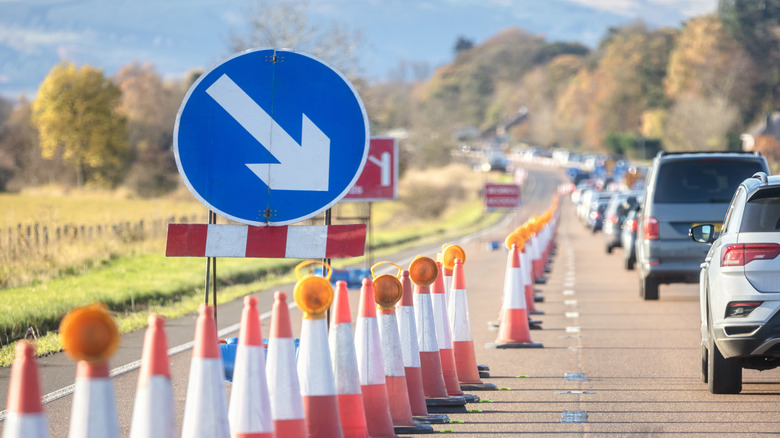
You're visiting Europe, and you've made the decision to rent a car and drive. Whether you're on the side of the road you're used to or you're driving on the left side of the road for the very first time, it can be quite an adjustment. There are different speed limits, distance signs may be in kilometers, and the road signs are definitely not what you're used to. In particular, you'll see blue road signs with symbols instead of writing on them. While a few of the symbols might make immediate sense, others may not, and it's vital to know what you're looking at before you hop in the car and start up the engine.
Circular blue signs without a red border indicate things you're required to do, while blue squares are giving you information. For instance, you may see circular blue signs with an arrow (pictured above) or a number inside. You might see blue signs with familiar symbols like walking people representing pedestrians and/or a bicycle, which is self-explanatory. There are also square blue signs with a red and white T and prohibitory signs with a blue background, a red border, and a red slash or X. It's important to know what these mean, from a minimum speed limit to places you cannot stop or park to areas where only pedestrians and bicycles can go.
Study these signs before you get in a car in Europe. You can be ticketed if you don't obey said signs. That's aside from the possibility of causing accidents. (You should also do a backup scan of documents like rental car info and your International Driving Permit.)
What blue traffic signs mean in Europe
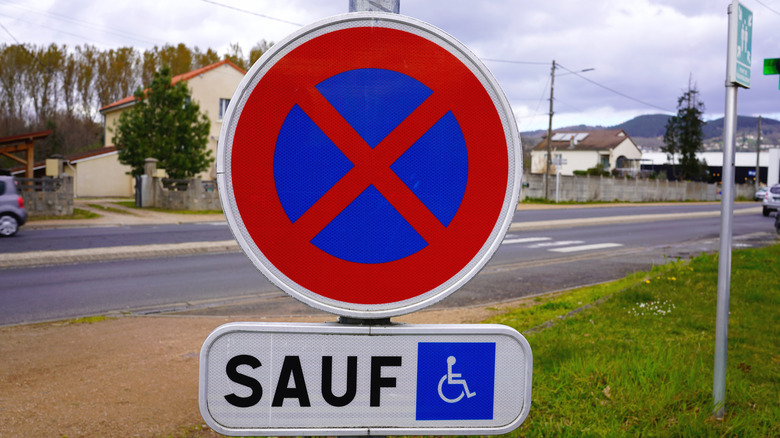
There are some blue signs that you'll likely see frequently, particularly the aforementioned blue circle with a red border and either a diagonal red line or red X through it. The blue sign with the red line means no parking. The blue sign with the red X means you can't park, stop, or wait, so you can't just drop someone or something off. You may see an exception posted below it, like a disabled symbol (pictured above) or one that says taxi, meaning taxi parking only.
A blue circle with a white number indicates a minimum speed rather than a maximum, which can be confusing for Americans. If you see a blue circle with a tire in it, snow tires or chains are required. A blue circle with an arrow means you have to go in the direction indicated. Three white arrows in a circle over a blue circle indicate a traffic circle. If you see a square blue sign with a P, it indicates parking, and as mentioned earlier, a walking-person symbol indicates a pedestrian zone, and a bicycle symbol indicates a bicycle zone (and they may be combined). A blue square with a red and white T means a dead end.
Speaking of signs, you should also know about parking discs, which often come in a rental car and can also be purchased at places like gas stations. That way you can set the disc, which is a cardboard clock, to the time you parked so you don't get a ticket if you stay within the indicated time limit on the nearby parking sign. Finally, you may actually want to think twice about renting a car in Europe if you're visiting big cities where walking is easy and parking is difficult. You can save a lot of money that way.