

One Of America's Most Dangerous Hikes Is Also The Most Beautiful Trail In Hawaii
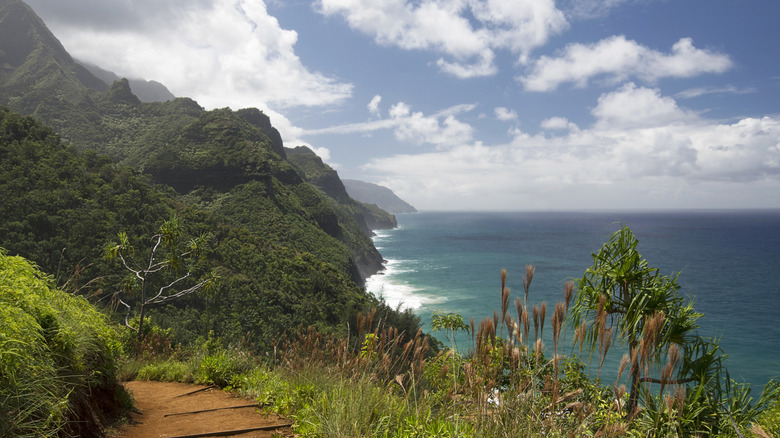
Given the nation's diverse and sometimes precarious terrain, dangerous hikes aren't unheard of in the United States. However, many of America's most challenging and risky hikes are often among its most beautiful. This is as true in the mainland U.S. as it is in states like Hawaii, where a warm tropical setting blends with a complex volcanic landscape defined by steep cliffs, deep valleys, and, in some cases, active volcanoes. One of the best examples of a Hawaiian hike that is simultaneously beautiful and dangerous is the Kalalau Trail on the island of Kauai. With exuberant vistas of green-laden sea cliffs, beaches, and tropical forests, the Kalalau Trail has all of the views (and dangers) that make Hawaii such a special destination.
As a highlight of Kauai (aka Hawaii's "Garden Island"), the Kalalau Trail weaves through a green corridor that's about as far removed from civilization as an area can be on a 552-square-mile island. The trailhead is about an hour-long drive from Kauai's Līhu'e Airport (LIH), where most Kauai visitors will arrive via inter-island flights from elsewhere in Hawaii. However, the trail is only about 20 to 25 minutes from population centers like Kauai's North Shore beach and waterfall gem town of Hanalei Bay. As a result, the journey to the Kalalau Trail alone provides an exceptional snapshot of Kauai's immense tropical beauty and vibrant culture. Once there, of course, the actual out-and-back hike on the Kalalau Trail is a bit more perilous than a simple drive across the island. Yet, while hikers must be prepared for strenuous challenges and potential dangers, the Kalalau Trail rewards such effort with some of the most beautiful panoramas found anywhere in Hawaii, and perhaps the U.S. as a whole.
The Kalalau Trail is a challenging jaunt through Kauai's magical coastline
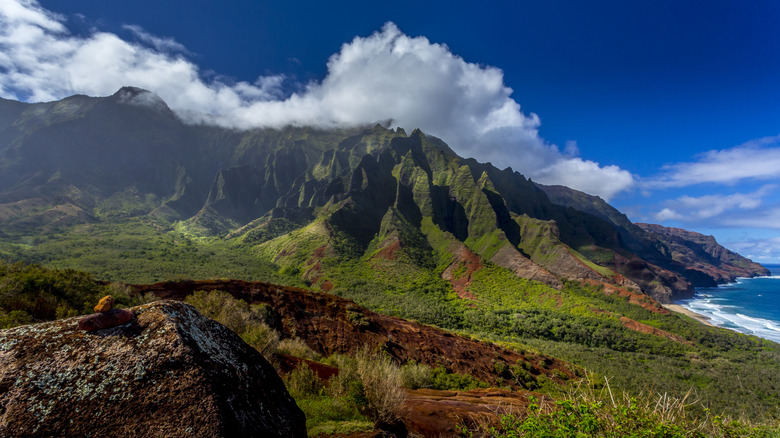
With so many vacation options and natural gems to explore, Hawaii is frequently ranked among the best tropical vacation destinations on the planet. The Kalalau Trail is perhaps the epitome of Hawaii's wild and rugged character, far from the cozy beachside resorts and tourist amenities that often define a Hawaiian vacation. The Kalalau Trail's abundant beauty stems from its location along Kauai's Nā Pali Coast and the Nā Pali Coast State Wilderness Park. The Nā Pali Coast covers about 15 miles along Kauai's northwest shore. Here, the blue waters of the Pacific strike towering red cliffs with sharp, narrow ridges ascending as high as 4,000 feet above the water. Though (thankfully) dormant, these monumental seaside cliffs are legacies of the same volcanic foundation that today powers the explosive natural beauty of Hawai'i Volcanoes National Park on the Big Island. Kauai's tropical climate decorates these cliffs in a veneer of emerald-green forests.
The full Kalalau Trail is about 22 miles out and back, or 11 miles from the trailhead to its beach terminus. Those 22 miles are the only (official) way to access the Nā Pali Coast State Wilderness Park via land. While most of the trail passes through the state wilderness park, it begins at the neighboring Hā'ena State Park and the ethereal Ke'e Beach, before proceeding through the rugged highs and lows of the Kalalau Valley. Along the trail, hikers will pass ravishing landmarks like Crawler's Ledge (a narrow volcanic pass overlooking the ocean), the beach-adjacent Ho'ole'a Falls, and the tropical serenity of Kalalau Beach. Though the trail can theoretically be completed in one day, the strenuous challenges on the return trip prompt many hikers to stay overnight at either Kalalau Beach or the park's Hanakoa Campground.
Safety concerns and practical considerations on the Kalalau Trail
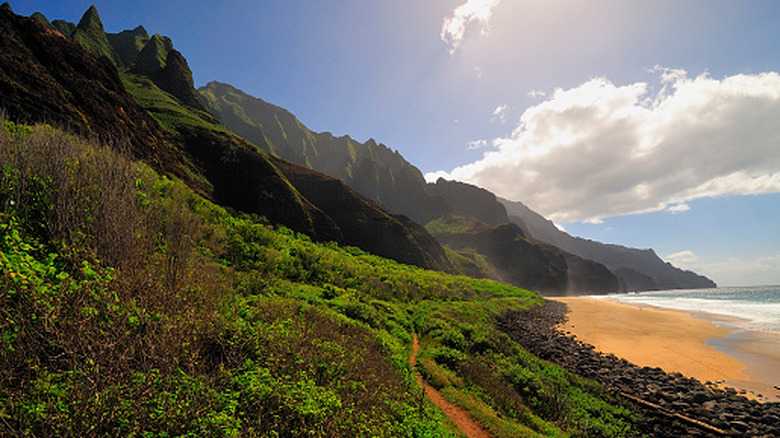
The same features that make the Kalalau Trail so beautiful also make it quite dangerous. The full Kalalau Trail involves a cumulative elevation gain between 5,000 and 6,500 feet, and hikers will, at times, straddle elevations about 800 feet above sea level. The volcanic rock underlying the trail is often fragile and can break or crumble without warning. Plus, much of the trail is prone to heavy sea winds that can throw hikers off balance, or dangerous flash floods that can suddenly inundate trail sections.
All of these factors increase the risk of potentially fatal falls down the trail's steep cliffs, especially at narrow chokepoints like Crawler's Ledge. The trail's grueling physical challenges can also cause medical emergencies like heat stroke under Kauai's tropical temperatures. Even if you make it to Kalalau Beach, your relaxing swimming excursion may involve dangerous rip currents or shorebreaks — without any lifeguards around. To date, there have reportedly been over a dozen recorded deaths along the trail.
You can mitigate the fall risk somewhat by taking slow, deliberate steps and maintaining a low center of gravity. Always mind the weather, and never attempt to cross flooded streams. Make sure that you are in top physical condition for a long, strenuous hike, and always bring plenty of water (as the natural streams along the trail may not be safe to drink from). You should also bring appropriate hiking clothing, sturdy (and preferably waterproof) boots, and other hiking essentials. Accessing the trail beyond Hanakāpīʻai Beach (at mile 2) requires a Nā Pali Coast State Wilderness Park camping permit (even for one-day visits), which costs $25 for Hawaii residents and $35 for non-Hawaii residents as of this writing.